Scoliosis and Swimming: The Auxiliary Effects of Aquatic Spinal Decompression on Scoliosis Correction
Introduction
Scoliosis has a prevalence of approximately 2–3% among adolescents in Taiwan, with about 300,000–400,000 patients nationwide. Conservative treatment for mild to moderate curvature (Cobb angle 10–40°) primarily involves physical therapy, corrective bracing, and specific exercises. Swimming has long been incorporated into auxiliary treatment plans for scoliosis by spinal surgeons and physical therapists, but its effectiveness and the choice of suitable strokes require scientific analysis.
Physiological Benefits of the Aquatic Environment for the Spine
Decompression Effects of Buoyancy:
On land, the spine must bear axial pressure generated by body weight (a 70 kg person standing experiences approximately 70–100 kg of compressive force on the lumbar spine). In water, buoyancy can offset 90% of body weight, allowing the intervertebral discs to fully decompress, increasing intervertebral foramen space, and facilitating relief of nerve root pressure.
Core Activation During Aquatic Exercise:
The viscosity of water requires the body to maintain stability in every direction, naturally activating deep core muscle groups such as the transversus abdominis and multifidus—muscles that are key to maintaining spinal stability.
Muscle Relaxation Effects of Warm Water:
Warm water at 28–32°C promotes relaxation of tense muscles on the convex side of the curvature, with even better results when combined with stretching exercises.
Swimming and Scoliosis: Which Strokes Are Suitable and Which Require Caution
| Stroke | Effect on Scoliosis | Recommendation Level |
|---|---|---|
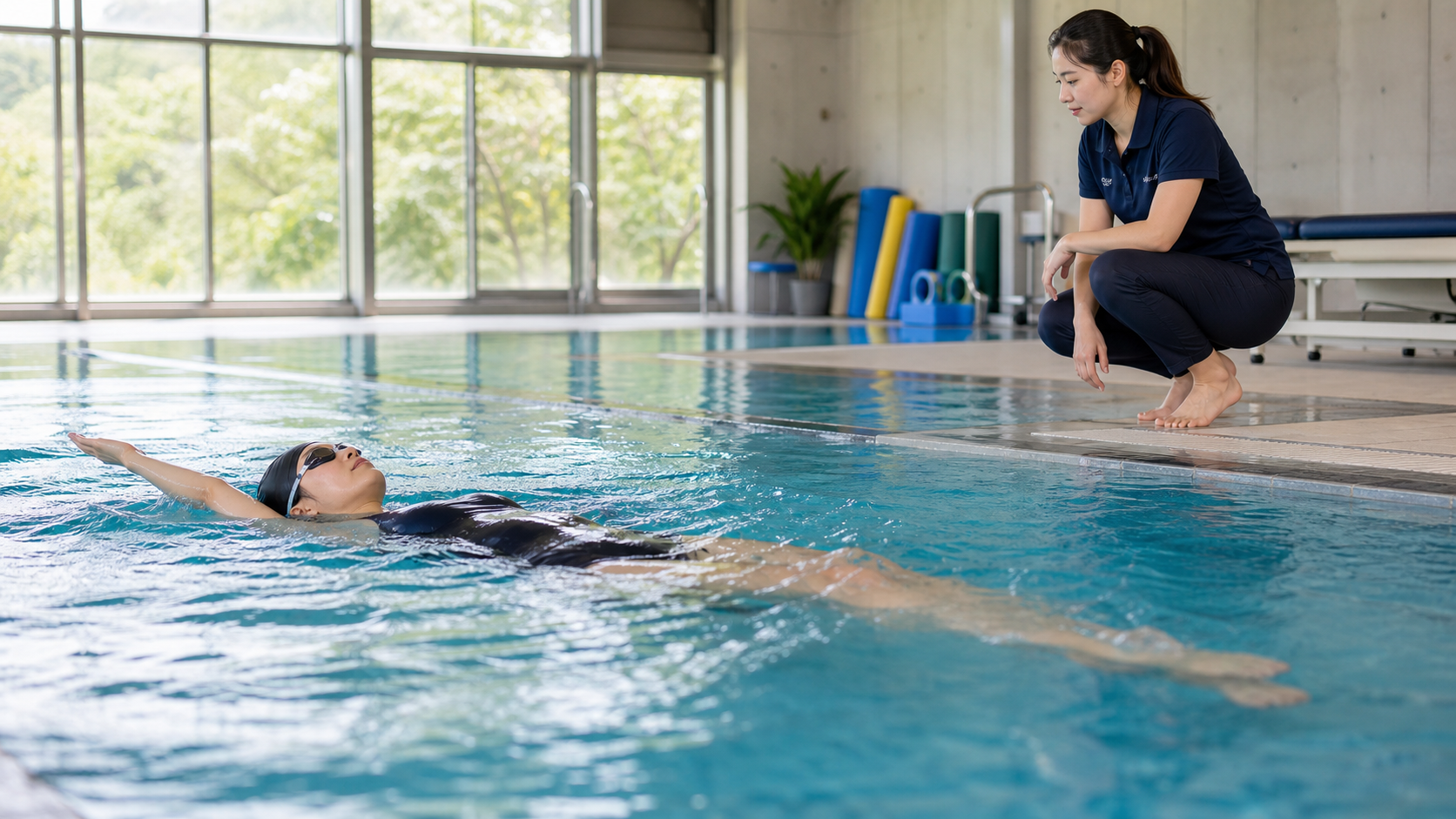
| Backstroke | Spine near neutral position, symmetrical training of bilateral muscles, most recommended | ★★★★★ |
| Freestyle | Head rotation may increase cervical rotation, but overall still symmetrical | ★★★★ |
| Breaststroke | Symmetrical movement is beneficial, but excessive lumbar extension; caution needed for moderate curvature | ★★★ |
| Butterfly | High-intensity lumbar extension; not recommended for Cobb angle > 25° | ★★ |
| Side swimming (therapeutic) | Under the guidance of a physical therapist, asymmetric training can be designed for the convex side | Follow medical advice |
Important Note: Strokes in regular swimming classes will not “correct” scoliosis, but they can improve the balance and flexibility of muscles surrounding the spine, supporting the effects of conservative treatment.
The Schroth Method and Its Application in Water
The Schroth breathing corrective method is an internationally recognized physical therapy approach for scoliosis. Its core principle involves asymmetrical breathing to expand the concave side of the rib cage and stretch the convex side. Some physical therapists have introduced Schroth principles into aquatic training:
- Performing concave-side breathing expansion exercises in water
- Combining aquatic rotational stretching to relax muscles on the convex side
- Using kickboards to assist in maintaining specific postures
In Taiwan, some hospitals (such as the Department of Physical Medicine and Rehabilitation at National Taiwan University Hospital and the Department of Orthopedics at Chang Gung Memorial Hospital) currently offer aquatic physical therapy programs. Patients with scoliosis can inquire about referrals.
Adolescent Scoliosis Screening and Swimming Intervention in Taiwan
Elementary and junior high schools in Taiwan have established scoliosis screening procedures (forward bend test + scoliometer), with referrals to orthopedic or rehabilitation departments for assessment after diagnosis. The conservative treatment pathway typically follows:
- Cobb angle 10–20°: Observation + auxiliary swimming training + core strength training
- Cobb angle 20–40°: Corrective bracing + physical therapy (Schroth) + auxiliary swimming
- Cobb angle > 40°: Surgical evaluation (swimming can still be used in postoperative rehabilitation)
Practical Recommendations
- Before starting swimming training, obtain an assessment and recommendations from a spinal surgeon or physical therapist to confirm the current Cobb angle and curvature type.
- Avoid attempting “special swimming movements to correct scoliosis” on your own; asymmetric training must be conducted under professional guidance.
- In addition to swimming, combining land-based core training (such as planks and bird-dog exercises) yields better results.
- Adolescents in their growth spurt should have X-ray follow-ups every 6 months to monitor changes in the curvature angle.
- Maintain proper sitting posture habits (especially for Taiwanese students with heavy academic workloads) to avoid prolonged poor posture offsetting the benefits of swimming.
Conclusion
Swimming is a safe and beneficial exercise choice for patients with scoliosis. The decompressive effects of the aquatic environment and its symmetrical training characteristics make it a high-quality auxiliary tool for conservative treatment. Some hospitals in Taiwan already offer aquatic physical therapy services. Under the guidance of a medical team, patients with scoliosis can integrate swimming into their personalized treatment plans, discovering more possibilities for spinal health in the water.
Related Reading
- Swimming and Pediatric Scoliosis: A Complete Guide to Correction, Prevention, and Exercise Selection
- Swimming and Lumbar Spine Protection: Posture Recommendations for Swimming with Spinal Conditions
- Swimming for Chronic Back Pain Relief: Aquatic Solutions for Spinal Decompression and Core Strengthening
- The Effectiveness of Swimming in Improving Chronic Back Pain and Precautions
一日北高/長距離團騎 常見問題補充篇 / 組團或跟團的眉角 / 壯車友容易被瘦車友慢性拉爆 / 原來屁股痛可能是這個原因...? / 風場配速法 / 公路車 / CT Yeh
2 年前
靠單車減肥35公斤 心得分享與整理
7 年前
[教學] Premiere 影片 手震 修正 教學 防抖 單眼 影像 GoPro 穩定 Video Stabilization
8 年前
碟煞公路車 銑面器 !? 原來銑完差這麼多! 降低蹭碟機率! | TIME 公路車 保養小記錄 | CT Yeh
3 年前
Nepest NOVA 碳條輪組:輕量、空力、舒適一次滿足!/ 公路車 / CT Yeh
7 個月前
CT暗黑廚房) 車友必備 宇宙無敵鮮蚵湯 幫助訓練恢復 天然食補 好市多 超肥鮮蚵 破PR
7 年前
一日北高常見問題大集合 | 攻略 | 路線 | 訓練 | 補給 | 自行車 單車 | 一日雙城 | 雙塔 | TWB北高360 | 屁股痛
6 年前
抖肩舞 台灣x日本交流版 (台灣 vs 前橋) 赤城山登山賽 coincidance
8 年前