Road Running Aid Station Strategy: Decision Principles for When to Drink Water and When to Drink Sports Drinks
Introduction
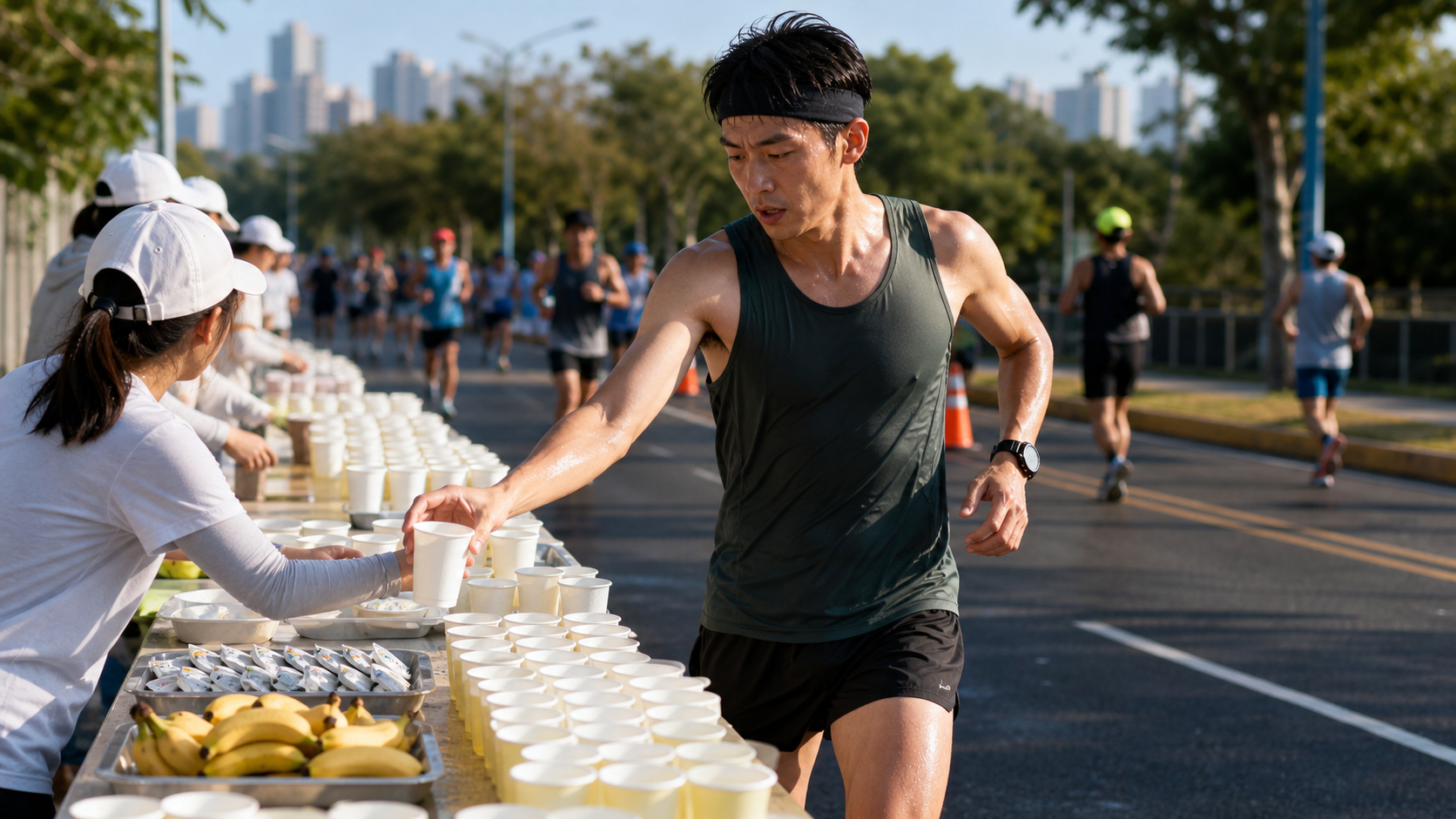
Road race aid stations are every runner’s “refueling stop,” but most people decide what and how much to drink based purely on feel. In reality, the quality of your fueling decisions directly affects your ability to maintain pace in the second half of the race. Drinking too much water can cause hyponatremia, while drinking too little leads to dehydration; drinking only plain water at the wrong time can cause a sudden energy crash after the 30-kilometer mark. This article provides a clear fueling decision framework so you can make the optimal choice at every aid station.
Water vs. Sports Drinks: Core Differences
| Characteristic | Plain Water | Isotonic Sports Drinks (e.g.,舒跑) | Hypertonic Energy Drinks |
|---|---|---|---|
| Osmolality | Low (0 mOsm) | 270–330 mOsm | 400+ mOsm |
| Absorption Speed | Fast | Fast | Slower |
| Electrolyte Replacement | None | Sodium 450–700mg/L | Varies by product |
| Carbohydrate Replacement | None | 6–8g/100ml | 10g/100ml or more |
| When to Use | Short durations, low sweat loss | Exercise over 60 minutes | When solid fuel is insufficient |
Key principle: For exercise lasting over 60 minutes with moderate to heavy sweating, prioritize electrolyte drinks over plain water.
Decision Principles for Fueling Timing
Using Running Distance as a Guide
- 0–10km: Most runners have stable blood sugar; 150–200ml of plain water or isotonic drinks every 2–3 kilometers is sufficient
- 10–21km: Entering the critical electrolyte depletion zone, switch to sports drinks, 200ml per station
- 21–32km: Energy demands increase; alternate fueling is recommended: drink sports drinks at odd-numbered stations, pair with energy gels at even-numbered stations
- After 32km: If you experience gastrointestinal discomfort, switch to cola (contains caffeine + sugar) or bananas for immediate sugar replenishment
Using Sweat Rate and Temperature as Guides
Taiwan road races are mostly held from March to May, with temperatures between 18–28°C, and sweat rates vary from person to person.
- Temperature below 20°C: 100–120ml of water per kilometer, primarily water
- Temperature 20–26°C: 120–150ml of water per kilometer, with sports drinks making up 60%
- Temperature above 28°C (summer road races): 150–200ml of water per kilometer, switching almost entirely to electrolyte drinks
Warning Signs of Hyponatremia
In full marathons lasting over 4 hours, drinking only plain water without replenishing electrolytes can lead to hyponatremia:
- Symptoms: nausea, headache, confusion, and in severe cases, seizures
- Prevention: must consume sodium-containing electrolytes (sports drinks or salt tablets) every 45–60 minutes
Practical Aid Station Strategies for Taiwan Races
Aid Station Handling Techniques
- Slow down early: Begin decelerating 20 meters before the aid station; don’t grab a cup only after sprinting past it
- Folded cup method: Slightly fold the paper cup and drink from the gap at the rim to avoid choking
- Drink while running: Practice during training so you don’t have to stop during the race
- Don’t drink too much at one station: 150–250ml per station is the upper limit to avoid stomach discomfort
Common Food Pairing Strategies at Taiwan Aid Stations
| Item Provided at Aid Station | When to Take It | Notes |
|---|---|---|
| Bananas | 25–35km | Potassium replenishment to prevent cramps |
| Salted plums / plums | After 20km | Replenishes sodium and organic acids, aids electrolyte balance |
| Sports drinks | Throughout the race | Primarily舒跑 and寶礦力 |
| Cola | After 32km | Caffeine + sugar dual effect, emergency fuel for the final stretch |
| Small steamed buns / crackers | After 25km | Solid fuel, needs to be paired with adequate water |
The Right Way to Drink Water
- Small amounts frequently is better than one large amount, reducing stomach discomfort
- Don’t sprint immediately after drinking; give your stomach 2–3 minutes to adapt
- Don’t wait until you’re thirsty to drink; thirst indicates mild dehydration (1–2%) has already set in
- Check urine color after each drink; pale yellow is ideal, dark yellow means you need to increase drinking frequency immediately
Practical Recommendations
- Simulate race fueling during training to determine your “hourly fluid requirement”
- If you’re prone to cramping, look for salt tablets at aid stations or carry a small packet of salt yourself
- For summer road races, drink an extra 400–500ml of electrolyte drink 15 minutes before the start as “pre-hydration”
- During prolonged high-intensity running (pace faster than 5:30 per kilometer), electrolyte loss is faster; replenish every 20 minutes
Conclusion
Aid stations are the most overlooked “tactical points” in road races. Mastering the decision principles of “when to drink water, when to switch to sports drinks, and when to pair with solid fuel” is equivalent to making an investment at every aid station that benefits your performance in the second half of the race. Taiwan’s aid stations commonly provide bananas, salted plums, and舒跑; making good use of these local fueling resources will help you stay in top form at the finish line.
Related Reading
- Sports Drinks or Plain Water: Hydration Choices for Long-Distance Cycling and Running
- Food Selection Strategies at Road Race Aid Stations: Making Energy Gels No Longer the Only Option
- Road Race Aid Station Techniques: Smooth Actions for Drinking Without Stopping and Taking Energy Gels
- Marathon Course Aid Station Strategies: The Art of Allocating Water, Sports Drinks, and Energy Gels
西進武嶺 免費訓練分析服務 Intervals | 練不夠還是練過頭?你哪一種類型選手?AI模型告訴你! | 備戰神器 | 公路車 訓練 | CT Yeh
4 年前
一日北高前的高裝檢 | 北高 360 | 挑戰11小時的裝備 | 一日雙塔 | 補給
6 年前
#公路車 #Fitting 靠人工智慧APP 幫你調整單車
6 年前
#公路車 #Vo2Max #最大攝氧量 測驗 體驗 | 心肺測試
6 年前
CT暗黑廚房) 車友必備 宇宙無敵鮮蚵湯 幫助訓練恢復 天然食補 好市多 超肥鮮蚵 破PR
7 年前
詳測) 小米 電動打氣筒 公路車胎要充多久? 值得買嗎? 米家充氣寶 小心燙手!
7 年前
西進武嶺 自製新版AI配速表產生器 x 賽前攻略 抱佛腳! 沒有功率計也可以產生配速表嗎?有什麼其他眉角賽前要注意的呢? | 西進武嶺 / 東進武嶺 KOM 攻略 | 公路車 | CT Yeh
4 年前
單車 一日北高 ( 雙城 ) 肥宅雙人瘋狂行 紀錄片 REACTO
10 年前