Swimming Training for Overweight Individuals: Designing an Effective Fat-Loss Program Leveraging Buoyancy Advantages
Introduction
According to statistics from the Health Promotion Administration, the proportion of overweight and obese adults in Taiwan (BMI ≥ 24) exceeds 45% and continues to rise. Obesity is a major risk factor for metabolic syndrome, diabetes, and cardiovascular disease. However, overweight individuals face a dual challenge when attempting land-based exercise: their knee and hip joints bear impact forces beyond normal levels, which often leads to interruption due to pain; the heavier the body weight, the higher the risk of injury from land-based exercise, creating a vicious cycle of “the heavier you are, the harder it is to exercise.” The buoyancy advantage of swimming breaks this cycle—body weight in water can be reduced by 75–90%, allowing overweight individuals to comfortably and consistently perform high-quality aerobic training.
Energy Expenditure Analysis of Swimming for Fat Loss
Actual calorie expenditure in swimming varies by stroke, speed, and individual body weight:
| Stroke | Body weight 70 kg (kcal/hour) | Body weight 90 kg (kcal/hour) | Body weight 110 kg (kcal/hour) |
|---|---|---|---|
| Breaststroke (easy) | 380 | 490 | 600 |
| Freestyle (moderate pace) | 480 | 615 | 750 |
| Freestyle (fast) | 590 | 760 | 930 |
| Butterfly | 650 | 835 | 1020 |
| Water aerobics | 280 | 360 | 440 |
Key finding: The heavier the body weight, the more calories swimming burns (because more energy is required to move the body), which is another blessing for overweight individuals in addition to the “buoyancy advantage.”
Special Considerations for Overweight Individuals Swimming for Fat Loss
Excessive buoyancy is actually a challenge:
Those with higher body fat percentages experience greater buoyancy in water, and their legs tend to float upward when first learning, causing unstable stroke mechanics. Recommended strategies:
- Learn breaststroke first (leg movements effectively help control horizontal body position)
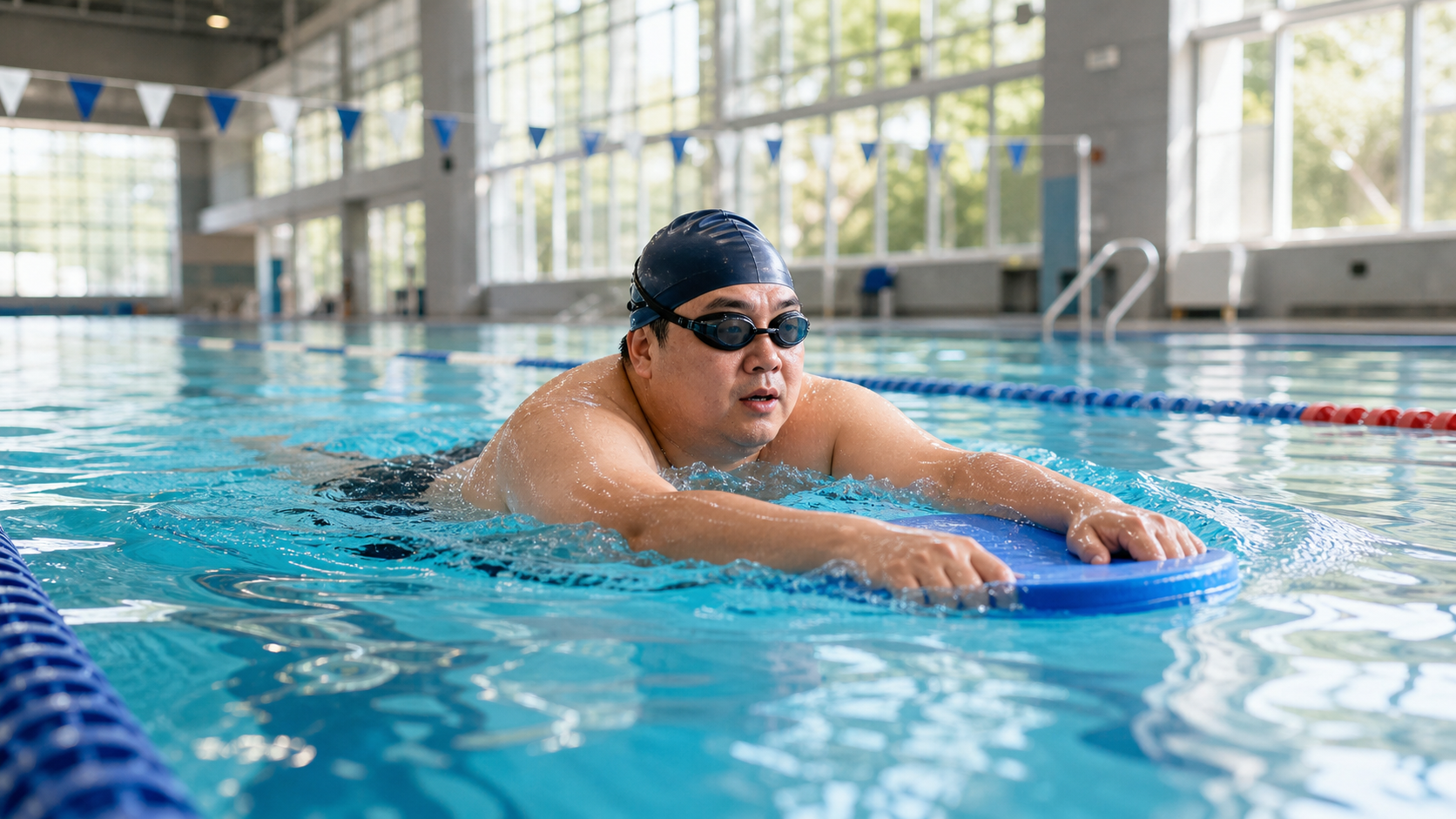
- Use a kickboard as an aid initially, practicing arm and leg movements separately
- Once core strength improves, stroke stability will naturally increase
Skin friction and overheating issues:
- Choose full-body swimwear with elastic sun-protection features to avoid inner-thigh chafing
- Rinse off immediately after swimming and dry skin folds (armpits, abdominal skin folds) thoroughly to prevent skin infections
12-Week Swimming Fat-Loss Program for Overweight Individuals
Weeks 1–3 (Adaptation phase):
- Frequency: 3 times per week
- Content: 15 minutes of water walking + 15 minutes of swimming (breaststroke, with ample rest)
- Goal: Complete without pain, establish a feel for movement in the water
Weeks 4–6 (Foundation phase):
- Frequency: 3–4 times per week
- Content: 30 minutes of breaststroke or freestyle, using an interval pattern of “swim 3 laps, rest 1 minute”
- Calorie expenditure target per session: 300–400 kcal
Weeks 7–12 (Intensification phase):
- Frequency: 4–5 times per week
- Content: 45–60 minutes of mixed training (freestyle + water aerobics + kickboard)
- Introduce HIIT elements: 2 all-out sprints (25m) + 2 slow recovery laps, repeated for 4–6 sets
- Calorie expenditure target per session: 500–700 kcal
Key Dietary Considerations
Many overweight individuals find that their appetite increases significantly after swimming (research shows that the cold water environment stimulates appetite through mechanisms stronger than those of land-based exercise). The following strategies can effectively prevent “eating more after swimming” from canceling out your efforts:
- Consume a light meal containing protein 1.5–2 hours before swimming (e.g., eggs + whole wheat toast)
- Choose high-protein, low-calorie foods as your first option after swimming (Greek yogurt, tofu)
- Rehydrate with 500ml or more of water, as hunger is often caused by dehydration
Practical Recommendations
- Choose a pool equipped with a lift-entry platform or a gradual ramp to allow overweight individuals to enter and exit the water safely, avoiding joint impact from jumping in from a height.
- Purchase well-fitting swimwear designed for larger body types (many brands offer up to 4XL); a proper fit significantly improves movement efficiency in the water.
- If knee joints already have pain from land-based exercise, apply ice for 10–15 minutes before and after swimming as a preventive measure.
- Set “non-scale” goals (such as swimming 500m without stopping, or completing 30 minutes of continuous swimming) to avoid losing motivation when the number on the scale doesn’t change dramatically in the short term.
- Weight-management specialty clinics at major hospitals in Taiwan (such as the NTU Hospital Metabolic Syndrome Specialty Clinic) can prescribe formal exercise prescriptions to complement a swimming program.
Conclusion
Swimming is the lowest-threshold entry point for overweight individuals to move toward better health. Buoyancy eliminates joint concerns, water resistance provides effective training, and combined with the natural advantage that heavier individuals burn more calories, swimming becomes the exercise modality most likely for overweight individuals to “stick with.” Taiwan’s comprehensive network of public pools provides the most complete infrastructure for this fat-loss journey—overweight individuals only need to take the first step, and the water will do the rest.
Related Reading
- Swimming Weight Management Program: Calorie Expenditure and Dietary Pairing for Swimming 4 Times a Week
- Swimming and Weight Management: Calorie Expenditure of Different Strokes and Dietary Pairing
- Swimming and Weight Management: The Truth About Calorie Expenditure in Water Exercise
- Weight Control Through Swimming: The Dietary Compensation Problem in High-Volume Swimmers
靠單車減肥35公斤 心得分享與整理
7 年前
16/02/16 - 夜訪中社路 緩慢進步中
10 年前
CT暗黑廚房) 車友必備 宇宙無敵鮮蚵湯 幫助訓練恢復 天然食補 好市多 超肥鮮蚵 破PR
7 年前
2016/4/20 - 中社路 夜騎 半年甩肉14KG 後測
10 年前
一日北高常見問題大集合 | 攻略 | 路線 | 訓練 | 補給 | 自行車 單車 | 一日雙城 | 雙塔 | TWB北高360 | 屁股痛
6 年前
單車 一日北高 ( 雙城 ) 肥宅雙人瘋狂行 紀錄片 REACTO
10 年前
live) 超越北高 之一日北高12小時 策略
7 年前
一日北高/長距離團騎 常見問題補充篇 / 組團或跟團的眉角 / 壯車友容易被瘦車友慢性拉爆 / 原來屁股痛可能是這個原因...? / 風場配速法 / 公路車 / CT Yeh
2 年前