Introduction
Ultramarathons (ultra-marathons, typically referring to distances over 50km) are a different nutritional universe. Marathon runners can rely primarily on energy gels and sports drinks to finish, but in a 100km race, runners need to consume 5,000–8,000 calories, and liquid fuel alone simply cannot sustain them. Solid food shifts from an “optional item” to a “mandatory item,” and gut management becomes far more important than running technique itself. This article uses the 100km race as a framework to provide a systematic strategy for allocating solid and liquid fuel.
Calculating Energy Demands for Ultramarathons
Estimated Caloric Expenditure for a 100km Race
| Runner Weight | Pace (average) | Estimated Finish Time | Total Caloric Expenditure |
|---|---|---|---|
| 55kg | 7 min/km | 11–12 hours | 5,000–5,500 kcal |
| 65kg | 8 min/km | 13–14 hours | 5,500–6,500 kcal |
| 75kg | 9 min/km | 15–16 hours | 6,000–7,500 kcal |
Ultramarathon caloric intake target: 250–350 kcal per hour (the gut’s actual absorption ceiling is approximately 400 kcal/hour)
The Shifting Roles of Solid vs. Liquid Fuel
| Race Segment | Solid Food Ratio | Liquid Fuel Ratio | Rationale |
|---|---|---|---|
| 0–30km | 20% | 80% | High gastric emptying demand, faster running pace |
| 30–60km | 35% | 65% | Solid food energy density becomes necessary |
| 60–80km | 50% | 50% | Solid food has a soothing effect on the gut |
| 80–100km | 60–70% | 30–40% | Slower pace allows the gut to handle solid food |
Segment-by-Segment Fueling Blueprint
Segment 1: 0–30km (Start-up Phase)
This segment’s strategy is close to a marathon, focusing on high-efficiency liquid fuel:
- Consume one energy gel every 20–25 minutes (with or without caffeine depending on personal strategy)
- Take in 200ml of sports drink at each aid station
- Solid food: half a banana (light, easy to digest)
- Caffeine gel: first one after the 20km mark
Segment 2: 30–60km (Transition Phase)
Gut fatigue begins to set in, requiring a more varied fueling approach:
- Reduce energy gel frequency to one every 30–40 minutes
- Introduce solid foods: salted crackers (for sodium), maltose (a traditional Taiwanese energy source)
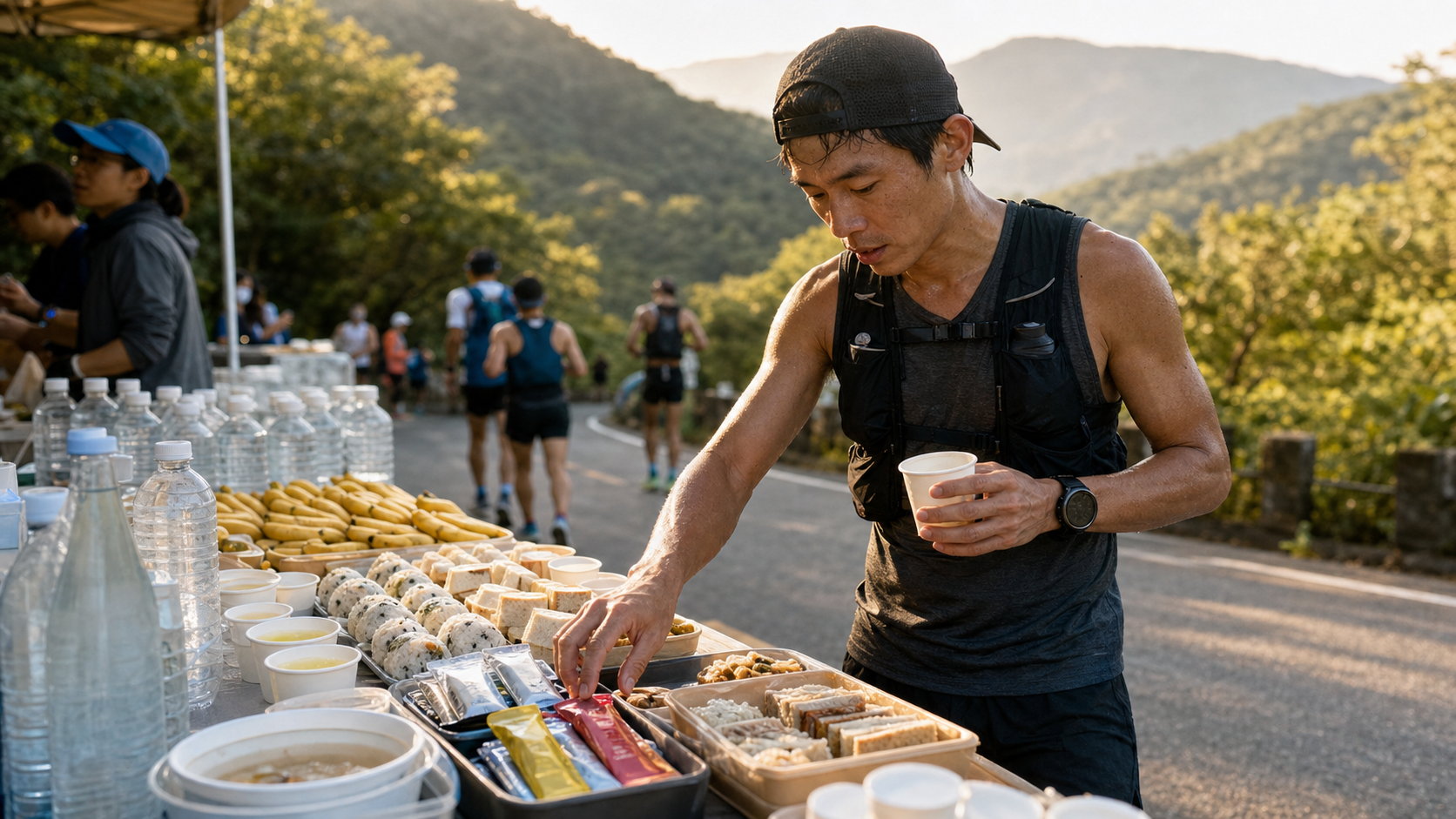
- Common food strategies at Taiwanese ultramarathon aid stations:
- Salty rice porridge (at the 50km aid station): warm, easy to digest, high in sodium
- Rice crackers or soda crackers: not cloying, easy to carry
- Thin slices of pork jerky: a combination of protein + sodium
- Start taking electrolyte tablets, one every 45 minutes
Segment 3: 60–80km (The Test Phase)
This segment is a high-risk zone for ultramarathon gut crises:
- Reduce the proportion of sweet foods (energy gels start to cause nausea)
- Increase savory foods: white rice + pickled mustard greens, sweet potato, white toast + peanut butter
- The Taiwanese ultramarathon aid station secret weapon: instant noodles (dry-mixed) — high in carbs, contains salt, and highly accepted by Taiwanese runners
- If feeling nauseous, temporarily switch to cola or ginger tea (ginger has anti-nausea effects)
- Consume solid food every 2–3 kilometers, in small amounts each time (50–100g)
Segment 4: 80–100km (Finish-line Sprint)
Fueling strategy for the final 20km:
- Caffeine: take a caffeine gel at both the 80km and 90km marks (final boost)
- Solid food takes priority: eat whatever is easy to digest (no need to chase the perfect combination anymore)
- Cola: at this point, cola can serve as a dual-purpose fuel providing liquid carbs + caffeine
- Sugar water (emergency backup): when you can’t eat anything else, a cup of sugar water with a pinch of salt is the last resort
Local Foods at Taiwanese Ultramarathon Aid Stations
| Food | Calories/100g | Suitable Segment | Availability in Taiwan |
|---|---|---|---|
| Salty rice porridge | 60 kcal | 50–70km | Commonly stocked at aid stations |
| Maltose | 320 kcal | Entire race | Convenience stores, grocery stores |
| Pork jerky (thin slices) | 280 kcal | 40–80km | FamilyMart, 7-Eleven |
| Instant noodles (dry) | 450 kcal | 60–80km | Provided at aid stations |
| Sweet potato (steamed) | 100 kcal | 30–70km | Commonly seen at aid stations |
| Cola (canned) | 140 kcal/350ml | After 80km | Commonly stocked at aid stations |
Gut-Protecting Dietary Principles for Ultramarathons
- Avoid high fiber before the race: The low-fiber diet in the 2 days before an ultramarathon should be stricter than for a marathon
- Test all foods: Every food found at ultramarathon aid stations must be tested during training
- Small amounts, frequent intake: Do not exceed 100–150g per eating session, so the gut isn’t overloaded
- Maintain temperature: In cold-weather races, warm foods (rice porridge, soup) are more easily accepted by the gut than cold foods
Practical Advice
- Prepare a personal fueling pack: Ultramarathon aid stations offer a wide variety of items, but the food you bring yourself is what best understands your own gut
- Communicate with your support crew: Arrange in advance with fellow runners or family members what to provide at which kilometer, to avoid making decisions while fatigued
- Carry backup fuel: Bring at least 20% more energy gels than planned, in case aid stations run out of stock or you fall behind your planned pace
- Learn to “eat while walking”: The walking sections of an ultramarathon are the best opportunities to fuel up
Conclusion
Finishing a 100km ultramarathon depends half on leg strength and half on your gut management ability. From Taiwanese salty rice porridge and pork jerky to maltose, local ingredients form the strongest fueling lineup for ultramarathons. Systematically planning the solid-to-liquid fuel ratio for each segment, and repeatedly testing it in training, is the only way to ensure your body still has enough energy to face the final challenge before the finish line.
Related Reading
- Ultramarathon Fueling Strategy: Energy and Electrolyte Rhythm from 50K to 100K
- Ultramarathon Fueling Strategy: Timing Management of Solid Food, Fluids, and Electrolytes
- Complete 100K Ultramarathon Fueling Rhythm Plan: The Scientific Formula for Hourly Calories, Sodium, and Solid-Liquid Switching
- Ultramarathon Nutrition Strategy: A Comprehensive Fueling Plan from Training to Race Day
CT暗黑廚房) 車友必備 宇宙無敵鮮蚵湯 幫助訓練恢復 天然食補 好市多 超肥鮮蚵 破PR
7 年前
靠單車減肥35公斤 心得分享與整理
7 年前
Live) 備戰2019彰化經典百K 賽前攻略 (已完賽請看新影片
7 年前
半日 小台灣 極限單車路線挑戰實錄
7 年前
一日北高前的高裝檢 | 北高 360 | 挑戰11小時的裝備 | 一日雙塔 | 補給
6 年前
2021 96聯賽 桃園市長盃 4K多視角實況 當天選手瓦數/推力比/均速/時間 即時數據分析 | 公路車 | CT Yeh
5 年前
西進武嶺 免費訓練分析服務 Intervals | 練不夠還是練過頭?你哪一種類型選手?AI模型告訴你! | 備戰神器 | 公路車 訓練 | CT Yeh
4 年前
2019 夏季KOM 5小 完賽心得 準備攻略 東進武嶺 夏季登山王之路 Taiwan KOM Challenge
7 年前