Carbohydrate Oxidation Rate Ceiling: The Scientific Basis of the 90g-Per-Hour Dual-Carbon-Source Strategy
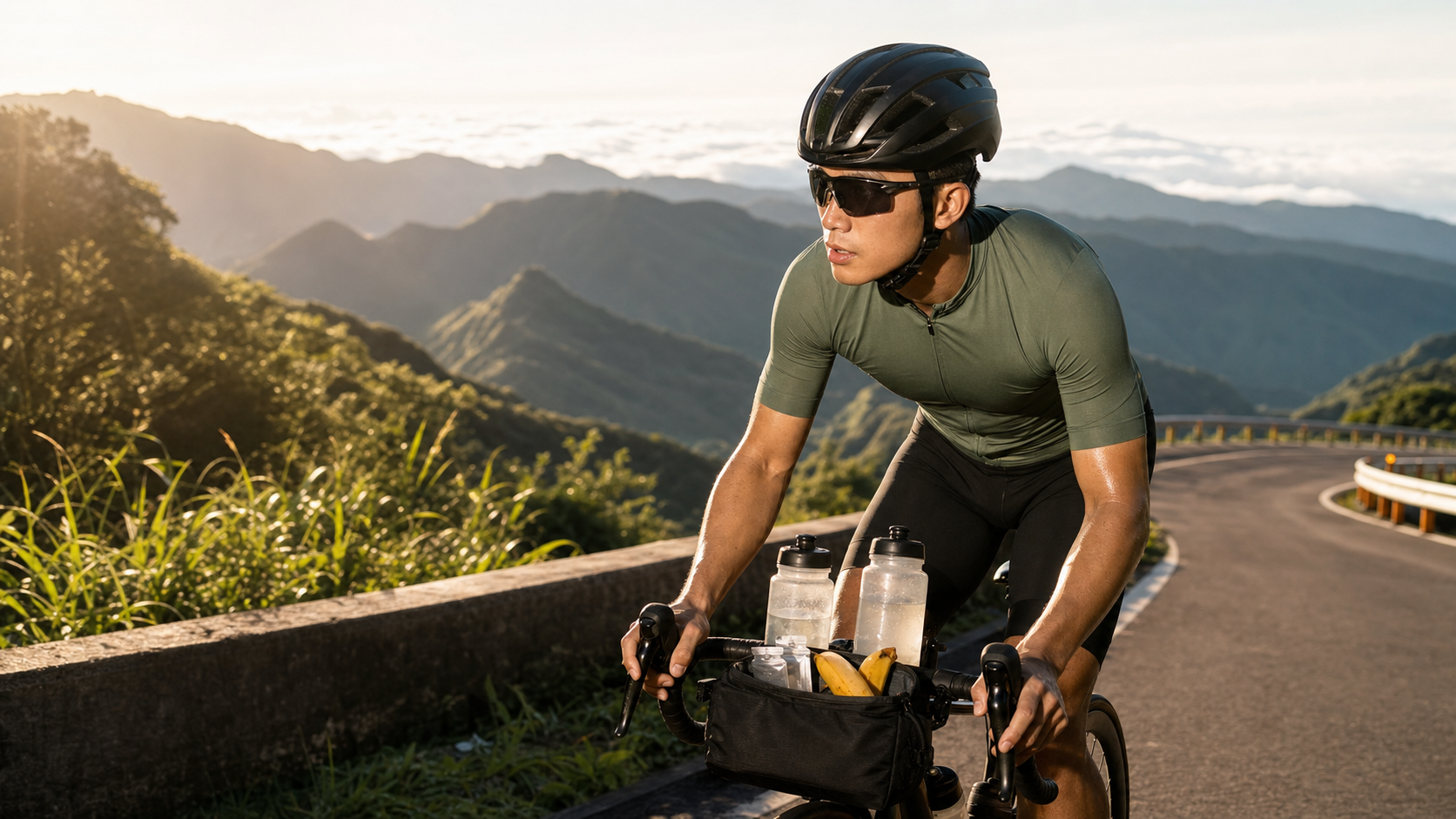
Introduction
“60 grams of carbohydrates per hour is the limit, right?” This claim was popular in sports science for a long time, until a series of studies by Jentjens and Jeukendrup overturned this assumption. Carbohydrate absorption of 90 grams, or even 120 grams, per hour is achievable—but only if you choose the right combination of carbohydrate types.
This discovery completely changed fueling strategies in professional road racing and provided a new scientific foundation for fueling plans in long-distance challenges such as Taiwan’s round-island rides and Formosa 900. This article will analyze, from the perspective of intestinal physiology, why the dual-carbon-source strategy can break through the oxidation rate bottleneck, and how to apply it in actual riding.
The Bottleneck of Intestinal Glucose Absorption
To understand the dual-carbon-source strategy, you must first understand how the small intestine absorbs carbohydrates:
Transporter Protein Saturation
Specific active transporter proteins on the surface of small intestinal epithelial cells are responsible for carbohydrate absorption:
| Carbohydrate Type | Transporter Protein | Maximum Absorption Rate per Hour |
|---|---|---|
| Glucose, Maltodextrin | SGLT1 (Sodium-Glucose Cotransporter 1) | ~60 g/hr |
| Fructose | GLUT5 (Glucose Transporter 5) | ~30–40 g/hr |
| Galactose | SGLT1 (competes with glucose) | Lower efficiency |
Key Finding: SGLT1’s glucose transport capacity is approximately 60 grams per hour. Glucose exceeding this amount remains in the small intestine and may cause osmotic diarrhea—this is the physiological basis for the “60 grams per hour limit.”
The Principle of Breaking the Bottleneck with Dual Carbon Sources
Glucose and fructose use different transporter proteins, so they can be “absorbed in parallel” rather than “absorbed competitively”:
- Glucose (60 g/hr, SGLT1 saturated) + Fructose (30 g/hr, GLUT5 saturated) = 90 g/hr total absorption
- With further optimization of fructose intake (GLUT5 upregulation after training), some studies show it can reach 110–120 g/hr
Supporting Data from Scientific Research
Several key studies have established the scientific foundation for the dual-carbon-source strategy:
- Jeukendrup (2010) meta-analysis: The maximum oxidation rate for a single carbohydrate (glucose) is 1.0 g/min (60 g/hr), while a 2:1 glucose:fructose mixture can reach 1.4–1.75 g/min (84–105 g/hr)
- Currell & Jeukendrup (2008): The 2:1 maltodextrin:fructose group improved 2-hour time trial performance by 8% compared to the pure glucose group
- Costa et al. (2017): Gut training can further increase fructose absorption rates by upregulating GLUT5 expression
Optimal Carbon Source Ratios and Food Choices
Recommended Glucose:Fructose Ratios
- 2:1 ratio (glucose:fructose): The most extensively studied, suitable for most riders
- 1:0.8 ratio: Some studies show higher fructose ratios work better for certain individuals
- To avoid: Pure fructose (HFCS high-fructose corn syrup) carries a high risk of gastrointestinal discomfort when exceeding 40 g/hr
Carbon Source Analysis of Common Fueling Products
| Product | Primary Carbon Source | Dual-Carbon-Source Friendliness | Carbohydrates per Serving |
|---|---|---|---|
| Maltodextrin energy gel | Glucose polymers | Requires additional fructose | 22–25g |
| 2:1 energy bar (Maurten / SIS) | Glucose:fructose 2:1 | ★★★★★ | 30–40g |
| Fruit juice (100% orange juice) | Glucose + fructose (approx. 1:1) | ★★★★ | Approx. 25g per 250mL |
| Sports drink (Gatorade) | Glucose + fructose (6% solution) | ★★★★ | Approx. 30g per 500mL |
| White rice ball (onigiri) | Almost pure glucose | Requires pairing with fructose-containing foods | Approx. 30–40g each |
| Banana | Glucose + fructose + sucrose | ★★★ | Approx. 25g each |
Fueling Plan Design for Long-Distance Riding in Taiwan
Scenario 1: Formosa 900 (900 km around Western Taiwan)
Hourly fueling targets (rides over 5 hours):
- Carbohydrates: 80–90 g/hr (dual carbon source)
- Fluids: 500–800 mL/hr (adjusted based on sweat rate)
- Sodium: 500–700 mg/hr
Recommended fueling plan (every 45–60 minutes):
- 1 dual-carbon-source energy gel (40g carbs)
- 150 mL diluted sports drink (15g carbs)
- Or: 1 rice ball (35g carbs) + 150 mL fruit juice (15g carbs)
Scenario 2: Wushan Climbing Challenge (3–5 hours)
- Riding intensity is high, gastrointestinal blood flow is reduced, making easily digestible liquid dual-carbon sources more necessary
- Recommendation: energy gels + water (rather than solid food), replenished every 30 minutes
- Temperatures are low at the summit, making liquid fueling more acceptable
The Importance of Gut Training
The dual-carbon-source strategy cannot be attempted for the first time just one week before a race. The gut needs training to accept high-carbohydrate fueling:
- Regularly consume solid food while riding (not relying only on water) to cultivate the gut’s ability to digest during exercise
- Fuel according to plan during 2–3 long training rides per week, rather than training fasted / with water only
- Gradually increase fueling frequency and amounts to allow the gut to adapt to high-throughput transport
- Complete gut adaptation typically requires 4–8 weeks
Practical Recommendations
- When purchasing fueling products, prioritize formulas combining glucose (or maltodextrin) + fructose, rather than pure glucose or pure maltodextrin
- Test high-carbohydrate fueling (> 60 g/hr) for the first time during training sessions, not directly in competition
- Excessively high fructose ratios (over 40% fructose) cause gastrointestinal discomfort in some individuals; personal testing is not optional
- The dual-carbon-source strategy is only necessary for rides exceeding 2.5 hours; for short, high-intensity efforts (< 90 minutes), water and simple sugars suffice
Conclusion
Saturation of the small intestine’s transporter proteins is not an insurmountable obstacle. The dual-carbon-source strategy opens a wider fuel supply channel for long-distance riders. By understanding the respective absorption mechanisms of glucose and fructose, choosing products with the correct ratio, and improving absorption efficiency through gut training, you can still have fuel in the final 200 km of Formosa 900—rather than relying on sheer willpower. Remember: fueling is the fourth discipline, and it deserves the same serious practice as your pedaling technique.
Related Reading
- A Practical Guide to Consuming 120g of Carbohydrates Per Hour While Riding
- Decoding Pro Riders’ 120g Per Hour Carbohydrate Strategy: The Latest Sports Nutrition Science
- Breaking the Carbohydrate Oxidation Ceiling During Exercise: New Research on the 120g/Hour Glucose Plus Fructose Mix
- 90 or 120 Grams of Carbs Per Hour on Race Day? Interpreting the Latest Intake Limits
Unaas X50 全碳纖幅條輪 數據實測對比PK | Lun Hyper 的高階版 | 板輪爬坡也可以很厲害? ! 武嶺2小時大師一起親測! CP值超高 | 公路車 | CT Yeh
4 年前
一日北高前的高裝檢 | 北高 360 | 挑戰11小時的裝備 | 一日雙塔 | 補給
6 年前
西進武嶺 世界紀錄挑戰!破2:30 ?!一群人推著一個夢上山 直播精華版 / ft. 張翰允 & 台視主播魏于恬 & KPLUS / #cycling 公路車 CT Yeh
2 個月前
西進武嶺 免費訓練分析服務 Intervals | 練不夠還是練過頭?你哪一種類型選手?AI模型告訴你! | 備戰神器 | 公路車 訓練 | CT Yeh
4 年前
一日北高 11小時 賽後心得分享篇 | TWB北高360 | 一日雙城 | 單車 | 公路車
6 年前
一日北高常見問題大集合 | 攻略 | 路線 | 訓練 | 補給 | 自行車 單車 | 一日雙城 | 雙塔 | TWB北高360 | 屁股痛
6 年前
Nepest NOVA 碳條輪組:輕量、空力、舒適一次滿足!/ 公路車 / CT Yeh
7 個月前
CT趣訪 西進武嶺 2小時組 EP2 全村的希望 蔣緯緯! 訓練菜單&技巧公開 |公路車 |CT Yeh
4 年前