Introduction
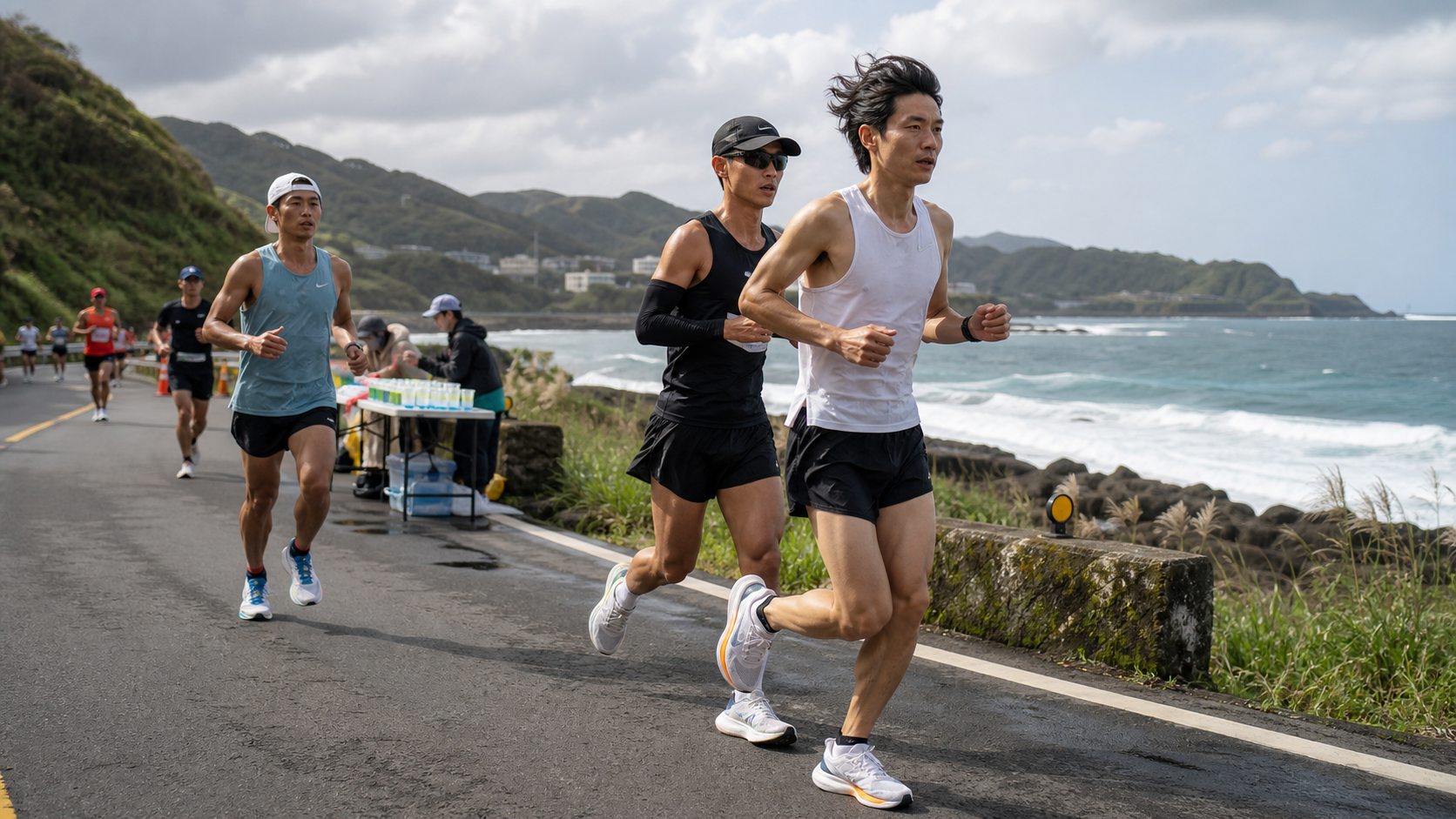
The Wan Jin Shi Marathon is held every March in Wanli, Jinshan, and Shimen in New Taipei City. The course stretches along the northeast coast, offering both spectacular scenery and formidable challenges. Many first-time runners are drawn in by the beautiful views but overlook the physical toll of the sea wind and rolling terrain. This article provides a comprehensive guide from three perspectives: wind strategy, elevation analysis, and aid station distribution.
Wind Strategy: Understanding the Patterns of the Northeast Monsoon
The Wan Jin Shi Marathon is typically held in March, when the northeast monsoon has not yet fully subsided, and its impact on the course is significant.
Course Wind Analysis
| Segment (km) | Direction | Wind Impact | Recommended Response |
|---|---|---|---|
| 0–10 km | Heading northeast | Predominantly headwind | Slow pace by 5–8 sec/km |
| 10–21 km | Turning southwest | Tailwind section | Accelerate moderately, maintain breathing |
| 21–32 km | Turning along the coast | Variable crosswinds | Shorten stride, stabilize core |
| 32–42 km | Heading north on return | Headwind + uphill | Prioritize heart rate, finish conservatively |
Core techniques for running into a headwind:
- Shorten your stride and increase cadence to maintain energy efficiency
- Lean slightly forward to reduce your frontal wind resistance
- Draft behind fellow runners in a “diamond formation” to break the wind
- Don’t fixate on pace numbers; control intensity by heart rate zone instead
Elevation Strategy: The Ups and Downs of Wan Jin Shi Should Not Be Underestimated
Many runners assume a coastal road race is flat, but the Wan Jin Shi course has a cumulative elevation gain of approximately 280 meters, with several key climbs that require advance planning:
- 18–22 km (near Yehliu): A series of rolling hills; shorten your stride on the climbs to conserve energy
- 28–30 km (Shimen Nuclear Power Plant section): The longest continuous climb; a conservative run-walk strategy is recommended
- 38–40 km (steep climb on the return): With energy already depleted late in the race, mental preparation is especially important
Uphill energy-saving strategy:
- Do not exceed 80% of your target heart rate
- Keep your eyes on the ground 3–4 meters ahead, maintaining a forward-leaning posture
- Increase arm swing amplitude to drive your rhythm with your upper body
Aid Station Distribution and Usage Strategy
The Wan Jin Shi Marathon sets up an aid station every 2.5–3 km, with denser coverage in the latter half of the race.
| Aid Station Location | Items Provided | Recommended Approach |
|---|---|---|
| 5 km, 10 km | Water, electrolyte drinks | Hydrate in small amounts frequently, 150–200ml per station |
| 15 km, 20 km | Water, bananas, energy gels | Supplement solid food based on your digestive capacity |
| 25 km, 30 km | Water, sports drinks, salt tablets | Start taking salt to prevent late-race cramping |
| 35 km, 40 km | Water, electrolytes, medical station | Assess your condition and stop if necessary |
Aid station usage tips:
- Don’t drink while running; slow down slightly to avoid choking
- Start taking energy gels before the 20 km mark; don’t wait until muscle glycogen is depleted
- Take one salt tablet or electrolyte capsule at every station starting from 25 km
Practical Advice
- Incorporate sea-wind simulation into training: Do long runs at the coast or in windy conditions beforehand to help your body adapt to wind resistance
- Scout the course the day before: Familiarize yourself with the start/finish route and the locations of turnaround points
- Clothing choices: Wear form-fitting running apparel to avoid loose clothing flapping in the wind and adding drag; fasten your cap securely
- Mental pacing: Don’t chase speed in the first half; conserve energy for the headwind + climb combination in the second half
Conclusion
The Wan Jin Shi Marathon is one of Taiwan’s most distinctive coastal marathons—breathtaking in scenery but genuine in challenge. Only by understanding the wind patterns, elevation distribution, and fueling rhythm in advance can you savor the most rewarding finish on the beautiful northeast coast. Set out with a strategy, and let the natural wind become your ally, not your obstacle.
Related Reading
- Wan Jin Shi Marathon: Complete Guide to Pace Adjustment and Aid Station Distribution in Coastal Headwinds
- Wan Jin Shi Marathon: Complete Guide to North Coast Scenery and Wind Speed Challenges
- Wan Jin Shi Marathon Guide: Elevation Response and Weather Variables on the Coastal Scenic Route
- Wan Jin Shi Marathon Guide: Rolling Pace and Fueling on the Coastal Mountain Road
大武山後門26%歡樂陡坡!JJSC南台灣單車行Day2 / 被颱風追著跑 / 公路車 / CT Yeh
2 年前
#公路車 #西進武嶺 配速配瓦實驗 坡度分析 四小時內攻略 建大盃 NeverStop #西進武嶺攻略
6 年前
西進武嶺 自製新版AI配速表產生器 x 賽前攻略 抱佛腳! 沒有功率計也可以產生配速表嗎?有什麼其他眉角賽前要注意的呢? | 西進武嶺 / 東進武嶺 KOM 攻略 | 公路車 | CT Yeh
4 年前
水金九不厭五分 10度寒流冷到不願停!feat. 卡卡 / 公路車 / CT Yeh
6 個月前
台北闊瀨陡坡 騎旅 / 日本單車雜誌編輯車友臨時加入!/ 髮香才是最強的 / feat. 北迴歸線小隊 / 公路車 CT Yeh
6 個月前
大武山20%魔王陡坡【JJSC南台灣遊騎Day2】!屁股真的要裂開了...凡士林抹滿也沒用?神秘金教堂還有超便宜夜市
3 個月前
一日北高前的西濱集訓 | 跟著11小時軍團 | 300W踩不動的大逆風 | 輪車破風差幾瓦?
6 年前
2019 夏季KOM 5小 完賽心得 準備攻略 東進武嶺 夏季登山王之路 Taiwan KOM Challenge
7 年前