Cycling and the Environment: Calculating the Carbon Emission Benefits of Choosing a Commuter Bike Over Cars and Scooters
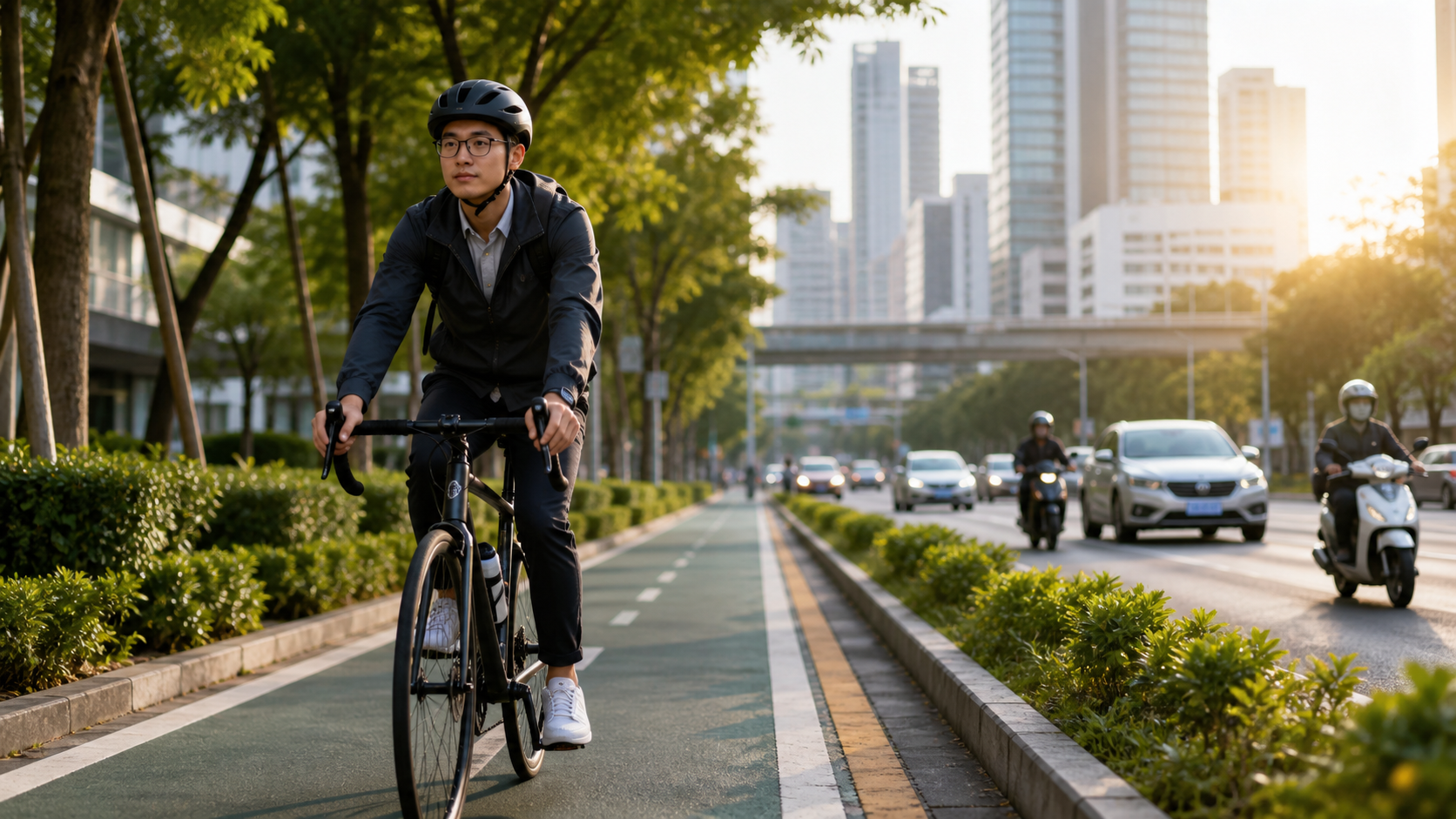
Introduction
Whenever the topic of climate change comes up, many people’s first reaction is, “What can one person do?” But if you narrow the perspective down to daily commuting decisions, the answer is actually quite concrete. According to statistics from the Ministry of Transportation and Communications, more than 70% of Taiwan’s daily commuters rely on cars or scooters as their primary mode of transport, and Taiwan’s scooter density ranks among the highest in the world. This makes Taiwan’s transportation-related carbon emissions particularly significant.
What this article aims to do is to clarify the question of “how environmentally friendly is commuting by bicycle” using specific numbers.
Basic Carbon Emission Data
To calculate commuting emissions, you first need to understand a few basic figures:
| Mode of Transport | CO₂ Emissions per km | Source |
|---|---|---|
| Gasoline car (average) | Approx. 180–220 g/km | IPCC 2023 data |
| Scooter (125cc) | Approx. 60–80 g/km | Taiwan EPA data |
| Electric scooter | Approx. 20–40 g/km (including power generation) | Estimated based on Taiwan’s electricity mix |
| MRT | Approx. 15–25 g/km (per passenger) | Taipei Metro environmental report |
| Bicycle | Close to 0 g/km | No combustion, only manufacturing emissions |
The “use phase” emissions of a bicycle are close to zero, but manufacturing a standard aluminum bicycle generates approximately 60–100 kg CO₂ (spread over 5 years, about 12–20 kg per year), which is far lower than any motorized mode of transport.
Taiwan Commuting Scenario Calculations
Using the most common commuting distance in Taiwan as an example (5–8 km one way), here is the annual carbon emission difference:
Scenario 1: Commuting by scooter every day (7 km one way)
- Daily commuting distance: 14 km (round trip)
- Scooter emissions: 70 g/km
- Daily emissions: 14 × 70 = 980 g = 0.98 kg CO₂
- Approximately 230 working days per year (excluding holidays and non-commuting days)
- Annual emissions: approximately 225 kg CO₂
Scenario 2: Switching to bicycle commuting (same distance)
- Use-phase emissions: approximately 0
- Annual share of manufacturing emissions: approximately 15 kg
- Annual emissions: approximately 15 kg CO₂
The Difference:
Switching from a scooter to a bicycle can reduce emissions by approximately 210 kg CO₂ per year, equivalent to:
- The annual carbon sequestration of planting about 10 mature trees
- The total emissions of about 4 round trips on the HSR between Taipei and Kaohsiung
- 3 times the monthly emissions of an average household’s electrical appliances
Collective Benefits at the City Level
If 100,000 scooter commuters in Taipei City switched to bicycles (about 5% of Taipei’s commuting scooter volume), the annual savings would be:
- 210 kg × 100,000 people = 21,000 tonnes of CO₂
This is equivalent to the carbon sequestration that planting 1 million trees could achieve. The collective impact of individual choices is far greater than we imagine.
Environmental Benefits Beyond Carbon Emissions
Choosing to commute by bicycle offers environmental benefits beyond carbon emissions:
- Reduced noise pollution: Scooters are one of the primary sources of noise in Taiwan’s cities, especially in alleys and narrow streets.
- Freed-up parking space: One scooter parking space can fit 5–8 bicycles, significantly increasing public urban space.
- Reduced traffic congestion: Bicycles take up one-third of the space of a scooter, placing less pressure on traffic flow.
- Fewer PM2.5 emissions: Two-stroke scooter engines are a major source of PM2.5 fine particulate matter in Taiwan. While electrification has improved things, older vehicles remain a problem.
Practical Recommendations
- Calculate your commuting emissions: Google’s carbon calculation tool (Environmental Insights Explorer) already includes data for Taiwan’s major cities.
- Make use of government subsidies: Some city and county governments offer commuter bicycle subsidies. Taipei and New Taipei both have relevant programs—check your local government website for details.
- Track your carbon-reduction mileage: Apps like Strava can record your riding distance and convert it into the amount of carbon emissions saved, which is a great way to stay motivated.
Conclusion
Environmental issues often make people feel powerless because the problems are too big and the individual too small. But commuting choices are decisions everyone makes every day—and the impact can be concretely quantified. There’s no need to wait for policy changes or make large investments. A NT$5,000 commuter bicycle is the most tangible climate action tool in your hands.
Related Reading
- Cycling and the Environment: Data Analysis of How Riding Reduces Your Carbon Footprint
- Cycling and Environmental Awareness: Calculating the Carbon Footprint of Two-Wheeled Commuting
- Bicycles and the Environment: Calculating Your Carbon Footprint Difference Through Pedaling
- Bicycles and Sustainable Living: The Cycling Philosophy of Reducing Your Carbon Footprint
靠單車減肥35公斤 心得分享與整理
7 年前
高雄綠園道鐵路自行車道 / 外地人能輕鬆駕馭 還是整路崩潰? / 2025 全線開通 春節實地探索一次!(附GPS連結)/ 公路車 / CT Yeh
1 年前
2025 自行車錶排行榜 兩萬車友大數據 / Garmin Bryton 排名會大洗牌嗎? / 全新的碼表前身分析 /公路車 / CT Yeh
1 年前
單車 一日北高 ( 雙城 ) 肥宅雙人瘋狂行 紀錄片 REACTO
10 年前
大家都在開箱的...單車用藍芽對講耳機真的有幫助嗎? SENA BiKom 20 長距離旅遊 & 海鷗繞圈賽 實際體驗心得 / 公路車 / CT Yeh
9 個月前
半日 小台灣 極限單車路線挑戰實錄
7 年前
#公路車 #Fitting 靠人工智慧APP 幫你調整單車
6 年前
2026 車錶排行榜!誰是最多車友正在使用?練家子最愛哪款?🏆 (2萬名車友數據) / 公路車 / CT Yeh
5 個月前