Introduction
Taiwan experiences an average of 3–5 typhoons that directly or indirectly affect the island each year, and with the plum rain season and frequent afternoon thunderstorms, Taiwanese riders aren’t facing the occasional “getting caught in the rain”—they’re facing a systemic challenge of wetness. Post-typhoon bicycle cleaning and maintenance has developed into a unique cultural practice in Taiwan—walk into any bike shop, and the weekend after a typhoon is usually the busiest maintenance day.
Many people’s habit is: ride in the rain, park the bike when you get home, and deal with it when the rain stops. This habit is precisely the main reason bicycles have their lifespans drastically shortened. This article provides a complete post-typhoon cleaning and maintenance workflow that takes about 45–90 minutes but can keep your beloved bike running for years longer.
How Rain Damages Your Bicycle
First, let’s understand why rain is so destructive:
| Component | Type of Rain Damage | Severe Consequences |
|---|---|---|
| Chain | Lubricant washed away, oxidation and rust | Chain stretch, chain drop |
| Shift cables | Moisture seeps into cable housing, corrosion | Poor shifting, cable breakage |
| Bearings | Moisture intrusion, grease emulsification | Noise, increased resistance |
| Disc brake rotors | Iron rust film formation | Brake noise, reduced performance |
| Seatpost | Water seeps into the frame | Internal frame oxidation |
| Steel bolts | Direct rusting | Loosening or seizing |
Post-Typhoon Cleaning and Maintenance SOP
Phase 1: Initial Rinse (Approx. 10 minutes)
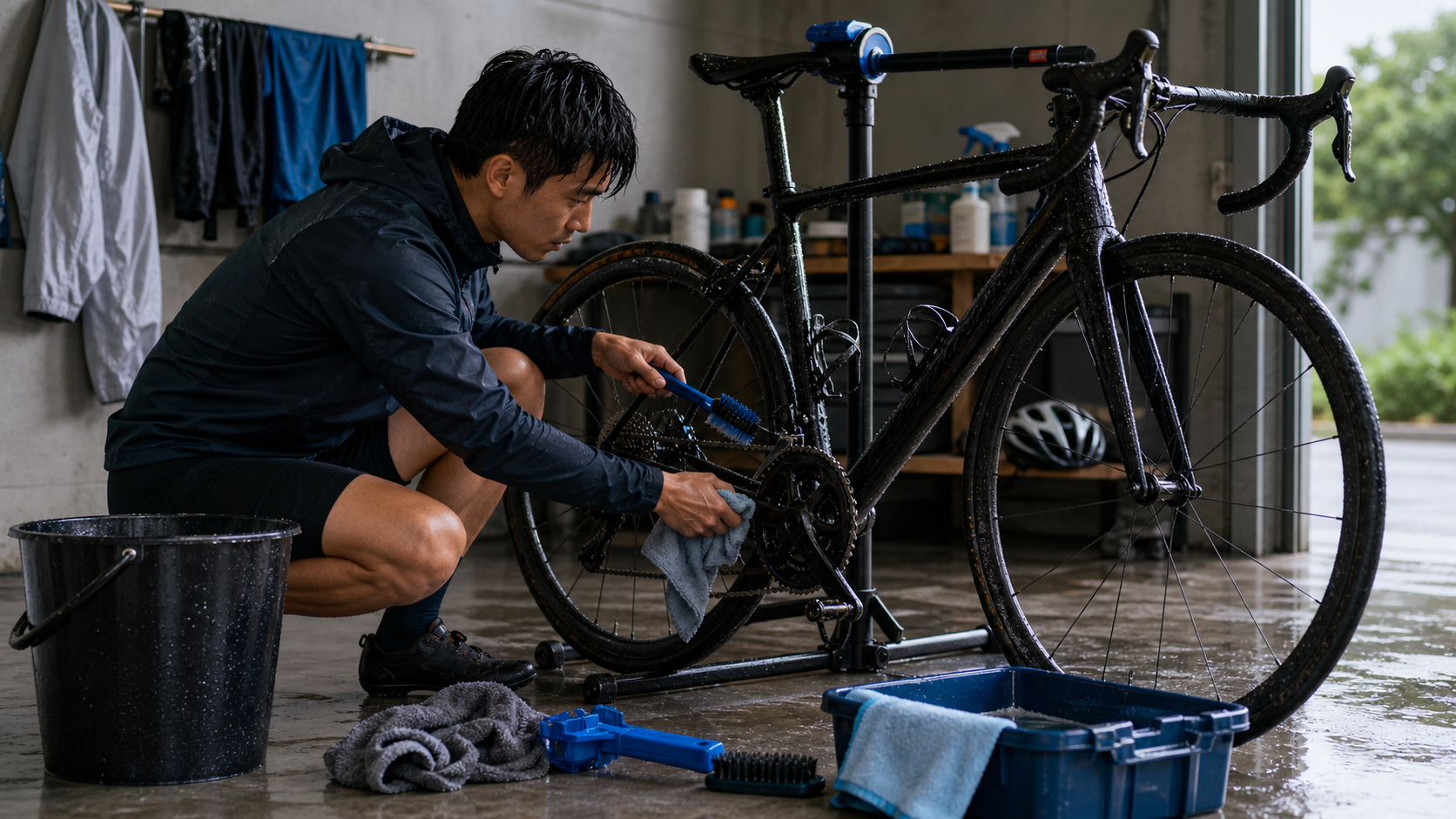
- Rinse with a low-pressure hose or bucket: Never aim a high-pressure water jet directly at bearing areas. High-pressure water will wash away waterproof grease, doing more harm than good.
- Rinse from top to bottom: Start with the frame, stem, and seatpost, and finish with the drivetrain (chainrings, chain, cassette).
- Focus on cleaning the drivetrain: Use a brush with bicycle-specific degreaser to thoroughly scrub away mud and grit from drivetrain components.
Phase 2: Drying and Detailed Cleaning (Approx. 20 minutes)
- Use a clean rag or paper towel to dry every reachable area, especially: cable entry/exit points on shift cables, bottom bracket threads, and seatpost clamp gaps.
- Special chain treatment: Clamp a dry cloth around the chain from the outside, slowly turn the pedals, and repeat several times to carry away residual moisture and grime.
- Wipe disc brake rotors with alcohol: Rust spots often appear on rotors after rain (though usually only surface-level). Wipe them with 99% isopropyl alcohol—do not use any cleaner containing oil.
Phase 3: Critical Lubrication (Approx. 15 minutes)
This is the most important and most often overlooked step:
- Lube the chain: After the chain is completely dry, drip oil onto the inside of each link while turning the pedals. For Taiwan’s hot, humid environment, wet lube is recommended, as it’s less easily washed off by rain.
- Wait 5 minutes, then wipe off excess oil: Gently wipe the outside of the chain with a dry cloth—excess chain oil will actually attract dirt.
- Spray penetrating oil into shift cable housing: Spray a little WD-40 or similar penetrating oil at the cable housing entry/exit points (note: penetrating oil is not chain oil and should not be mixed), to help drive out moisture.
Phase 4: Function Check (Approx. 5 minutes)
After cleaning and maintenance is complete, lift the rear wheel, spin it, and test:
- Whether front and rear shifting is smooth (shift through every gear one by one)
- Whether the brakes engage firmly (test left and right separately)
- Whether there are any unusual noises (the drivetrain should spin without obvious sounds)
Special Post-Typhoon Considerations
- Pay extra attention to carbon fiber frames: Carbon can develop invisible cracks after impacts. If your bike was knocked over or collided with something during the typhoon, inspect it carefully.
- Remove the seatpost to let it dry: If water accumulates in the seat tube of an aluminum frame over time, it can cause the seatpost to seize and become impossible to remove—a condition known as “stuck seatpost syndrome.” After a typhoon, you can temporarily remove the seatpost to confirm there’s no water inside the tube.
- Check the waterproof rating of lights and electronic devices: Most cycling computers are only rated IPX5–IPX7, and typhoon-level horizontal wind-driven rain may exceed their specifications.
Practical Advice
- Build the habit of “wiping the chain after every ride”: You don’t need to do a full clean every time, but after every rainy ride, spending 3 minutes drying the chain and adding lube can greatly extend its lifespan.
- Keep a set of “rainy-day commuter accessories”: A used entry-level bike fitted with low-maintenance fenders and full mudguards lets you keep riding after a typhoon without worrying about damaging your prized main bike.
- Don’t skip the annual full service: No matter how diligent your regular maintenance is, have your bike sent to a shop for a comprehensive full service at least once a year. A mechanic’s eyes and tools can catch problems invisible to the naked eye.
Conclusion
Taiwanese riders need to understand rainy-day maintenance more than riders in most parts of the world, simply because that’s what Taiwan’s climate demands. But precisely because of this, Taiwanese cyclists generally have their own hard-won insights into bike care. This maintenance culture, forged through adversity, is in fact a unique strength of Taiwan’s cycling community.
Related Reading
- Emergency Maintenance SOP After Riding in the Rain: Save Your Bike in 10 Minutes
- Post-Ride Maintenance in the Rain: Rust Prevention and Key Component Drying Steps
- Daily Bicycle Maintenance Habits: A 10-Minute Weekly Chain Cleaning Routine
- Bicycle Cleaning and Rust Prevention: Vehicle Protection Strategies for Taiwan’s Humid Climate
洗單車神器 吹水機! 實際洗車用用看 暴力洗鍊條大法 | 公路車 | CT Yeh
4 年前
自助洗車場 洗單車 50元有找 清鍊條大法 居然還有小小兵
7 年前
碟煞公路車 銑面器 !? 原來銑完差這麼多! 降低蹭碟機率! | TIME 公路車 保養小記錄 | CT Yeh
3 年前
單車 一日北高 ( 雙城 ) 肥宅雙人瘋狂行 紀錄片 REACTO
10 年前
洗完單車整隻手黑的解決妙招🤣 #bike
1 年前
大武山後門26%歡樂陡坡!JJSC南台灣單車行Day2 / 被颱風追著跑 / 公路車 / CT Yeh
2 年前
摔車後補裝備: 好市多新款單車安全帽& Specialized Romin 北高整路屁股都不痛的坐墊 | 一千元居然有MIPS | CT Yeh | 公路車
4 年前
下雨天就是要改車 #ceramicspeed #bike
1 年前