Lower Back Pain After Cycling: A Comprehensive Analysis of Core Weakness, Frame Geometry, and Handlebar Height
文章導覽
- Introduction
- Core Muscles: The First Line of Defense for Stabilizing the Lumbar Spine
- Typical Cycling Symptoms of Core Weakness
- Core Training Prescription for Cyclists
- The Impact of Frame Geometry on the Lower Back
- Frame Size Selection
- The Importance of Stack and Reach
- Coordinated Setup of Handlebar Height and Saddle Height
Introduction
“My back was about to break after climbing Wuling,” “My back gets really tight after 2 hours on flat roads”—such descriptions are all too common in Taiwan’s mountain bike and road bike communities. According to Taiwan sports injury research, lower back pain is one of the most common injuries in cycling, accounting for 30–40% of all cycling-related injuries. However, the causes of lower back pain are often multifactorial and intertwined—it cannot be solved simply by swapping a saddle or buying a lumbar support belt. It requires addressing the root causes.
Core Muscles: The First Line of Defense for Stabilizing the Lumbar Spine
Cycling involves a highly repetitive pedaling motion, with approximately 5,000 pedal strokes per hour. If the core muscles (including the transversus abdominis, multifidus, and quadratus lumborum) are not strong enough, the spine must withstand greater shear forces during every power transfer from each pedal stroke.
Typical Cycling Symptoms of Core Weakness
- Pelvic rocking begins after 1 hour of riding
- The lower back “collapses” when pedaling to exhaustion, with the spine shifting from its natural curve to excessive forward flexion
- The whole body sways when climbing, making it impossible to maintain a stable riding position
Core Training Prescription for Cyclists
| Exercise | Target Muscles | Recommended Sets | Frequency per Week |
|---|---|---|---|
| Dead Bug | Transversus abdominis, multifidus | 3×10 reps | 3 times |
| Bird Dog | Multifidus, gluteus maximus | 3×10 reps | 3 times |
| Plank | Full core | 3×30–60 sec | 4 times |
| Side Plank | Quadratus lumborum, gluteus medius | 3×20–30 sec | 3 times |
| Glute Bridge | Gluteus maximus, hamstrings | 3×15 reps | 3 times |
The Impact of Frame Geometry on the Lower Back
Frame Size Selection
A frame that is too large or too small will lead to poor riding posture, directly affecting the load on the lumbar spine:
- Frame too large: The torso is overstretched, requiring the upper body to maintain balance in a “suspended” state. The lumbar spine undergoes prolonged isometric contraction, leading to fatigue
- Frame too small: The body is compressed too tightly, leaving insufficient room for the hips to shift backward, often causing excessive anterior or posterior pelvic tilt
The Importance of Stack and Reach
Modern frame design emphasizes two core values: Stack (the vertical height from the top of the head tube to the bottom bracket) and Reach (the horizontal extension distance):
- High-Stack frames (such as Endurance geometry): The rider sits more upright, placing less stress on the lumbar spine—suitable for weekend leisure and long-distance comfort riding
- Low-Stack, high-Reach frames (such as Race geometry): Aerodynamic position requires the lumbar spine to remain stabilized in a flexed state for extended periods, demanding strong core strength
Recommendation: Unless there is a racing need, most Taiwanese cyclists will find Endurance or Sportive geometry noticeably more comfortable for their lower backs.
Coordinated Setup of Handlebar Height and Saddle Height
The Impact of Handlebar Height
- Handlebar too low (excessive saddle-to-handlebar drop): The torso must lean forward significantly, increasing the lumbar flexion angle. Both the anterior abdominal muscles and posterior back muscles must continuously contract against gravity, which is extremely energy-consuming and leads to muscle fatigue
- Handlebar too high: The center of gravity shifts rearward, slightly reducing riding stability, but it does place less stress on the lower back
The Knock-On Effect of Saddle Height
When the saddle is too high, the rider’s pelvis rocks side to side in order to maintain contact with the pedal at bottom dead center. Over time, this asymmetrical movement pattern can lead to unilateral lower back pain and even hip problems.
Standard saddle height formula (LeMond’s formula):
Inseam length (cm) × 0.883 = Saddle height (from bottom bracket center to top of saddle)
Utilizing Taiwan’s Medical Resources
If lower back pain persists for more than 2 weeks, or is accompanied by radiating leg pain, numbness, or difficulty with bowel or bladder control, seek medical attention immediately. Relevant departments available in Taiwan:
- Orthopedics: To rule out structural issues such as herniated discs or spondylolisthesis
- Physical Medicine & Rehabilitation: For posture analysis, core assessment, and physical therapy
- Sports Medicine (available at NTU Hospital, Chang Gung Memorial Hospital, and Mackay Memorial Hospital): For integrated assessment of cycling-related injuries
Practical Recommendations
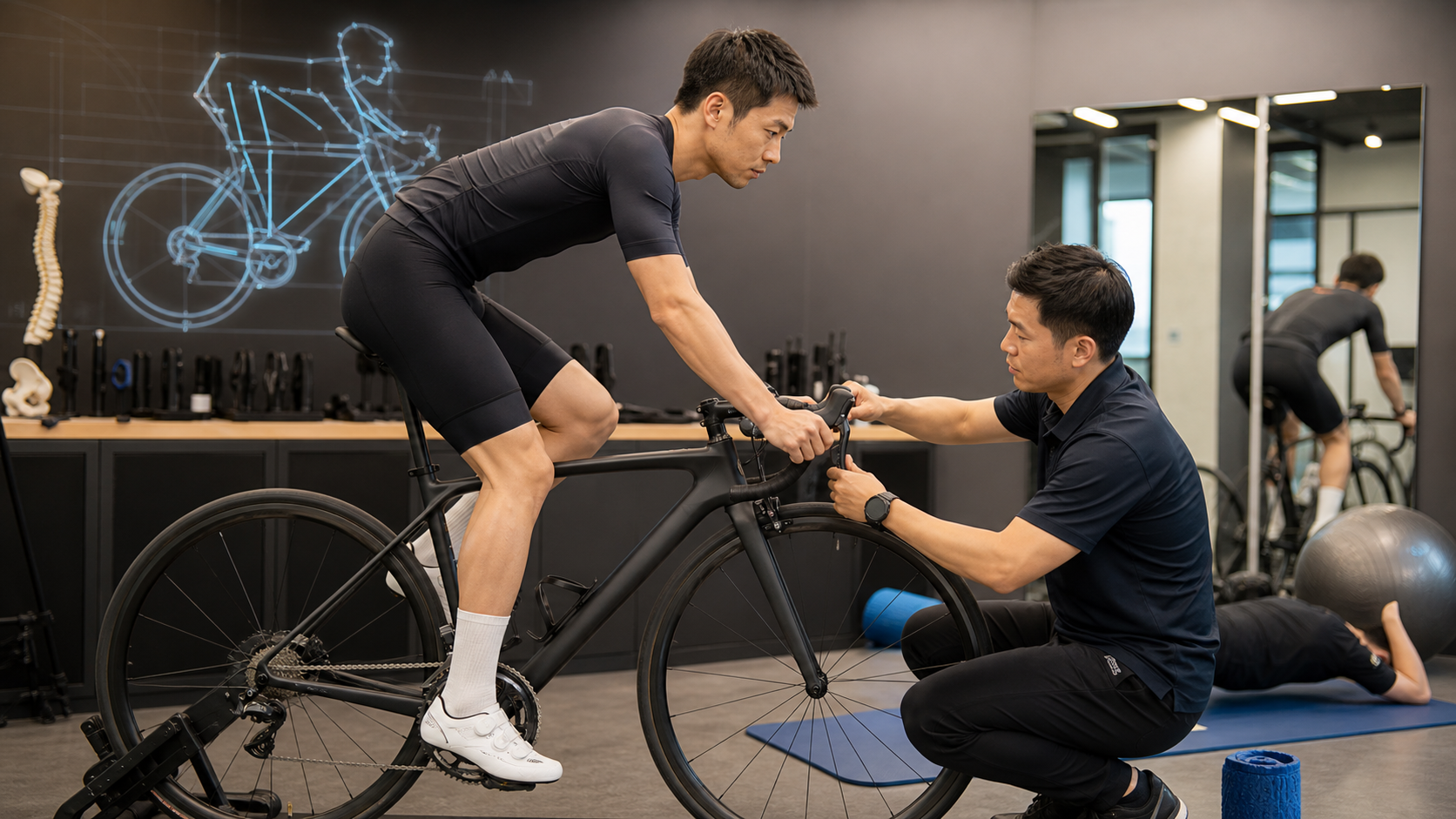
- Prioritize Bike Fitting: Spending NT$3,000–6,000 on a professional fitter for a full bike adjustment is often more effective than buying a pile of support gear
- Warm Up Before Riding: Do 10 minutes of dynamic warm-up (hip flexor stretches, torso rotations) before departure to reduce the impact of a cold start on the lumbar spine
- Stand and Pedal for 5 Minutes Every Hour: Standing while pedaling temporarily relieves pressure on the lumbar spine
- Ice or Heat After Riding: Ice for acute pain (within 24 hours), heat for chronic tightness, 15–20 minutes per session
Conclusion
Lower back pain is the result of multiple factors working together, and relying on a single solution often yields limited results. From strengthening core training and optimizing frame geometry to fine-tuning handlebar and saddle adjustments, every element is part of the whole. Taiwan has a well-established rehabilitation medical system and increasingly mature Bike Fitting services. Cyclists don’t have to endure pain while riding—actively seeking professional assistance is the way to ride longer and ride healthy.
Related Reading
- Lower Back Pain After Cycling: Improving Core Insufficiency and Posture Issues
- Cycling Lower Back Pain: Treatment Plans for Core Strengthening and Riding Posture Adjustment
- Cycling and Lower Back Pain Management: A Guide to Preventing and Treating the Most Common Spinal Issues Among Taiwanese Cyclists
- Lower Back Pain and Bicycles: Cause Analysis, Posture Correction, and Long-Term Solutions