Cycling Neck Stiffness: Cervical Spine Strain from Prolonged Head-Down Riding and a Stretching Prescription
Introduction
Road cyclists in a low, aerodynamic position must “lift” their heads to look forward while their torso is tilted forward. Anatomically, this is a compound posture of cervical extension combined with thoracic flexion. According to spinal biomechanics research, for every 15 degrees the head tilts forward, the effective weight borne by the cervical spine increases from the head’s original 4–5 kg to approximately 12 kg; at a 60-degree forward tilt, the load can reach 27 kg. The cumulative effect of long-distance riding often causes severe neck discomfort among Taiwanese cyclists after endurance challenges such as round-island tours or Wuling climbs.
The Interaction Between Cervical Spine Anatomy and Cycling Posture
The Normal Physiological Curve of the Cervical Spine
The cervical spine (C1–C7) normally exhibits a lordotic curve (lordosis). Riding with the head down tends to flatten this curve (military neck) or even reverse it into kyphosis, which over time affects the health of the intervertebral discs and facet joints.
Main Structures Affected
- Suboccipital muscles: The primary stabilizers for lifting the head; prolonged contraction easily leads to fatigue and tension headaches at the back of the head
- Upper trapezius: A large muscle connecting the neck and shoulders; it remains in near-constant isometric contraction while riding
- Cervical facet joints: Compressed during excessive cervical extension, accelerating degeneration over time
- Cervical intervertebral discs: Forward flexion increases pressure on the anterior portion of the discs; if combined with rotation (such as turning the head to check traffic behind), the risk is even higher
Comparison of Cervical Spine Load Across Riding Types
| Riding Type | Torso Tilt Angle | Head Lift Angle | Estimated Cervical Load | Suitable For |
|---|---|---|---|---|
| Urban/leisure bike | 10–20° | 5–10° | Low | Everyone |
| Mountain bike (AM/Trail) | 30–40° | 15–25° | Moderate | Riders with some core strength |
| Road bike (Sportive geometry) | 40–50° | 20–30° | Moderate to high | Core-trained riders |
| Road bike (Race geometry) | 50–70° | 30–45° | High | Highly trained riders |
| TT/Triathlon bike | 60–80° | 30–50° | Extremely high | Professional athletes |
Assessing Neck Symptoms
General Muscle Fatigue (Can Be Managed Independently)
- Neck tightness and stiffness after riding
- Mild discomfort when turning the head
- Resolves on its own after 1–2 days of rest
Warning Symptoms Requiring Medical Attention
- Numbness, tingling, or radiating pain in the arms or fingers: May indicate cervical radiculopathy
- Balance problems or unsteady gait: May indicate cervical myelopathy
- Severe headache or blurred vision: Rule out vertebral artery issues
- Localized neck tenderness accompanied by fever: Rule out infection
In Taiwan, neurosurgery, orthopedics, or rehabilitation medicine departments can perform cervical X-rays and MRI evaluations.
Complete Stretching Prescription
Pre-Ride Warm-Up (5 minutes)
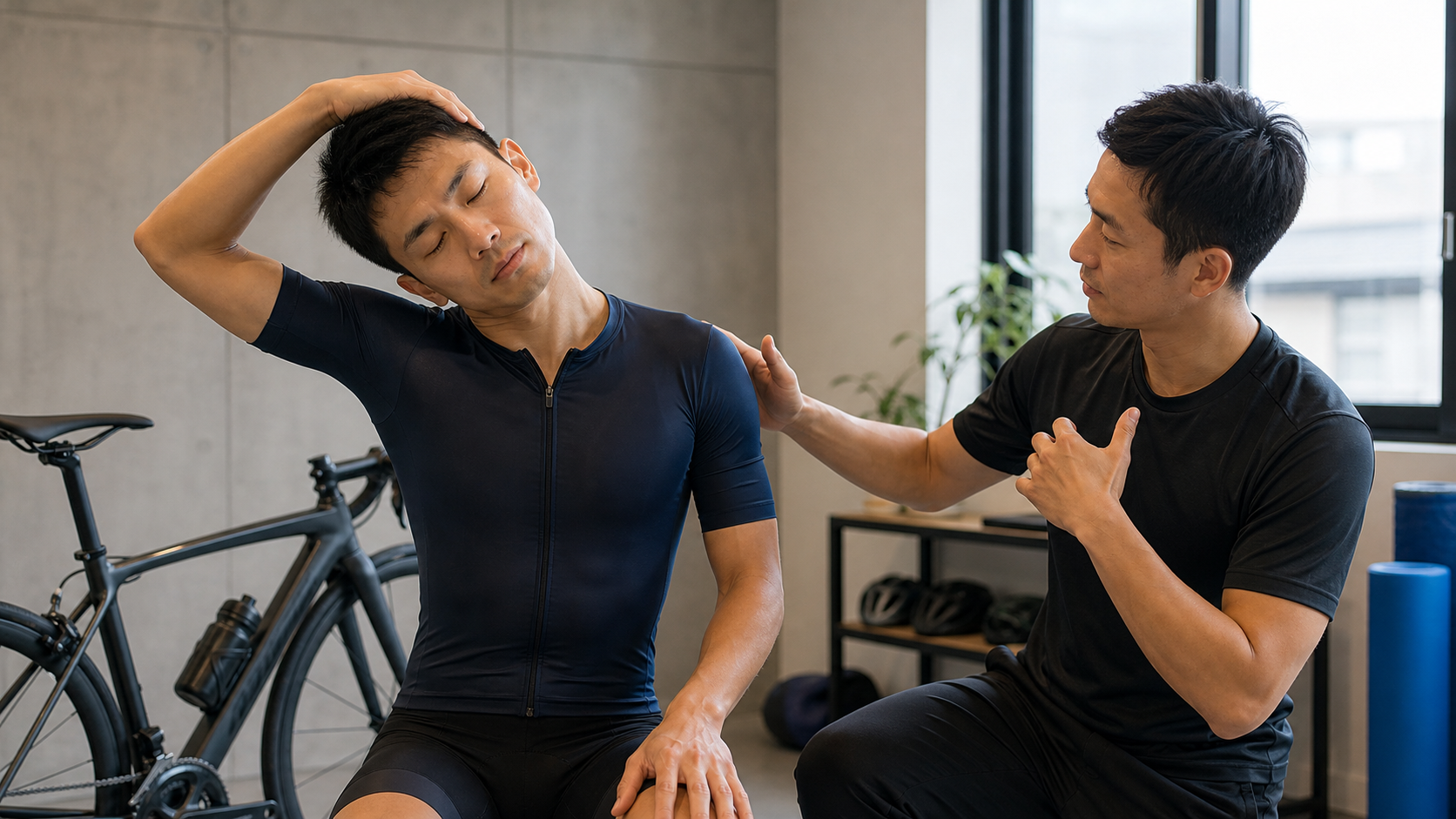
- Neck lateral flexion stretch: Slowly tilt the head to one side, bringing the ear toward the shoulder on the same side; gently press the top of the head with the opposite hand. Hold for 20 seconds, repeat 3 times on each side
- Neck rotation: Slowly turn the head left and right 5 times each, feeling the range of motion in the neck muscles
- Thoracic rotation (opening the thoracic spine): From a kneeling position, place one hand on the ground and the other behind the head, rotate upward, 10 times per side
During the Ride (Every 60–90 Minutes)
- Ride out of the saddle for 5 minutes: Relieves the cervical spine from the forward-flexed position
- Gentle neck rotation: On safe sections of road, slowly turn the head left and right 3 times each
- Shoulder shrug and release: Consciously shrug the shoulders toward the ears, hold for 3 seconds, then relax; repeat 5 times to release tension in the upper trapezius
Post-Ride Cool-Down (10 Minutes)
- Ceiling gaze stretch: Standing, interlace your hands behind your head, slowly lean back, and feel the stretch along the front of the neck. Hold for 15 seconds
- Towel neck traction: Lying on your back, place a folded towel under the neck to slightly elevate the head, and relax for 5 minutes
- Cat-cow spinal mobility: On all fours, alternately arch the back (cat pose) and let the lower back sag (cow pose), 10 repetitions each
Bike Fit Adjustment Recommendations
- Raise the handlebar height (add spacers or change the stem angle): This is the fastest way to relieve neck pressure
- Shorten the stem length: Reduces torso forward lean, so the cervical spine does not need to lift as much
- Choose compact handlebars (shallow drops): Using the drops results in a more natural cervical spine angle
Practical Advice
- Before long rides, strengthen the deep cervical flexors: Lying on your back, gently perform a chin tuck and feel the deep muscles at the front of the neck contract. Do 10 reps × 3 sets to effectively improve cervical spine stability
- For rides exceeding 4 hours: Mandatory 5-minute rest every hour to perform neck stretches
- When choosing a helmet, select a lightweight (under 200 g) and well-ventilated model to reduce additional burden on the cervical spine
Conclusion
Neck stiffness is an almost unavoidable challenge for road cyclists, but with proper bike fitting, regular stretching habits, and timely medical attention when symptoms worsen, the damage can be minimized. Remember: cycling should make you healthier the more you ride, not accumulate a body full of chronic injuries.
Related Reading
- Cycling Neck Stiffness: Stretching and Strengthening for Cervical Spine Load Under Forward-Leaning Posture
- Cyclists’ Cervical Spine and Neck-Shoulder Issues: A Complete Guide to Posture Correction
- Cervical Spine Pain and Long-Distance Riding: Biomechanics of Disc Pressure and 5 Prevention Strategies
- Neck and Shoulder Discomfort from Prolonged Low-Position Riding: Cause Analysis and Fit Adjustment Directions
一日北高/長距離團騎 常見問題補充篇 / 組團或跟團的眉角 / 壯車友容易被瘦車友慢性拉爆 / 原來屁股痛可能是這個原因...? / 風場配速法 / 公路車 / CT Yeh
2 年前
一日北高常見問題大集合 | 攻略 | 路線 | 訓練 | 補給 | 自行車 單車 | 一日雙城 | 雙塔 | TWB北高360 | 屁股痛
6 年前
太平山單車員工旅遊 | 這樣玩CP值最高!| 公路車
5 年前
「悲情男車友」創作單曲 爆笑MV / 公路車 / CT Yeh / 4K劇情版
7 個月前
Never Stop 西進武嶺 前後雙機 完整全程錄影 訓練台 實境
8 年前
CT 喇低賽) 單車 比賽總是沒照片? 攝影師的觀點大公開 姿勢就是力量! 請加速1.25倍收看
7 年前
靠單車減肥35公斤 心得分享與整理
7 年前
碟煞公路車 銑面器 !? 原來銑完差這麼多! 降低蹭碟機率! | TIME 公路車 保養小記錄 | CT Yeh
3 年前