Introduction
The number of senior swimmers in Taiwan has been growing year by year. Many people over 65 have discovered that swimming is an ideal exercise that maintains health without harming the joints. However, there is a considerable gap between “an elderly person going to the pool for a swim” and “a systematic water training schedule for seniors.”
This article addresses the physiological characteristics of adults over 65—including the natural decline in cardiopulmonary function, loss of muscle mass (sarcopenia), reduced balance, and joint degeneration—to design a safe and effective low-intensity water training schedule.
Physiological Characteristics of Adults Over 65
Understanding these characteristics is a prerequisite for designing a safe schedule:
| Physiological Change | Impact on Swimming Training | Corresponding Schedule Adjustment |
|---|---|---|
| Decline in cardiopulmonary function | Lower maximum heart rate, slower recovery | Intensity should not exceed “slightly challenging”; avoid high heart rates |
| Sarcopenia (muscle loss) | Reduced propulsion, easy fatigue | Incorporate water resistance training to maintain muscle |
| Osteoporosis risk | Swimming is non-weight-bearing and contributes little to bone density | Supplement with land-based weight-bearing training |
| Reduced balance | Increased safety risk when entering and exiting the pool | Ensure safety facilities are available; recommend training with a partner |
| Reduced thermoregulation | Sensitive to water temperature, prone to feeling too cold or too hot | Choose a pool with water temperature of 28–30°C |
| Joint degeneration | Possible range-of-motion limitations in shoulders, knees, and hips | Avoid excessive range of motion; emphasize low impact |
Safety Principles for Senior Swimming
Before designing a schedule, the following safety items must be confirmed:
Medical Clearance:
- Those with heart disease, hypertension, or diabetes must consult their primary physician before exercising
- Training intensity should be maintained within the range of “can speak in full sentences but slightly breathless”
- If chest tightness, dizziness, or palpitations occur while swimming, stop immediately and rest; call the lifeguard if necessary
Environmental Safety:
- Choose a pool with handrails and non-slip flooring
- Avoid swimming during crowded hours to reduce the risk of accidental collisions
- Swim with a partner and look out for each other
- Inform pool staff that you are a senior and confirm the location of first-aid equipment
Heart Rate Monitoring:
- Target heart rate range for seniors: (220 - age) × 50–65%
- Age 65: target heart rate 78–100bpm
- Age 70: target heart rate 75–97bpm
Sample Senior Swimming Schedule
Beginner Schedule (for beginners or those who haven’t swum in a long time)
30–40 minutes per session, 2–3 times per week
- Poolside warm-up (5 minutes): shoulder circles, ankle rotations, gentle waist twists
- Water walking (10 minutes): walk back and forth in the shallow area to acclimate to water temperature and resistance
- Kicking at the wall (5 minutes): hold the pool edge with both hands and practice breaststroke kicks or gentle flutters
- Easy swimming (10–15 minutes): mainly breaststroke or backstroke; rest 1–2 minutes after each lap (25m)
- Water cool-down (5 minutes): stand in the water, slowly raise and lower both arms to relax the shoulders
Intermediate Schedule (for those with a regular swimming foundation)
45–60 minutes per session, 3 times per week
| Segment | Content | Distance/Time |
|---|---|---|
| Land warm-up | Shoulder, hip, and ankle joint mobility | 5 minutes |
| Water warm-up | Water walking + easy kicking with a kickboard | 200m / 8 minutes |
| Technique swimming | Breaststroke (low intensity) or backstroke | 200m / 10 minutes |
| Main set | Freestyle or breaststroke, 2–4 x 100m, rest 2–3 minutes between sets | 200–400m |
| Water exercises | Water leg raises, water core rotations (see next section) | 10 minutes |
| Water cool-down | Slow backstroke or standing relaxation in the water | 100m / 5 minutes |
Water Exercises: Highly Recommended for Seniors
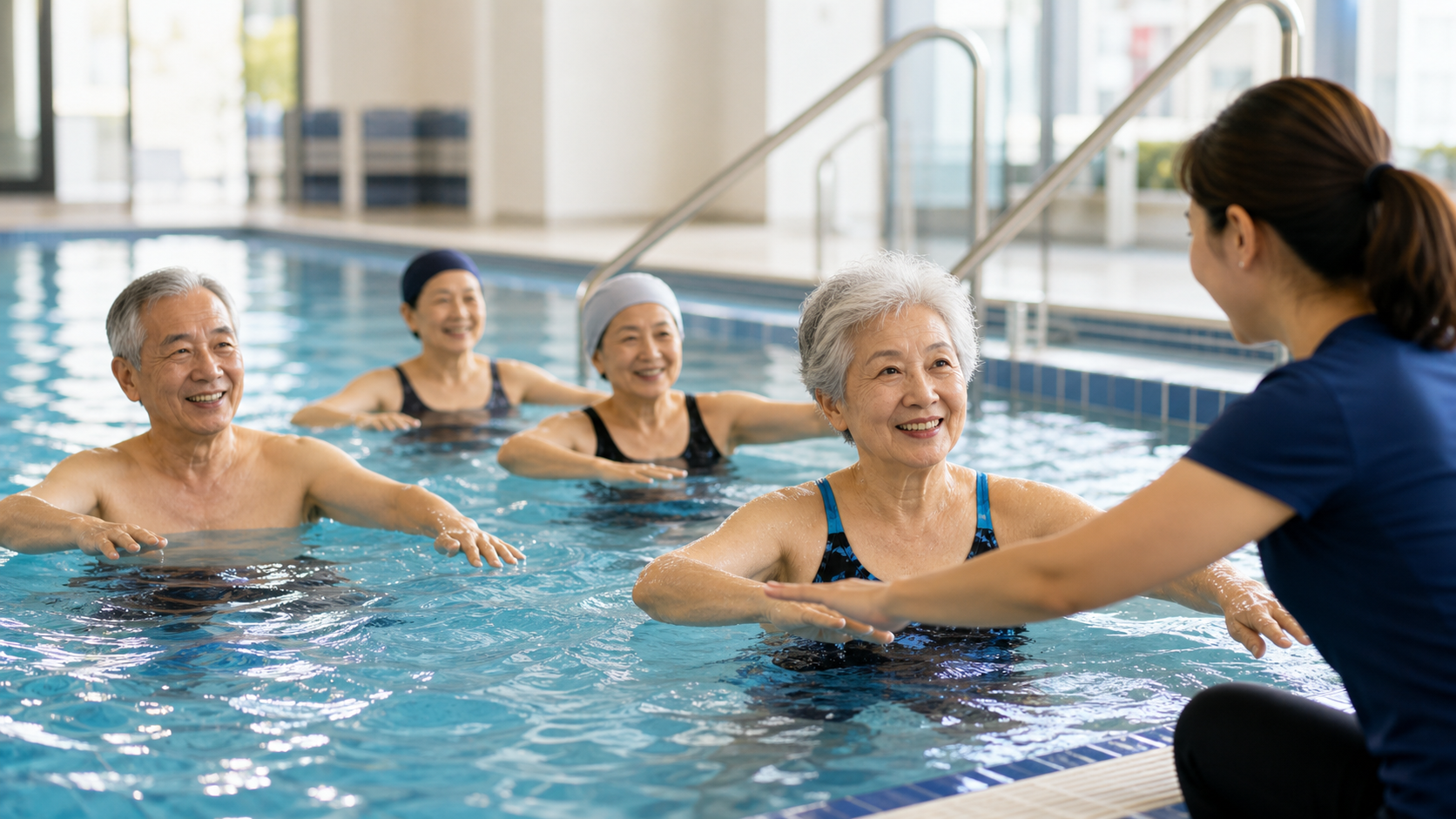
The buoyancy of water greatly reduces joint pressure, making it ideal for performing movement training that is difficult to do on land:
Exercise 1: Water Leg Raises
- Stand with your back against the pool wall, hold the handrail with both hands, and alternately raise each leg slowly to horizontal
- Primarily strengthens the hip flexors and core, which is very helpful for gait stability
- Recommendation: 10–15 reps per side, 2 sets
Exercise 2: Water Walking (forward/backward and lateral)
- Walk in water of moderate depth (waist to chest level); water resistance replaces gravity for training effect
- Lateral walking is especially effective for training the adductor and abductor muscles and improving balance
- Recommendation: 2 lengths in each direction (10–15m long)
Exercise 3: Water Arm Push-Pull
- With hands half-clenched, repeatedly perform “push water → pull water” motions in the water
- Mimics the swimming stroke motion to maintain shoulder strength
- Recommendation: 20 reps in each direction, 2–3 sets
Exercise 4: Marching in Place
- In water of moderate depth, march in place with high knees
- Combines cardiovascular stimulation with lower-body strength training
- Recommendation: march for 30 seconds, rest 30 seconds, repeat 5–8 times
Swimming Adjustments for Common Health Conditions
For those managing hypertension:
- Avoid keeping the head lower than the heart for extended periods (reduce time spent on backstroke kicking)
- Keep swimming intensity at moderate or below; no sprinting
- Those taking blood pressure medication should confirm their blood pressure is stable before entering the water
For those with knee arthritis:
- Breaststroke kicks may increase pressure on the knees; switch to freestyle or backstroke kicks instead
- Water walking is more suitable than swimming for those with severe knee degeneration
- If the knees feel swollen after swimming, immediately reduce training volume
For those with shoulder degeneration:
- Avoid butterfly stroke (the stroke that places the greatest load on the shoulder joints)
- Backstroke and breaststroke are generally the most shoulder-friendly strokes
- If the pull motion causes shoulder discomfort, switch to kickboard training
Practical Advice
- Joining a senior swimming class is the safest way to start; pools in cities and counties across Taiwan typically offer classes for older adults
- Record your energy levels and joint condition after each swim; if a particular joint remains uncomfortable for two consecutive weeks, seek medical evaluation
- Pair swimming with land-based balance training (tai chi, yoga, barefoot walking) to more comprehensively improve seniors’ motor function
- Don’t stop striving for progress just because of age; adults aged 65–80 can still see significant improvements in physical fitness through systematic training
Conclusion
Swimming is one of the most ideal long-term health activities for seniors in Taiwan. Its low-impact, full-body, and social nature allows older adults to maintain their fitness and health consistently. Designing a schedule for seniors is not about limiting them to “just a gentle swim,” but rather about systematically maintaining and improving their cardiorespiratory endurance, muscle strength, and functional mobility within a safe range—making swimming the best partner for healthy aging.
Related Reading
- Senior Swimming Safety Guidelines: A Complete Beginner Schedule Design for Ages 65+
- Senior Swimming Training: A Safe Beginner Plan and Precautions for Ages 65+
- Senior Swimming: An Aerobic Exercise Guide Even 75-Year-Olds Can Do
- Senior Swimming Guide: Safe Water Entry and Training Advice After Age 50
西進武嶺 免費訓練分析服務 Intervals | 練不夠還是練過頭?你哪一種類型選手?AI模型告訴你! | 備戰神器 | 公路車 訓練 | CT Yeh
4 年前
一日北高/長距離團騎 常見問題補充篇 / 組團或跟團的眉角 / 壯車友容易被瘦車友慢性拉爆 / 原來屁股痛可能是這個原因...? / 風場配速法 / 公路車 / CT Yeh
2 年前
實景訓練台) 彰化經典百K 高強度喵團 90分鐘 跟著一起練功 2019 Indoor workout Changhua Classic 100 Taiwan
7 年前
一日北高常見問題大集合 | 攻略 | 路線 | 訓練 | 補給 | 自行車 單車 | 一日雙城 | 雙塔 | TWB北高360 | 屁股痛
6 年前
白沙屯媽祖進香在家走!UREVO 坡度自調走步機 / 可連接訓練遊戲APP MyWhoosh / 邊看直播邊走起來 / CT Yeh
11 個月前
滑雪新手們慘摔學習全紀錄(請開字幕),滑雪好好玩 | Snowboard + Ski | 岩原 スキー場 | 滑雪APP使用 | GoPro Max
6 年前
靠單車減肥35公斤 心得分享與整理
7 年前
NEKO's Fun 高美濕地團練
8 年前