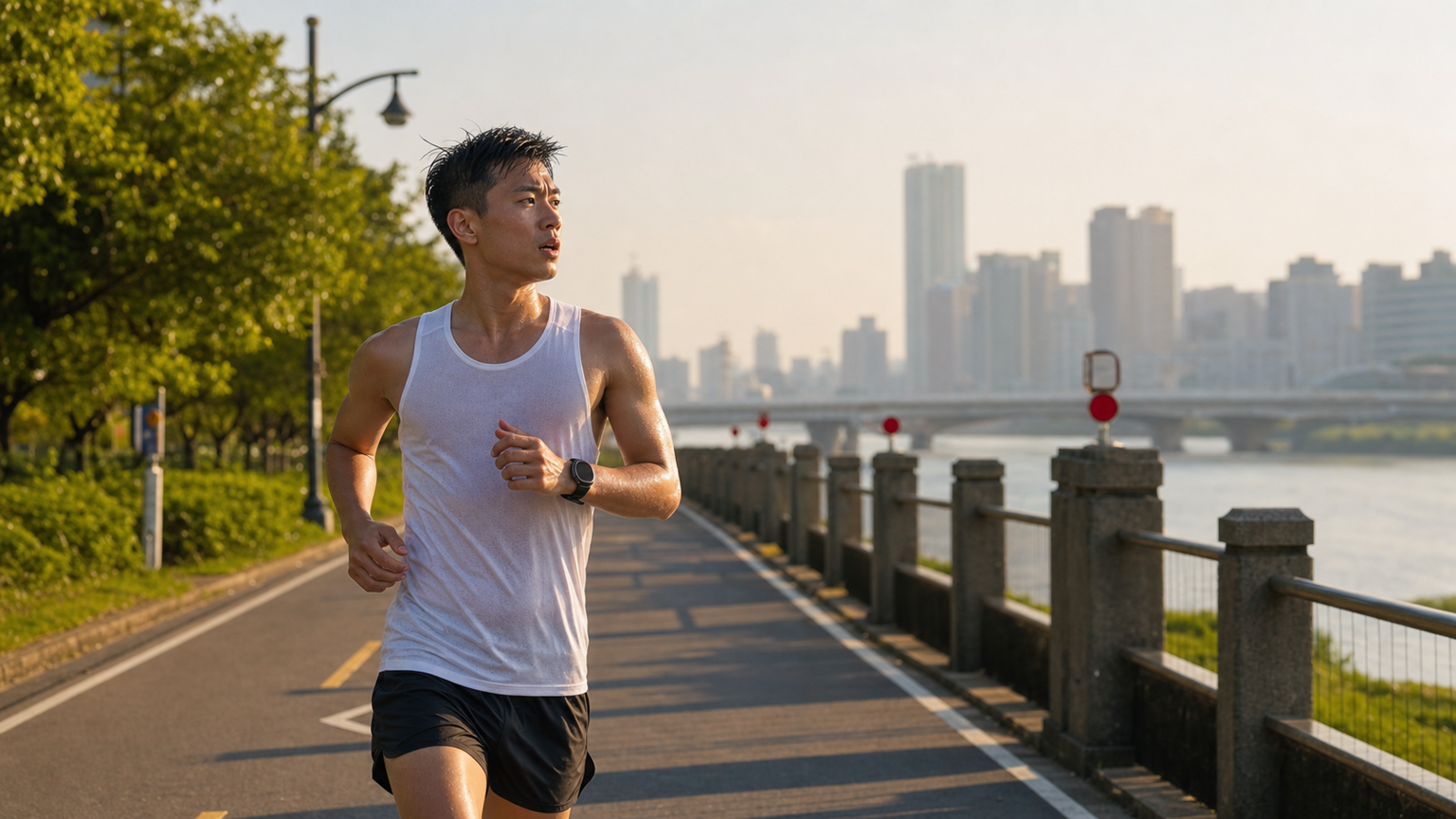
Introduction
Every summer, similar posts appear in Taiwan’s Facebook running groups: “It’s 30°C today and I ran 10K. It felt so slow and tiring. Am I getting worse?” The answer is: no, you’re not getting worse. Your body is doing something very correct—protecting itself in high heat. The problem is that many runners don’t know how much slower they should go. Some over-adjust, some under-adjust, leading to inconsistent quality in summer training.
What is WBGT?
Wet-Bulb Globe Temperature (WBGT) is a composite heat stress index that integrates air temperature, humidity, radiant heat, and wind speed. It reflects the body’s actual heat stress better than air temperature alone.
WBGT estimation formula (simplified version):
WBGT ≈ 0.7 × wet-bulb temperature + 0.2 × black-globe temperature + 0.1 × dry-bulb temperature
For general runners, the following simplified estimation can be used:
WBGT (°C) ≈ 0.567 × dry-bulb temperature + 0.393 × water vapor pressure + 3.94
Or an even simpler on-site estimate: in Taiwan’s summer, if your phone’s weather app shows 32°C with 75% humidity, WBGT is approximately between 27–29°C.
WBGT and Running Risk Classification
| WBGT Range | Risk Level | Recommendation |
|---|---|---|
| < 10°C | Extremely Low | Normal training, keep warm |
| 10–18°C | Low | Ideal training conditions, best window in Taiwan’s winter |
| 18–23°C | Moderate | Normal training, increase hydration frequency |
| 23–28°C | High | Pace reduction of 5–10%, consider shortening distance |
| 28–32°C | Very High | Pace reduction of 10–20%, cancel intensity training |
| > 32°C | Dangerous | Easy jog only or cancel outdoor training |
The average WBGT in Taipei City in August is approximately 28–31°C; Kaohsiung and Tainan may be even higher.
Pace Adjustment Formula
Research literature (including Ely et al. 2007’s marathon temperature analysis) provides the following pace adjustment reference:
Based on optimal training temperature (WBGT ≈ 12°C) as baseline:
| WBGT | Estimated Pace Reduction |
|---|---|
| 18°C | -1.5% |
| 22°C | -3% |
| 25°C | -6% |
| 28°C | -10% |
| 30°C | -14% |
| 32°C | -19% |
Conversion example:
- Runner’s target marathon pace: 5:41/km (4-hour finish)
- Summer training at WBGT 28°C: 5:41 + 10% ≈ 6:15/km
- If you stubbornly maintain 5:41, the cardiac load is equivalent to running at an intensity faster than LT2 in cool weather
Taiwan Summer Special Considerations
Urban Heat Island Effect
The urban heat island effect in the Taipei Basin makes city temperatures 2–5°C higher than the suburbs. Runners in Daan District and Xinyi District should add an additional 1–2°C WBGT correction. Before 6 AM or after 8 PM, heat stress drops by approximately 20–30% due to the absence of solar radiation.
The Impact of Relative Humidity
Taiwan’s summer humidity often exceeds 80%, making sweat evaporation difficult. At the same air temperature:
- 50% humidity: high sweat evaporation efficiency, good heat dissipation
- 80% humidity: sweat evaporates with difficulty, body temperature accumulates more easily
Practical rule: For every 10% increase in humidity (above 60%), slow your pace by an additional 5–10 seconds/km.
Hydration Strategy in High Heat
- Before exercise: Consume 400–600 ml 2 hours before training
- During exercise: Consume 150–250 ml every 15–20 minutes (don’t wait until you’re thirsty)
- Electrolytes: For training exceeding 60 minutes, consume sodium-containing drinks (500–700 mg/L) rather than plain water
- Indicator: Light yellow urine indicates adequate hydration; dark yellow indicates dehydration
Heat Acclimatization Training
If you must race in a hot environment (such as a summer road race), starting heat acclimatization 10–14 days in advance can improve hot-weather performance by 4–8%.
Heat acclimatization protocol:
- 60–90 minutes daily of light-to-moderate aerobic training in the target temperature environment
- First 5 days focus on adaptation, intensity no higher than Zone 2
- Days 5–9 onward can incorporate Zone 3–4 training
- Physiological adaptations: increased plasma volume, improved sweat output efficiency, lower heart rate at the same intensity
Practical Recommendations
- Download the Central Weather Bureau WBGT App: Monitor the exercise heat index in real time; Taiwan has a free WBGT data service
- Actively seek shaded routes: Running routes with shade can lower WBGT by 2–4°C (e.g., Taipei Riverside Park is relatively open but has less morning sunlight)
- Ice caps, ice towels: Cooling the neck and wrists before or during a race can lower core body temperature by 0.3–0.5°C
- Accept being slow in summer: The purpose of summer training is to maintain your base, not to set new PRs. Mentally accepting a slower pace is key to sustaining long-term training motivation
Conclusion
Taiwan’s summer heat is not an obstacle but a touchstone of training wisdom. Runners who stubbornly follow their winter pace in 30°C summer heat often miss the best training window before the autumn/winter racing season due to overtraining or injury. Accepting the reality of WBGT and scientifically adjusting your pace is the correct strategy for maximizing the benefits of summer training in Taiwan.
Related Reading
- Hot-Weather Marathon Finish Strategy: Pace Adjustment at Wet-Bulb Temperatures Above 28°C
- Hot-Weather PB Adjustment: Pace Adjustment Formula in 35°C Environments
- The Impact of Taiwan’s Summer Heat on Pace: Pace Adjustment During the Heat Adaptation Period
- Running in Taiwan’s Summer Heat: Training Strategies in 33°C Hot Environments
一日北高 11小時 賽後心得分享篇 | TWB北高360 | 一日雙城 | 單車 | 公路車
6 年前
#公路車 #Fitting 靠人工智慧APP 幫你調整單車
6 年前
TBA 北高360 逆風爆熱再送空汙 苦行挑戰賽全記錄 4K沈浸式臨空畫質| 公路車 | CT Yeh
3 年前
一日北高前的西濱集訓 | 跟著11小時軍團 | 300W踩不動的大逆風 | 輪車破風差幾瓦?
6 年前
一日北高/長距離團騎 常見問題補充篇 / 組團或跟團的眉角 / 壯車友容易被瘦車友慢性拉爆 / 原來屁股痛可能是這個原因...? / 風場配速法 / 公路車 / CT Yeh
2 年前
一日北高常見問題大集合 | 攻略 | 路線 | 訓練 | 補給 | 自行車 單車 | 一日雙城 | 雙塔 | TWB北高360 | 屁股痛
6 年前
單車AI教練!全新 ChatGPT4o 幫你分析訓練成果!排武嶺課表,分析騎車姿勢! 太神了! / 公路車 / CT Yeh / feat. 緯緯
2 年前
單車 一日北高 ( 雙城 ) 肥宅雙人瘋狂行 紀錄片 REACTO
10 年前