Introduction
Every year in Taiwan, a significant number of head injuries result from bicycle accidents. Research shows that a certified helmet can reduce the risk of head injury by roughly 85%. However, “certified” doesn’t just mean wearing something on your head — the market is flooded with all kinds of certification marks, some backed by international standards and others merely self-tested by manufacturers. A helmet that truly protects you needs to pass rigorous third-party certification. This article walks you through the differences between these certifications so every ride comes with genuine protection.
Breaking Down the Three Major Certification Standards
CPSC (U.S. Consumer Product Safety Commission)
CPSC is a mandatory U.S. federal certification — every bicycle helmet sold in the U.S. market must pass it:
- Test method: The helmet is dropped from a height of 2 meters in free fall onto flat and angled anvils
- Pass criteria: Peak acceleration at the impact point must not exceed 300g (gravitational acceleration)
- Test temperatures: Covers three conditions — room temperature, high temperature (50°C), and low temperature (-10°C)
- Intended use: Primarily designed with urban riding and general recreational use in mind
CE EN1078 (European Union Standard)
A mandatory EU safety standard — any helmet entering the European market must carry this certification:
- Test method: The helmet is dropped from a height of 1.5 meters, with peak acceleration required to stay below 250g
- Notable feature: Although the drop height is lower than CPSC’s, it additionally tests the durability of the chin strap and the strength of the buckle
- Coverage: Beyond bicycles, it also applies to helmets used for inline skating, skateboarding, and similar sports
- How to identify it: Look inside the helmet for the CE mark followed by the number 1078
Comparing Certification Levels
| Certification | Governing Body | Mandatory | Test Drop Height | Acceleration Limit | Temperature Range Covered |
|---|---|---|---|---|---|
| CPSC | U.S. CPSC | Mandatory (U.S.) | 2.0m | 300g | 3 temperatures |
| CE EN1078 | European Union | Mandatory (EU) | 1.5m | 250g | Room temperature |
| AS/NZS 2063 | Australia/NZ | Mandatory (Australia/NZ) | 1.5m | 250g | 2 temperatures |
| CNS 1332 | Taiwan | Partially mandatory | 1.5m | 250g | Room temperature |
Helmets sold in the Taiwanese market are typically marked with either CPSC or CE EN1078 — both indicate the helmet has passed a basic safety standard.
MIPS: Not a Certification, a Technology
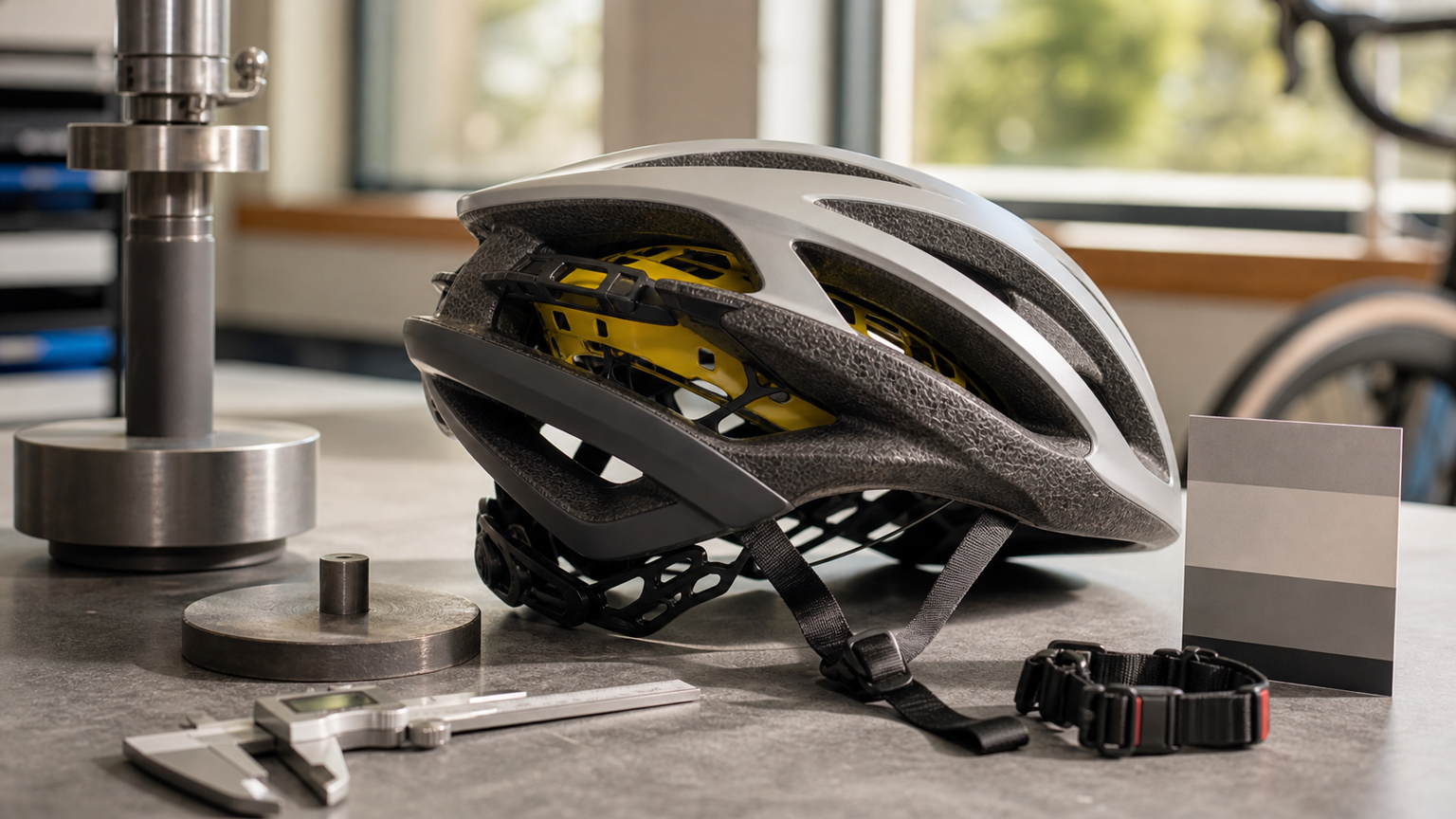
MIPS (Multi-directional Impact Protection System) is a helmet technology developed by Swedish researchers — not a certification mark — but in recent years it has become an important spec on high-end helmets:
- How it works: An additional low-friction sliding layer inside the helmet allows the helmet to shift 10–15mm relative to the head during an angled impact
- Protection goal: Reduces rotational forces that cause shearing injuries to the brain (research shows angled impacts are the most common pattern in real-world accidents)
- Weight impact: Adds roughly 25–35g to each helmet
- How to identify it: Look for a yellow sliding layer visible on the inside of the helmet
It’s worth noting that MIPS itself is not a safety certification — a helmet with MIPS still needs to pass CPSC or CE EN1078 to be considered compliant.
Key Buying Considerations for Taiwanese Riders
Taiwan’s hot summers (30–38°C) and rainy climate place special demands on helmets:
- Ventilation design: Wearing a closed helmet in Taiwan’s summer heat can easily lead to heat exhaustion — look for a design with at least 20 vents
- Straps and buckles: Straps tend to slip once you start sweating, so choose a model with adjustable buckles to keep the fit secure
- Replacement cycle: Helmets should be replaced every 3–5 years — even if the exterior shows no visible damage, the foam degrades over time and its protective performance drops significantly
- Replace immediately after an impact: After a crash, even if there’s no visible external damage, the internal foam structure has already been compromised and the helmet must be replaced
Practical Recommendations
- Buy from a reputable bike shop or well-known online platform, and avoid uncertified helmets of unknown origin
- An entry-level model with MIPS (roughly NT$2,500–4,000) is generally a better priority than a pricier model without MIPS
- Head shapes vary significantly, so trying the helmet on is essential — Asian Fit and Western fit models differ noticeably
- For long-distance rides (such as Wuling), consider a helmet weighing under 250g to reduce neck strain
- When checking certification, look directly at the printed marking or label inside the helmet rather than relying solely on box claims
Conclusion
Choosing a helmet shouldn’t come down to price or looks alone — certification standards are the real baseline for safety. CPSC and CE EN1078 represent the minimum threshold, while MIPS technology offers more comprehensive head protection, particularly against the angled impacts most common in real-world accidents. In Taiwan’s riding environment, ventilation and ease of strap adjustment matter just as much. Remember: a good helmet is the single most important investment you’ll make for cycling — it’s not the place to cut corners.
Related Reading
再快都跟的上!? 單車跟隨攝影機之王 HOVERAir X1 PROMAX 全面實測 / 唯一!8K畫質&自行車專用模式和跟蹤信標&前後避障 / DJI Neo 可參考/ 公路車 / CT Yeh
1 年前
全台首發!邁金P715踏板功率計!市場價格撼動者再出招 / 功率對比實測 / FAVERO ASSIOMA 可參考! / 公路車 / CT Yeh
1 年前
單車 一日北高 ( 雙城 ) 肥宅雙人瘋狂行 紀錄片 REACTO
10 年前
單車元宇宙新霸主?TrainingPeaks Virtual 實測 / Zwift 完美平替? 還是超越?/ 有台灣國旗!前身 indieVelo / 公路車 / CT Yeh
1 年前
下次拍照前要查清楚啦🤣 #cycling
7 個月前
Nepest NOVA 碳條輪組:輕量、空力、舒適一次滿足!/ 公路車 / CT Yeh
7 個月前
#公路車 台北 #風櫃嘴 23:47 全台單車實境請訂閱鎖定
7 年前
DJI Osmo 360 全球首發!單車適合嗎?深度體驗報告/ 大疆第一台全景相機 Insta360 瑟瑟發抖? / 公路車 / CT Yeh
1 年前