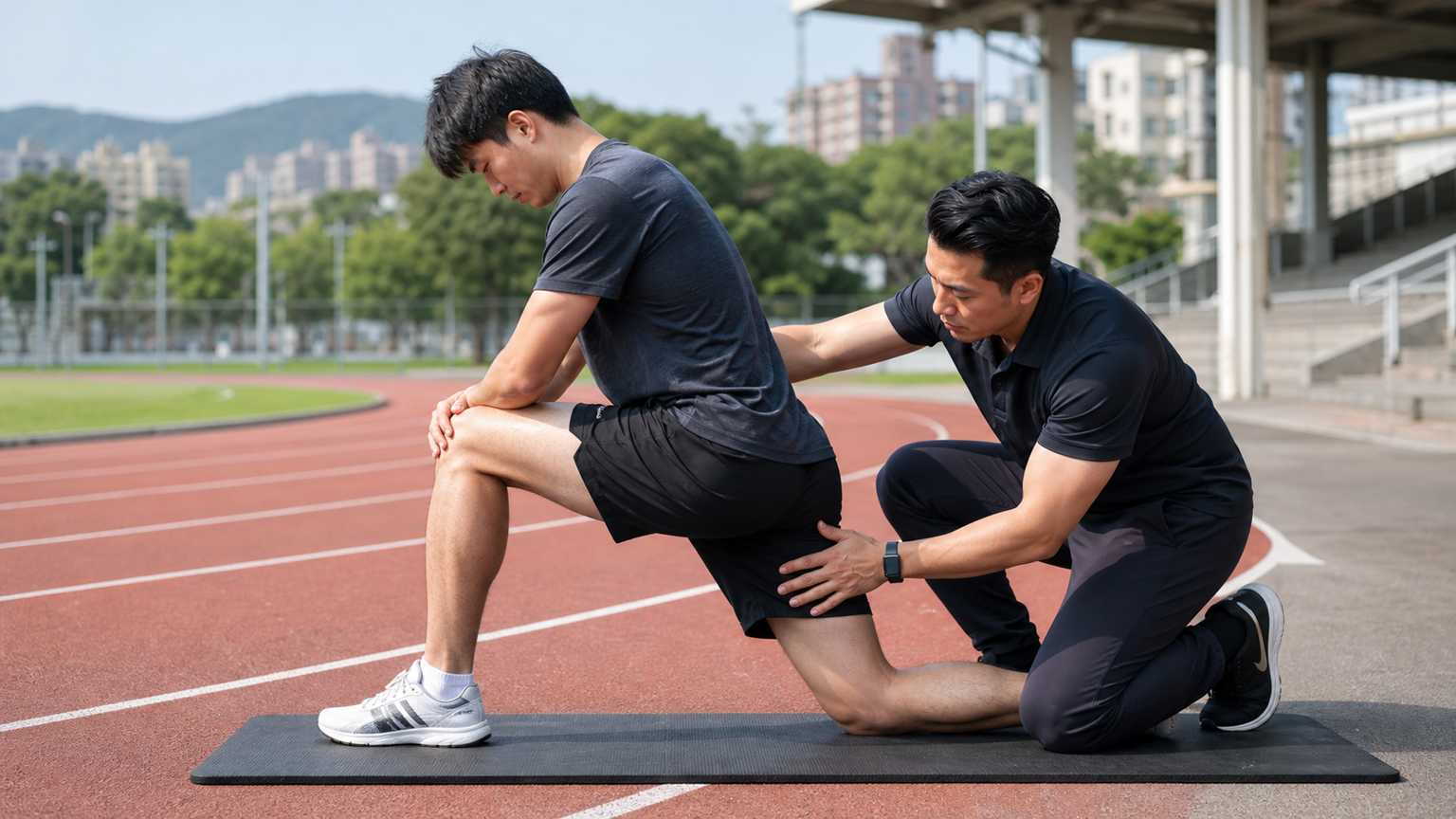
Introduction
In Taiwan’s middle-distance running and marathon circles, hamstring strains are more commonly seen in runners performing sprint training or speed intervals, and they are also the most recurrent injury among all sports injuries. Literature reports show that previously injured runners have a re-injury rate as high as 30–40%. Understanding proper assessment methods and rehabilitation strategies is crucial to avoiding the cycle of repeated injury.
Anatomy and Function
The hamstring muscle group consists of three muscles: the semimembranosus, semitendinosus, and the long head of the biceps femoris. These three muscles cross both the hip and knee joints and play the following roles during running:
- Late swing phase: Eccentric contraction (rapid lengthening) to decelerate the forward swing of the thigh
- Just before ground contact: Transition to eccentric contraction, bearing extreme tension
- Push-off phase: Assists hip extension, providing propulsive force
This “lengthened-then-contracted” eccentric working pattern is the root cause of strain injuries.
Injury Grade Assessment
| Grade | Severity | Symptoms | Estimated Recovery Time |
|---|---|---|---|
| Grade 1 (Mild) | Partial micro-tearing of muscle fibers | Mild soreness, normal walking | 1–2 weeks |
| Grade 2 (Moderate) | Extensive tearing of muscle fibers | Noticeable pain, swelling, altered gait | 4–8 weeks |
| Grade 3 (Severe) | Complete tear or avulsion from the ischium | Severe pain, significant loss of function, palpable gap | 3–6 months (possible surgery) |
Ischial avulsion fracture: More common in adolescents, when the ischial tuberosity apophysis has not yet fused; forceful contraction may pull off a bone fragment, requiring X-ray confirmation.
Acute Phase Management (Days 1–3)
PEACE & LOVE Principles (Replacing the Old RICE)
- P (Protection): Protect the injured area, reduce vigorous movement, but complete immobilization is not necessary
- E (Elevation): Elevate the affected limb to reduce swelling
- A (Avoid anti-inflammatory): Avoid anti-inflammatory medications (including NSAIDs) during the acute phase, as initial inflammation is a necessary stage of repair
- C (Compression): Use elastic bandages or compression tights to control swelling
- E (Education): Understand the injury and set reasonable recovery expectations
The later phase enters the LOVE stage:
- L (Load): Early appropriate loading to avoid prolonged immobilization
- O (Optimism): A positive mindset aids recovery
- V (Vascularisation): Non-impact aerobic exercise (swimming, cycling) promotes blood flow
- E (Exercise): Perform rehabilitation exercises according to grade
Graded Rehabilitation Plan
Early Stage (Weeks 1–2)
- After normal walking is restored, add light stretching (pain < 3/10)
- Isometric contractions: Prone knee flexion at 30 degrees, hold for 5 seconds against light fixed resistance, 5 sets total
- Water running: Perform running movement patterns in a reduced-gravity environment
Middle Stage (Weeks 3–6)
-
Nordic Hamstring Curl — currently the most evidence-based training for preventing recurrence:
- Kneeling position with heels anchored, slowly lean forward (eccentric) until falling, then catch with hands
- Start with 5 reps per set, increase weekly, target 3 sets × 12 reps
- Studies show it can reduce the future risk of hamstring strain by 50%
-
Romanian Deadlift: Hinge forward from the hips, feeling the hamstrings stretch, 3 sets × 12 reps
-
Prone Leg Curl: Using a machine or resistance bands, start with both legs then progress to single leg
Late Functional Training (After Week 6)
- Running technique drills: High knees, butt kicks, A-Skips, B-Skips
- Acceleration runs: Straight-line acceleration over 40m, initially limited to 70% of maximum speed, increasing by 10% each week
- Agility ladder drills: Direction changes to simulate the acceleration/deceleration demands of racing
Return-to-Running Criteria
Before performing speed work, the following tests must be passed:
- Single Leg Bridge: 15 reps, pain-free
- Nordic Hamstring Curl: Able to complete more than 5 reps, with strength asymmetry between injured and healthy sides < 10%
- 15-minute jog: Pain < 2/10, with no worsening the following day
Practical Prevention Recommendations
- Nordic hamstring curls twice per week are currently the most evidence-based prevention strategy and should be incorporated into routine strength training
- Warm up thoroughly before speed training: Include dynamic stretching and 4–5 progressive acceleration runs (50%→70%→90%) to gradually activate the muscle group
- Avoid speed training in a fatigued state: Only perform interval runs after adequate recovery
- Balance training volume and intensity: Do not increase both mileage and speed training within the same week
Conclusion
The high recurrence rate of hamstring strains stems primarily from two causes: returning to running too early and lacking targeted eccentric strengthening training. As long as Nordic hamstring curls are incorporated into the rehabilitation plan and return-to-running criteria are strictly followed, the vast majority of runners can safely return to the track and run more steadily than before the injury.
Related Reading
- Hamstring Strain in Basketball Players: An Analysis of Explosive Power Injuries
- Hamstring Strain Grading and Return-to-Running Timeline: The Most Complete Recovery Map After Muscle Tears
- Hamstring Injury Prevention: The Complete Protection Guide Every Runner Must Learn
- Hamstring Strain Rehabilitation: Research on the Protective Effects of the Nordic Hamstring Exercise
一日北高/長距離團騎 常見問題補充篇 / 組團或跟團的眉角 / 壯車友容易被瘦車友慢性拉爆 / 原來屁股痛可能是這個原因...? / 風場配速法 / 公路車 / CT Yeh
2 年前
摔車後補裝備: 好市多新款單車安全帽& Specialized Romin 北高整路屁股都不痛的坐墊 | 一千元居然有MIPS | CT Yeh | 公路車
4 年前
iPhone內建一秒變長腿🤣 車友必備#cycling
2 年前
西進武嶺 免費訓練分析服務 Intervals | 練不夠還是練過頭?你哪一種類型選手?AI模型告訴你! | 備戰神器 | 公路車 訓練 | CT Yeh
4 年前
[教學] Premiere 影片 手震 修正 教學 防抖 單眼 影像 GoPro 穩定 Video Stabilization
8 年前
戰略) Zwift Race 如何咬在第一集團 如何評估自己要開多少推力 (請開1.5倍速看)
7 年前
Never Stop 西進武嶺 前後雙機 完整全程錄影 訓練台 實境
8 年前
爬陡坡被爆胎的車友跑步超車 #cycling #里佳部落
9 個月前