Introduction
Leading a 10–20 person swim training group in a pool is relatively straightforward; however, conducting group training in open water requires more thorough safety planning and organizational structure. In recent years, Taiwan’s triathlon community has flourished, with more and more training teams hoping to conduct open-water training camps in Northeast Coast, Penghu, or Kenting, yet many teams lack a systematic organizational approach.
This article provides a complete organizational framework for open-water group training, from venue setup to workout design.
Escort Kayaker Roles and Configuration
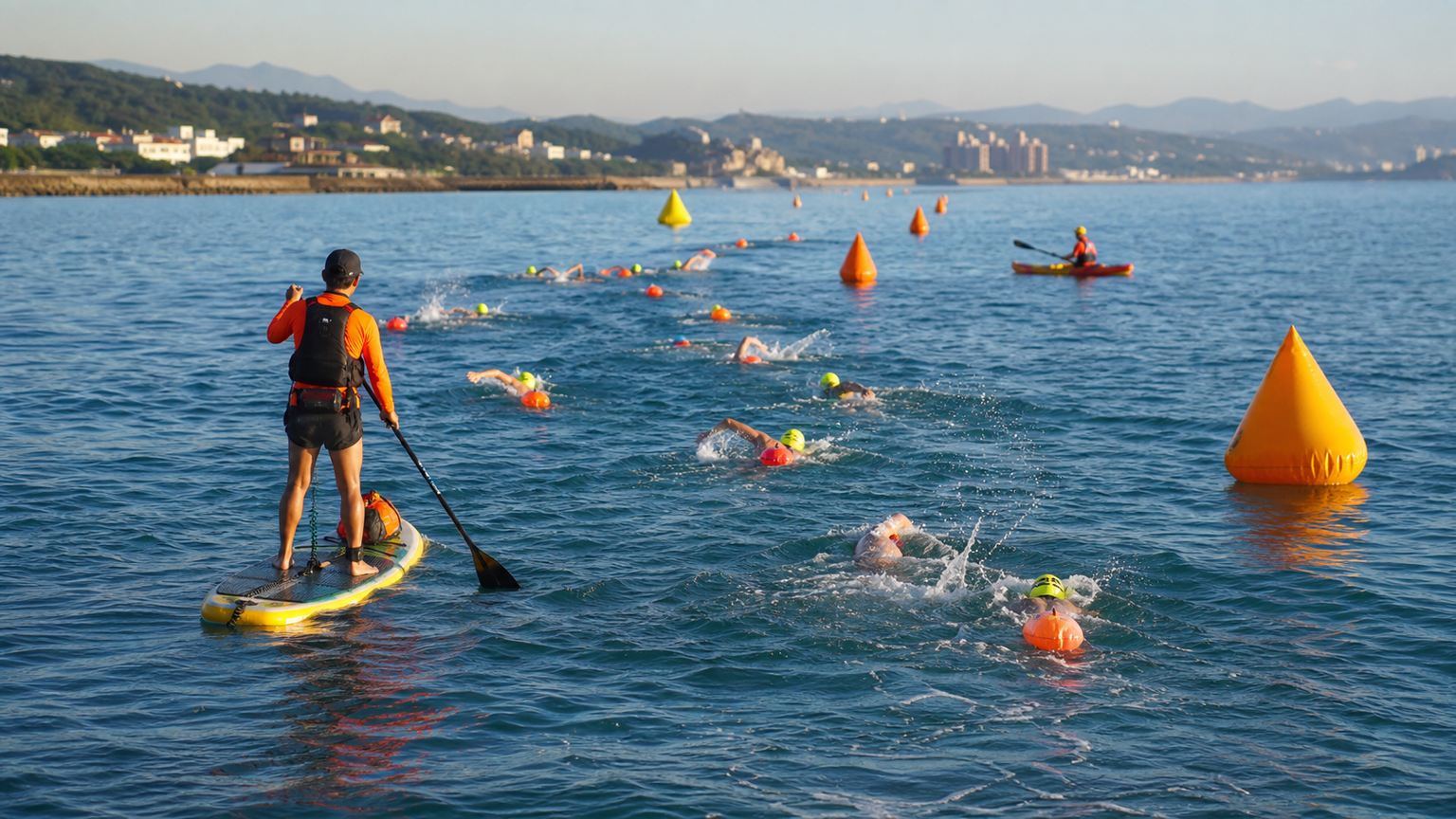
Escort kayakers (Escort Kayaker / Safety Spotter) are the safety core of open-water group training.
Personnel Configuration Principles
| Number of Trainees | Minimum Escort/Safety Personnel | Recommended Configuration |
|---|---|---|
| 1–5 people | 1 shore-based spotter | 1 swim escort + 1 shore-based |
| 6–15 people | 1 on-water (kayak or SUP) + 1 shore-based | 1 front + 1 rear + 1 shore-based |
| 16–30 people | 2 on-water + 1 shore-based | One on-water each at front, middle, and rear |
| 30+ people | 3 on-water + 2 shore-based | Recommend splitting into groups |
Escort Kayaker Equipment Requirements
- Watercraft: Inflatable kayak (most maneuverable), stand-up paddleboard (good visibility), rescue buoy with tow line
- Communication: Waterproof two-way radio (for shore contact), whistle
- First Aid Equipment: Waterproof first aid kit, spare swim cap (bright color)
- Observation Tools: Polarized sunglasses (to help spot swimmers through surface glare)
Marker Buoy Setup Techniques
Buoy Type Selection
- Race marker buoys: Large inflatable cone-shaped buoys, high visibility, suitable for race scenarios
- Training buoys: Medium inflatable buoys, easy to transport, equipped with anchoring systems
- Personal safety floats: Small inflatable floats carried by individual swimmers, dual-purpose
Setup Steps
- Site selection principles: Choose a location with no submerged rocks, uniform water depth, and a safe distance from shore
- Anchoring system: Use sandbag anchors (sand-filled type) or umbrella anchors fixed to the seabed
- Rope length calculation: Water depth + buoy height + 30% slack rope length (to prevent the buoy from sinking due to tidal changes)
- Color selection: Use orange or yellow for turning points (high visibility); different colors can be used for intermediate distance markers
- Distance setting: 100–200 meters between buoys for beginner training; 300–500 meters for advanced training
Route Setup Examples
Rectangular Route (1200 meters):
- Start from shore → 300m straight swim → right turn → 300m cross-swim → right turn → 300m return leg → right turn → 300m back to shore
- Requires 3 turning buoys
- Suitable for race simulation training
Out-and-Back Route (600–1000 meters):
- Start from shore → swim straight to the far buoy → circle the buoy and return
- Requires 1 far-end buoy
- Simple to manage, suitable for first-time group training
Open-Water Group Workout Design
Open-water training time is precious (affected by weather, tides, and location), so workouts need to be highly efficient:
Warm-Up (15–20 minutes)
- On-land dynamic stretching and shoulder activation
- After entering the water, swim 200–400 meters along the shore (to familiarize with water conditions)
- Brief instruction confirmation: sighting signals, emergency assembly signals, and the day’s current direction briefing
Main Workout (40–60 minutes)
Choose based on training goals:
- Technique training day: Low-intensity swimming, standing (or treading water) after each set to receive feedback, repeating sighting drills and breathing rhythm
- Endurance training day: Continuous swimming for 30–50 minutes, maintaining target heart rate at 65–75% of max heart rate
- Speed training day: 8–10×200 meters, 30-second rest intervals, targeting 85–90% intensity
- Race simulation day: Swim the preset distance (1500 meters or race distance) at full effort, with timing recorded
Cool-Down (10–15 minutes)
- Easy swimming for 200–300 meters (active recovery)
- Group feedback after exiting the water: issues observed today, focus points for tomorrow
Emergency Response Procedures
All escort kayakers and team members should know before entering the water:
- Emergency assembly signal: Three short whistle blasts; everyone immediately swims toward the nearest escort kayaker or the shore
- Signal for assistance: Continuously waving one arm (waving overhead)
- Nearest emergency resources: 119 phone number, location of the nearest medical facility
- Division of duties: Who makes the phone call, who performs the water rescue, who maintains order among the other athletes
Taiwan Venue Application and Regulations
Some beaches and waters in Taiwan require usage permits; it is recommended to:
- For managed bathing beaches (e.g., Fulong): Contact the management unit in advance to obtain permission
- For natural bays (e.g., Longdong): Notify the local Coast Guard detachment, reporting the number of trainees and training times
- For Penghu waters: Contact the Penghu County Government or the local maritime rescue association
Conclusion
Organized open-water group training is one of the most efficient ways to improve athlete skills, and it is also a necessary condition for ensuring training safety. By investing time in planning escort kayaker configuration, marker buoy setup, and emergency response procedures, your training team can continue to grow safely in Taiwan’s marine environment.
Related Reading
- Team Training in Open-Water Swimming: Pacing Groups and Protection Strategies
- Open-Water Safety: Lifeguard Deployment, Signal Buoys, and Emergency Response
- Open-Water Safety Regulations: Taiwan Venues, Lifeguard Configuration, and Swim Escort Rules
- Triathlon Swim Training: Overcoming Fear and Improving Efficiency in Open Water
新屋團體繞圈賽 | 眾多菁英好手賽道奔馳 | 千瓦女子軍團 | 無敵交管狂獲好評 明年你一定不能錯過 | #公路車
5 年前
2023桃園團體繞圈賽/環台賽等級拍攝/賽事精華/ 10人一隊缺一不可!50隊廝殺大場面 / 第三屆 海鷗繞圈賽 /公路車/CT Yeh
2 年前
備戰 戀戀197 賽前關門點分析 西濱團練 #公路車 4K高畫質
6 年前
FTL 與 SYB 車隊專訪 西進武嶺 實用攻略分享! 2小時 如何練?!你不知道的眉角!新手準備武嶺必看 EP1 | 實力派女車友 | 精華版 | 公路車 | CTYeh
4 年前
一日北高/長距離團騎 常見問題補充篇 / 組團或跟團的眉角 / 壯車友容易被瘦車友慢性拉爆 / 原來屁股痛可能是這個原因...? / 風場配速法 / 公路車 / CT Yeh
2 年前
西進武嶺 免費訓練分析服務 Intervals | 練不夠還是練過頭?你哪一種類型選手?AI模型告訴你! | 備戰神器 | 公路車 訓練 | CT Yeh
4 年前
一起升級!海鷗盃LSD團練...JJSC Zone2招待 騎到手抖 / 公路車 / CT Yeh
1 天前
2025 海鷗團體繞圈賽 網路直播 超激烈裁判長視角 / EIPC 李廷威、Waypoint 等眾多高手競爭 / feat. 卡密兒主持 / 海鷗繞圈賽
9 個月前