Introduction
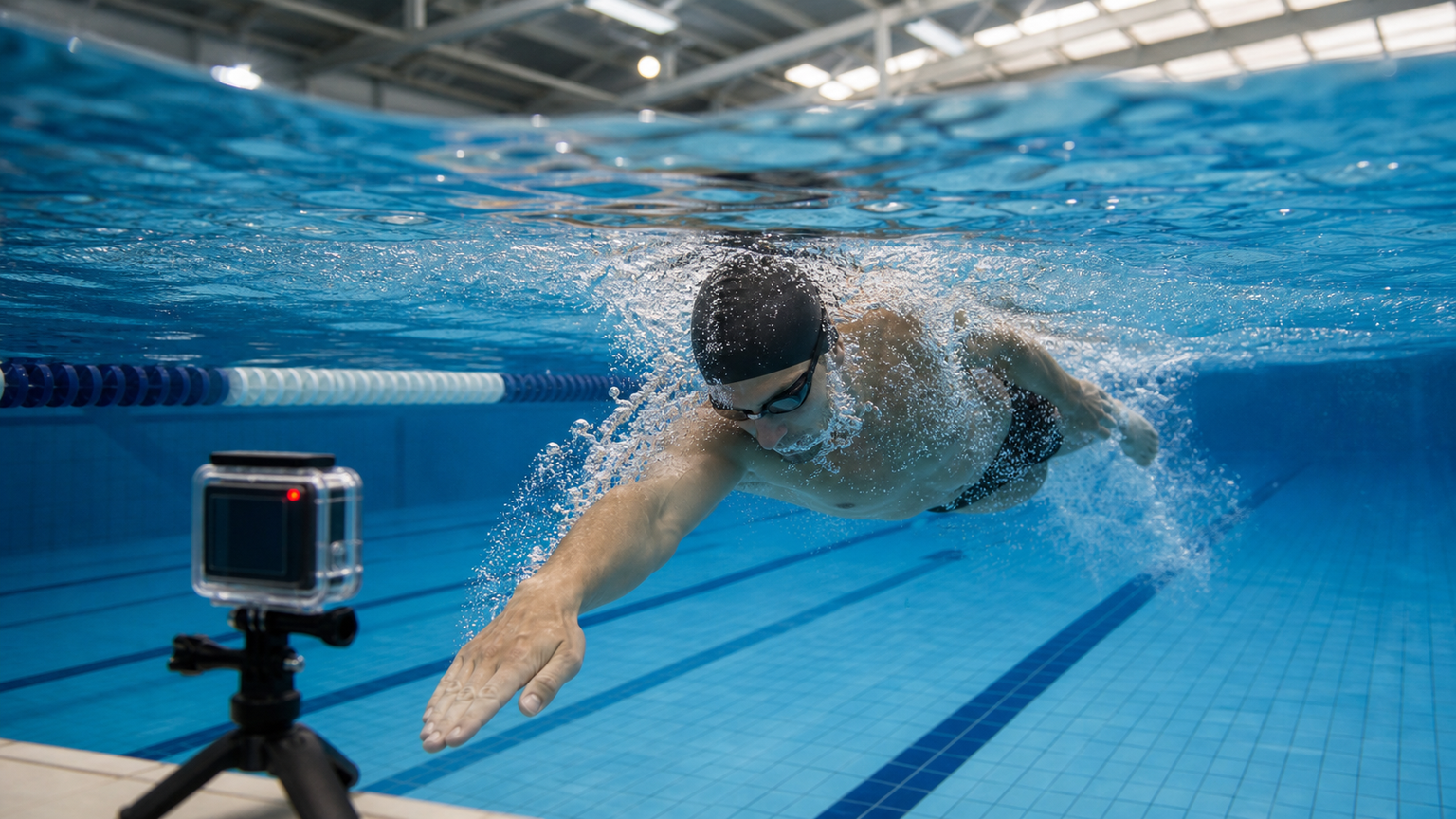
Swimming is a sport performed underwater, and athletes cannot adjust their movements by looking in a mirror or observing themselves mid-action like runners or cyclists can. Underwater video provides a “spectator’s perspective,” allowing athletes to see what they actually look like while swimming—which often comes as a shock: “I thought I was doing a high-elbow catch, but it turns out my elbow was completely dropped!” This gap between “feeling” and “reality” is a crucial breakthrough point for improving swimming technique.
Underwater Filming Equipment and Setup
Equipment Selection
| Equipment Type | Budget Range | Pros and Cons |
|---|---|---|
| GoPro waterproof action camera | NT$5,000–15,000 | Good image quality, but requires a pool mount |
| Smartphone + waterproof case | NT$500–2,000 | Inexpensive, but waterproof case quality varies greatly |
| Pool-specific underwater camera rig | NT$2,000–5,000 (including mount) | Fixed angle provides stability, ideal for repeated analysis |
| Have a teammate hold the camera | Free | Highly flexible, but footage stability is poor |
Recommended Filming Angles
Different angles can reveal different technical issues:
- Direct side view (underwater): Observe body horizontal position, kick depth, and arm entry angle
- Direct front view (underwater): Observe left-right symmetry of the pull and entry width
- Direct rear view (underwater): Observe kick rhythm and leg action
- Above the water (overhead view): Observe stroke rhythm and degree of body snake-like weaving
- Side view (surface): Observe breathing height and head position
Key Observation Checklist
Freestyle Underwater Analysis Focus Points
Entry and Extension:
- Is the hand entry position in front of the shoulder line? Does it cross the midline?
- Is there sufficient forward extension after entry?
Catch Phase:
- Is the elbow higher than the wrist (high-elbow catch)?
- Can the forearm become vertical and press backward after the catch?
Finish of the Pull:
- Does the pull extend fully down to the thigh?
- Is there an outward thumb rotation during the exit?
Body Position:
- Is the waist maintained level?
- Is the hips sinking?
- Does the head position allow the water surface to cut across the middle of the forehead?
Kicking:
- Does the kick originate from the hips?
- Are the ankles relaxed?
- Is the kick depth within a reasonable range (toes no deeper than 35 cm)?
Step-by-Step Video Analysis Method
Step 1: Watch at Normal Speed
First, watch at normal speed to get a feel for the overall rhythm and fluidity, and note any issues you “feel” are present.
Step 2: Slow-Motion Analysis
Use 0.25x speed to analyze frame by frame, focusing on the following moments:
- The instant of hand entry
- The deepest point of the catch
- The completion point of the pull
- The highest point of head rotation during breathing
Step 3: Compare with Reference Footage
Select footage of world-class athletes or top Taiwanese swimmers with a similar build to yours for comparison. YouTube has a wealth of usable material.
Step 4: Prioritize Improvements
A single video analysis usually reveals multiple issues. Recommendations:
- Choose only 1–2 of the most critical issues to improve first
- Prioritize issues that cause the greatest loss of speed
- Do not attempt to fix too many things at once, or your movement coordination may break down
Underwater Filming Resources in Taiwan
- National Sports Training Center (Zuoying): Equipped with a professional underwater camera system, available for national team and development squad athletes
- University swim teams: Some schools (such as NTU, NTNU, and NSYSU) have underwater filming equipment
- Commercial swim clubs: Some high-end swimming instruction organizations offer paid underwater video analysis services
- Self-filming: Using a GoPro mounted on the poolside guardrail is the most common method of self-analysis
Recommended Video Analysis Tools
- Coach’s Eye (App): Professional sports analysis app, supports slow motion and drawing annotations
- Dartfish (Desktop software): Professional grade, commonly used by Taiwan national team coaches
- iMovie / CapCut: Free tools, suitable for basic slow-motion analysis
- YouTube: You can upload videos as “unlisted” for easy sharing with remote coaches
Practical Advice
It is recommended to conduct a systematic underwater video analysis every 4–6 weeks, rather than filming at every practice session. When filming, choose a pace that makes the movements clearly visible (slightly slower than maximum speed); at too high a speed, the details become difficult to discern. Immediately after the analysis, record 2–3 improvement focus points in a notebook or on your phone, and review them before the next practice session, forming a positive cycle of “film → analyze → improve → film again.”
Conclusion
Underwater video is the most powerful self-coaching tool for swimmers. In situations where a professional coach is not available for constant guidance (which is the reality for most amateur swimmers in Taiwan), regular video self-analysis can substitute for a coach’s eyes, giving technical improvement an objective basis rather than relying purely on feel. Make good use of this tool, and your swimming technique will progress with greater direction and a sense of accomplishment.
Related Reading
- Self-Analysis of Swimming on Video: Technical Diagnosis Methods for Above- and Underwater Filming
- Swimming Technique Video Analysis: Using Your Phone to Identify Technical Flaws
- Swimming Video Analysis: Key Observation Points for Above- and Underwater Filming
- Video Training for Swimmers: Practical Applications of Underwater Video Analysis
[教學] Premiere 影片 手震 修正 教學 防抖 單眼 影像 GoPro 穩定 Video Stabilization
8 年前
教學) 如何做出專業 慢動作 影片 Slow Motion 120fps GoPro 7 ActionCam AX700 A99II
7 年前
如何把 GoPro 影片 翻轉 批次 轉正?
6 年前
Rouvy 影片路線製作及上傳 教學
6 年前
類空拍神器 Feiyu Pocket 2s (有優惠連結)三軸穩定 運動攝影機 開箱!比GoPro 還強的滑順視角!三小時長時間錄影 行車記錄器 | 環花東365實測 | 公路車 CT Yeh
4 年前
[八甲田滑雪] 攝影器材介紹篇 DJI OSMO Mavic Pro ActionCam X3000 Insta360
7 年前
CT 喇低賽) 單車 比賽總是沒照片? 攝影師的觀點大公開 姿勢就是力量! 請加速1.25倍收看
7 年前
iPhone 13 Pro 電影級 VLOG 實拍測試!優缺點 原理分析! 夜間效果對決 GoPro10!蘋果沒有說的超強錄影體驗!? | CT Yeh
4 年前