Introduction
Protein intake is one of the most overlooked variables in a swimmer’s training program. Many athletes eat by intuition, neither understanding their own protein requirements nor knowing the protein content of various foods, leading to chronic insufficient protein intake that compromises muscle recovery and competitive performance. This article provides a scientific method for calculating daily protein needs, helping Taiwanese swimmers establish personalized protein intake strategies.
Protein Requirement Benchmarks for Swimmers
The daily protein requirement for the general adult population is approximately 0.8 grams per kilogram of body weight (RDA standard), but swimmers who train regularly require significantly more. According to sports nutrition research:
- Recreational swimmers (training 2–3 times per week): 1.2–1.4 g per kilogram of body weight
- Competitive adolescent swimmers: 1.4–1.7 g per kilogram of body weight
- Adult competitive swimmers (daily training): 1.6–2.0 g per kilogram of body weight
- High-intensity race preparation period: 1.8–2.2 g per kilogram of body weight
Calculating Daily Protein Needs by Body Weight
| Body Weight (kg) | Recreational Swimmer (1.3g/kg) | Competitive Athlete (1.8g/kg) | Race Preparation (2.0g/kg) |
|---|---|---|---|
| 45 kg | 58.5g | 81g | 90g |
| 55 kg | 71.5g | 99g | 110g |
| 65 kg | 84.5g | 117g | 130g |
| 75 kg | 97.5g | 135g | 150g |
| 85 kg | 110.5g | 153g | 170g |
High-Protein Food Sources in Taiwan
Knowing the protein content of various foods is essential for effectively planning your daily diet:
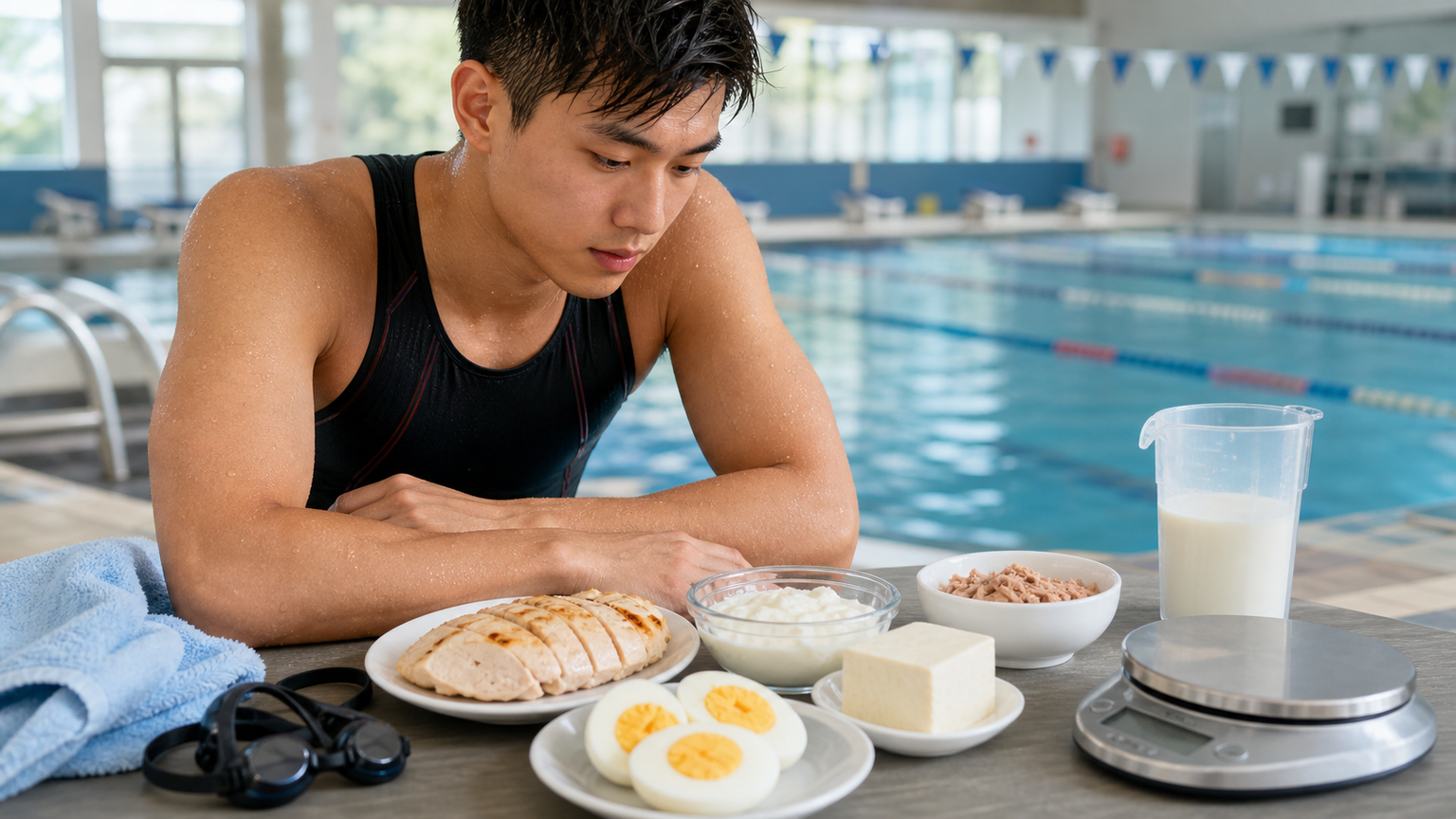
- Chicken breast (100g): Approximately 31g of protein, the most widely available high-protein food in Taiwan
- Canned tuna (100g): Approximately 25–28g of protein, convenient to carry and affordable
- Tofu (firm tofu, 100g): Approximately 8g of protein, suitable for vegetarian athletes
- Eggs (1 egg): Approximately 6–7g of protein, with high bioavailability
- Low-fat milk (240ml): Approximately 8g of protein, also provides calcium
- Unsweetened Greek yogurt (150g): Approximately 15g of protein, contains probiotics
- Edamame (100g, shelled): Approximately 13g of protein, a common plant-based protein source in Taiwan
- Salmon (100g): Approximately 25g of protein, also provides Omega-3
Strategies for Spreading Protein Intake
Research shows that protein intake should be distributed across multiple meals throughout the day rather than concentrated in a single meal. The upper limit of protein intake per meal is approximately 30–40 grams (beyond this amount, excess amino acids are metabolized rather than used for muscle synthesis):
- Breakfast: Soy milk + 2 tea eggs → approximately 20–25g
- Lunch: Chicken leg rice (skin removed) → approximately 30–35g
- Post-training snack: Unsweetened yogurt + banana → approximately 15g
- Dinner: Tofu and salmon miso soup + white rice → approximately 25–30g
- Before bed: Low-fat milk 240ml → approximately 8g
Total daily protein amounts to approximately 98–113g, suitable for competitive swimmers weighing 60–65 kg.
The Impact of Training Volume on Protein Requirements
The greater the training volume, the higher the degree of muscle damage, and protein requirements increase accordingly:
- For every additional 1000m of daily swimming training volume, protein needs are estimated to increase by approximately 5–10g
- High-intensity interval training (e.g., 400m × 8 sets) depletes more protein than slow swimming over the same distance
- Athletes doing double sessions (two workouts per day) need to pay special attention to protein replenishment between the two sessions
Practical Recommendations
- Use a mobile app (such as MyFitnessPal) to log your diet and understand your baseline daily protein intake
- Prioritize whole food sources; supplements (whey protein powder) serve as an aid when dietary intake is insufficient
- Plant-based proteins (legumes, tofu) have slightly lower bioavailability; vegetarian athletes may moderately increase their intake
- Protein needs are linked to total calorie intake; avoid drastically cutting protein during weight-loss dieting
- If you cannot reach your target intake through regular meals, whey protein powder is the most cost-effective supplement option
Conclusion
Protein is the foundational material for a swimmer’s training adaptation. Scientifically calculating and planning daily intake is a key step toward improving training effectiveness. Taiwan’s abundant food options provide diverse high-protein sources—athletes don’t need to rely on expensive imported supplements. By making good use of chicken breast, tofu, eggs, and dairy products, swimmers can easily meet their daily protein targets to support sustained high-intensity swim training.
Related Reading
- Protein Needs for Swimmers: Recommended Intake per Kilogram of Body Weight
- Protein Supplementation for Swimmers: Per-Meal Distribution Strategies for Muscle Synthesis
- Daily Caloric Needs for Swimmers: Differences Between High and Moderate Training Volumes
- Weight Management for Swimmers: Maintaining Competitive Weight Without Losing Muscle
CT暗黑廚房) 車友必備 宇宙無敵鮮蚵湯 幫助訓練恢復 天然食補 好市多 超肥鮮蚵 破PR
7 年前
西進武嶺 免費訓練分析服務 Intervals | 練不夠還是練過頭?你哪一種類型選手?AI模型告訴你! | 備戰神器 | 公路車 訓練 | CT Yeh
4 年前
靠單車減肥35公斤 心得分享與整理
7 年前
一日北高常見問題大集合 | 攻略 | 路線 | 訓練 | 補給 | 自行車 單車 | 一日雙城 | 雙塔 | TWB北高360 | 屁股痛
6 年前
一日北高/長距離團騎 常見問題補充篇 / 組團或跟團的眉角 / 壯車友容易被瘦車友慢性拉爆 / 原來屁股痛可能是這個原因...? / 風場配速法 / 公路車 / CT Yeh
2 年前
一日北高前的高裝檢 | 北高 360 | 挑戰11小時的裝備 | 一日雙塔 | 補給
6 年前
#公路車 #Vo2Max #最大攝氧量 測驗 體驗 | 心肺測試
6 年前
16/02/16 - 夜訪中社路 緩慢進步中
10 年前