Introduction
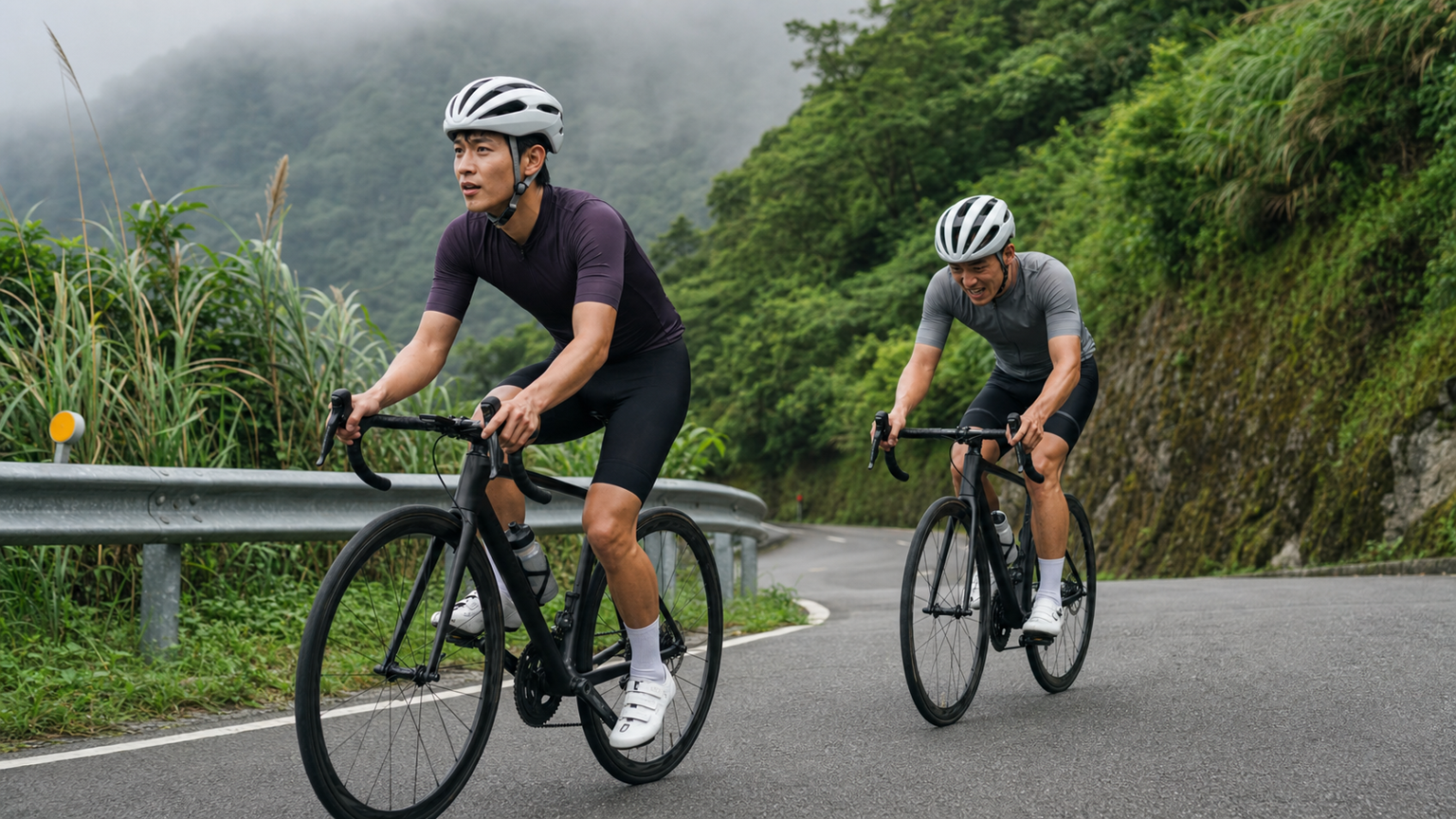
On Taiwan’s climbing routes—whether it’s the Provincial Highway 14A at Wuling, the Yangjin Road on Yangmingshan, or the Beiyi Highway in Wulai, New Taipei—you’ve surely observed an interesting phenomenon: some riders spin a brisk high cadence as they ascend slowly, while others grind forward step by step with a heavy low cadence. The two styles are completely different, but which one is more efficient? The answer isn’t black and white; it depends on physiological conditions, gradient profiles, and individual training backgrounds.
The Physiological Mechanism of High-Cadence Climbing
High cadence is generally defined as pedaling above 80 revolutions per minute. In a climbing context, high cadence means choosing a smaller gear ratio (a lighter chainring or a larger cassette cog), reducing the resistance of each pedal stroke, and maintaining power output through frequency.
From a physiological perspective, high cadence primarily relies on slow-twitch muscle fibers (Type I), which have the following characteristics:
- High aerobic metabolic capacity, efficiently utilizing fat and glycogen for energy
- Resistant to fatigue, suitable for sustained effort over long durations
- Relatively low heat production, delaying the rise in core body temperature
- Low lactate production rate, keeping blood lactate levels stable
For riders with a solid aerobic base but relatively weaker quadriceps strength, high cadence allows the heart and respiratory system to take on more of the workload, while the muscles avoid entering the anaerobic metabolic zone prematurely.
The Physiological Mechanism of Low-Cadence Climbing
When climbing at a low cadence (generally below 70 RPM), riders choose a heavier gear ratio, requiring greater force with each pedal stroke. This approach heavily recruits fast-twitch muscle fibers (Type II), particularly Type IIa.
Physiological characteristics of low-cadence climbing:
- Each pedal stroke generates higher muscle tension, approaching the stimulus of strength training
- Fast-twitch muscle fibers have poorer fatigue resistance, accelerating acidification during prolonged riding
- The instantaneous load on the cardiorespiratory system is relatively lower, but the muscles bear greater stress
- Requires a stronger strength foundation, particularly in the quadriceps and gluteus maximus
| Comparison Item | High Cadence (>80 RPM) | Low Cadence (<70 RPM) |
|---|---|---|
| Primary Muscle Fibers | Slow-twitch (Type I) | Fast-twitch (Type IIa/b) |
| Cardiorespiratory Load | Higher | Lower |
| Muscle Tension | Low | High |
| Lactate Production | Slow | Faster |
| Suitable Gradient | Gentle to moderate climbs (3–8%) | Short sprints or steep climbs (>10%) |
| Suitable Distance | Long climbs (>10 km) | Short climbs (<3 km) |
Finding Your Optimal Cadence
Research shows that the optimal cadence for trained road cyclists during climbs typically falls between 70–85 RPM. This range balances the burden on muscles and the cardiorespiratory system, preventing premature fatigue.
However, the optimal cadence varies from person to person. The following factors influence your best choice:
- Aerobic Base: The higher a rider’s VO2max, the better they can tolerate the cardiorespiratory stress of high cadence
- Strength Level: Riders with strong lower-limb strength can maintain efficiency even at low cadence
- Gradient: When the gradient exceeds 10%, low cadence is usually more biomechanically appropriate
- Stage Length: On long climbs like the eastern approach to Wuling exceeding 40 kilometers, preserving cadence is key
Practical Recommendations
- Early stages of a long climb: Use 75–85 RPM as a baseline to avoid prematurely depleting fast-twitch fibers
- When hitting steep sections (>10%): Briefly drop to 60–70 RPM, combined with out-of-the-saddle pedaling
- Final push to the summit: Increase cadence to 90+ RPM to unleash remaining reserves
- Training advice: Schedule one “low-cadence climbing session” per week (55–65 RPM, maintained for 20 minutes) to strengthen muscular power; simultaneously incorporate high-cadence practice to improve neuromuscular coordination efficiency
Conclusion
High cadence and low cadence are not opposites but complementary tools. Understanding the physiological mechanisms behind both allows you to make smart strategic choices on the climbs of Yangjin, Beiyi, or Wuling. It’s recommended to use a bike computer to record heart rate and power at different cadences; over time, you’ll discover your own optimal climbing rhythm.
Related Reading
- Climbing Cadence Selection: The Muscle Group Impact of High Cadence vs Low Cadence Climbing
- Small Gear High Cadence vs Big Gear Low Cadence: The Scientific Choice of Climbing Cadence
- Cadence Strategy for Climbing: High Cadence vs Low Cadence Choices in the Mountains
- Climbing Cadence vs Big Gear Ratio: Timing the Decision Between Seated and Standing
一日北高常見問題大集合 | 攻略 | 路線 | 訓練 | 補給 | 自行車 單車 | 一日雙城 | 雙塔 | TWB北高360 | 屁股痛
6 年前
一日北高/長距離團騎 常見問題補充篇 / 組團或跟團的眉角 / 壯車友容易被瘦車友慢性拉爆 / 原來屁股痛可能是這個原因...? / 風場配速法 / 公路車 / CT Yeh
2 年前
如果Pogačar騎西進武嶺可以多快?會破2嗎?各種情況深度推估探討 / 公路車 / CT Yeh
2 年前
單車 一日北高 ( 雙城 ) 肥宅雙人瘋狂行 紀錄片 REACTO
10 年前
大武山後門26%歡樂陡坡!JJSC南台灣單車行Day2 / 被颱風追著跑 / 公路車 / CT Yeh
2 年前
單車 梅山36灣 坡度介紹 路段介紹 空拍 (相關遊記影片,請參考說明或我的頻道喔,歡迎訂閱)
6 年前
公路車 爬坡 破PR 紀錄 小技巧 分享
6 年前
台北闊瀨陡坡 騎旅 / 日本單車雜誌編輯車友臨時加入!/ 髮香才是最強的 / feat. 北迴歸線小隊 / 公路車 CT Yeh
6 個月前