Introduction
Taiwan’s plum rain season runs from March to June each year, and the typhoon season spans May to October. Combined with the hot, humid microclimate of basin-shaped cities (like Taipei), Taiwanese marathon runners face climate challenges rarely seen elsewhere in the world. Although major marathons are mostly concentrated in autumn and winter (October–March), the training period inevitably spans the hot summer months, while spring races (such as the Wan Jin Shi Marathon in March) happen to fall within the period affected by the plum rain front. Understanding how weather affects running physiology and preparing coping strategies in advance is essential local knowledge for Taiwanese runners.
Effects of High Heat and Humidity on Running Physiology
When temperatures exceed 20°C and humidity surpasses 70% (the norm in Taiwan’s summer), the physiological cost of running rises sharply:
| Environmental Conditions | Impact on Running | Recommended Pace Adjustment |
|---|---|---|
| 25°C / 60% RH | Mild impact, increased sweating | Slow down 0–5"/km |
| 28°C / 70% RH | Heart rate rises 5–8 bpm at same pace | Slow down 10–15"/km |
| 30°C / 80% RH | Reduced cooling efficiency, increased oxygen consumption | Slow down 20–30"/km |
| 32°C / 85%+ RH | Significantly higher risk of heat exhaustion | Strongly advised to move indoors or drastically reduce pace |
In high-humidity environments, the body relies primarily on sweat evaporation for cooling, but the evaporation efficiency in humid air is extremely low, causing body temperature to rise and heart rate to increase compensatorily—the same aerobic output requires more oxygen consumption.
Plum Rain Season Training Strategies (March–June)
Weighing Temperature vs. Rainfall
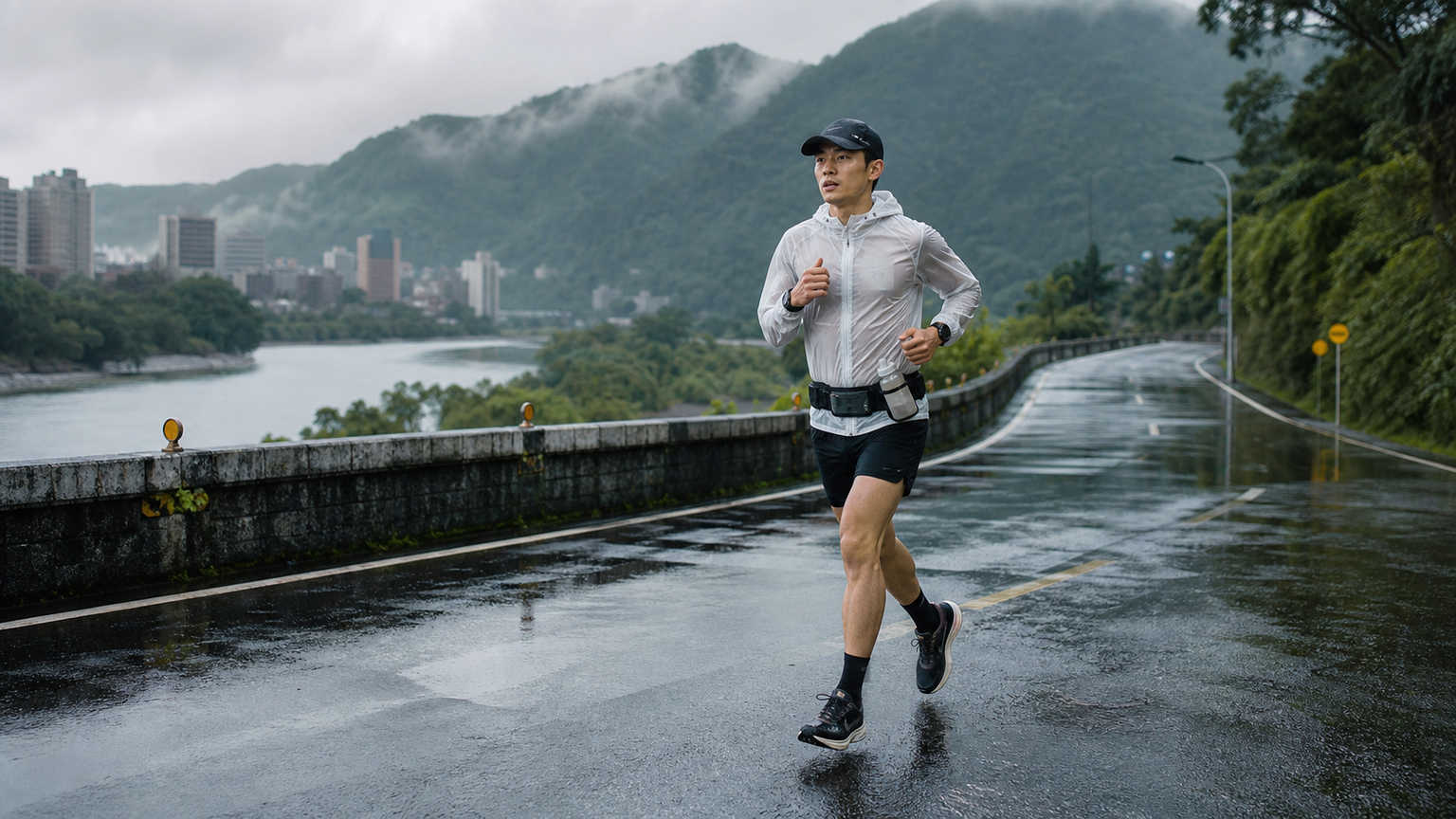
During Taiwan’s plum rain season (May–June), temperatures typically range from 24–30°C, accompanied by intermittent heavy rainfall. Training strategy adjustments:
- Rain is not the obstacle—heat is: Running in light rain can actually help cool you down, making it more suitable for training than a sunny 30°C scorcher. Just prepare a waterproof cap brim (to shield rain from your face) and a non-absorbent thin long-sleeve top
- Adjust your stride for slippery roads: When roads are waterlogged during the plum rain season, shorten your stride by 5–10% and extend foot-ground contact time to avoid side-slip injuries
- Lightning and thunder require immediate cessation: Thunderstorms are frequent during Taiwan’s plum rain season. If you hear thunder, find indoor shelter within 30 seconds—running outdoors in thunderstorm conditions poses real danger
Upgraded Electrolyte Replenishment During Plum Rain Season
In high humidity, sweat evaporation efficiency is low, but sweat volume does not decrease—it may even increase, with sodium loss reaching 1000–1500mg per hour. For training sessions exceeding 60 minutes:
- Replenish with electrolyte-containing drinks every 30 minutes (not plain water)
- Take salt tablets (available at regular pharmacies): 1 tablet every 45–60 minutes
- Check urine color after long runs: if dark yellow, hydrate immediately; if colorless, you may have consumed too much plain water and need electrolytes
Post-Typhoon Race Preparation (1–3 Days After a Typhoon)
Taiwan’s autumn races (October–November) occasionally coincide with weather conditions right after a typhoon has departed. Organizers usually do not cancel the race, but runners need special preparation:
Course Condition Assessment:
- Within 24 hours after a typhoon, the course may have standing water, fallen branches, and mud
- Check official race announcements before departure; some courses may be shortened or rerouted
- Wear training shoes with stronger grip rather than carbon-plated racing shoes (ultra-thin soles are unsuitable for slippery surfaces)
Pace Advantage from Weather Characteristics:
Post-typhoon conditions typically bring cooler temperatures and lower humidity (especially after the northeast monsoon arrives), making this Taiwan’s most ideal autumn marathon weather. Runners should seize the opportunity:
- At 12–18°C with humidity < 60%: running 5–10"/km faster than normal pace is feasible
- However, post-typhoon barometric pressure changes may affect perceived fatigue, so hold your pace ceiling through the first 10K
Handling Weather Fluctuations at Taiwan’s Spring Marathons (March)
The Wan Jin Shi Marathon (third week of March) is Taiwan’s most prominent international spring event, but northern spring weather is highly unstable:
- Worst case: Strong winds (northeast monsoon gusts > force 7) + low-temperature rain—wear a windproof vest and gloves
- Best case: Clear skies, 15–18°C—the perfect day for a PR
- Mindset: Accurate weather forecasts are only available 5 days before the race; don’t alter your training plan prematurely based on weather forecasts. Only confirm the weather 2 days before the race and adjust your gear checklist accordingly
Pace Strategy in Strong Winds:
- Actively slow down on headwind sections, controlling intensity by heart rate rather than GPS pace (heart rate rises at the same pace when running into headwinds)
- Make up time on tailwind sections, using the wind to accelerate but without overexerting
- A common mistake among Taiwanese runners: forcing pace into headwinds → collapsing in the second half
Practical Recommendations
- Deliberately train in bad weather: Occasionally complete workouts in plum rain or windy conditions to accustom your body and mind to “non-perfect conditions,” so race day weather won’t disrupt your rhythm
- Have an indoor backup plan: Rather than forcing outdoor training in typhoon weather, switch to treadmill for intensity workouts—Taiwan’s major cities have ample treadmill resources at public sports centers
- Race-day emergency pace reduction rule: If the temperature exceeds 25°C at the start, slow your target pace by 5 seconds for every additional 1°C—this isn’t admitting defeat, it’s letting your training fully pay off
Conclusion
Weather is an unavoidable variable for Taiwanese runners, but it is also the best training ground for building adaptability. Every long run completed in the plum rain, every effort to hold pace on post-typhoon roads, quietly strengthens your confidence to face any weather on race day. Prepare your gear—rain or shine, just go.
Related Reading
- Effects of Taiwan’s Summer Heat on Pace: Pace Adjustments During the Heat Acclimation Period
- Compensating for Speed Loss in Hot Weather: Pace Adjustment Strategies for Taiwan Summer Training
- Weather Strategies for Road Races: Adjusting for Rain, Heat, and Strong Winds
- Running in Taiwan’s Summer Heat: Training Strategies for 33°C Conditions
雨戰! 西進武嶺員工旅遊 加料 各路段大數據分析 | 同事端出5公斤的公路車來挑戰!? EP1
4 年前
下雨天就是要改車 #ceramicspeed #bike
1 年前
CT暗黑廚房) 車友必備 宇宙無敵鮮蚵湯 幫助訓練恢復 天然食補 好市多 超肥鮮蚵 破PR
7 年前
大武山後門26%歡樂陡坡!JJSC南台灣單車行Day2 / 被颱風追著跑 / 公路車 / CT Yeh
2 年前
單車 一日北高 ( 雙城 ) 肥宅雙人瘋狂行 紀錄片 REACTO
10 年前
微雨戰! 2022桃園市長盃錦標賽 無敵交管 沒來玩太可惜了! 羅馬公路太可怕 差點成佛! 公路車 | CT Yeh
4 年前
一日北高/長距離團騎 常見問題補充篇 / 組團或跟團的眉角 / 壯車友容易被瘦車友慢性拉爆 / 原來屁股痛可能是這個原因...? / 風場配速法 / 公路車 / CT Yeh
2 年前
Live) 備戰2019彰化經典百K 賽前攻略 (已完賽請看新影片
7 年前