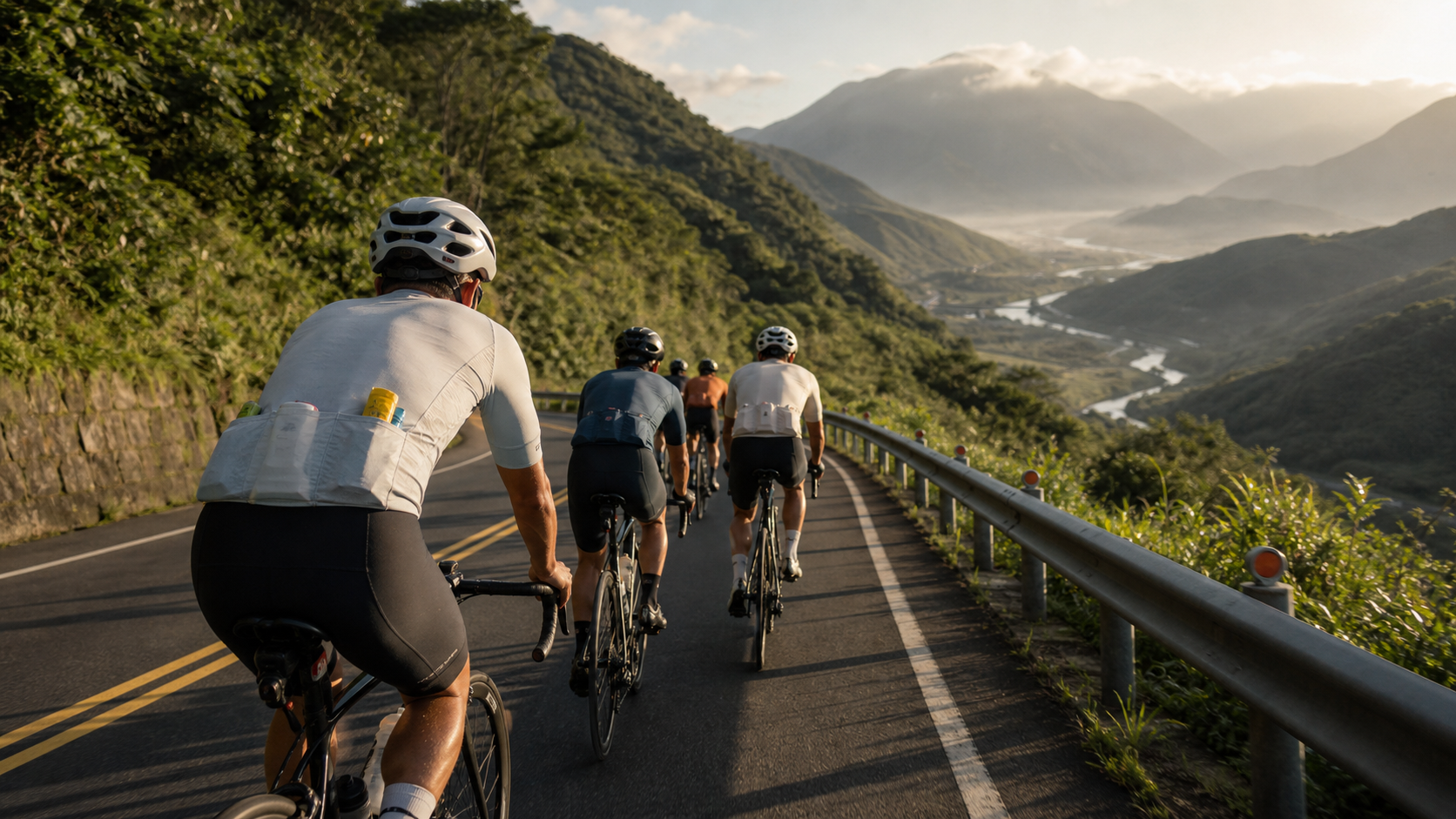
Introduction
Gran Fondo, which originates from Italy, means “big ride” and refers to long-distance cycling events, typically road races of 120 to 230 kilometers. In Taiwan, similar events include “Round-Taiwan One-Day,” “East Taiwan Rift Valley Challenge,” and 100-kilometer-plus long rides organized by various counties and cities. For most amateur riders, simply finishing such an event is an achievement in itself, and how to “finish strategically”—rather than collapsing halfway and being picked up by the sag wagon—is the core of this article.
The Core Challenges of a Gran Fondo
| Challenge | Cause | Impact |
|---|---|---|
| Bonking | Insufficient fueling or pacing too fast | Significant slowdown in the latter half, or even inability to continue |
| Dehydration / Hyponatremia | Heavy sweating but insufficient fluid intake / drinking only water | Cramps, dizziness, impaired judgment |
| Muscle Fatigue | Repeated climbing efforts, declining pedaling efficiency | Pain in the back of the knees and glutes |
| Mental Breakdown | No finish line in sight in the latter half, physical discomfort | Loss of motivation, forcing yourself to finish |
Pacing Strategy: “Sustainable Power” as the Core
In the early stages of a Gran Fondo, staying in Zone 2–3 is the basic principle, for the following reasons:
- Feeling “very easy” in the first 50 km is normal—and it’s correct
- After 100 km, your body starts telling you how tired you are; that’s when the real race begins
- Power target: for rides over 5 hours, 70–78% of FTP is the sustainable power ceiling for most amateur riders
Segment-by-Segment Pacing Recommendations (using 180 km / 3,500 m as an example):
- 0–60 km: Zone 2, warm up the body, fuel normally
- 60–120 km: Zone 2–3, push higher as appropriate on climbs, return to Z2 on flats
- 120–150 km: Zone 3, the body starts to fatigue; you need to consciously maintain your rhythm
- 150–180 km: Zone 3–4, use your remaining energy to close out the final 30 km and sprint toward the finish
Fueling Rhythm: “Proactive Fueling” Rather Than “Eating When Hungry”
In ultra-long distances, by the time your body feels hunger or thirst, you’ve already fallen 20–30 minutes behind on your fueling schedule. The right approach is proactive, scheduled fueling:
- Every 30–45 minutes: Eat a solid or semi-solid food (energy bar, rice ball, banana, dried fruit)
- Every 15–20 minutes: Take small sips of water or electrolyte drink, about 100–150 ml each time
- Every 60–90 minutes: Take one salt tablet (especially important in summer or when sweating heavily)
Aid stations at Taiwanese cycling events are typically set up every 25–40 km—check the aid station locations in advance to decide what to carry on the bike and what to replenish at the stations.
Mental Strategy: Break the Long Distance into Smaller Segments
Facing 180 km, the brain’s most common reaction is “how much farther is there.” The solution is to force yourself to think only about the next milestone:
- Divide the entire course into 5–6 segments, each with a small goal (reaching a certain aid station, getting past a certain climb)
- After completing each segment, do a mental check-in: “First segment done—how am I feeling?”
- When physical discomfort sets in during the latter half, keep riding in 5-minute increments, telling yourself “I can evaluate whether to stop after five more minutes”—usually after five minutes, you won’t want to stop anymore
In-Race Emergency Response
- Leg cramps: Stop and stretch for 2–3 minutes, take salt tablets and water, resume riding in a low gear at a low cadence
- Bonking: Immediately consume fast-acting sugar (gel, energy gel, cola), drop your speed to Zone 1, and wait for your body to recover
- Mechanical issues: Carry tire repair tools and quick links, and know basic tire repair and chain repair techniques
Practical Advice
- At least three months before the event, complete at least one long training ride of over 140 km to give your body a “memory” of long-distance riding.
- Test your fuel: confirm the acceptability of your nutrition during long training rides before the event; don’t try new foods on race day.
- Saddle comfort is extremely important: over a 5-hour-plus ride, saddle discomfort can break you faster than fatigue.
Conclusion
Finishing a Gran Fondo is not a miracle—it’s strategy. With planned pacing, disciplined fueling, and a bit of mental toughness, any amateur rider with a basic training foundation can cross that line with pride at the finish.
Related Reading
- The Complete Gran Fondo Preparation and Pacing Guide: Long-Distance Challenges from Training to Finish
- Multi-Day Riding Strategy: Key Training Points for Tackling Grand Fondos or Multi-Day Events
- Long-Distance Cycling: A Complete Guide to Preparing for a 200 km One-Day Ride, from Planning to Execution
- Trail Running Race Strategy: A Finish Guide for 100-Mile Events like UTMF and TNF100
單車 一日北高 ( 雙城 ) 肥宅雙人瘋狂行 紀錄片 REACTO
10 年前
半日 小台灣 極限單車路線挑戰實錄
7 年前
#公路車 #Fitting 靠人工智慧APP 幫你調整單車
6 年前
大武山後門26%歡樂陡坡!JJSC南台灣單車行Day2 / 被颱風追著跑 / 公路車 / CT Yeh
2 年前
一日北高常見問題大集合 | 攻略 | 路線 | 訓練 | 補給 | 自行車 單車 | 一日雙城 | 雙塔 | TWB北高360 | 屁股痛
6 年前
台北闊瀨陡坡 騎旅 / 日本單車雜誌編輯車友臨時加入!/ 髮香才是最強的 / feat. 北迴歸線小隊 / 公路車 CT Yeh
6 個月前
一日北高/長距離團騎 常見問題補充篇 / 組團或跟團的眉角 / 壯車友容易被瘦車友慢性拉爆 / 原來屁股痛可能是這個原因...? / 風場配速法 / 公路車 / CT Yeh
2 年前
Live) 備戰2019彰化經典百K 賽前攻略 (已完賽請看新影片
7 年前