Bike-Friendly City Development: A Comparison of Cycling Paths in Taipei, Taichung, and Kaohsiung
Introduction
The way a city treats its cyclists reveals the city’s values. Whether there are连贯的 bike lanes, the degree of integration with public transit, and the adequacy of parking facilities—these details determine whether cycling can truly become part of residents’ daily lives, rather than merely a weekend leisure luxury. This article compares the similarities and differences in bike-friendly infrastructure across Taipei, Taichung, and Kaohsiung, offering practical assessments from a user’s perspective.
Taipei: Mature Riverside Networks and Downtown Challenges
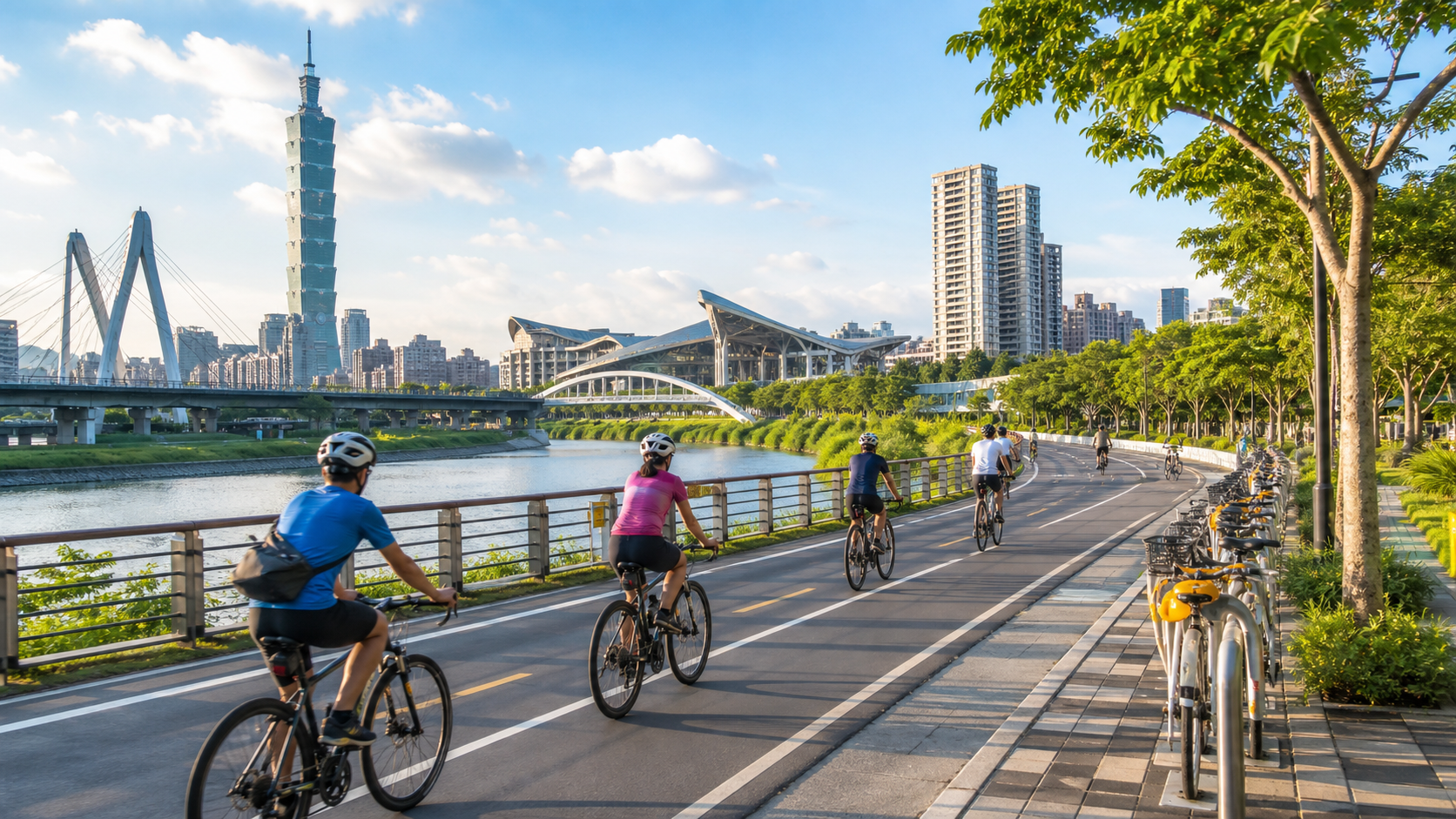
Taipei’s cycling infrastructure is built around the “riverside bike lanes” as its core backbone. The riverside lanes along the Tamsui River, Xindian River, and Keelung River total over 110 km, making it one of Taiwan’s most complete urban cycling networks. The biggest advantage of this system is its complete separation from automobile traffic, offering high safety, with multiple supply stations and rest areas along the way.
However, Taipei’s challenge lies in the “last mile” problem. When cyclists need to transition from the riverside lanes into the urban core, they often face an awkward lack of connectivity—lanes suddenly disappear, forcing riders to cross busy arterial roads, with unclear pavement markings. While areas like Xinyi District and around Daan Forest Park have some bike-friendly designs, overall, the riding experience in Taipei’s urban core remains noticeably inferior to the riverside system.
YouBike public bicycles are another highlight of Taipei. Currently, there are over 1,500 stations across the city, and the system integrates with MRT and bus transfers, partially alleviating the “last mile” problem. However, while the dockless design of YouBike 2.0 offers flexibility, it sometimes also leads to issues with improperly parked bikes.
Taichung: The Challenge of Integrating Old and New
Taichung has actively promoted cycling city development in recent years, with the most representative projects being the “Central Park Cycling Network” and the integrated planning of the “Water Resources Agency Dongfeng Bike Green Corridor.” The Dongfeng Green Corridor is Taiwan’s earliest railway-converted bike path, spanning 15 km with motor vehicles almost entirely banned along the route, making it Taichung’s most popular weekend riding route.
Taichung’s urban bike lane development is relatively uneven—newer development areas such as the Seventh Redevelopment Zone and Shuinan Economic and Trade Park have more complete planning, but bike lanes in the older districts (Central, South, and West Districts) are more fragmented. Although Taichung’s BRT system was not fully realized, the bike lanes designed along its corridor provide a partial commuting backbone.
Kaohsiung: Tourism-Oriented Coastal Network
Kaohsiung’s most distinctive cycling infrastructure includes the tourism-oriented routes around Love River and Lotus Pond, as well as the “Kaohsiung Coastal Bike Path” extending along the coastline. The coastal route, spanning over 75 km, connects attractions such as Cijin, Sizihwan, and Lianhai Road, making it one of Taiwan’s most valuable urban cycling networks for tourism.
Kaohsiung’s C-Bike public bicycle system has relatively weaker integration with the MRT compared to the other two cities, with lower station density than Taipei, but rental fees are more affordable. In recent years, the Kaohsiung City Government has actively promoted “bike-friendly section” certification, requiring businesses along the route to provide basic facilities (air pumps, drinking water).
Comparison Table of the Three Cities
| Evaluation Item | Taipei | Taichung | Kaohsiung |
|---|---|---|---|
| Total bike lane length | Approx. 340 km | Approx. 280 km | Approx. 260 km |
| MRT integration | Excellent (YouBike widespread) | Moderate | Moderate |
| Urban core connectivity | Needs improvement | Uneven | Better |
| Tourism riding resources | Average | Good | Excellent |
| Commuting suitability | Good (riverside) | Partial sections | Partial sections |
| Nighttime safety | Good | Moderate | Good |
Common Challenges for Urban Cycling Infrastructure in Taiwan
Despite their distinct characteristics, the three cities face several shared challenges:
- Mixed motorcycle and slow-vehicle traffic: Many urban sections merge bike lanes with motorcycle lanes, significantly reducing the sense of safety and willingness to ride
- Insufficient parking facilities: High-quality covered bike racks remain scarce at most destinations
- Inconsistent pavement quality: Elevation differences often exist at intersections between bike lanes and regular roads, increasing riding risks
- Lack of continuity: Different sections are managed by different agencies, resulting in a lack of system integration, with cyclists often encountering lanes that abruptly end
Practical Recommendations
- Taipei commuters are advised to use the riverside system as the “main trunk line,” paired with YouBike for movement within the downtown core
- For weekend riding in Taichung, the Dongfeng Green Corridor combined with routes around Dakeng is the top recommendation, offering safety throughout and pleasant scenery
- For tourism riding in Kaohsiung, the classic route is Love River → Cijin Undersea Tunnel → Cijin Coast, with an evening departure recommended to enjoy the sunset
- When riding in all three cities, it is recommended to download “Bikemap” or “Komoot” to stay informed of real-time road conditions and pavement ratings
Conclusion
The cycling infrastructure of Taiwan’s three major cities reflects each region’s distinct urban character and development priorities. Taipei values efficiency, Taichung seeks integration, and Kaohsiung embraces tourism—there is no perfect answer, but each city is moving forward at its own pace. For cyclists in Taiwan, the most exciting prospect is that one day these three cities will be connected by complete rail- or highway-grade cycling networks, making low-carbon north-south travel a genuine possibility.
Related Reading
- Urban Life with Bike Commuting: A Comparison of Commuting Cycling Culture in Taipei, Taichung, and Kaohsiung
- Comparing Bike-Friendly Cities in Taiwan: Which City Is Best for Cycling Life
- Introduction to Taiwan’s Bike Lane Systems: Features and Connectivity of Bike Lanes Across Counties and Cities
- The Complete Guide to Taipei’s Cycling Network: A Full Overview of Riverside Routes and Bike Lanes
高雄綠園道鐵路自行車道 / 外地人能輕鬆駕馭 還是整路崩潰? / 2025 全線開通 春節實地探索一次!(附GPS連結)/ 公路車 / CT Yeh
1 年前
半日 小台灣 極限單車路線挑戰實錄
7 年前
單車 一日北高 ( 雙城 ) 肥宅雙人瘋狂行 紀錄片 REACTO
10 年前
4K單車實境) 嘉義 梅山36灣 訓練台 爬坡 輕鬆騎
6 年前
2023自行車展!與環台賽選手一同表演賽 / 全自動AI Fitting?/ TIME新車發表/神秘充電桌等 精華分享 VLOG | CT Yeh | 公路車
3 年前
[海外單車] 日本 茨城 霞之浦單車 銀杏 慢遊體驗
7 年前
日本自助單車旅,茨城絕景路線/ 新手也可以體驗 / 4K空拍絕景 / 機票省錢大法 / 單車友善旅館 / 國家級霞之浦180K自行車道 / feat. 緯緯 / CT Yeh
1 年前
多到選擇障礙... 換個單車把帶想一個小時 / BTP / 編織&軟木特有材質超吸睛! / 公路車 / CT Yeh
1 年前