Introduction
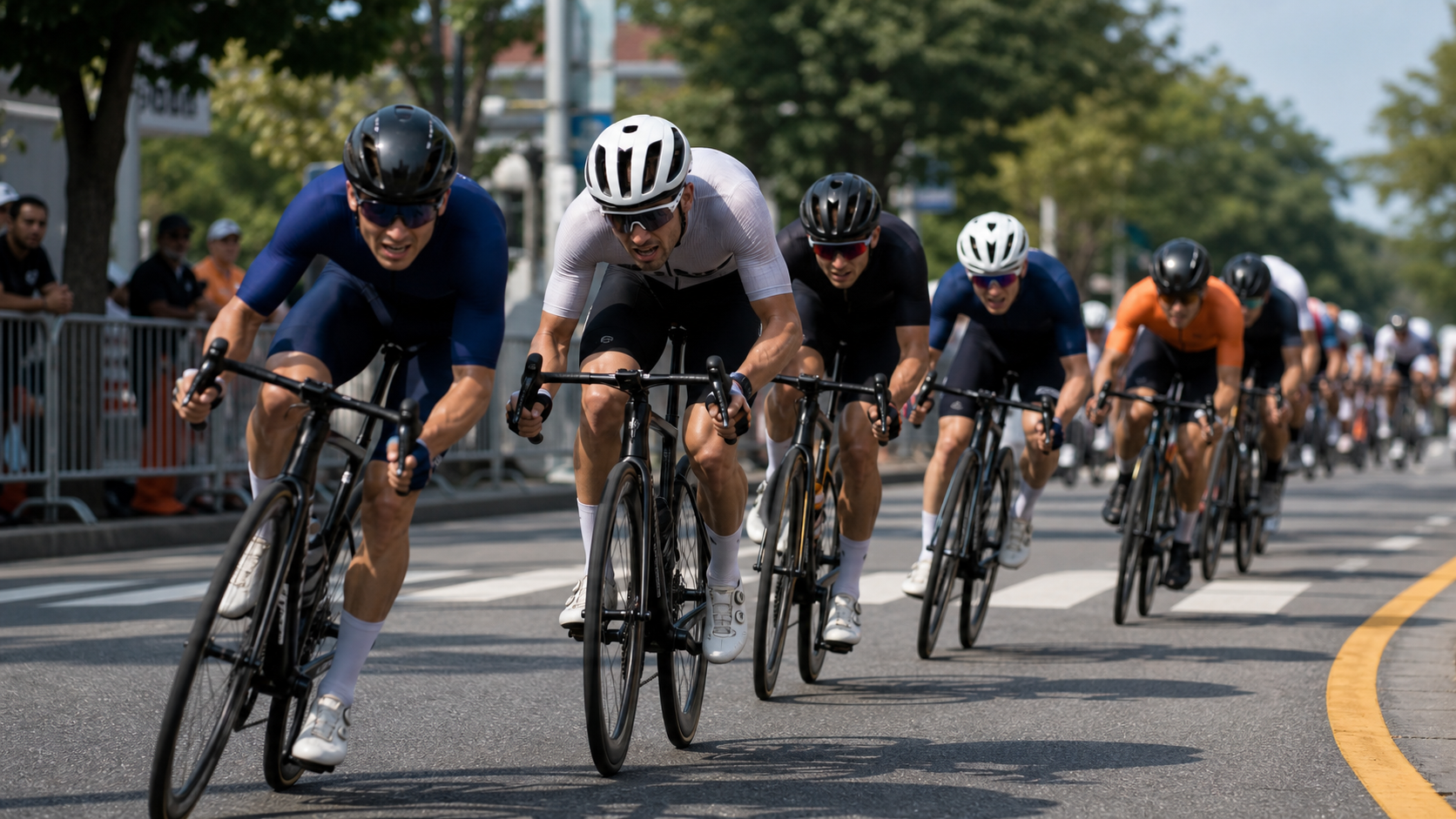
Criteriums (Crits) are one of the most common race formats in Taiwan’s amateur racing scene, typically held on closed circuits of 1–3 kilometers with a total distance of about 40–80 kilometers. Criteriums are characterized by high speeds, high technical demands, and frequent sprints—not just on the final lap, but with sprint points on every lap. This article focuses on the last 500 meters of the final lap, which determines the final placing, and analyzes how to get ahead at the finish line through position management and timing judgment.
Position Preparation Before the Final Lap: Starting from the Second-to-Last Lap
| Timing | Target Position | Action |
|---|---|---|
| Middle of the second-to-last lap | Within the top 15 | Begin actively moving forward |
| Last corner of the second-to-last lap | Within the top 10 | Ensure you’re in the front group entering the final lap |
| Straight section early in the final lap | Top 5–8 | Stay close to the lead riders, conserve sprint energy |
| Last corner of the final lap (finish corner) | Top 3–5 | Secure the acceleration line out of the corner |
Three Key Timing Points in the Last 500 Meters
Timing Point 1: Entering the Final Corner (Approximately 500–300 Meters from the Finish)
This is the most critical positioning point of the entire race. Your position entering the corner determines your acceleration space coming out of it:
- Ideal position: Within the top 3 entering the corner, choosing the inside line (shortest path)
- Second-best position: Top 5, with enough straight-line acceleration after the corner
- Dangerous position: On the outside of the corner, squeezed by riders ahead after exiting, unable to accelerate
Technical key points: Be slightly conservative before entering the corner (to avoid sliding out), then immediately pedal at full effort after exiting.
Timing Point 2: Following the Lead-Out Sprint or Jumping Early
Pure sprinters typically prefer the lead-out tactic (Leadout + Final Sprint), but criteriums have many corners and a tight pack, so sometimes jumping early works better:
- Pure sprinters: Wait until the last 150–200 meters to jump; if your explosive power is sufficient, you can overpower everyone
- Diesel-type riders: Jump early at 300–400 meters, build a lead, and hold position by making it impossible for opponents to pass
- Tactical riders: Observe the habits of key opponents and find gaps to overtake during the “dead period” before they launch their sprint
Timing Point 3: Body Mechanics for the Sprint Launch
- Grip the drop bars with both hands to lower your center of gravity
- Lift your hips and increase explosive power by rocking the bike
- Keep your eyes on the finish line, not on riders to your left or right (to avoid drifting off line)
- Maintain your pedaling rhythm until 2–3 meters past the line before easing off
Sprint Differences by Rider Body Type
- Heavier riders with high explosive power (>75 kg): High absolute power, suited for a short-range jump in the final 150 meters
- Lightweight riders with good endurance (<65 kg): Less explosive power, suited to opening a gap early at 300–400 meters
- Medium-build riders: High flexibility, can choose strategy based on race conditions
Common Mistakes in the Final Lap of a Criterium
- Jumping too early (500 meters or more out): Gives riders behind ample opportunity to “draft and overtake,” causing you to lose instead
- Position too far back: Starting the final lap in 15th place or worse makes it nearly impossible to reach the top three
- Overtaking in corners: On wet roads or in a tight pack, overtaking in corners is the highest-risk move
- Following the wrong rider: Sticking with a rider who has poor sprint positioning leaves you trapped in the crowd together
Practical Advice
- Training for criteriums isn’t just about fitness—add 1–2 high-intensity interval sessions per week (30-second all-out × 10 reps) to simulate the repeated high-intensity demands of the final lap.
- Watching criterium live streams or recordings to learn how pro riders advance their position before the final lap is the most effective way to learn tactics.
- After each race, record your position and jump timing in the final lap to identify the common reasons you lose each sprint.
Conclusion
The sprint in a criterium is an art form where speed, positioning, and judgment intertwine. The fastest rider doesn’t always win, but riders with good positioning sense often achieve the best results with less energy expenditure. Continuously practicing final-lap tactics in races is the most effective path to improving your criterium results.
Related Reading
- Positioning Guide for Criteriums: Calculating Energy Expenditure for Positioning Before Corners
- Criterium Race Strategy: How to Win in Short-Distance Explosive Efforts
- Road Bike Sprint Technique: Body Position and Power Output in the Final 200m
- Criterium Tactics: 60 Minutes, 80 Laps of Corners and Repeated Accelerations
CT 喇低賽) 武嶺牽車 才是王道 西進牽車四小時內秘訣 攝手位置 如何判斷 防抽筋小秘訣
7 年前
Live) 備戰2019彰化經典百K 賽前攻略 (已完賽請看新影片
7 年前
2023桃園團體繞圈賽 / 海鷗繞圈賽 | 全程空拍數據版 | 公路車 | CT Yeh
2 年前
單車實況) 車測中心高速賽道 96 彰化讚 挑戰組一圈實錄 | ARTC
6 年前
第二屆 海鷗繞圈賽 / 桃園團體城市繞圈賽!多視角實況精華版 | | 訪問才是最好笑的 | 公路車 | CT Yeh
3 年前
新玉門關 單車挑戰賽 多視角主集團衝刺菁華版 4K #公路車
5 年前
富士山KOM 賽事篇 VLOG!/ 小野田出沒!/ 完整路段分析 / 武嶺要騎多快才能拿環?/ 台灣選手 第20回Mt.富士ヒルクライム 参加!/ 公路車 / CT Yeh
2 年前
2025 海鷗團體繞圈賽 / 前八強賽事精華!/ 環台賽等級拍攝 / 國手菁英隊伍較勁 / CT Yeh #公路車
8 個月前