Introduction
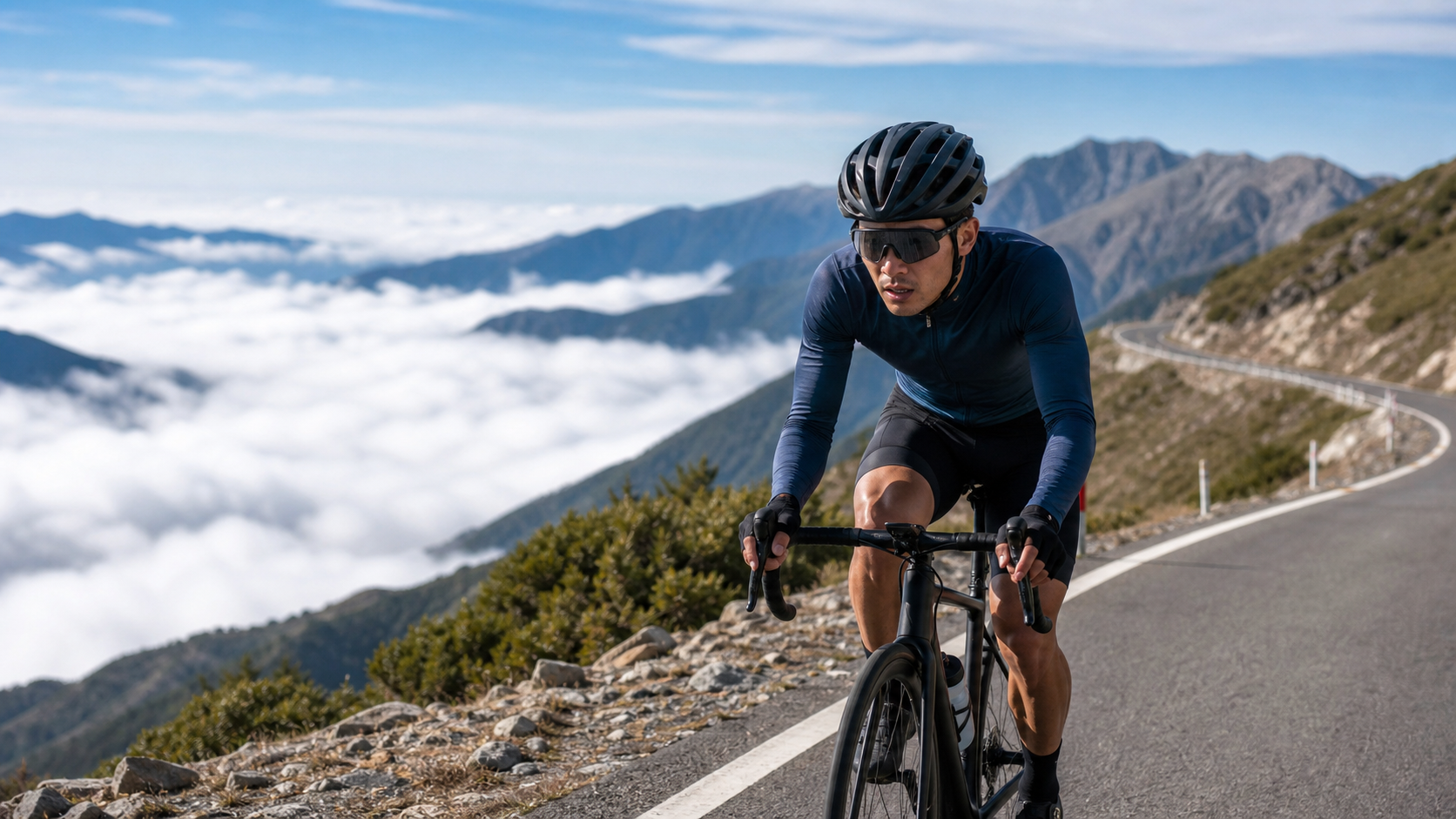
Taiwan’s Central Mountain Range offers Taiwanese cyclists a training resource rarely found anywhere in the world: from sea level to Wuling at 3,275 meters, a ride of just 100 kilometers. Professional teams must fly all the way to the European Alps or the Colorado Plateau for high-altitude training, but Taiwanese riders can reach it in a single day of riding. This article will analyze the effects of Wuling’s hypoxic environment from a physiological perspective, and how to scientifically utilize this resource.
The Atmospheric Physics of High Altitude
The higher the altitude, the lower the atmospheric pressure. Although oxygen still makes up 21% of the air, the number of oxygen molecules inhaled with each breath decreases:
| Altitude | Atmospheric Pressure (hPa) | Partial Pressure of Oxygen (hPa) | Oxygen Availability Relative to Sea Level |
|---|---|---|---|
| 0m (Sea Level) | 1013 | 213 | 100% |
| 1000m | 899 | 189 | 89% |
| 2000m (Hehuan Mountain) | 795 | 167 | 78% |
| 2700m (Near Yuanfeng) | 735 | 154 | 72% |
| 3275m (Wuling) | 694 | 146 | 69% |
| 4000m | 616 | 129 | 61% |
Acute Effects of Hypoxia on Athletic Performance
Typical reactions upon first arriving at Wuling:
- Immediate decline in aerobic capacity: VO2max drops by approximately 10–15% at 2,000m, and by approximately 25–30% at 3,000m
- Elevated heart rate: At the same power output, heart rate runs about 10–15 BPM higher than normal (hypoxia → decreased blood oxygen saturation → compensatory heart rate increase)
- Increased respiratory rate: Breathing becomes deeper and more frequent in an attempt to take in more oxygen
- Acute Mountain Sickness (AMS): Headache, nausea, dizziness—can appear in some individuals above 2,500m
Actual impact on power output:
For every 1,000m of elevation gain, aerobic power drops by approximately 8–10%. In other words, at the summit of Wuling (approximately 3,275m), your effective FTP is reduced to roughly 70–75% of your sea-level value.
Physiological Adaptation Mechanisms of High-Altitude Training
With long-term training or residence at high altitude, the body undergoes the following adaptations:
- Increased EPO secretion: When the kidneys detect hypoxia, they secrete more erythropoietin (EPO), stimulating red blood cell production
- Increased red blood cell count: Blood oxygen-carrying capacity improves, increasing by 3–5% after 2–3 weeks
- Increased 2,3-DPG: 2,3-diphosphoglycerate in red blood cells increases, making it easier for hemoglobin to release oxygen at the tissue level
- Increased mitochondrial density: Oxygen utilization efficiency at the muscle cell level improves
- Increased buffering capacity: Lactate clearance improves, delaying acidosis
Wuling High-Altitude Training Strategies
“Live High, Train Low”:
The ideal high-altitude training approach is to reside at high altitude (receiving hypoxic stimulus to promote red blood cell production) while training at lower altitudes (allowing high-quality training at near-normal intensities).
Taiwan application plan (3–4 day Wuling program):
- Day 1: Depart from Puli or Lishan, climb to Wuling (low-intensity acclimatization)
- Day 2–3: Light riding or walking near Wuling (2,800–3,275m), ensuring sufficient hypoxic exposure
- Day 4: Descend to Hehuan Mountain (approximately 2,000–2,600m) for moderate-intensity training
- Within 2–4 weeks after returning to lower elevations: Use the high-altitude adaptation benefits for key races or heavy training blocks
Important considerations (Taiwan’s unique climate factors):
- Wuling has a high risk of afternoon thunderstorms in summer; it is recommended to complete the summit section before 11:00 AM
- Wuling may be closed in winter (snow accumulation); always check the road conditions from the Directorate General of Highways
- UV intensity in the mountains is significantly higher than at lower elevations, making sun protection especially important
Prevention and Management of Acute Mountain Sickness
Prevention strategies:
- Ascend gradually: Do not gain more than 500–600m of elevation per day (reaching Wuling requires more than 2 days of climbing)
- Stay well hydrated: Humidity is low at high altitude, and fluid loss is substantial without being easily noticed
- Avoid alcohol: Alcohol worsens the symptoms of hypoxia
First aid for Acute Mountain Sickness:
- Mild headache: Rest, hydrate, and take ibuprofen if there is no improvement
- Moderate to severe symptoms (vomiting, inability to walk): Descend immediately—this is the most effective treatment
Practical Recommendations
- For a first Wuling plan, stay 2 days in advance in Lishan (1,950m) for initial acclimatization
- Training at the Wuling summit should be primarily low-intensity, with power targets set at 70–75% of sea-level values
- During high-altitude stays, use a pulse oximeter (approximately NT$500–1,000) to monitor blood oxygen saturation; consider descending if it falls below 85%
- The 2–3 weeks following high-altitude training represent the optimal “supercompensation period” for physiological status—schedule key races or tests during this window
- Conducting 2–3 high-altitude training camps at Wuling per year is sufficient to continuously reap the benefits of high-altitude adaptation
Conclusion
Wuling is not just Taiwan’s most beautiful cycling challenge—it is a world-class high-altitude training ground. Armed with the correct knowledge of hypoxic physiology, every Wuling challenge is not merely an achievement in mileage, but an opportunity to upgrade your physiological systems. Turn Taiwan’s geographical advantage into your competitive advantage.
Related Reading
- The Benefits of Altitude Training for Cyclists: Taiwan’s Natural Advantage at Wuling
- Altitude Effect Training for Cycling: The Cardiopulmonary Stimulus of Taiwan’s High-Mountain Riding
- Preventing Acute Mountain Sickness on High-Altitude Rides: Considerations for Hehuan Mountain 3275m
- The Physiology of High-Altitude Cycling: Scientific Preparation for Taiwan’s Mountain Riding
#北橫 + #北進武嶺 最硬的員工旅遊 EP1 | #公路車 #拉拉山 | 明池 | 武嶺 | 武陵農場 | 雲海 | Taiwan Cycling Route Wulin
6 年前
台灣登山王之路 KOM 全程參賽4K臨空錄影 PART1 穿越峽谷地形! #東進武嶺 太魯閣 / 燕子口 / 天祥 / 西寶 PART1 (公路車 / CT Yeh)
3 年前
大禹嶺 到 武嶺牌樓 全程前後實況錄影 | 北進武嶺 | 東進武嶺 | KOM | 訓練台 | 坡度分析 | Taiwan KOM Last 10 km HARD | 公路車
6 年前
大武山20%魔王陡坡【JJSC南台灣遊騎Day2】!屁股真的要裂開了...凡士林抹滿也沒用?神秘金教堂還有超便宜夜市
3 個月前
風櫃嘴時間 預測西進武嶺時間?13000名車友統計數據分析告訴你 !
5 年前
CT趣訪 西進武嶺 2小時組 EP2 全村的希望 蔣緯緯! 訓練菜單&技巧公開 |公路車 |CT Yeh
4 年前
FTL 與 SYB 車隊專訪 西進武嶺 實用攻略分享! 2小時 如何練?!你不知道的眉角!新手準備武嶺必看 EP1 | 實力派女車友 | 精華版 | 公路車 | CTYeh
4 年前
雨戰! 西進武嶺員工旅遊 加料 各路段大數據分析 | 同事端出5公斤的公路車來挑戰!? EP1
4 年前