Introduction
“I just run—why would I do strength training?” This is a common misconception among many half-marathon runners. In reality, running is a repetitive single-leg support movement that requires strong coordination among the glutes, quadriceps, core muscles, and ankle stabilizers. Without sufficient muscular support, late-race pace collapse, lateral knee pain (iliotibial band syndrome), and runner’s knee are often just a matter of time. A twice-weekly, 30-minute strength routine is the most worthwhile supplementary training investment during half-marathon preparation.
Key Muscle Groups Half-Marathon Runners Need to Strengthen
- Glutes (gluteus maximus, gluteus medius): The primary source of propulsion; a weak gluteus medius is the main cause of knee valgus (inward knee collapse)
- Quadriceps: The shock-absorbing muscles that control landing impact; the primary site of fatigue in the latter stages of long runs
- Hamstrings: Assist with propulsion and protect the knees; generally weak in runners
- Core (transversus abdominis, obliques, erector spinae): Maintain running form stability and reduce wasted energy from lateral sway
- Calves (gastrocnemius, soleus): Provide the final push-off force in running and are also the most cramp-prone area
Designing the Twice-Weekly Strength Routine
Workout A: Glutes and Lower Body (Tuesday or Thursday)
| Exercise | Sets × Reps | Key Cues |
|---|---|---|
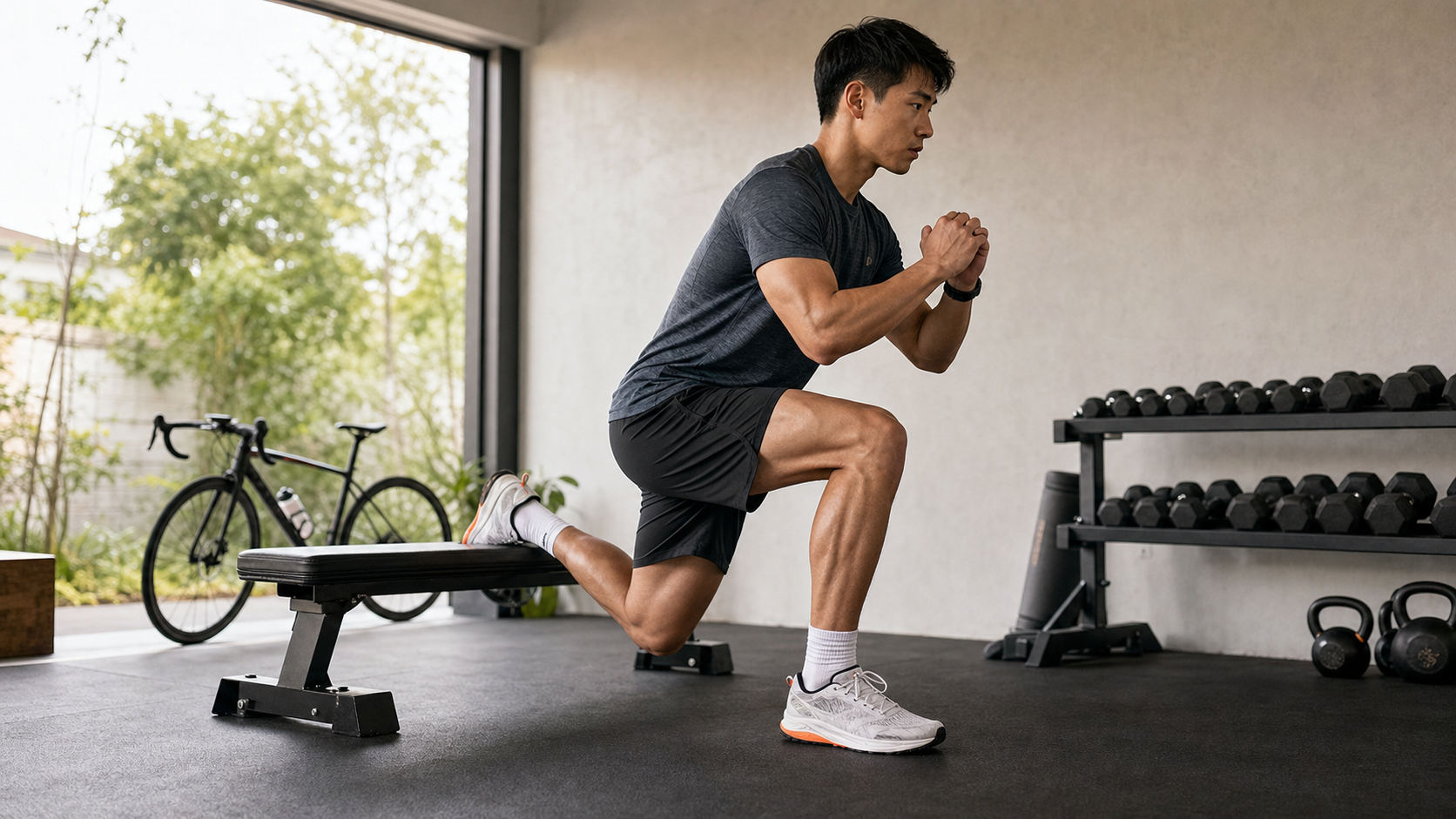
| Bulgarian Split Squat | 3 × 10 (per leg) | Front knee stays behind toes; rear foot rests on a bench |
| Glute Bridge | 3 × 15 | Hold for 2 seconds at the top; feel the gluteus maximus contract |
| Side-Lying Clamshell | 3 × 15 (per side) | Strengthens the gluteus medius to prevent knee collapse |
| Single-Leg Squat (Assisted Pistol Squat) | 2 × 8 (per leg) | Use a wall for support; trains single-leg stability |
| Standing Calf Raise | 3 × 20 | Single-leg version is more effective; helps prevent plantar fasciitis |
Workout A Duration: Approximately 25–35 minutes (including 60-second rest between sets)
Workout B: Core and Stability (Friday or around the weekend)
| Exercise | Sets × Time | Key Cues |
|---|---|---|
| Plank | 3 × 45 seconds | Keep spine neutral; no shrugged shoulders or sagging hips |
| Bird Dog | 3 × 12 (per side) | Diagonal extension; strengthens deep core muscles |
| Side Plank | 3 × 30 seconds (per side) | Strengthens the connection between obliques and gluteus medius |
| Dead Bug | 3 × 10 (per side) | Lower back pressed into the floor; activates the transversus abdominis |
| Single-Leg Romanian Deadlift | 3 × 10 (per leg) | Strengthens hamstrings; improves hip stability during running |
Workout B Duration: Approximately 25–30 minutes
Placement Principles Within the Training Week
Strength training should be scheduled to avoid interfering with high-intensity running days:
- Interval or tempo run days: Do not schedule strength training
- After easy runs: Strength training can be done on the same day (performing it after the run is more effective)
- The day after a long run: Rest completely or do core work only; no lower-body strength training
Sample Weekly Schedule:
- Monday: Rest
- Tuesday: Easy run 10 km + Workout A (lower body)
- Wednesday: Tempo run (no strength work)
- Thursday: Easy run 8 km + Workout B (core)
- Friday: Rest
- Saturday: Long run 18–20 km
- Sunday: Easy recovery run 6 km
Strength Training Resources for Runners in Taiwan
- Doable at Home: Bulgarian split squats (using a chair), glute bridges, and plank variations all require no equipment
- Sports Center Gyms: Monthly memberships at Taipei’s various sports center gyms cost NT$300–500 and are fully equipped
- TRX Suspension System: Can be mounted on a door frame at home; excellent for single-leg squats and suspension core training
Practical Advice
- In the early phase of strength training (first 2 weeks), focus on bodyweight only; don’t rush to add load—establish proper movement patterns first
- The depth of the Bulgarian split squat should bring the rear knee to 2–3 cm from the ground; shallower squats yield diminished benefits
- Every 3 weeks, add one set or slightly increase the load, following the principle of progressive overload
- Stop strength training 2 weeks before race day (during the taper period) to allow full muscular recovery
Conclusion
Strength training is the foundational investment that makes running safer and more efficient. A twice-weekly, 30-minute lower-body and core routine won’t take up much time, yet it will help you maintain stable running form in the latter stages of your half-marathon, translating your hard-earned aerobic base into concrete pace results.
Related Reading
- Preventive Strength Training: Twice-Weekly Glute and Core Training to Reduce Injury Rates
- Strength Training for Half-Marathon Runners: 5 Key Movements to Prevent Injury
- Integrating Core Training for Road Running: How to Embed a Twice-Weekly 20-Minute Core Routine
- Running-Related Lower Back Pain: Analysis of 4 Major Muscle Groups and At-Home Recovery Strategies
一日北高/長距離團騎 常見問題補充篇 / 組團或跟團的眉角 / 壯車友容易被瘦車友慢性拉爆 / 原來屁股痛可能是這個原因...? / 風場配速法 / 公路車 / CT Yeh
2 年前
西進武嶺 免費訓練分析服務 Intervals | 練不夠還是練過頭?你哪一種類型選手?AI模型告訴你! | 備戰神器 | 公路車 訓練 | CT Yeh
4 年前
一日北高常見問題大集合 | 攻略 | 路線 | 訓練 | 補給 | 自行車 單車 | 一日雙城 | 雙塔 | TWB北高360 | 屁股痛
6 年前
Never Stop 西進武嶺 前後雙機 完整全程錄影 訓練台 實境
8 年前
2019 夏季KOM 5小 完賽心得 準備攻略 東進武嶺 夏季登山王之路 Taiwan KOM Challenge
7 年前
一日北高前的高裝檢 | 北高 360 | 挑戰11小時的裝備 | 一日雙塔 | 補給
6 年前
FTL 與 SYB 車隊專訪 西進武嶺 實用攻略分享! 2小時 如何練?!你不知道的眉角!新手準備武嶺必看 EP1 | 實力派女車友 | 精華版 | 公路車 | CTYeh
4 年前
實景訓練台) 彰化經典百K 高強度喵團 90分鐘 跟著一起練功 2019 Indoor workout Changhua Classic 100 Taiwan
7 年前