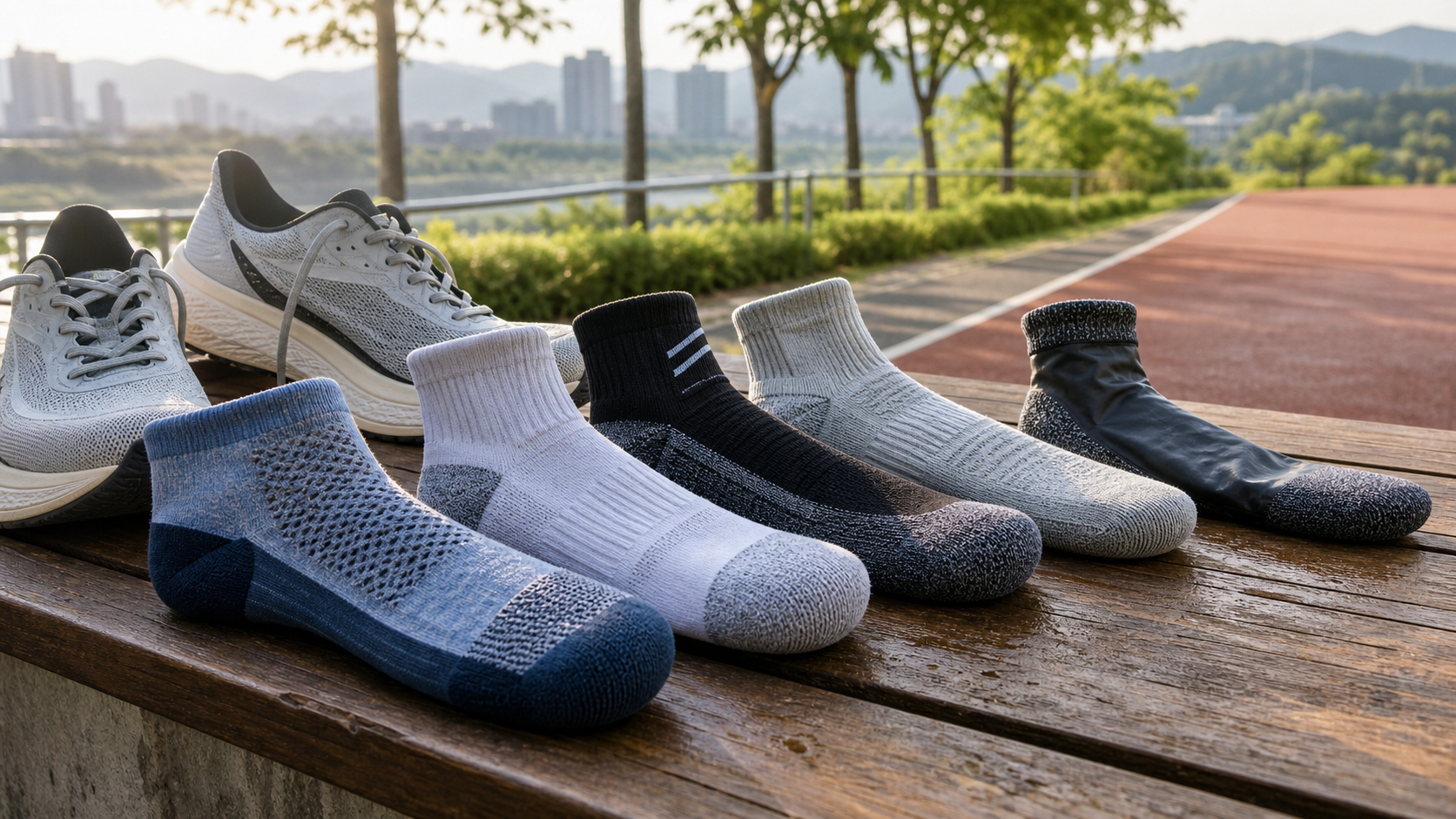
Introduction
Many beginner runners are willing to spend thousands of dollars on a good pair of shoes, yet settle for ordinary cotton socks. However, running socks directly determine whether your feet blister, your toes chafe, or your heels slip. The benefits of a quality pair of running socks can sometimes be more immediately noticeable than switching shoes. Taiwan’s hot and humid summers place even higher demands on moisture-wicking and antibacterial properties in running socks—choose wisely, and every run becomes more enjoyable.
Running Sock Material Comparison
| Material | Moisture-Wicking & Quick-Dry | Odor Resistance | Durability | Cost | Suitability for Taiwan Summers |
|---|---|---|---|---|---|
| Cotton | ★ (Absorbs but doesn’t dry quickly) | ★★ | ★★★ | Low | ✗ (Not recommended for running) |
| Polyester | ★★★★ | ★★★ | ★★★★ | Low to Medium | ★★★★ |
| Nylon | ★★★★ | ★★★ | ★★★★★ | Medium | ★★★★ |
| Merino Wool | ★★★ | ★★★★★ | ★★★ | High | ★★★ (Cool season only) |
| Waterproof (Gore-Tex Socks) | ★ (Fully waterproof) | ★★ | ★★★ | High | ✗ (Too hot and stuffy for Taiwan summers) |
Synthetic Fiber Running Socks
Polyester / Nylon are the most mainstream running sock materials in the Taiwanese market, characterized by quick-drying and moisture-wicking properties, making them suitable for Taiwan’s year-round hot and sweaty climate. Major brands:
- Balega (South African brand): Widely praised in Taiwan’s trail running community, featuring blister-prevention design and a heel cup design that prevents slipping
- Darn Tough (American brand): Nylon-based, extremely durable, even offering a lifetime warranty
- 2XU, CEP (compression versions): Running socks that also provide compression, suitable for long-distance training
- Local Taiwanese brands: Some Taiwanese textile brands produce performance running socks, such as Triathlon Master, Italian Multi-Step, etc.
Key points for choosing synthetic running socks:
- Confirm they feature a Y-shaped heel design to prevent heel looseness and slippage
- Choose seamless toe construction for toe stitching, avoiding toe friction from seams during long distances
- An arch support band provides light support during long-distance runs
Merino Wool Running Socks
Merino wool, thanks to its natural odor-resistant properties, is a popular choice among trail runners and ultramarathoners—even after 2–3 days of continuous wear, strong odors won’t develop:
Advantages:
- Excellent natural odor resistance (the keratin in wool fibers inhibits bacteria)
- Retains warmth even when wet (in contrast, wet cotton socks completely lose their insulating ability)
- Natural cushioning with a soft foot feel
Limitations for use in Taiwan:
- Taiwan’s summer temperatures are high; merino wool’s insulating properties actually cause stuffiness in environments above 30°C
- Recommended for winter training or mountain trail running only
- Major brands: Icebreaker, Smartwool, available at Taiwan’s outdoor gear stores (such as Tushin)
Choosing Thickness
Running sock thickness affects cushioning and heat:
- Ultra-Light/No-show: The top choice for Taiwan summers, providing close contact with the shoe’s outsole, strong ground feel, and optimal heat dissipation
- Light: Suitable year-round, the go-to choice for most road runners
- Medium: Suitable for trail running, ultramarathons, and winter mountain running, offering extra cushioning protection
- Cushion: Suitable for ultra-long distances or trail hiking; rarely used for regular road running
Waterproof Running Socks
Waterproof running socks (such as DexShell, Sealskinz, and Darn Tough GORE-TEX versions) feature a waterproof membrane layer, suitable for:
- Long-distance training on rainy winter days in Taiwan
- Protection during water-crossing sections in ultramarathons
However, they are completely not recommended for Taiwan summers. The waterproof membrane blocks moisture from escaping while also blocking sweat evaporation, causing feet to accumulate sweat inside the socks, making blisters even worse.
Preventing Common Running Blisters
Even with good running socks, blisters are fundamentally caused by “friction + moisture”:
- Double Layer Socks: Such as the Wrightsock brand, where the inner and outer layers slide against each other, reducing friction on the skin
- Vaseline / Anti-chafing balm: Apply to the heels and between toes before long distances to significantly reduce the chance of blisters
- Check shoe size: Blisters also often result from shoes that are too small, causing toes to repeatedly hit the toe box
Practical Advice
- Running socks, like running shoes, require a “break-in period.” Try new socks on short distances first, and only use them for long distances or races after confirming there’s no discomfort
- Wash running socks immediately after running. Taiwan’s climate is humid; if left stuffed in a shoe bag for several hours, bacteria multiply very quickly
- It’s recommended to purchase at least 5–7 pairs of running socks and rotate them, giving each pair ample time to dry
Conclusion
Running socks are one of the highest value-for-money investments in your overall running gear. A quality pair of running socks costing NT$500–800 can solve blister problems that a several-thousand-dollar pair of shoes cannot fully address. Based on Taiwan’s climate characteristics—quick-dry synthetics for summer, merino wool for winter or trail running—combined with the right thickness choice, let every step you take land on the most suitable foundation.
Related Reading
- In-Depth Running Sock Selection Guide: A Comprehensive Comparison of Materials, Thickness, and Waterproofing
- Running Sock Buying Guide: Why You Can’t Run a Marathon in Cotton Socks
- Don’t Overlook Your Feet’s Second Skin: The Importance of Running Socks and a Complete Buying Guide
- Hiking Sock Materials and Layer Selection: Real-World Testing of Wool, Synthetic, and Double-Layer Socks
單車 一日北高 ( 雙城 ) 肥宅雙人瘋狂行 紀錄片 REACTO
10 年前
3D 列印車褲墊 / 舒適改善? / 無痕 x 分區壓縮 / ATK & Decider系列 / JE22黑科技 / #公路車 #CTYEH
11 個月前
單車 重低音 藍芽喇叭 音質實測 SoundBot SB525 Real Sound Test
8 年前
CT暗黑廚房) 車友必備 宇宙無敵鮮蚵湯 幫助訓練恢復 天然食補 好市多 超肥鮮蚵 破PR
7 年前
Live) 備戰2019彰化經典百K 賽前攻略 (已完賽請看新影片
7 年前
訓練台體驗) 2019台北自行車展 三大家 訓練台體驗 Tacx Neo Flux 2 Xepdo Apx Wahoo Kickr
7 年前
2025 自行車錶排行榜 兩萬車友大數據 / Garmin Bryton 排名會大洗牌嗎? / 全新的碼表前身分析 /公路車 / CT Yeh
1 年前
2026 車錶排行榜!誰是最多車友正在使用?練家子最愛哪款?🏆 (2萬名車友數據) / 公路車 / CT Yeh
5 個月前