Introduction
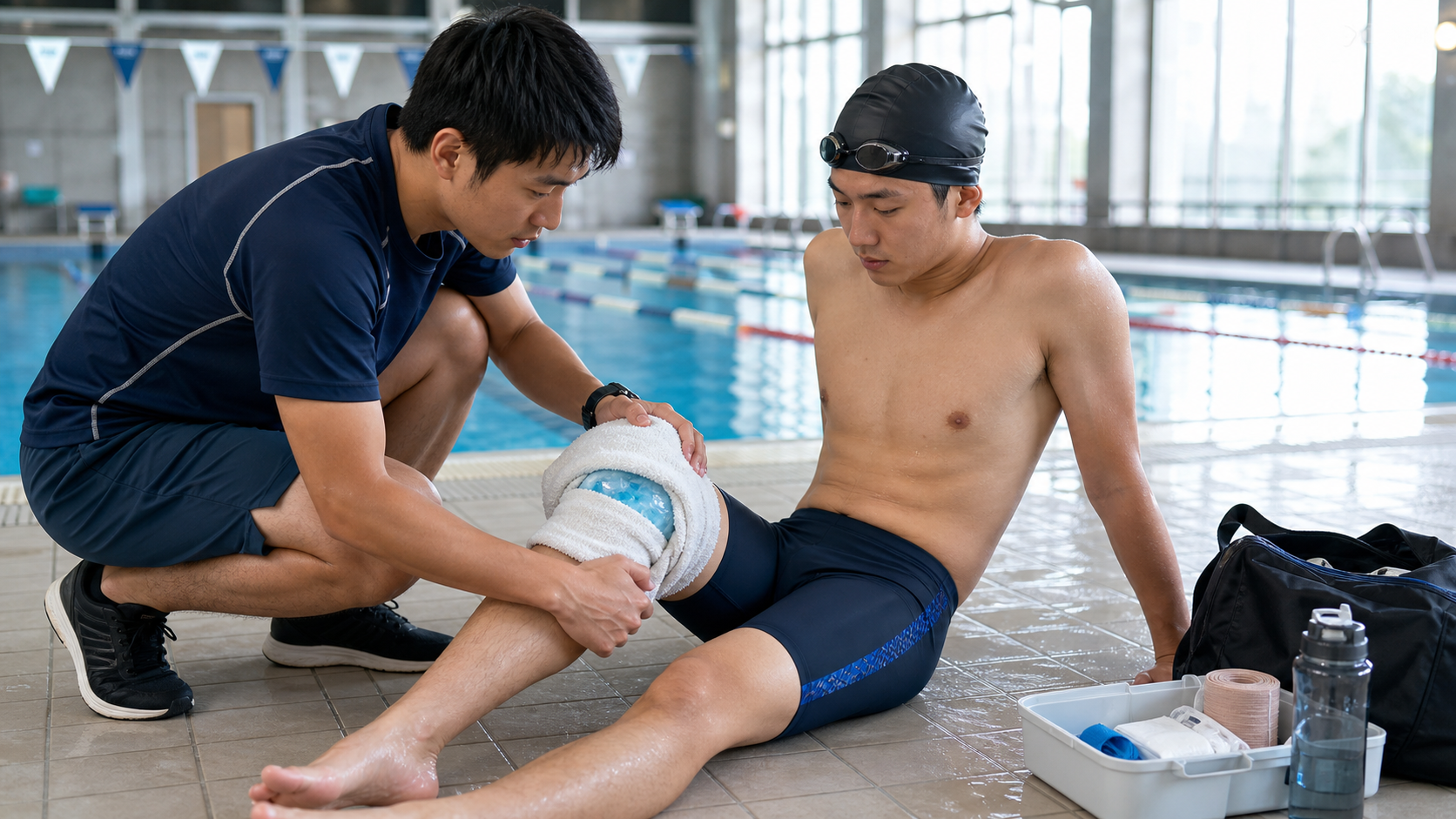
Whether at a municipal pool in Taipei or a community pool in the south, sports injuries can occur without warning. Muscle strains, ankle sprains, head impacts, and even severe loss of consciousness—in a pool environment, these situations require correct initial management within the shortest possible time to create the best conditions for subsequent medical treatment.
The traditional RICE principle (Rest, Ice, Compression, Elevation) is the most familiar acute injury management mnemonic for the general public; modern sports medicine has further developed the advanced POLICE principle (Protection, Optimal Loading, Ice, Compression, Elevation), providing more refined guidance in different scenarios.
This article uses real-world scenarios at Taiwanese pools as its backdrop, offering a complete practical workflow for acute injury management.
Common Acute Injuries in Swimming
| Injury Type | Common Scenario | Severity |
|---|---|---|
| Muscle cramp | During swimming, calf or sole of foot | Mild to moderate |
| Ankle sprain | Fall on slippery pool deck | Moderate |
| Shoulder tendon strain | Forceful stroke or dive entry | Moderate |
| Head impact | Hitting pool wall, diving without judging distance | Moderate to severe |
| Knee sprain | Fall at poolside or rapid breaststroke kick | Moderate |
| Cervical spine injury | Diving or flipping in shallow water | Very severe |
| Drowning/loss of consciousness | Exhaustion, arrhythmia | Most urgent |
Detailed Explanation of the RICE and POLICE Principles
Traditional RICE Principle
- R – Rest: Stop activity immediately to avoid re-injury. Keep the affected area unloaded, with immobilization as the priority
- I – Ice: Within 24–48 hours after injury, apply ice for 15–20 minutes per session, repeating every 1–2 hours. The ice pack must be wrapped in a towel to avoid direct skin contact and frostbite
- C – Compression: Use an elastic bandage, wrapping from the distal end toward the proximal end, with moderate pressure (should not cause numbness) to reduce swelling
- E – Elevation: Elevate the affected limb above heart level to promote venous return and reduce swelling
Modern POLICE Principle (Updated Version)
- P – Protection: Protect the injured area short-term (1–3 days) using braces, crutches, or splints
- OL – Optimal Loading: Begin light activity as early as possible without causing pain to promote tissue repair; complete immobilization (absolute bed rest) actually delays healing
- I – Ice: Same as RICE
- C – Compression: Same as RICE
- E – Elevation: Same as RICE
When to use RICE? When to use POLICE?
- First 24–48 hours after injury: RICE (conservative rest)
- After 48 hours when swelling and pain subside: transition to POLICE (progressive loading)
Acute Management of Common Poolside Injuries
Muscle Cramp (Most Common)
- Stop swimming immediately and roll onto your back into a floating position
- For calf cramps: point toes upward (dorsiflexion), use hands to assist stretching toward the calf while massaging the cramped muscle
- After the cramp subsides, swim slowly to the pool edge—do not swim rapidly
- In Taiwan’s hot summer pools, dehydration is the main cause of cramps; rehydrate and rest briefly before reassessing whether to continue
Ankle Sprain (Fall at Poolside)
- Stop bearing weight immediately (do not “walk it off”)
- Help the injured person sit down and move to a dry, safe surface
- Assess whether the ankle can be moved and sensation (Ottawa Ankle Rules: if unable to bear weight for 4 steps, or tenderness over the malleoli, X-ray is needed to rule out fracture)
- Apply ice immediately (pools usually have ice machines or ice packs in first aid kits), and wrap with athletic tape or an elastic bandage
- If a fracture is suspected, immobilize the limb and seek medical attention
Head Impact (Hitting Pool Wall)
- Assess consciousness immediately (check for response to calling). If conscious: help the person out of the water and rest in a horizontal position
- Assess for the following danger signs: loss of consciousness, worsening headache, vomiting, blurred vision, bleeding from ears or nose—if any one is present, call 119 immediately
- Do not give any food or drink; wait for rescue
- If the injured person has neck pain or suspected cervical spine injury: do not move the head or neck, keep in a neutral position and wait for emergency medical personnel
Loss of Consciousness (Drowning, Cardiac Event)
- Call for help immediately, designate someone to call 119
- Pull the injured person out of the water horizontally (activate AED simultaneously)
- Assess breathing (confirm within 10 seconds); if no normal breathing: begin CPR immediately (30 chest compressions + 2 rescue breaths)
- Taiwanese regulations require pools over 50 meters to be equipped with an AED; the earlier an AED is used, the higher the survival rate (survival decreases by 10% for every 1 minute of delay)
Pool First Aid Equipment Checklist
The following are first aid supplies every swimming pool should have; swimmers can also carry a basic kit in their sports bag:
- Ice packs (reusable or instant cold packs)
- Elastic bandages (one roll each of 6 cm and 10 cm)
- Athletic tape (kinesio tape or rigid tape)
- Sterile gauze and adhesive tape
- AED (mandatory for facilities; swimmers need to know its location)
Practical Recommendations
- Every swimming coach should hold a valid first aid certificate (CPR + AED operation); the Red Cross Society of Taiwan and hospital emergency departments offer courses regularly
- When entering a new pool, first confirm the AED location and the nearest exit—this habit could save you or someone else in an emergency
- Warm up thoroughly before swimming, especially the lower limb muscles; this is the most important measure for preventing cramps
- Fire departments in Taiwan’s counties and cities offer “on-site first aid training” services; swimming pool communities can apply for group training
- Before returning to training after injury, you should be assessed by a physical therapist to confirm functional recovery rather than just the absence of pain
Conclusion
At poolside, correct acute injury management knowledge can be the dividing line in injury outcomes—the difference between weeks of recovery and months of rehabilitation, or even between life and death. Every swimmer and coach should possess basic first aid knowledge; this is not just self-protection, but also a responsibility to pool companions. Swimming lets us enter the embrace of water, and first aid knowledge allows us to look after one another at poolside as well.
Related Reading
- RICE vs MEAT vs PEACE & LOVE: Latest Recommendations for Acute Sports Injury Management
- Post-Swimming Muscle Strain Management: Applying the PRICE Principle in Water Sports
- RICE vs MEAT vs PEACE & LOVE: The Evolution of Acute Sports Injury Management
- The POLICE Principle: A Modern Guide to Running Injury Management Replacing Traditional RICE
[教學] Premiere 影片 手震 修正 教學 防抖 單眼 影像 GoPro 穩定 Video Stabilization
8 年前
CT暗黑廚房) 車友必備 宇宙無敵鮮蚵湯 幫助訓練恢復 天然食補 好市多 超肥鮮蚵 破PR
7 年前
#PUSHBIKE 原來這麼好玩! 小朋友 滑步車 初體驗 超可愛
6 年前
一日北高/長距離團騎 常見問題補充篇 / 組團或跟團的眉角 / 壯車友容易被瘦車友慢性拉爆 / 原來屁股痛可能是這個原因...? / 風場配速法 / 公路車 / CT Yeh
2 年前
CT 喇低賽) 武嶺牽車 才是王道 西進牽車四小時內秘訣 攝手位置 如何判斷 防抽筋小秘訣
7 年前
摔車後補裝備: 好市多新款單車安全帽& Specialized Romin 北高整路屁股都不痛的坐墊 | 一千元居然有MIPS | CT Yeh | 公路車
4 年前
抖肩舞 台灣x日本交流版 (台灣 vs 前橋) 赤城山登山賽 coincidance
8 年前
海豚島滑沙
11 年前