Introduction
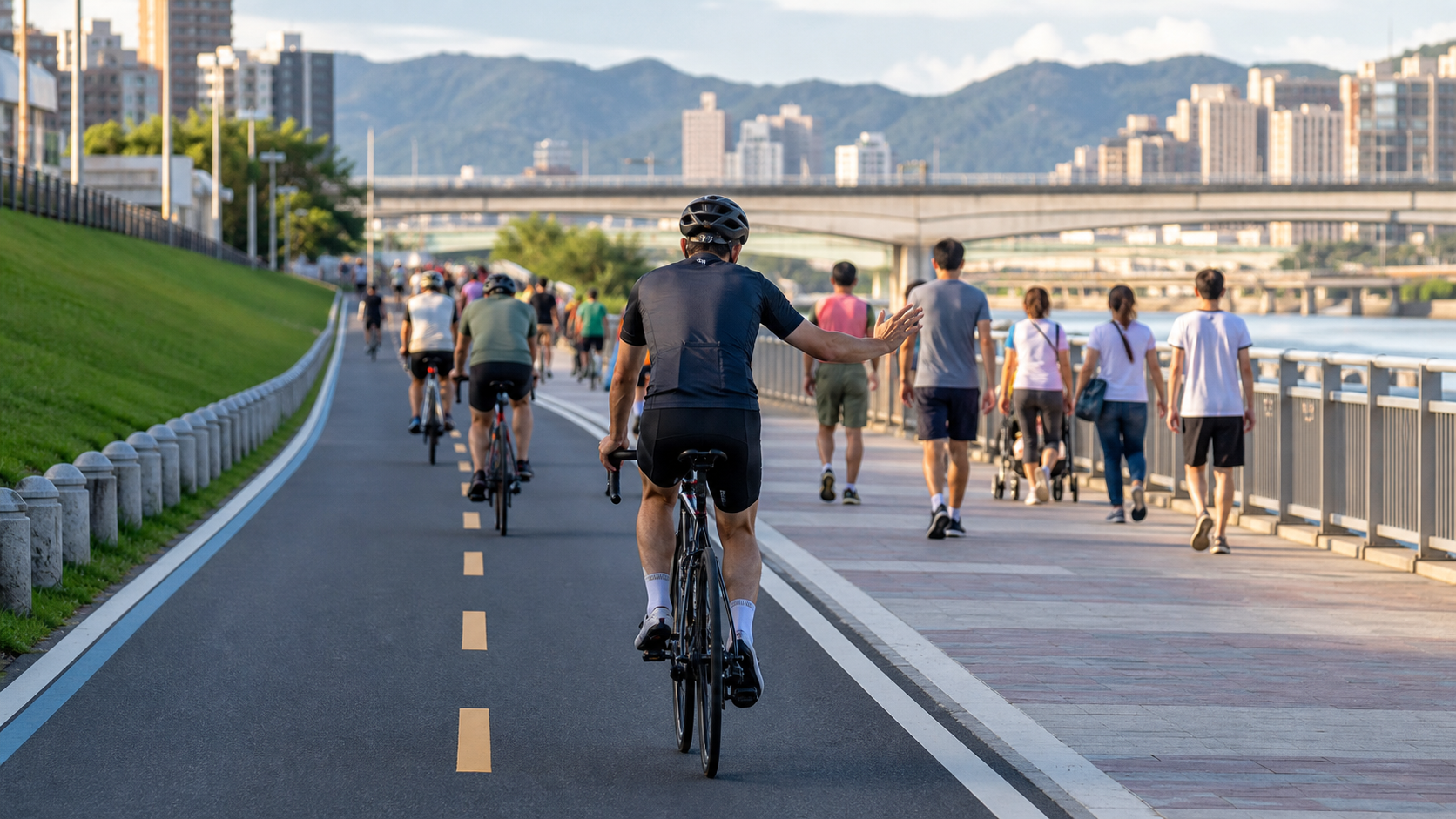
Taiwan’s bike lanes don’t belong exclusively to cyclists—pedestrians stroll on them, vendors set up shop alongside them, and scooters sometimes cut through them. This reality of “multi-purpose coexistence” is a unique challenge of Taiwan’s road environment, and an ecosystem every rider must learn to navigate. Good cycling etiquette isn’t empty preaching; it’s the lubricant that keeps this complex shared environment running peacefully, and it’s every rider’s fundamental responsibility for their own safety and the safety of others.
Current Challenges Facing Taiwan’s Bike Lanes
Taiwan’s bike lane environment faces several structural challenges:
- Mixed-use phenomenon: Many surfaces marked as “bike lanes” are simultaneously used by pedestrians, wheelchairs, strollers, and even light scooters, with no clear physical separation
- Inconsistent road surface quality: Height differences are common at transition points between bike lanes and regular roads, and parked cars and scooters occupying the lane are an everyday occurrence
- Wide speed disparities: Competitive road cyclists and commuters riding YouBikes share the same lane, with speed differences that can exceed 3 times
- Lack of safety education: Compared to scooter training, Taiwan has no systematic cycling safety education program
Basic Cycling Etiquette Guidelines
The following are basic behavioral guidelines that riders in Taiwan should collectively follow, covering different usage scenarios:
On dedicated bike lanes:
- Separate by speed: faster riders use the outer side (closer to the roadway), slower riders use the inner side (closer to pedestrians)
- Always overtake from the left, and give verbal notice before passing (“coming through” or a bell ring)
- Don’t stop to chat in the lane; if you need to stop, move to an open area beside the lane
- Avoid riding side-by-side, especially on sections with other users
On regular roads:
- Ride on the right side, keeping 30–50 cm from the curb (to avoid being hit by suddenly opened car doors)
- When waiting at intersections, don’t enter the waiting area in front of cars and scooters, to avoid blind-spot accidents
- Night riding requires front and rear lights; Taiwan law mandates a front light and rear reflector for cycling at night
- Don’t ride on expressways or freeway sections where bicycles are prohibited
Coexisting with pedestrians:
- Slow down well before approaching pedestrians; don’t expect them to make way for you
- In crowded plazas, market areas, and other pedestrian-dense zones, consider dismounting and walking your bike
- Anticipate sudden pedestrian movements; many pedestrians aren’t accustomed to watching for fast-moving bicycles
Guidelines for Taiwan-Specific Situations
| Situation | Recommended Approach | Wrong Approach |
|---|---|---|
| Pedestrians blocking riverside paths | Ring bell early, give verbal notice, wait patiently for them to make way | Approaching at high speed and squeezing past closely beside people |
| Scooters occupying bike lanes | Avoid by going around or wait for the scooter to move | Hitting the scooter or getting into conflict with the rider |
| Waiting at a red light | Wait behind the stop line, don’t go past cars ahead | Running the red light or weaving through traffic |
| Approaching crowds at high speed downhill | Brake and slow down early, prioritizing crowd safety | Ringing the bell to demand pedestrians move aside without slowing yourself |
| Riding against traffic (rare cases) | Absolutely avoid—wrong-way riding is one of the leading causes of traffic accidents in Taiwan | Doing it because “it’s faster this way” |
Proper Response to Accidents
Cycling accidents are not uncommon in Taiwan, and responding correctly when one occurs can prevent secondary harm:
- Stay calm: Regardless of who’s at fault, heated emotions only make the situation worse
- Check for injuries: Prioritize confirming whether either party is injured; if so, call 119 immediately
- Remain at the scene: Don’t leave before things are properly handled, or you may face hit-and-run liability
- Take photos: Use your phone to document the accident scene, both vehicles, and road conditions
- Notify your insurer: If you have personal liability or accident insurance, notify the company promptly
Personal Responsibility in Promoting a Safety Culture
Every rider’s behavior shapes the public’s collective impression of the cycling community:
- One image of someone running a red light circulating on social media reinforces the stereotype that “cyclists don’t follow the rules”
- One act of proactively yielding to a pedestrian may make that pedestrian more friendly toward cyclists next time
- Building a cycling-friendly environment in Taiwan depends on the collective civic behavior of riders—this isn’t a trivial personal matter, but the accumulation of an entire culture
Practical Recommendations
- A helmet is the most basic safety gear; Taiwanese law already requires helmets for cyclists under 14, and adults should proactively wear one too
- Buying a loud bell (or electronic horn) is a practical investment for dealing with Taiwan’s sidewalk usage habits
- Consider taking a cycling safety training course; some city and county governments offer free courses where you can learn proper emergency braking techniques and intersection safety judgment
- Lighting equipment for night riding deserves serious investment: at least 400 lumens for the front light, and a flashing mode for the rear light to make yourself more noticeable to drivers behind you
Conclusion
Taiwan’s roads are shared space for all users, and its safety culture won’t appear out of thin air—it’s built collectively by everyone moving on them. When cyclists choose to be courteous, yielding, and responsible in using this space, they’re not just protecting themselves, but also paving the way for more people who want to join the cycling community in the future. A good cycling culture accumulates from every time you ring your bell and every time you proactively slow down.
Related Reading
- Traffic Safety While Cycling: Proper Riding Behavior Under Taiwan’s Road Conditions
- Taiwan Bike Lane Regulations: Differences Between Dedicated Lanes and Regular Roads
- Women’s Cycling Culture: The Growth and Community of Female Riders in Taiwan
- The Complete Guide to Mountain Bike Trail Etiquette: Letting Everyone Enjoy the Mountains
單車 一日北高 ( 雙城 ) 肥宅雙人瘋狂行 紀錄片 REACTO
10 年前
高雄綠園道鐵路自行車道 / 外地人能輕鬆駕馭 還是整路崩潰? / 2025 全線開通 春節實地探索一次!(附GPS連結)/ 公路車 / CT Yeh
1 年前
「悲情男車友」創作單曲 爆笑MV / 公路車 / CT Yeh / 4K劇情版
7 個月前
太平山單車員工旅遊 | 這樣玩CP值最高!| 公路車
5 年前
4K 東眼山 x 水蜜桃冰沙 百人單車約騎! 操完再吃冰 多爽快
7 年前
花東縱谷單車遊 feat. Doris 景點五分鐘快速掃瞄 / 公路車 / CT Yeh
2 年前
2023自行車展!與環台賽選手一同表演賽 / 全自動AI Fitting?/ TIME新車發表/神秘充電桌等 精華分享 VLOG | CT Yeh | 公路車
3 年前
風櫃嘴 | 全台最多大砲的單車路線 | 尋寶網攝影師告訴你怎麼擺拍起來才好看 | 熱門攝影地點巡禮
6 年前