Introduction
Swimming competitions are divided into two specifications: short course (25 meters) and long course (50 meters). World records are calculated separately, and race strategies differ significantly. Many training pools in Taiwan are primarily 25 meters, but national-level competitions mostly use 50-meter long course pools. Swimmers who are only accustomed to one specification often find themselves caught off guard when switching to the other venue. Understanding the fundamental differences between the two course types is essential to performing at your best across different competition formats.
Core Differences Between Course Specifications
| Item | Short Course (SCM) | Long Course (LCM) |
|---|---|---|
| Pool Length | 25 meters | 50 meters |
| Number of turns in 100m | 3 | 1 |
| Proportion of wall push-offs | High (approximately 3–5% of time) | Low |
| World Records | Calculated separately (typically faster) | Olympic standard |
| Swimmer Preference | Those skilled at turns | Those skilled at straightaway sprinting |
Because short course features frequent turns, each wall push-off is “free power.” Swimmers with strong turn technique often achieve better results in short course. Long course tests a swimmer’s pure swimming ability, especially the efficient management of stroke rate and stroke length.
Short Course Race Strategy
Prioritizing Turn and Wall Push-off Efficiency
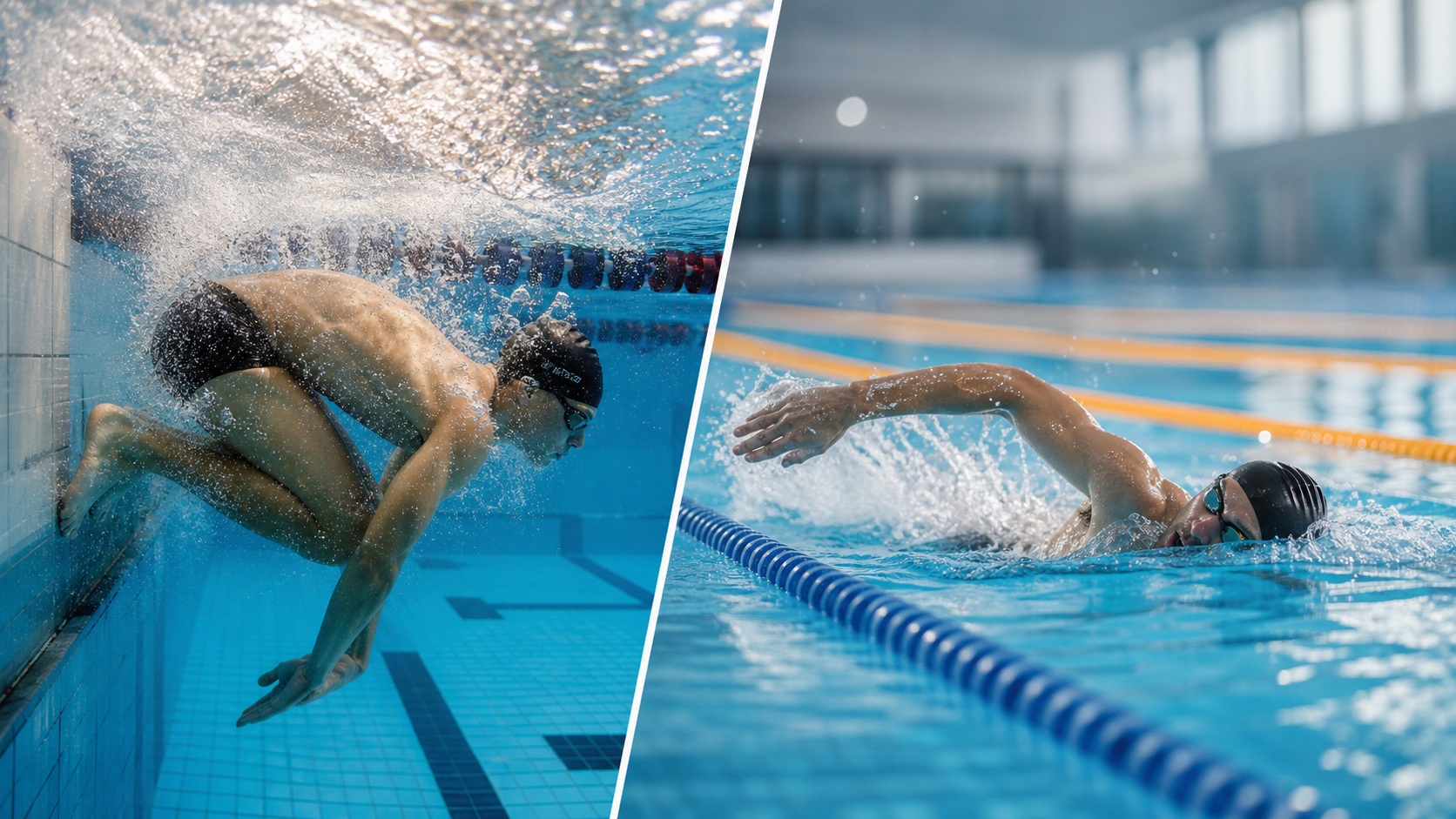
The key to short course racing lies in maximizing glide distance off each wall push-off. An ideal flip turn requires attention to:
- The final stroke before the wall should not disrupt rhythm
- Push-off angle maintained 15–20 cm below the water surface
- Streamlined glide position, arms pressed against ears, ankles flexed
- Begin stroking only when glide speed drops to swimming speed (typically 1.5–2 meters)
More Aggressive Pacing
With frequent turns providing added power, short course allows for more aggressive early-race pacing. Taking the 200m freestyle as an example, swimmers can be slightly bolder in the first 100m, relying on four wall push-offs to sustain power in the latter half.
Breathing Strategy Adjustments
- In short course, the wall is reached every 25m, and some swimmers are accustomed to “holding their breath and sprinting” the final 5m before the wall
- Short course races have a more compact rhythm; it is recommended to breathe every 3–4 strokes to maintain oxygen supply
Long Course Race Strategy
Stroke Efficiency Is the Core
In long course, there is only one turn every 50 meters. Swimmers cannot rely on wall push-offs to replenish power, so the economy of stroke technique determines everything. Training focus:
- Increase Stroke Length: distance traveled per stroke
- Maintain a streamlined entry angle to reduce drag
- Core stability to avoid excessive body roll that wastes energy
First-Half/Second-Half Pacing Principles
Longer events (200m and above) commonly adopt the “Negative Split” strategy, where the second half is slightly faster than the first half:
- 400m freestyle: Preserve 3–5% energy in the first 200m, accelerate in the final 200m
- 200m individual medley: Don’t start the butterfly too fast, use backstroke for breathing recovery, maintain rhythm in breaststroke, and go all-out in freestyle
Training Recommendations for Cross-Course Transition
- Swimmers accustomed to short course: Strengthen straightaway stroke efficiency training, reduce reliance on wall push-offs, and build endurance through sustained long-distance swimming
- Swimmers accustomed to long course: Refine flip turn technique, practice fast approach to the wall and push-off angles, and enhance short course advantages
- Cross-training: If conditions allow, schedule 2–3 training sessions per month in pools of different lengths to improve adaptability
Practical Recommendations
- Confirm the competition pool specification before the race and adjust your training plan accordingly
- For short course races, practice “approach-to-wall rhythm” to ensure smooth turns without interrupting swimming speed
- For long course training, record and analyze stroke efficiency more frequently, tracking changes in stroke length
- Conduct simulation races in pools matching the actual competition specification to avoid in-race discomfort
Conclusion
The difference between short course and long course is not just distance—it is an entirely different competitive logic. Swimmers who leverage turn advantages excel in short course, while those with high stroke efficiency shine in long course. The most elite swimmers can adapt to both—by understanding the strategic differences and training with purpose, every swimmer can find their own winning formula in either format.
Related Reading
- Technical Differences Between Short Course and Long Course: The Impact of Turn Frequency on Pacing
- Technical Differences Between 50m Short Pool and Long Pool Swimming: Turn Ratio and Pacing Strategy
- Training Differences Between Taiwan’s 50m and 25m Pools: A Complete Guide to Workout Adjustments
- 25m Short Pool vs 50m Long Pool: What Exactly Is the Difference in Training Strategy?
Live) 備戰2019彰化經典百K 賽前攻略 (已完賽請看新影片
7 年前
live) 超越北高 之一日北高12小時 策略
7 年前
CT 喇低賽) 武嶺牽車 才是王道 西進牽車四小時內秘訣 攝手位置 如何判斷 防抽筋小秘訣
7 年前
西進武嶺 免費訓練分析服務 Intervals | 練不夠還是練過頭?你哪一種類型選手?AI模型告訴你! | 備戰神器 | 公路車 訓練 | CT Yeh
4 年前
崇越盃武嶺冠軍高手 賽前JJSC 群峰會精華!對應大數據分析,會有落差嗎?/ feat. JJSC中部公路車約騎 /公路車 / CT Yeh
2 年前
2019 夏季KOM 5小 完賽心得 準備攻略 東進武嶺 夏季登山王之路 Taiwan KOM Challenge
7 年前
半日 小台灣 極限單車路線挑戰實錄
7 年前
實景訓練台) 彰化經典百K 高強度喵團 90分鐘 跟著一起練功 2019 Indoor workout Changhua Classic 100 Taiwan
7 年前