Introduction
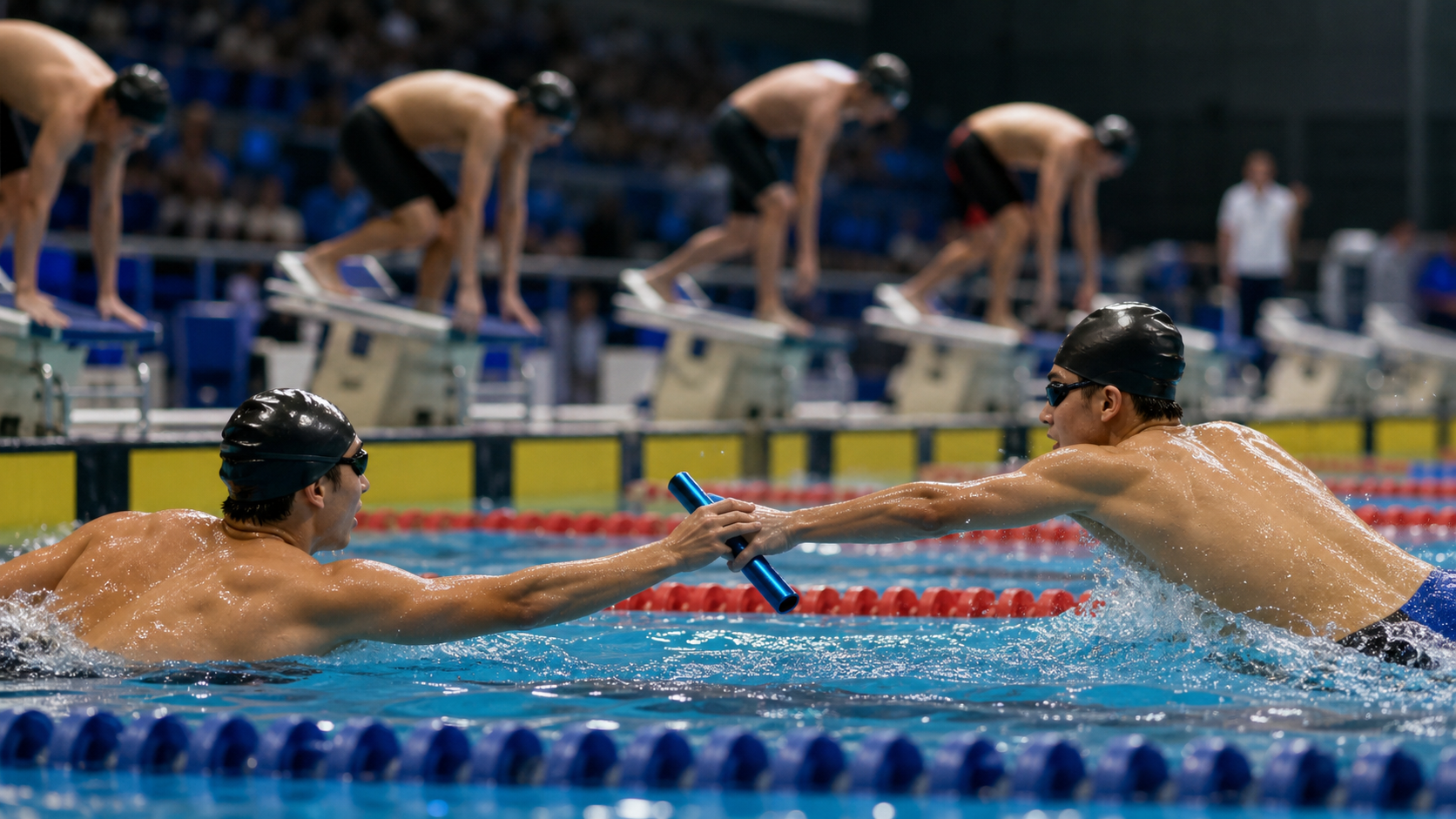
The swimming relay is one of the few swimming events that requires team collaboration, and it is also one of the most exciting segments for spectators. Taiwan’s National High School Athletic Games, National Intercollegiate Athletic Games, and National Championships all feature the 4×100m freestyle relay and the 4×100m medley relay. Relay results are not merely the sum of four individual performances—exchange precision, starting order strategy, and team psychological coordination are all decisive factors in the final ranking. A well-executed exchange can legally save 0.1–0.2 seconds, and with four exchanges, that adds up to a 0.4–0.8 second advantage.
Relay Rules and Exchange Timing
According to World Aquatics rules, the incoming swimmer’s feet must not leave the block until the preceding swimmer has touched the wall, but swimmers can use an “anticipatory start” to complete the push-off from the block at the same moment the touch occurs. Mastering this timing differential is the core of relay exchange training.
| Exchange Method | Timing Control | Risk | Advantage |
|---|---|---|---|
| Conservative exchange | Jump only after seeing the touch | Loses 0.3–0.5 seconds | Zero disqualification risk |
| Precise exchange | Anticipate the touch timing, nearly synchronized | Requires extensive practice | Saves 0.1–0.2 seconds |
| Early exchange (disqualification) | Leaves the block too early | DQ (disqualification) | — |
The Strategy Philosophy of Starting Order
Common Arrangements for the 4×100m Freestyle Relay
There is no one-size-fits-all formula for relay order, but several common strategic logics exist:
Strategy 1: Strong–Weak–Weak–Strong
- Leg 1 (lead-off): Second-strongest swimmer, establishes a solid start without being overly aggressive
- Leg 2: Third-strongest swimmer, maintains relative position
- Leg 3: Weakest swimmer, minimizes the deficit
- Leg 4 (anchor): Strongest swimmer, settles the race with the best ability
Strategy 2: Strong–Strong–Weak–Strong
- Build an advantage from the start, applying psychological pressure on opponents
- Risk: The weak leg faces greater pressure
Strategy 3: Decide Based on Daily Form
- Assess each swimmer’s warm-up feel on race day and adjust the order dynamically
Stroke Arrangement in the Medley Relay
The stroke order in the 4×100m medley relay is fixed (backstroke → breaststroke → butterfly → freestyle), but the selection strategy:
- Backstroke lead-off: The start is the only one taken from the water, requiring particular proficiency in the backstroke start
- Breaststroke second leg: After the exchange, a compliant underwater glide is required, demanding high technical skill
- Butterfly third leg: Typically assigned to the team’s strongest butterfly swimmer
- Freestyle anchor: The team’s strongest sprint-type swimmer is placed here to close the race
Exchange Training Methods
Timed Exchange Training
- Have the incoming swimmer stand on the block, practicing judging the takeoff timing by “watching the preceding swimmer’s speed over the final 5 meters”
- Time from “preceding swimmer touches the wall” to “incoming swimmer enters the water,” aiming for under 0.1 seconds (precise exchange)
- Repeat extensively to build an automated “visual trigger → push-off” response
Psychological Coordination Training
Relays are not just technical; they are also psychological:
- The preceding swimmer must touch the wall “cleanly” (without relying on the wall or signaling the incoming swimmer) to avoid an accidental DQ
- The incoming swimmer must stay focused, undistracted by crowd noise or the timing board display
- Simulate race pressure in training so exchanges are performed in front of spectators
Common Relay Mistakes in Taiwan
- Overly conservative exchanges: Waiting too long out of fear of disqualification, losing significant time. Countermeasure: Practice extensively to build confidence in precise exchanges
- Unclean touch by the preceding swimmer: When fatigued, the touch position may be off (e.g., only grazing the corner of the wall), causing judgment issues or making it hard for the incoming swimmer to see clearly. Countermeasure: Train a “standard touch technique” to ensure the hands or body clearly contact the wall
- Last-minute changes to relay order: Plans are clear before the race, but changes are made at competition time, leaving swimmers psychologically unprepared. Countermeasure: Finalize the relay roster and backup swimmer strategy well in advance
Practical Recommendations
- Hold “relay practice races” during training: Schedule one relay practice per week to make exchanges a habitual action
- Film and analyze exchange segments: Side-angle video clearly reveals whether exchange timing is precise
- Design a “contingency plan”: If a scheduled swimmer is injured or underperforms before the race, have a backup swimmer order ready
- Pre-relay team huddle: A brief team huddle before the race boosts cohesion and confidence heading into the event
Conclusion
The swimming relay is a collective art—the combined technique of four swimmers plus precise exchange strategy can produce a team performance better than the sum of individual results. Exchange training deserves the same emphasis as technical training, while starting order strategy tests the coach’s big-picture vision. Cultivate relay chemistry through daily practice, and only then can you showcase seamless team power on race day.
Related Reading
- Team Strategy in the Four-Stroke Relay: Competitive Considerations of Order Arrangement and Exchange Technique
- Swimming Relay Races: Split Strategy and Swimmer Substitution in the Four-Person Relay
- Complete Analysis of Relay Exchange Technique in Swimming: The Art of 0.03 Seconds
- Key Technical Points in Swimming Relays: Exchange Timing and Teammate Coordination
Live) 備戰2019彰化經典百K 賽前攻略 (已完賽請看新影片
7 年前
CT 喇低賽) 武嶺牽車 才是王道 西進牽車四小時內秘訣 攝手位置 如何判斷 防抽筋小秘訣
7 年前
Zwift跨國線上追逐賽 第二站 台灣 TTR vs. 日本 JETT 第二場 (台灣追日本) | 數百位國內外公路車高手,同場較勁 | 多視角賽事直播
4 年前
新屋團體繞圈賽 | 眾多菁英好手賽道奔馳 | 千瓦女子軍團 | 無敵交管狂獲好評 明年你一定不能錯過 | #公路車
5 年前
#公路車 #西進武嶺 配速配瓦實驗 坡度分析 四小時內攻略 建大盃 NeverStop #西進武嶺攻略
6 年前
西進武嶺 自製新版AI配速表產生器 x 賽前攻略 抱佛腳! 沒有功率計也可以產生配速表嗎?有什麼其他眉角賽前要注意的呢? | 西進武嶺 / 東進武嶺 KOM 攻略 | 公路車 | CT Yeh
4 年前
2025 海鷗團體繞圈賽 網路直播 超激烈裁判長視角 / EIPC 李廷威、Waypoint 等眾多高手競爭 / feat. 卡密兒主持 / 海鷗繞圈賽
9 個月前
live) 超越北高 之一日北高12小時 策略
7 年前