Gravel Bike vs Road Bike: A Comprehensive Analysis of the Differences and Buying Guide
文章導覽
- 1. Frame Geometry: Stability vs Agility
- 2. Tire Clearance: The Fundamental Difference in Versatility
- 3. Braking Systems: The Dominance of Disc Brakes
- 4. Drivetrain: The Difference in Gearing Philosophy
- 5. Handlebar Design: The Diversity of Hand Positions
- 6. Load Capacity and Mounting Points: The Infrastructure for Adventure
- 7. Suspension and Comfort Design
- 8. Price and Maintenance Costs
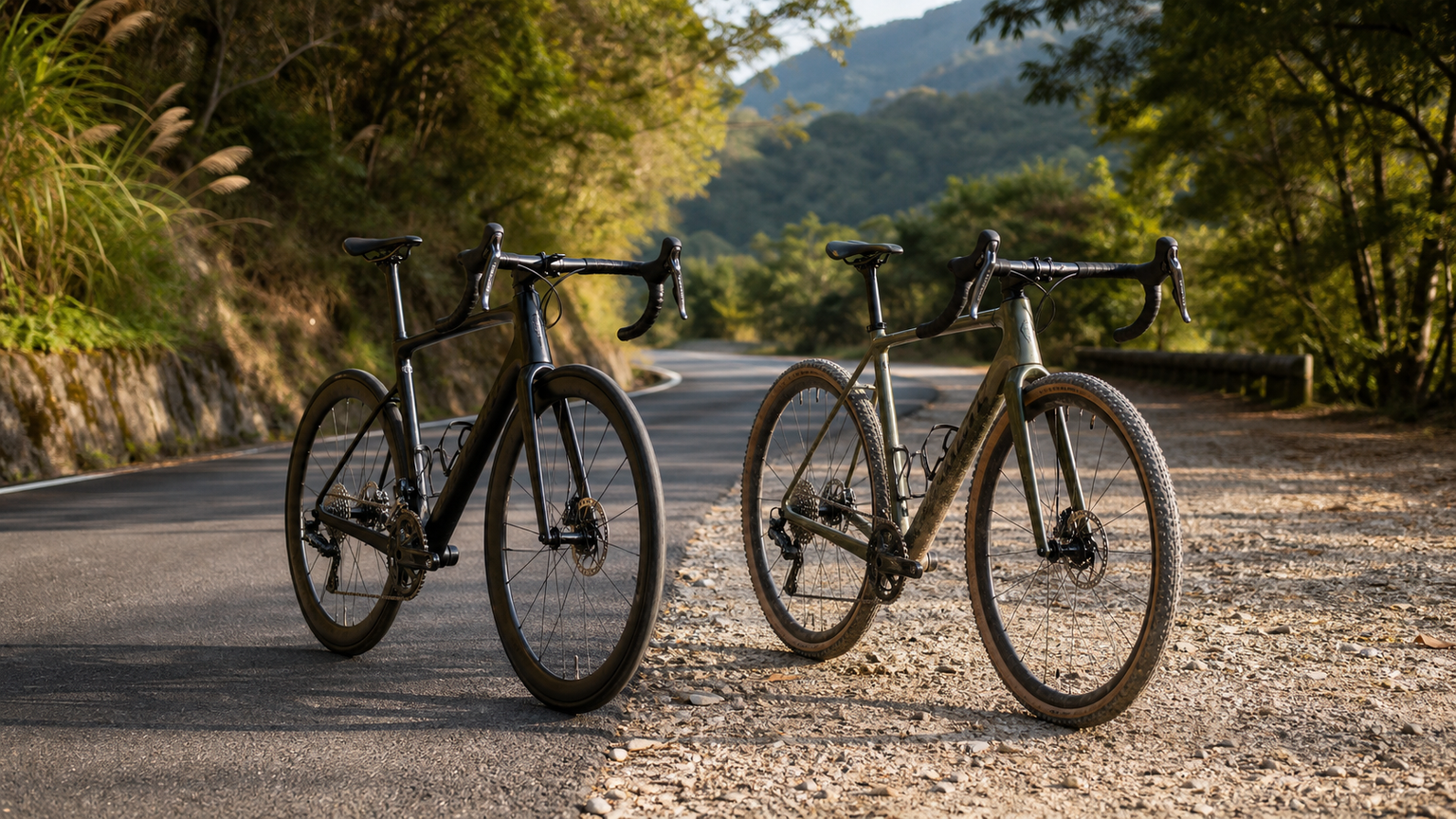
Gravel Bike vs Road Bike: A Comprehensive Analysis of the Differences and Buying Guide
In recent years, the gravel riding trend has swept across the global cycling world, with more and more riders starting to pay attention to this category that sits between road bikes and mountain bikes. However, many people ask the same question when first encountering a gravel bike: “What exactly is the difference between it and a road bike?” This article will provide an in-depth comparison across eight key aspects to help you make the most informed choice.
1. Frame Geometry: Stability vs Agility
Road bike frame geometry is designed for high speed and agile handling. The head tube angle is steeper (approximately 72-73 degrees) with a shorter fork offset, allowing the front end to respond quickly and carve precisely through every corner when cruising at high speeds on asphalt.
Gravel bikes, on the other hand, adopt a more relaxed geometry. The head tube angle typically ranges between 70-72 degrees, paired with a longer fork offset and a longer wheelbase. This design sacrifices some agility in exchange for greater straight-line stability on unstable surfaces such as gravel roads and trails. Simply put, when riding on bumpy gravel roads, a gravel bike won’t make you feel like the bike is about to slip out of your hands the way a road bike might.
Another key difference is the BB drop (bottom bracket drop). Gravel bikes typically have a larger BB drop (approximately 70-75mm), resulting in a lower center of gravity, which provides better stability on technical terrain. Road bikes have a BB drop of approximately 65-70mm, and the higher center of gravity aids pedaling efficiency and cornering lean.
2. Tire Clearance: The Fundamental Difference in Versatility
This is the most obvious difference between the two bike types. Road bike tire clearance typically only accommodates 25-32mm tires, while modern gravel bikes commonly support 40-50mm or even wider tires.
The benefits of wider tires go beyond just off-road capability. Wider tires mean:
- Lower tire pressure: Can run at 30-40 psi, significantly improving comfort
- Larger contact patch: Better traction on loose surfaces
- Greater shock absorption: Road vibrations are no longer transmitted directly to your arms
- Lower risk of flats: Larger tire volume makes snake bites less likely
3. Braking Systems: The Dominance of Disc Brakes
Modern gravel bikes almost exclusively use disc brakes, and for good reason. On muddy, slippery gravel surfaces, rim brakes suffer a significant loss of braking power, whereas disc brakes are unaffected by weather and surface conditions, delivering consistent braking performance.
On road bikes, while disc brakes have become mainstream, some models and riders still prefer rim brakes. The advantages of rim brakes are lighter weight and simpler maintenance, but in gravel riding scenarios, these benefits are far outweighed by the safety assurance that disc brakes provide.
Most gravel bikes use 160mm rotors, and some models even feature 180mm rotors on the front wheel to handle the heat dissipation demands of long descents and loaded riding.
4. Drivetrain: The Difference in Gearing Philosophy
Road bikes pursue speed, so their gearing tends toward large chainrings paired with small cassettes. A common setup is a 52/36T chainset paired with an 11-28T or 11-30T cassette, with a maximum gear ratio reaching 4.7:1 or higher.
Gravel bikes, however, need to handle climbing, gravel, and even hike-a-bike scenarios, so their gearing leans more toward climbing capability. A common setup is a 40T or 42T single chainring paired with a 10-44T or 10-52T cassette. Single-chainring systems are particularly popular in the gravel world for several reasons:
- Simplified operation: Only one shift lever is needed, reducing operational complexity when riding off-road
- Lower failure rate: Eliminating the front derailleur removes one component prone to mud and debris interference
- Weight reduction: Saves the front derailleur, left shifter mechanism, and one chainring
- Chain stability: Paired with narrow-wide chainrings, significantly reducing the risk of chain drops
5. Handlebar Design: The Diversity of Hand Positions
Road bike drop bars are designed with aerodynamics and multiple hand positions in mind. Gravel bike drop bars typically have a wider flare (outward angle), with the drops flaring outward anywhere from 12 to 24 degrees.
This design is extremely practical on gravel roads. The wider drops provide better handling stability, much like extending the lever arm for steering. Additionally, the flared angle places the wrists in a more natural position when gripping the drops, making long rides more comfortable.
Some gravel riders even add bar ends or use special loop bar designs to further increase the variety of hand positions.
6. Load Capacity and Mounting Points: The Infrastructure for Adventure
This is one of the fundamental differences in design philosophy between road bikes and gravel bikes. Gravel bike frames are typically covered with mounting points:
- Front and rear rack mounting holes
- Bottle cage bosses (usually 3 or more sets)
- Frame bag mounting points
- Cargo cage mounting holes on the fork
- Top tube bag attachment points
These mounting points give gravel bikes bikepacking capability, allowing riders to carry the gear needed for multi-day camping rides. Road bikes typically only have basic bottle cage bosses, with at most an additional mounting point behind the seatpost.
7. Suspension and Comfort Design
Some high-end gravel bikes come equipped with front suspension systems or frame-integrated compliance mechanisms (such as Specialized Future Shock, Trek IsoSpeed, etc.), which are extremely rare on road bikes.
Even without a suspension system, gravel bikes enhance comfort through thinner seatposts (27.2mm), longer exposed seatpost length, and the flex characteristics of carbon fiber. Road bikes, in contrast, tend to favor thick, aero-shaped tubing to pursue stiffness and aerodynamics.
8. Price and Maintenance Costs
Entry-level gravel bikes are typically priced similarly to road bikes in the same tier, but maintenance costs may be slightly higher. Wider tires need to be replaced more frequently (especially when ridden mostly on gravel surfaces), and disc brake pads also require regular inspection and replacement.
However, gravel bike components are generally more durable than those on road bikes. Sturdier wheels, thicker tires, and wider chains all contribute to greater long-term reliability for gravel bikes.
Who Should Choose a Gravel Bike?
If you meet any of the following criteria, a gravel bike might be the better choice:
- Diverse riding routes: You don’t just ride on pavement—you also want to explore farm roads, trails, and riverside gravel paths
- Comfort is a priority: You’re not chasing top speed but rather enjoying the experience of long-distance riding
- You have bikepacking plans: You want to carry gear for multi-day riding adventures
- You want one bike for everything: You hope a single bike can handle commuting, exercise, travel, and other scenarios
Conclusion
There is no absolute superiority between road bikes and gravel bikes—only what suits your riding style. If your goal is to chase speed on asphalt, a road bike remains the undisputed choice. But if you crave a freer, more diverse riding experience, a gravel bike opens the door to endless possibilities.
In Taiwan, from the farm roads along the northern coast to the trails in the central region and the gravel paths through the eastern rift valley, a gravel bike can take you to scenery that road bikes simply cannot reach. Perhaps this is the most captivating aspect of gravel riding—the end of the road is where the real adventure begins.
Related Reading
- Gravel Bike Beginner’s Guide: The Perfect Balance Between Road Bikes and Mountain Bikes
- Gravel Bike Basics: Riding Differences and Technical Adjustments Between Gravel and Road Bikes
- 650B vs 700C: The Complete Guide to Choosing Gravel Bike Wheel Sizes
- Gravel Bike Off-Road Riding: The Rise of Gravel Roads and Taiwan Routes