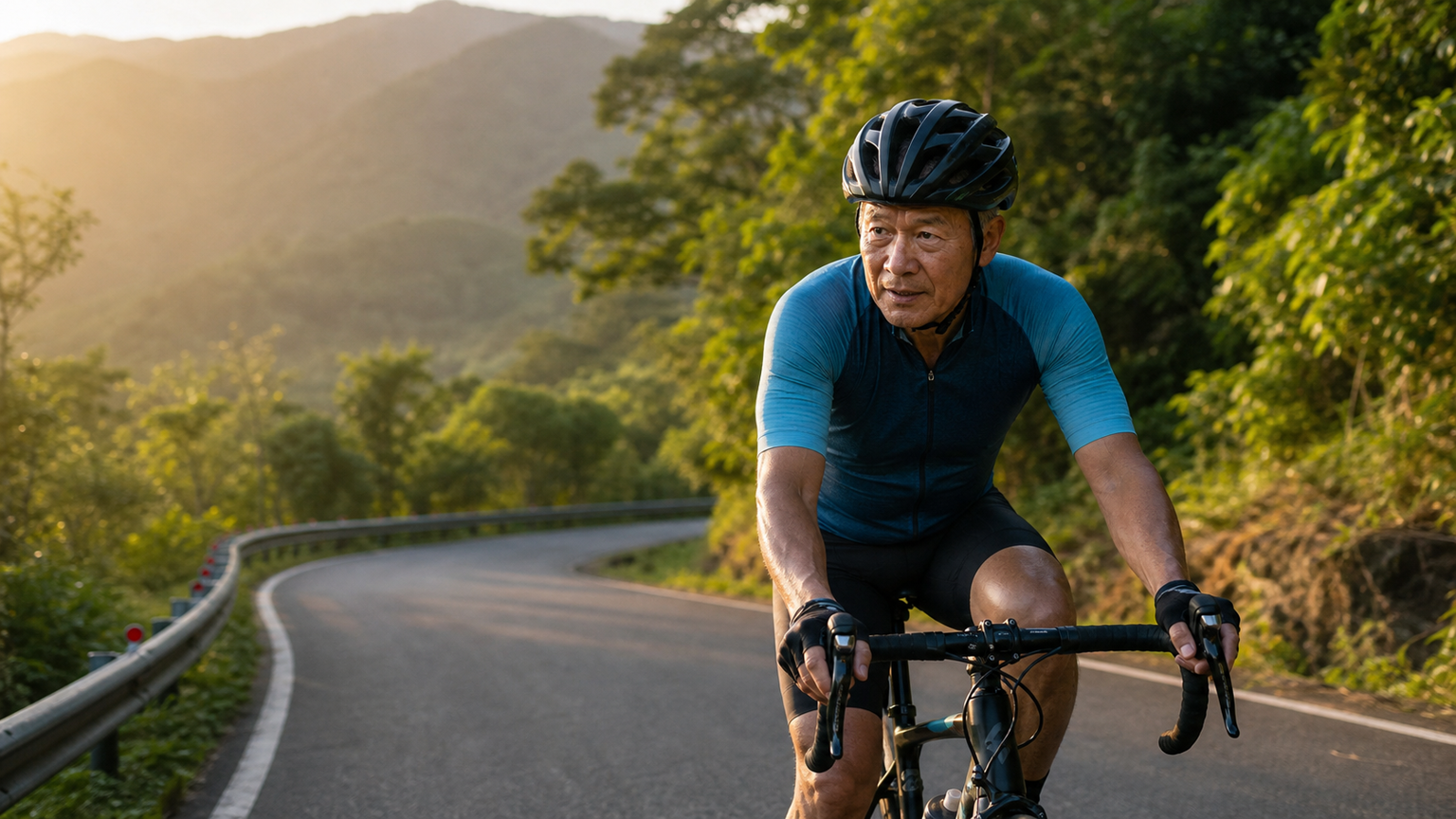
Never Too Late: Comeback Stories and Lessons from Masters Athletes
Introduction: Every Return to the Bike Is a Rebirth
In the world of cycling, there is a group of people whose stories are especially moving—they are not star athletes who claimed glory at their peak, but ordinary people who, after facing setbacks, illness, or a long hiatus, chose to get back on the bike.
What they share is not talent, but courage. Starting over requires more strength than simply persevering, especially when your body is no longer what it was twenty years ago.
Here are the comeback stories of several inspiring Masters athletes, along with the valuable lessons we can learn from them.
Story One: The Road to a Championship After Heart Bypass Surgery
Mr. Lin’s Story, Age 62
Mr. Lin was once an active amateur cyclist. At age 55, a routine health check revealed severe coronary artery blockage, requiring triple bypass surgery.
“When I woke up and saw that long scar on my chest, I thought I would never ride a bike again,” he recalls.
However, under the guidance of his cardiac rehabilitation physician, Mr. Lin began pedaling at very low intensity on an indoor trainer starting from the eighth week after surgery. Initially, he could only manage ten minutes, with his heart rate strictly controlled within the safe range set by his doctor.
Key milestones in his comeback:
- 2 months post-surgery: 15 minutes/day on the indoor trainer
- 4 months post-surgery: First outdoor ride (5 km on flat roads)
- 8 months post-surgery: Completed his first 50 km ride
- 14 months post-surgery: Entered his first Masters race (60–64 age group)
- 24 months post-surgery: Placed third in the 60–64 age group at the National Masters Championship
Lesson: Scientific Progression and Patience
Mr. Lin’s story teaches us that the comeback process demands extreme patience and a scientific approach. He strictly adhered to the principles of cardiac rehabilitation, with every step carried out under the supervision of his medical team. There are no shortcuts—only steady, gradual progression.
He often says: “That surgery wasn’t an ending; it was a chance for me to start over in a healthier way. Now I ride smarter than I did before the surgery, and I’m more grateful for every opportunity to ride.”
Story Two: A Former Collegiate Cyclist Returns After Twenty Years
Ms. Chen’s Story, Age 48
Ms. Chen was a cyclist on her university team. After graduating, she completely gave up sports due to work and family. For over two decades, her life was consumed by her job, raising children, and household chores. She gained 25 kg and her fitness declined dramatically.
On her 47th birthday, her children gave her a road bike as a gift, with a card that read: “Mom, we want to see you ride like you did when you were young.”
Challenges during her comeback:
- Her first ride lasted only 3 km before she was gasping for air
- Her hips and wrists ached for two full weeks
- She felt discouraged being easily passed by other riders on the road
- Time pressure from work and family left little room for training
How she overcame them:
Ms. Chen made several smart decisions:
- Joined a cycling club: She found a local club that welcomed beginners, gaining community support
- Set realistic goals: Instead of comparing herself to her younger self, she tracked her monthly progress
- Used fragmented time: She switched her commute to cycling (16 km round trip), integrating training into daily life
- Leveraged technology: She used an indoor trainer for 45-minute structured sessions after her children went to bed
Results after one year:
- Lost 15 kg
- Completed her first amateur 100 km event
- FTP improved from 120W to 185W
- Referred to by colleagues as “the most energetic manager”
Lesson: It’s Okay to Start from Zero
Ms. Chen’s experience shows us that even after a long break from exercise, the body has remarkable adaptive capacity. Scientists call it “muscle memory”—muscles that have been trained before recover much faster when retrained than those that have never been trained.
Her most important advice: “Don’t overthink it—just take the first step. I know starting to ride again at 47 sounds crazy, but if I hadn’t started then, I’d still be that unhappy, increasingly unfit version of myself.”
Story Three: The Ironman Journey After Beating Cancer
Mr. Chang’s Story, Age 55
Mr. Chang was diagnosed with stage II colorectal cancer at age 51, undergoing surgery and six months of chemotherapy. During chemo, he was so weak that even walking was difficult, and he lost 12 kg—almost all of it muscle.
In the first month after chemotherapy ended, with his wife’s support, he began walking 10–15 minutes a day near his home. Three months later, he bought an entry-level road bike.
“Chemotherapy made me realize how precious the body is. I didn’t want to waste it anymore,” he says.
Mr. Chang’s comeback timeline:
| Time after chemo | Activity | Notes |
|---|---|---|
| Month 1 | Daily 10–15 minute walks | Extreme fatigue, needed rest breaks |
| Month 3 | Started cycling (5 km on flat roads) | Monitored by oncologist |
| Month 6 | Rode 3 times/week, 30–45 minutes each | Added swimming rehabilitation |
| Month 12 | Completed first 100 km ride | In tears the entire way |
| Month 18 | Began triathlon training | Swimming, cycling, running |
| Month 24 | Completed a half Ironman | One of the loudest cheers of the event |
| Month 36 | Completed a full Olympic-distance triathlon | Age 54, cancer follow-ups clear |
Lesson: Exercise Is the Best Recovery Prescription
A growing body of research confirms that moderate exercise has significant positive effects on cancer recovery. It alleviates post-chemo fatigue, strengthens immune function, reduces the risk of recurrence, and greatly improves quality of life.
Mr. Chang’s oncologist later wrote in his medical records: “This patient’s rate and quality of recovery are among the best cases I have seen in my career. Exercise played an irreplaceable role.”
Story Four: A Corporate Executive Finds a New Identity After Retirement
Mr. Huang’s Story, Age 58
Mr. Huang was a senior executive at a tech company who took early retirement at 56. In the first six months after retiring, he fell into a serious identity crisis—without his title and packed schedule, he didn’t know who he was.
“I spent thirty years building an identity, and it vanished overnight.”
By chance, he accompanied a friend to a bike shop and test-rode a carbon fiber road bike. The feeling of the wind on his face awakened something deep inside him that had been dormant for a long time.
Two years later:
- Rides five days a week and is a core member of his local cycling club
- Earned a cycling coach certification and volunteers to mentor teenagers
- Finished in the top five in the 55–59 age group at the National Masters Championship
- Started a blog about middle-aged cycling with a steady readership
- “My identity now isn’t ‘former executive’—it’s ‘a person who rides.’ This identity makes me happier.”
Lesson: Exercise Can Redefine Your Life
The identity shift after retirement is a psychological challenge many people face. Cycling offers a new community, new goals, and a new sense of self. You don’t need to be the fastest—you just need to be the most committed.
Common Lessons from These Stories
Lesson One: The Starting Point Doesn’t Matter—the Direction Does
Whether your starting point is a post-surgery hospital bed, a body that hasn’t exercised in years, or the weakness left by chemotherapy, as long as your direction is right, every step is taking you somewhere better.
Lesson Two: The Power of Community Cannot Be Underestimated
Every athlete who successfully made a comeback mentioned the importance of community support—teammates, encouragement from family, guidance from coaches, or simply a “you can do it.”
Lesson Three: Embrace the Imperfect Process
The comeback journey is never smooth sailing. There will be days of regression, days of pain, and days when you want to give up. But it is precisely these imperfections that make the final achievement all the more precious.
Lesson 4: Redefining Success
In these stories, success is no longer defined by KOMs on Strava or race results, but rather by:
- Being able to finish today’s training
- Riding 5 kilometers more than last month
- Enjoying the scenery while waiting for your partner at the summit
- The joy you feel when you put on your cycling jersey
Conclusion: Your Story Is Waiting to Be Written
If you are considering starting over, or struggling on the road to a comeback, I hope these stories can give you strength.
Every Masters athlete was once a beginner. Every achievement today began with a first step yesterday. And the day you take that first step is the day your comeback story begins.
No matter how old you are, no matter where your starting point is—go ride. Your future self will thank you for the you of today.
Related Reading
- Training Strategies for Riders Over 40: The Golden Rules for Masters Riders
- Getting Back on the Bike After 40: Body, Mindset, and Unexpected Surprises for Middle-Aged Riders
- Returning to Cycling After Heart Surgery: The Road to Recovery from Hospital Bed to Saddle
- The Science of Masters Athletes: How to Stay at Your Peak and Get Stronger Smarter After 40
Never Stop 西進武嶺 前後雙機 完整全程錄影 訓練台 實境
8 年前
單車實況) 車測中心高速賽道 96 彰化讚 挑戰組一圈實錄 | ARTC
6 年前
公路車 | DanCup 繞圈賽 | 馮俊凱 151 林彥君 等大咖同場交流 | 卡丁車場也可以繞!| 4K超高畫質
5 年前
96桃園繞圈賽 各組觀戰精華 Insta360 X3 模擬搖臂空拍 | 馮俊凱 黃亭茵 | U17 M30 M40 女子 菁英 | 公路車 CT Yeh
3 年前
日本公路最高登山賽,台灣首位YT挑戰實錄,乘鞍登山賽40週年,賽前篇完整版,請到我的YT收看 #公路車 #cycling
10 個月前
西進武嶺 免費訓練分析服務 Intervals | 練不夠還是練過頭?你哪一種類型選手?AI模型告訴你! | 備戰神器 | 公路車 訓練 | CT Yeh
4 年前
公路車 | 塔塔加驚險員工旅遊 | 還好手腳快沒被抓交替!
5 年前
血脈噴張) 2019 美利達 彰化經典百K 搖滾版 ft. Team Neko 市民的環台賽
7 年前