文章導覽
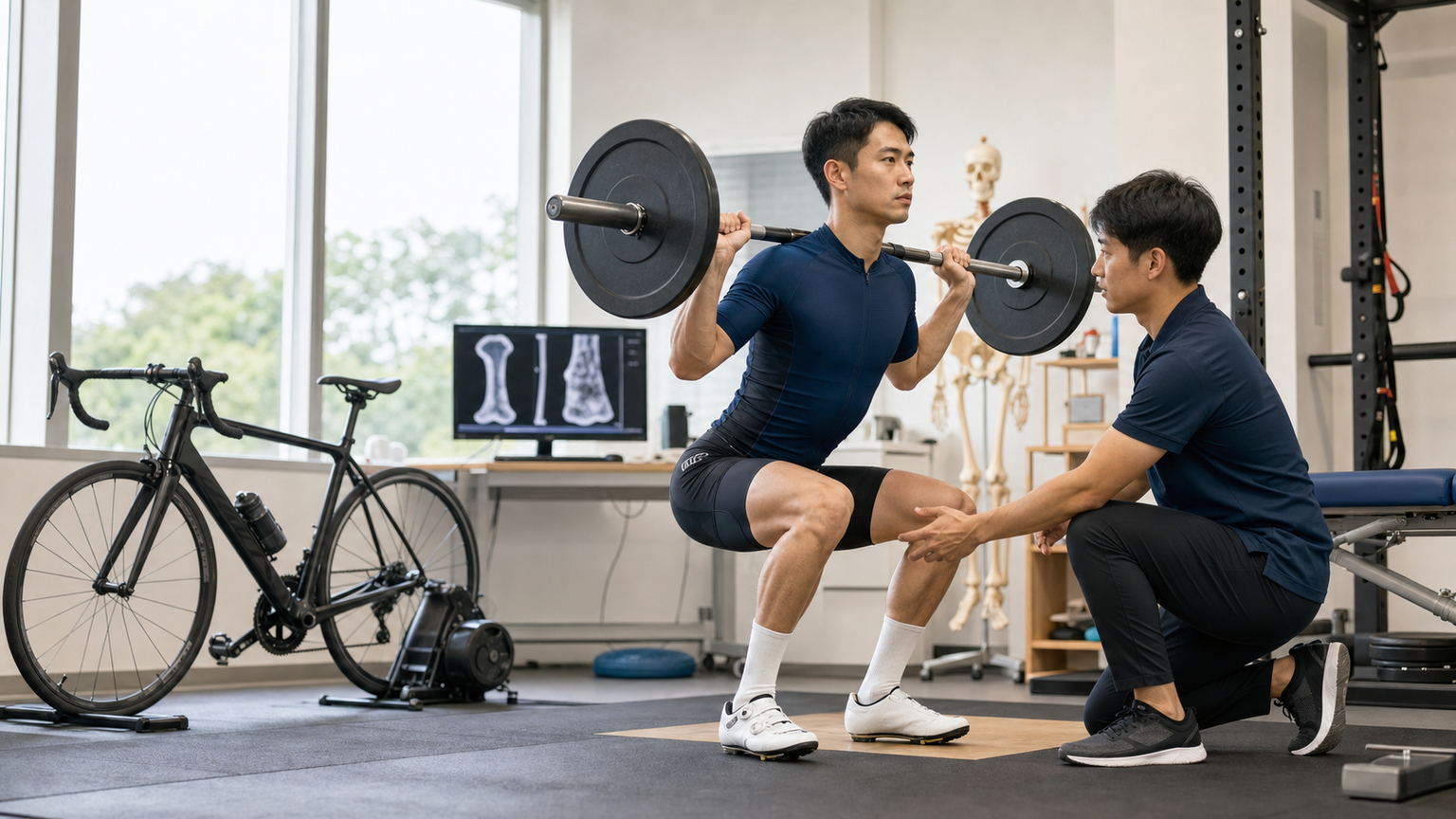
Bone Bank: The Battle for Athletes’ Bone Density
Foreword: The Risk Hidden Behind a Healthy Appearance
Here’s an unsettling fact: many cyclists who look perfectly healthy actually have lower bone density than sedentary people of the same age.
A study published in Medicine & Science in Sports & Exercise found that professional road cyclists generally have low bone density in the spine and hips, with some even meeting the criteria for osteoporosis. This seems contradictory—these people exercise for over a dozen hours a week, how could their bones be in poor shape?
The answer lies in the basic biology of bone: bones require weight-bearing and impact to maintain and increase density, and cycling happens to be a non-weight-bearing exercise.
Understanding Bone Density
The Dynamic Nature of Bone
Bone is not a static structure; it undergoes “remodeling” every day—osteoclasts absorb old bone, and osteoblasts form new bone. In youth, new bone formation outpaces absorption, and bone density steadily increases until reaching “peak bone mass” at ages 25-30.
After that, bone resorption gradually exceeds bone formation, and bone density begins to decline slowly:
- Men: approximately 0.5-1% per year
- Women (pre-menopausal): approximately 0.5-1% per year
- Women (post-menopausal): can decline 2-5% per year for the first 5-7 years, then slows to 1-2%
Wolff’s Law
Bone adapts its structure based on the mechanical loads it experiences—areas under stress become stronger, areas without stress become weaker. This is why:
- Tennis players have significantly higher bone density in their racket-holding arm than in their non-racket arm
- Runners typically have excellent bone density in their legs
- And cyclists—since the saddle supports most of their body weight—subject their lower-limb bones to far less impact and weight-bearing than running or walking
Why Cyclists Face Higher Risk
Lack of Bone Stimulation
When riding, your body weight is distributed mainly across the saddle, handlebars, and pedals, so the forces on your leg bones are far lower than when standing or walking. Research estimates that the forces on lower-limb bones during cycling are only 10-20% of those during running.
Calcium Loss Through Heavy Sweating
Prolonged high-intensity riding causes significant calcium loss through sweat. You can lose 40-100 mg of calcium per hour. A single 4-hour ride can deplete more than 30-40% of the daily recommended intake.
Relative Energy Deficiency
Cyclists pursuing lightweight builds and low body fat may be in a chronic state of insufficient energy intake (RED-S: Relative Energy Deficiency in Sport), which severely compromises bone health.
Low Body Weight
Cycling tends to selectively favor lighter body types, yet body weight itself is a source of mechanical stimulation for bone. Being underweight directly increases the risk of osteoporosis.
Bone Density Assessment for Middle-Aged Cyclists
DEXA Scan
The gold standard for assessing bone density is dual-energy X-ray absorptiometry (DEXA). The following groups are recommended for testing:
- All women over 50
- All men over 65
- Those who have long engaged in non-weight-bearing sports (cyclists, swimmers)
- Those with a history of fractures, family history, or other risk factors
- Underweight athletes
Understanding T-scores
| T-score | Classification |
|---|---|
| > -1.0 | Normal |
| -1.0 to -2.5 | Osteopenia |
| < -2.5 | Osteoporosis |
Follow-Up Recommendations
After the initial scan, follow up every 1-2 years; tracking the trend matters more than any single value.
Weight-Bearing Exercise: Making Deposits for Your Bones
Most Effective Bone-Building Exercises
Based on research evidence, the following exercises offer the most significant benefits for bone density:
Impact Exercises (Most Effective):
-
Running/Jogging
- Even just 2 sessions per week of 20-30 minutes each is beneficial
- If your knees can’t handle running, brisk walking also helps (though less effective)
-
Plyometric Training
- Simple jumping movements can generate powerful bone stimulation
- Recommended: squat jumps, lateral jumps, single-leg hops
- 50-100 jumps in various directions per day is sufficient
-
Jump Rope
- Highly efficient bone stimulation with excellent time efficiency
- 5-10 minutes per day
- Particularly beneficial for ankle joint and shin bone density
Resistance Training (Very Effective):
-
Weight Training
- Compound movements such as squats, deadlifts, and lunges
- Must reach sufficient load (60-85% of body weight or higher)
- 2-3 times per week
-
Loaded Carrying
- Walking with a backpack or weighted vest
- Combines aerobic exercise with bone stimulation
- 30-60 minutes per session
A Bone-Density Training Plan for Cyclists
The following plan can be integrated into your existing cycling training, requiring only an additional 60-90 minutes per week:
Monday (Bone Day 1) — 30-40 minutes:
Warm-up: 5 minutes of easy jogging

Jumping circuit (15 minutes):
- Squat jumps 3×10
- Lateral jumps 3×10/side
- Single-leg hops 3×8/leg
- Box jumps or step jumps 3×8

Weight training (15 minutes):
- Squats 3×8 (moderate to heavy weight)
- Lunges 3×8/leg
- Calf raises 3×15

Cool-down: 5 minutes of stretching
Thursday (Bone Day 2) — 30-40 minutes:
Warm-up: 5 minutes of easy jump rope

Running/brisk walking: 15-20 minutes (easy pace)

Weight training (15 minutes):
- Deadlifts 3×8
- Single-leg squats/Bulgarian split squats 3×8/leg
- Weighted calf walks 3×20 steps

Cool-down: 5 minutes of stretching
Safety Notes for Jump Training
- Start with low intensity: If you’ve never done jump training, begin with basic pogo hops
- Landing technique: Keep knees slightly bent and land on the balls of your feet, avoiding hard landings
- Progress gradually: Increase jump volume by no more than 10% per week
- Proper footwear: Wear athletic shoes with good cushioning
- Surface selection: Jump on grass or wooden floors, avoid concrete
Nutritional Strategies: Supplying Building Materials for Bone
Calcium
- Daily requirement: 1000-1200 mg (1200 mg recommended for women over 50)
- Best sources: Milk, yogurt, cheese, tofu, sesame seeds, dried small fish, dark leafy greens
- Supplements: If dietary intake is insufficient, take no more than 500 mg per dose (split doses absorb better)
- Special considerations for riding: Supplement calcium before and during long rides to mitigate the effects of sweat loss
Vitamin D
- A key factor in promoting calcium absorption
- Daily recommendation: 800-2000 IU (adjusted based on blood test results)
- Ideal blood level: 30-50 ng/ml
- Sources: Sunlight (though consider skin cancer risk), cod liver oil, salmon, egg yolks
- Get tested: Many people (especially in Asian regions) are vitamin D deficient without knowing it
Protein
- Adequate protein intake supports the formation of the bone matrix
- 1.6-2.0 grams per kilogram of body weight
Vitamin K2
- Directs calcium to deposit in bone rather than in blood vessels
- Sources: natto, cheese, egg yolks
- Consider supplementing with the MK-7 form, 100-200 mcg per day
Magnesium
- Bone contains approximately 60% of the body’s magnesium stores
- 300-400 mg per day
- Sources: nuts, dark leafy greens, whole grains
What to Avoid
- Excess caffeine: More than 3 cups of coffee per day may increase calcium loss
- Excess alcohol: Suppresses osteoblast function
- Excess sodium: Increases calcium excretion in urine
- Carbonated drinks: High phosphoric acid content may interfere with calcium absorption
Lifestyle Adjustments
Don’t “Just” Ride
This is the most important advice for all cyclists. Diversify your exercise patterns:
- At least 2 weight-bearing workouts per week
- Consider adding running, hiking, or ball sports
- Incorporate walking into your daily routine (take the stairs instead of the elevator)
Avoid Over-Restrictive Dieting
Overly restricting your diet in pursuit of a “race weight” is a major enemy of bone density. Make sure your energy intake is sufficient to support training and daily activities.
Quit Smoking
Smoking accelerates bone loss. If you still smoke, quit as soon as possible—for your bones (and for all other reasons).
Conclusion
Bone density is like a bank account—you need to keep making deposits (weight-bearing exercise and nutrition) while reducing withdrawals (avoiding excessive calcium loss through sweat and avoiding energy deficiency). Cycling gives you excellent cardiovascular health, but you need extra investment to ensure your bones are equally strong.
Starting today, add two weight-bearing workouts per week, ensure adequate calcium and vitamin D intake, and track your bone density regularly. These simple steps will let you enjoy all the benefits cycling offers while maintaining a strong, durable skeleton.
Your heart and lungs and your bones deserve to be treated equally.
Related Reading
- Osteoporosis Risk for Cyclists: The Skeletal Cost of Low-Impact Exercise
- Bone Density in Cyclists: Why Riders Need to Do Strength Training
- The Impact of Long-Term Cycling on Bone Density: Why Cyclists Need to Add Gravity Training
- The Bone Density Crisis for Cyclists: Why Pure Riders Need to Add Strength Training