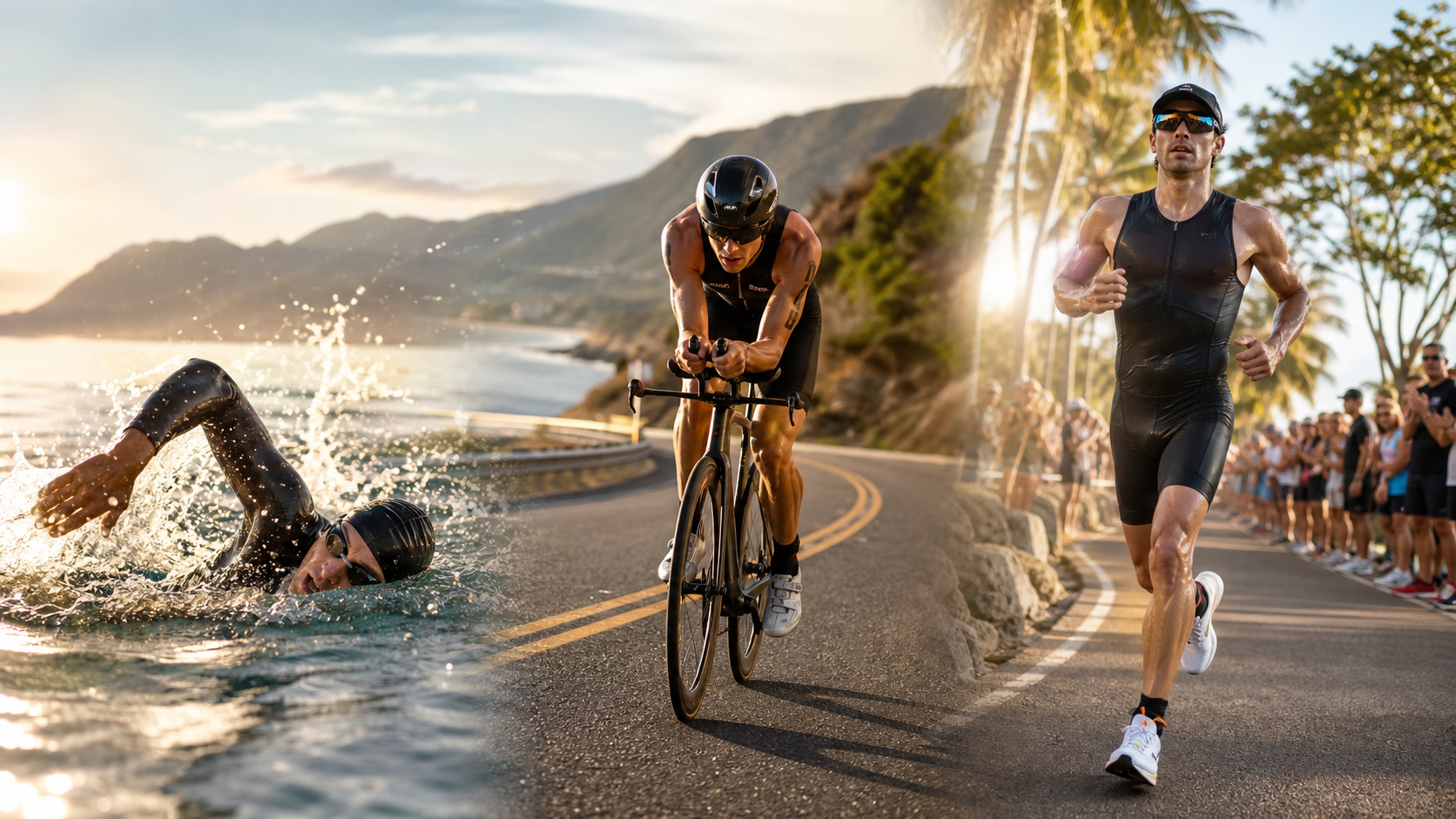
Coach’s Opening: 70.3 Is Not “Two Olympic Distances Added Together”
Every year, when the 70.3 season rolls around—Taitung Puyuma, Kenting, or overseas in Phuket and Bali—my training stand fills up with a certain type of athlete: they race Olympic-distance triathlons (51.5K) smoothly, think “just double the distance,” and then hit their first 70.3 only to completely shut down in the latter half of the run, walking and crying across the finish line.
I’ve coached triathletes for 15 years, from first-time finishers who are office workers to veterans chasing Kona (KONA, Ironman World Championship) slots. I can tell you responsibly: the hardest part of a 70.3 half Ironman isn’t the fitness in any single discipline—it’s the compounding effect of “pacing discipline” and “nutrition rhythm” over 4 to 7 hours.
A 1.9K swim, 90K bike, and 21.1K run—this distance combination has a brutal characteristic: it’s long enough that every small mistake you make early (swimming too hard, pushing too big a gear on the bike, missing a nutrition feeding) gets magnified into a disaster in the latter half of the run; but it’s not so long that it forces you to be conservative by nature like a full Ironman (226K). So many athletes with decent fitness instead die from “thinking they can go a little faster.”
In this article, I’ll use the same tone I use with my athletes, laying out target intensities for all three legs, a nutrition schedule you can copy directly, the most likely breaking points in each leg with countermeasures, and actionable advice for athletes of different levels. By the end, you’ll have a complete race script in hand.
1. Foundational Concepts: First Understand the 70.3 “Energy Ledger”
1.1 This Is a Race “Aerobic-First, Sugar-Assisted”
For the vast majority of age-group athletes, a 70.3 finish time falls between 5 and 7 hours. That duration means: your primary engine is fat oxidation (the aerobic system), but what truly determines whether you blow up is your glycogen (carbohydrate) stores and the rate at which you replenish them.
The human body’s glycogen stores (muscle + liver) are limited—a typical adult has enough for about 90 minutes to 2 hours of high-intensity exercise. A 70.3 far exceeds that, so you can’t “finish on stored sugar alone”; you must continuously take in carbs from external sources. That’s why nutrition strategy in a 70.3 is nearly as important as fitness.
1.2 Intensity Must Be Locked to “Pace/Power/Heart Rate,” Not Feelings
On race day, adrenaline is through the roof, and “feeling easy” is the most deceptive thing there is. My rule: every leg needs an objective metric to keep you in check—no exceeding it.
- Swim: Control via stroke rate and breathing rhythm; the goal is “don’t blow up your heart rate by the time you exit the water.”
- Bike: If you have a power meter, use power (locked to a percentage of FTP); if not, use heart rate; at the very least, use the feel of “can still breathe through your nose and speak short sentences.”
- Run: Use pace (min/km) plus heart rate as a double check; deliberately hold back for the first 5K.
1.3 Two Variables on Taiwan Race Courses: Heat and Humidity
Most 70.3 events in Taiwan (Taitung, Kenting) fall in warm, humid seasons, which makes two things worse: higher sweat rates and overestimated perceived effort. In hot, humid conditions, at the same power your heart rate drifts higher, gut absorption worsens, and sodium loss accelerates. So racing a 70.3 in Taiwan means pacing one notch more conservatively than a temperate-climate race, and being more aggressive with fluid and sodium intake—I’ll give specific numbers in the nutrition section.
2. Leg-by-Leg Strategy: Target Intensities for All Three Legs
2.1 Swim 1.9K: Save Energy Getting Out, Not Racing for Position
The swim is only about 8 to 12% of total time, but it determines “what condition you enter T1 (first transition) in.” I’ve seen too many people fight tooth and nail in the first 400 meters, only to exit the water with a heart rate of 170, dizzy and nauseous, spending the entire bike leg paying off that debt.
Target intensity: Hold near your comfortable 1000m cruise pace, with steady breathing (I recommend breathing at least every 3 strokes; fall back to every 2 strokes when anxious). After sprinting the first 200 meters to secure your position, immediately settle the pace down.
Practical key points:
- Don’t start on the front row: Unless you’re truly elite in the swim, start in the middle-to-back, on the outside, to avoid the worst washing-machine chaos. The energy you save is more than you think.
- Learn to sight properly: Look up at the buoy every 6 to 10 strokes. Swim 50 meters off course and you’ve added a killer amount of distance.
- Start kicking 200 meters before the exit: This gets blood flowing back to your legs, preventing dizziness or lightheadedness when you stand up.
Athlete case: I once had a triathlete who thought he was a strong swimmer and always sprinted at the start. One year I required him to “cap the first 300 meters at 5 seconds slower per 100m.” He exited the water with a heart rate nearly 15 beats lower, easily passed a bunch of people in the first 30K of the bike, and set a personal best overall. What he saved, he got back later.
2.2 Bike 90K: The “Strategic Core” of the Entire Race
The bike is where a 70.3 is won or lost, because it’s the longest leg (2.5 to 3.5 hours for most people) and the easiest place to secretly overextend without realizing it. The discipline here directly determines whether you can run at all.
Target intensity (with power meter): Based on your FTP (Functional Threshold Power), aim for Normalized Power (NP) at 75% to 85% of FTP. Beginners or first-time 70.3 athletes should target around 75%; experienced athletes with strong run legs can push to 82–85%. An Intensity Factor (IF) of roughly 0.75–0.82 is a healthy range.
Target intensity (heart rate only): Hold near your aerobic threshold heart rate, feeling like “the Zone 2 to Zone 3 boundary”—able to breathe through your nose and speak 5 to 7-word short sentences without gasping.
Below is a table of bike-leg intensity recommendations I give to athletes of different levels:
| Athlete Level | Target NP (%FTP) | Heart Rate Zone | Feel Description | Common Mistake |
|---|---|---|---|---|
| First-time finisher | 70~76% | Zone 2 primarily | Feels “a bit too easy” the whole way | Blowing up from excitement in the first 30K |
| Advanced age-group | 76~82% | Zone 2~3 | Steady output, can speak short sentences | Standing to surge on climbs, wasting matches |
| Veteran chasing results | 82~85% | Zone 3 | Focused but controlled | Grinding into headwinds just for average speed |
Three practical bike principles:
- Deliberately hold back for the first 30K. This is the phrase I repeat most to every athlete. Fresh off the swim, legs are fresh and adrenaline is maxed—you’ll want to push. Hold it. Keep power at the lower edge of your target range for the first 30K, and you’ll have the capital to maintain later.
- Don’t stand and surge on climbs to show off. When you hit a hill, stay seated and spin through at a high cadence (85–95). Don’t stand and surge, spiking power above FTP—that’s all burning matches you need for the run.
- Downhills and flats are your nutrition time. Eat and drink when intensity naturally drops, scheduling gut work for when your body has the most capacity.
2.3 Run 21.1K: Put “Don’t Blow Up” Before “Run Fast”
The moment you get off the bike, your legs are stiff, your heart rate is drifting, and your stomach may already be protesting. In a 70.3 run, the task for the first 3 to 5 kilometers is not to run fast, it’s to ‘teach your body how to run again.’
Target Pace Strategy: Adopt a “negative split” mindset—deliberately slow in the first half, and if you have energy left in the second half, pick it up. For the first 5 kilometers, aim for your target half-marathon pace plus 10 to 20 seconds slower per kilometer. Once things feel smooth and your stomach settles, gradually work your way down to your target pace.
Heart Rate Management: It’s normal for your running heart rate to be a notch higher than on the bike, but if your heart rate spikes near max right out of T2 and won’t come down, that’s a clear sign you pushed too hard on the bike. At that point, decisively slow down to protect your finish.
Run Execution Key Points:
- Use every aid station: Taiwan races are hot. Go into every station, and if you need to, walk a few steps to finish your water and pour a sponge over your head to cool down before running again. Those few seconds won’t make you slower, but they can save you from heatstroke.
- Cooling first: Pour ice water and sponges over the back of your neck, groin, and wrists—areas where major blood vessels pass—and your body temperature will drop immediately.
- Chunk the race mentally: Don’t think “21 kilometers to go.” Think “get to the next aid station.” 21.1K is just a series of small segments between 4 and 5 aid stations.
3. Nutrition Strategy: A Copy-Paste Timeline
This is the most practical section of the whole article. I’ll give you the principles first, then a complete timeline.
3.1 Carbohydrates: Target and Upper Limit
Sports science and practical data consistently show that for long-distance endurance events, the recommendation is about 30 to 90 grams of carbohydrates per hour, and 70.3 athletes on average consume around 75 grams per hour during actual racing, usually with a “front-loaded” pattern—pushing up to about 90 grams per hour on the bike, then dropping to about 55 to 60 grams per hour on the run (Precision Hydration’s real-world data analysis).
Key limitation: the intestinal absorption ceiling for glucose alone is roughly 60 grams per hour, and exceeding that tends to cause stomach issues (same source). So if you want to hit 80 grams per hour or more, you must use multi-transport carbohydrate products like “glucose + fructose” so different intestinal pathways absorb simultaneously without overloading.
My recommended range:
- Bike leg: 60 to 90 grams of carbs per hour (depending on gut tolerance).
- Run leg: 40 to 60 grams of carbs per hour, mainly from liquids and gels for easy absorption.
3.2 Fluid and Sodium: The Top Priority in Taiwan’s Heat
Sports science literature indicates that endurance athletes lose roughly 1 gram (1000 mg) of sodium per liter of sweat, but individual variation is huge—sweat sodium concentration can range from 300 mg to over 2000 mg per liter (USA Triathlon sweat rate and hydration guide).
An even more important safety concept: Exercise-associated hyponatremia (EAH) is primarily caused by “drinking too much water,” not sodium loss itself—excessive fluid intake combined with exercise-induced antidiuretic hormone secretion dilutes blood sodium below 135 mmol/L, and that’s when problems occur (NIH/PMC hyponatremia review). The literature also points out that drinking according to thirst can almost completely prevent hyponatremia (same source).
So my practical principles are:
- Drink by thirst—don’t chug. It’s not “more is better”; it’s “don’t get thirsty, don’t overdo it.”
- You can only afford to drink if you’re replacing sodium. In Taiwan’s heat you sweat a lot, so take in about 500 to 1000 mg of sodium per hour (via electrolyte tablets or sports drinks) so the water you drink actually stays in and gets used.
- Measure your sweat rate before race day: during training, weigh yourself before and after exercise (accounting for fluids consumed). The difference is your fluid loss for that session—convert it to an hourly rate, and you’ll have a personalized hydration target for race day.
3.3 Complete Nutrition Timeline (Example: 5.5-Hour Finish)
The table below is the actual version I gave to an athlete weighing about 68 kg with a target finish time of 5.5 hours. You can adjust it based on your own weight and gut tolerance:
| Segment / Time Point | Nutrition Content | Carbs (g) | Fluid / Electrolytes | Coach’s Notes |
|---|---|---|---|---|
| 3 hours pre-race | Normal breakfast (toast + banana + low-fat) | ~80-100 | 300-500 ml with electrolytes | Avoid high-fiber, high-fat foods to prevent stomach issues during the race |
| 15 minutes pre-race | Half a gel or half a banana | ~15-25 | A small sip of water | A base layer before the swim |
| Bike 0-30K | Start eating small amounts, drink water first | ~30/hour to start | A sip of water every 10-15 minutes | Deliberately conservative early on to let the gut warm up |
| Bike 30-75K | Rotate gels + bars + sports drinks | 60-90/hour | 500-750 ml per hour, sodium 500-800 mg | Eat on flats and descents; focus on pedaling on climbs |
| Bike 75-90K | Switch back to easily digestible liquid carbs | ~45-60/hour | Keep up fluid and sodium | “Clear out” solid food for the run |
| Run 0-5K | Water and electrolytes only; settle the stomach first | Minimal or paused | Small sip at each station + cooling | Don’t rush to take gels; wait until your body settles |
| Run 5-18K | Gels + cola + sports drinks | 40-60/hour | Hydrate and replace sodium at every station, pour water over head | If you feel nauseous, cut back—don’t force it |
| Run 18-21.1K | Cola / gels for the final push | As tolerated | Drink only if thirsty | Last 3K to go—rely on willpower and sugar |
This table isn’t scripture; it’s a starting point. Everyone’s gut, sweat rate, and target time are different. The one iron rule is: every single nutrition product must be tested in training—never use anything untried on race day. I’ve seen too many athletes grab unfamiliar products at the race and have their stomachs shut down on them.
3.4 “Gut Training” Is a Severely Underrated Component
Many athletes train their fitness diligently but have never seriously practiced “eating while exercising at high intensity.” As a result, on race day, even though the plan is to consume 80 grams of carbs per hour, they feel like throwing up by the third gel.
Your gut is just like your muscles—it can be trained. Your gastric emptying rate and your gut’s tolerance for high-concentration carbohydrates will both improve with repeated practice. I require my advanced-level athletes to “eat according to their race nutrition plan” during their long bike and run sessions in the 8 to 10 weeks leading up to the race, so the gut adapts during training. By race day, this routine is an old friend to the body, not a surprise attack.
Here’s the practical approach: for every long training session over 90 minutes, use the same gels, drinks, and bars you’ll use in the race, consuming them at the same time points and quantities as your race plan. Note down which products cause bloating, which go down smoothly, and at which time points your gut starts to protest—write all of this into your race nutrition sheet. This “personal gut map” is worth more than any generic advice you’ll find online.
4. Brick Training: Gluing the “Three Disciplines” into “One Race”
Simply getting stronger in swim, bike, and run individually doesn’t mean you can race a 70.3. The “transition” between the three disciplines is a skill in itself—especially that bizarre heavy-legged feeling when going from bike to run, which can only be tamed through specific training. This is the value of Brick training (a combined bike-then-run workout) .
4.1 Why Your Legs Feel So Heavy After the Bike
While pedaling, your legs contract repeatedly at a specific angle using specific muscle groups, with blood heavily shunted to the muscles used for cycling. The moment you dismount and start running, the muscle recruitment pattern switches instantly, and your nervous system and muscles haven’t caught up yet—so your legs feel like they don’t belong to you, your running form feels clunky, and your heart rate drifts upward. This feeling is completely normal, and the purpose of Brick training is to get your body so familiar with this “switch” that it becomes second nature.
4.2 A Sample Progressive Brick Training Plan
The table below is the Brick progression I gave to an athlete preparing for their first 70.3 with about 12 weeks of preparation. Intensity is described by feel and heart rate zones; adjust the actual distances based on your individual baseline:
| Phase | Brick Content | Intensity | Training Purpose |
|---|---|---|---|
| Base Phase (Weeks 1–4) | 60 min bike (Zone 2) + 10 min run (easy) | Low | Introduce the body to the feeling of “switching” |
| Build Phase (Weeks 5–8) | 90 min bike + 20–25 min run (including 5 min at race pace) | Moderate | Practice transition rhythm + run feel at race pace |
| Specific Phase (Weeks 9–11) | 2–2.5 hr bike (including race-intensity segments) + 30–40 min run | Moderate-High | Simulate running under race fatigue; practice nutrition |
| Taper Phase (Week 12) | 45 min bike + 15 min run (maintain feel) | Low | Preserve neuromuscular memory without adding fatigue |
4.3 Three Reminders for Brick Training
- Make the transition fast and realistic. When doing Brick sessions, change shoes and start running right where you dismount, incorporating the T2 process into the workout. Don’t take a leisurely 10-minute break before running—that defeats the purpose.
- Your pace will be slower for the first kilometer—don’t panic. The heavy-leg feeling will gradually subside within 5 to 10 minutes, and this is exactly the rhythm you want your body to remember.
- Practice nutrition together. Brick sessions are the perfect opportunity to test the sequence of “switching to liquid carbs in the latter part of the bike and stabilizing your gut early in the run.”
5. Common Breaking Points and Countermeasures
This section is a compilation of the most hard-earned lessons I’ve seen while coaching athletes over the years. For each breaking point, I’ll give you both “why it happens” and “how to fix it.”
5.1 Breaking Point 1: Hyperventilation and Panic at the Swim Start
Symptoms: You can’t catch your breath the moment you hit the water, chest tightness, and a desperate urge to grab a buoy. This most often happens to first-timers in cold water, crowded conditions, or when nervous.
Countermeasure: Immediately flip onto your back or grab a buoy and rest for 10 to 20 seconds to get your breathing back under control—never try to push through it. Deliberately start slower than you do in training, and only pick up the pace once your heart rate settles. You must practice open-water swimming regularly; no matter how well you swim in the pool, your first time in the ocean can still trigger panic.
5.2 Breaking Point 2: Riding Too Hard Early, Fading Late
Symptoms: Your average speed looks great for the first 40 km, but after 60 km your power drops while your heart rate refuses to come down, leaving you with no legs for the run.
Countermeasure: This is the most classic and most common mistake—and there’s no saving it once it happens; it can only be prevented. The only solution is the phrase I’ve repeated to the point of exhaustion: deliberately hold back for the first 30 km. Use power or heart rate to keep yourself on a leash and resist that urge to “overtake.” Remember: the people you pass on the bike will come back to haunt you on the run.
5.3 Breaking Point 3: Heavy Legs and Gut Upset After Dismounting
Symptoms: Coming out of T2, your legs feel like lead, your running form is stiff, and your gut is churning and nauseous from all the solid food you stuffed down during the bike leg.
Countermeasure:
- The leg issue is solved through training—you must practice Brick training (bike-to-run transition workouts) regularly so your body gets used to the switch.
- The gut issue is solved through strategy—switch to liquid, easily digestible carbs in the final 15 km of the bike to “clear the runway” for the run. Don’t take any gels in the first 5 km of the run; wait until your body settles before refueling.
5.4 Breaking Point 4: Hitting the Wall (Bonk)
Symptoms: Sudden full-body weakness, dizziness, loss of focus, and legs that feel like jelly. This is the classic bonk from depleted glycogen and low blood sugar.
Countermeasure: This is the result of “nutrition falling behind.” Prevention is far more effective than rescue—eat on a regular schedule and don’t skip a feeding just because you’re “not hungry right now.” By the time you feel hungry, it’s usually already too late. If you do bonk, immediately take in fast sugar (cola, energy gels), slow down and walk for a bit until your blood sugar recovers—don’t try to tough it out.
5.5 Breaking Point 5: Heat Exhaustion and Cramping
Symptoms: The most common issue on Taiwanese race courses. Core temperature spikes, dizziness, nausea, goosebumps on the skin, or sweating that suddenly stops; or your calves and thighs suddenly lock up in cramps.
Countermeasure:
- Cooling down is the top priority: Pour water over yourself at every aid station—don’t wait until you’re already overheating. If something feels off, slow down, walk, and find shade.
- Cramping is usually a combination of fatigue + electrolyte loss + excessive intensity. Stretch, slow down, and take in electrolytes in the moment—don’t keep pushing the pace. Heat exhaustion is life-threatening. If you experience severe dizziness or confusion, stop and seek help immediately. No finish line is worth that risk.
6. Psychological Milestones: Managing Your Mind Over 4 to 7 Hours
No matter how well you’ve trained your fitness, over the long hours of a 70.3, your mind will pass through several checkpoints. I break them down like this:
- The “Panic Gate” at the swim start: Get through it with breathing rhythm and segmented thinking—“I just need to swim to the first buoy.”
- The “Boredom Gate” mid-bike: Between 60 and 75 km, it’s easiest to lose focus, slack off, and forget to fuel. Set up a mechanical routine of “check power + fuel every 15 minutes” so discipline replaces willpower.
- The “Doubt Gate” at T2 dismount: This is when your legs feel heaviest and you most want to quit. Tell yourself, “If I just survive the first 5 km, my body will reboot”—this is a physiological fact, not just encouragement.
- The “Willpower Gate” after 15 km of the run: You’ve fueled, your legs are tired, and what remains is pure will. Shrink your goal to “the next aid station” and count them off one by one.
I often tell my athletes: in the second half of a 70.3, it’s not about who’s stronger—it’s about who breaks down less and whose discipline holds out longer.
7. Actionable Advice for Athletes at Different Levels
7.1 First-Time 70.3: The Goal Is a “Beautiful Finish”
- Mindset: Finishing is victory—delete “running fast” from your vocabulary.
- Pacing: Stay at the lower end of your zones across all three disciplines. Target 70–76% FTP for bike NP, and run the first 5 km slow enough to feel “a little boring.”
- Nutrition: Be regular, be conservative, and only use what you’ve practiced. Better to keep it simple than to take risks.
- Training focus: Get plenty of Brick sessions in, practice open-water swimming, and test all your nutrition products thoroughly during long training sessions.
6.2 Advanced Age-Group Athletes: Goal Is “Beat My Own PB”
- Pacing: Push the bike to 76–82% FTP, use a negative-split strategy on the run, and accelerate in the second half to close out the result.
- Nutrition: In training, raise bike-leg carbohydrate intake to over 80 grams per hour (using multiple-transport carbohydrate blends), and confirm during workouts that your gut can handle it.
- Training focus: Add race-pace specific sessions, simulate race-day fueling rhythm, and practice “maintaining technique without falling apart under intensity.”
6.3 Seasoned Athletes Chasing Results: Goal Is “Qualification or Podium”
- Pacing: The bike can be pushed to 82–85% FTP, but power distribution into headwinds and climbs must be calculated with extreme precision to avoid burning matches needlessly.
- Nutrition: Measure sweat rate and sweat sodium very precisely, and build a highly individualized fueling plan.
- Training focus: Heat acclimation (a must for Taiwan races), lactate tolerance at key race pace, and optimizing transition-zone seconds.
8. Final-Week Reminders Before Race Day
- Don’t add extra sessions during the taper: Cut training volume in the final week, but keep a little high-intensity stimulus so the body stays “awake.” Don’t panic and spike your training because of nerves.
- Check all gear before race day: Tires, repair tools, cycling shoes, race number belt, and nutrition placement should all be set the day before. Don’t leave it until race morning and scramble.
- Bank your sleep ahead of time: It’s normal not to sleep well the night before the race. The key is to get plenty of sleep 2 to 3 nights out.
- Eat breakfast according to plan: Use the breakfast you tested in training, finish it 3 hours before the start, and don’t experiment with new foods at the venue.
9. Common Questions FAQ
These are the questions athletes ask me most often before races. I’ve compiled them all here for you.
Q1: I don’t have a power meter on my bike. Can I rely on heart rate alone?
Absolutely. A power meter is a great tool, but it’s not a necessity. When using heart rate to set intensity, watch out for two things: first, in hot weather your heart rate will naturally drift higher, so don’t panic and slow down unnecessarily; second, heart rate has a “lag”—it takes a few dozen seconds to reflect changes in intensity—so combine it with perceived exertion (can you speak in short sentences?) for a more accurate read. Many excellent age-group athletes have never used a power meter and still race very well.
Q2: Swimming is my weakest leg. Will I get cut off by the time limit?
First, check the race’s swim cutoff time (most 70.3s allow about 70 minutes), then compare it with your current 1.9K pool time (open water is usually a bit slower). If you’re close to the cutoff, focus your pre-race preparation on “energy-saving technique” and “open-water adaptation” rather than speed. A wetsuit (if the race allows one) significantly improves buoyancy and saves energy—it’s a best friend for weak swimmers. If you’re truly worried, start at the very back of the start area to give yourself room.
Q3: What and how much should I eat on race morning?
The principle is “familiar, easy to digest, carbohydrate-focused, low fat and low fiber.” Finish your main meal 3 hours before the start (e.g., white toast with banana and a little honey), and 15 to 30 minutes before the start you can top up with some fast-acting sugar. The key phrase remains: only eat what you’ve tested in training. Your gut is more sensitive on race day—it’s not the time to try new things.
Q4: I keep feeling nauseous and can’t get gels down during the run. What should I do?
This is usually a sign of “reduced blood flow to the gut plus fueling that’s too concentrated and too much.” What to do in the moment: slow down, switch to small sips of sports drink or cola (many people can actually tolerate carbonated cola), pause solid food and thick gels, and resume fueling gradually once the nausea subsides. The long-term fix is to go back and train your “gut training” and lower the intensity of the bike leg—nausea is often the delayed bill for pushing too hard on the bike.
Q5: Cramps keep hitting me. Is it a salt deficiency?
The exact cause of exercise-associated cramps isn’t fully settled, but in practice it’s usually a combination of “muscle fatigue + intensity beyond your usual training + electrolyte imbalance,” and rarely just a salt deficiency. So the solution isn’t to slam salt tablets, but rather: build your pacing adequately (don’t let race intensity far exceed your training), replace electrolytes appropriately, and when a cramp hits, stretch and slow down. If you have recurring severe cramps, it’s worth having a professional evaluate your training load and pacing setup.
Q6: Taiwan races are so hot. How should I prepare?
Do “heat acclimation.” In the 2 to 3 weeks before the race, deliberately schedule several sessions during the hotter parts of the day to improve your sweating efficiency and reduce heart-rate drift at the same intensity. On race day, implement cooling (pour water at every aid station), actively replace fluids and sodium, and take pacing down one more notch. For races in Kenting and Taitung, Taiwan, heat and humidity are the biggest obstacle—prepare for it and you’ve already beaten half the field.
Conclusion: Upgrade “Finishing” to “Being in Control”
A 70.3 half-ironman is a very honest race. It faithfully reflects your greed in pacing, your laziness in fueling, and your panic under pressure. Conversely, if you keep your pacing in check, follow your fueling plan to the letter, and dismantle each mental checkpoint one by one, those 4 to 7 hours will transform from “a gritty gamble on luck” into “a performance you fully control.”
Every athlete I’ve coached has had a different look in their eyes after their first clean 70.3 finish—not because they got dramatically stronger, but because they finally understood: the most captivating thing about endurance sports is that discipline and patience eventually turn into that relaxed smile before the finish line.
Take this playbook to your next 70.3. See you at the finish line.
This article is for educational purposes and does not replace individual assessment by a physician, physical therapist, or nutritionist.
References
- Precision Hydration — IRONMAN® vs IM 70.3®: Comparing race nutrition strategies: https://www.precisionhydration.com/performance-advice/nutrition/comparing-race-nutrition-strategies-for-ironman-and-ironman-70-3/
- USA Triathlon — How to Optimize Your Performance: Sweat Rate and Optimizing Hydration: https://www.usatriathlon.org/articles/training-tips/How-to-Optimize-Your-Performance-Sweat-Rate-and-Optimizing-Hydration
- NIH / PMC — Exercise-Associated Hyponatremia in Endurance and Ultra-Endurance Performance (Narrative Review): https://www.ncbi.nlm.nih.gov/pmc/articles/PMC6780610/
Related Reading
- 70.3 Half-Ironman Finish Guide: Breakthrough Rhythm for Middle-Distance Athletes
- IRONMAN 70.3 Distance Fully Explained: How to Estimate Finish Time for 1.9/90/21.1 km
- 70.3 Half-Ironman Pacing: Breaking 4.5 Hours into 11 Decision Points
- Sub-6 70.3: Target Pace for Each Leg and a 24-Week Training Blueprint
Live) 備戰2019彰化經典百K 賽前攻略 (已完賽請看新影片
7 年前
半日 小台灣 極限單車路線挑戰實錄
7 年前
2019 夏季KOM 5小 完賽心得 準備攻略 東進武嶺 夏季登山王之路 Taiwan KOM Challenge
7 年前
FTL 與 SYB 車隊專訪 西進武嶺 實用攻略分享! 2小時 如何練?!你不知道的眉角!新手準備武嶺必看 EP1 | 實力派女車友 | 精華版 | 公路車 | CTYeh
4 年前
2016 桐花飛舞 單車挑戰 精華片段
10 年前
西進武嶺 免費訓練分析服務 Intervals | 練不夠還是練過頭?你哪一種類型選手?AI模型告訴你! | 備戰神器 | 公路車 訓練 | CT Yeh
4 年前
JE22 百里任務體驗,心跳不能過150,三小時內有可能...? 沒有天時地利難度有多高? / 公路車 / CT Yeh
1 年前
#公路車 #西進武嶺 配速配瓦實驗 坡度分析 四小時內攻略 建大盃 NeverStop #西進武嶺攻略
6 年前