Triathlon Relay and Team Events: The Right Way to Open the Door with the Lowest Barrier to Entry
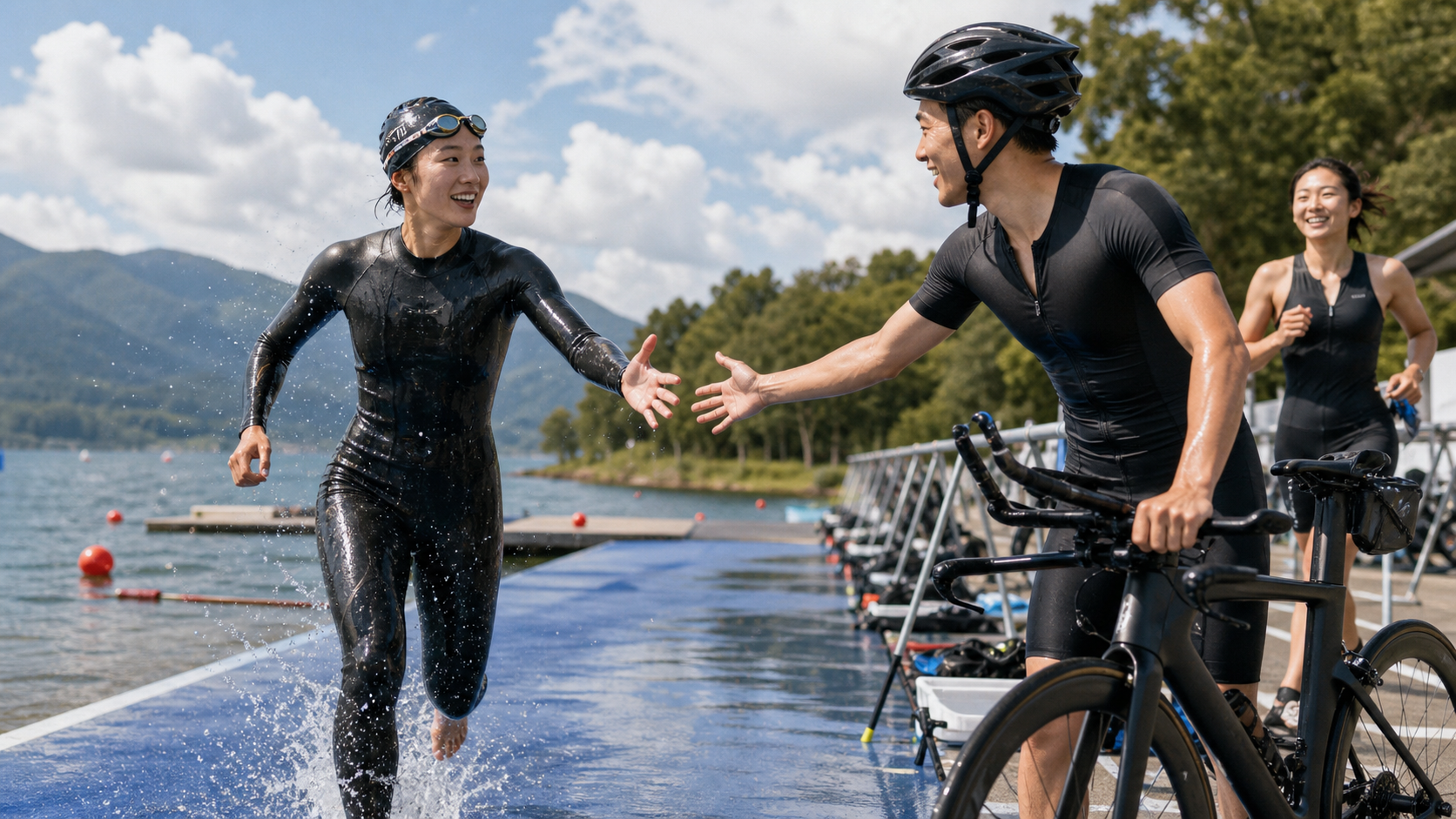
Coach’s Opening: The Year I Used a Relay to Turn Three “Absolutely Impossible” People into Triathletes
Let me tell you a true story. Three years ago, a student named A-Kai came to me, saying he wanted to try triathlon but “my friends all laughed, calling me crazy, and no one wanted to join.” I asked him what each of those friends was good at—one was a former university swim team member who only occasionally hit the pool after retiring; one was a commuter who rode a U-Bike daily, with decent leg strength but no road bike experience; and another was a marathon runner with a sub-four-hour full marathon time who turned pale at the sight of open water.
I told A-Kai, “You don’t need to convince them to become triathletes. You just need to let each of them do the one part they already know how to do.” That year, we registered a relay team for a 51.5 km standard distance triathlon. The former swimmer swam 1.5 km, the commuter cycled 40 km, and the runner ran 10 km, while A-Kai himself competed in the individual category on the same course. The result? The moment that relay team finished, all four of them hugged and cried at the finish line. The following year, two of the three “absolutely impossible” people signed up for their first individual triathlon.
The relay category is the most effective gateway I’ve found in my 15 years of coaching to pull people into the triathlon world. It has a low barrier to entry, low risk, and low psychological burden, yet it allows someone who has never touched triathlon to stand on a real race course for the first time, hear the cheers at the finish line, and receive a finisher’s medal. In this article, I’m going to thoroughly explain how to use a relay race to bring friends into the sport, covering everything from rules and leg assignments to practical race-day scenarios.
1. First, Establish the Concept: What Exactly is a Relay Team?
The Basic Structure of a Triathlon Relay
In an individual triathlon, one person completes the three disciplines of swimming, cycling, and running in sequence. A relay team (some races call it a group or team category) splits these three segments among different people—typically three people each take one leg, though two-person teams (where one person does two legs) also exist. You’ll see the timing chip “baton” being handed over in the transition area, and the total time is the sum of the three segment times plus the transition times.
The spirit of this is the same as a track relay race: You only need to do your job well on your leg, and leave the rest to your teammates. For someone who has never done a triathlon, the psychological significance of this statement is huge—they don’t have to face the suffocating total volume of “swimming, then cycling, then running.” They only need to focus on the segment they already know, or at least aren’t so afraid of.
Why is a Relay the Lowest Barrier to Entry?
I often use an analogy with my students: An individual first triathlon is like asking you to carry three suitcases up five flights of stairs at once. A relay is like three people each carrying one suitcase. The total weight hasn’t changed, but by sharing it, each person’s burden is at the “edge of their comfort zone” rather than the “edge of collapse.” The difference between these two determines whether a beginner thinks “I want to do this again after finishing” or “I swear I’ll never touch this again after finishing.”
Taking the most common 51.5 km standard distance (also known as Olympic distance) as an example, let’s break down the actual load for each leg:
| Discipline | Distance | Actual Load for the Relay Leg Athlete | Suitable Friend to Recruit |
|---|---|---|---|
| Swim | 1.5 km | A solid base if they can continuously swim over 1000 meters in a pool | Someone who swam in their school days, afraid of running and cycling |
| Bike | 40 km | Has leg strength from U-Bike/commuting, just borrow a road bike | Someone who cycles regularly and has decent leg strength |
| Run | 10 km | Can compete if they can finish a 10K road race | A friend who runs, a marathon runner |
Do you see it? You can definitely find one of each of these three types of people around you. This is precisely the magic of the relay category: it makes “forming a team” incredibly easy because each person only needs to be responsible for their strength.
You Can Also Play at Longer Distances
Relays aren’t just for the standard distance. In Taiwanese triathlon events, the 113 km half-distance (commonly called 113 or 70.3) and even the 226 km full distance (IRONMAN) often have relay/team categories. Taking the 2026 Fubon Financial IRONMAN Penghu International Triathlon as an example, this signature event’s full distance includes a 3.8 km sea swim, 180 km bike, and 42.2 km full marathon, and offers various categories like individual/relay/visually impaired/mixed disability relay for the 51.5 km and 113 km distances (see source at the end of the article).
What does this mean? It means even if your friend only wants to run a 10K, or only wants to cycle without getting in the water, you can find a corresponding relay combination to get them onto the stage of a top-tier Taiwanese triathlon. Bringing a friend into the sport through an IRONMAN-branded event carries a weight of memory completely different from a small community race.
2. The Scientific Basis: Why is “Segmenting” So Friendly to Beginners?
Sharing the Physiological Load
Completing an individual standard distance triathlon, the total caloric expenditure for a typical amateur athlete roughly falls in the range of 1500 to 2500 kcal (varying greatly by weight, pace, and environment). This energy expenditure is a huge challenge for an undertrained beginner—it’s not just muscle fatigue, but also involves a chain of issues like nutrition, electrolytes, and core body temperature control.
A relay splits this load into three parts, with each person’s continuous exercise time typically falling between 25 minutes and 1.5 hours (depending on the discipline and distance). For someone who “exercises regularly but hasn’t trained for triathlon,” this duration is within a range their body can handle without severe metabolic imbalance. Simply put: a person who can run a 10K won’t “hit the wall” when running their relay leg; a person who can continuously swim 1500 meters won’t experience hypothermia or cramp-induced collapse during their swim leg.
Sharing the Psychological Load is Even More Critical
In sports science, there’s a concept called “Rating of Perceived Exertion (RPE),” which refers to how hard the body subjectively feels it is working. Interestingly, RPE is not only influenced by physiology but is also heavily affected by psychological anticipation. When a beginner knows “I still have three hurdles ahead: swimming, cycling, and running,” this anticipation alone can heighten their tension and fatigue.
The relay category removes this psychological ceiling. The leg athlete only needs to take responsibility for “one segment.” Their focus sharpens, anxiety drops, and performance actually improves. I’ve coached too many cases like this: the same person runs a 10K in 62 minutes in an individual race, but clocks 55 minutes for the same 10K in a relay—not because they got stronger, but because they were no longer held back by the psychological shadow of “there’s still a lot more to come.”
The Hurdle of Open Water
Let me specifically address swimming. The biggest deterrent for beginner triathletes, nine times out of ten, is open water swimming. No matter how well you swim in a pool, the moment you enter a sea or lake where you can’t see the bottom, there are waves, and hundreds of people start simultaneously, your heart rate can instantly spike above 170 bpm. Panic, hyperventilation, and cramps follow one after another. I’ve seen people who can swim 2000 meters in a pool raise their hand for help after just 200 meters in open water.
The value of the relay category lies here: You can hand the swim leg to the person with the biggest heart, the one least afraid of the water, allowing the other two friends to completely bypass this hurdle. For someone who “wants to get into the sport but fears water,” this is equivalent to directly tearing down the highest wall.
3. Practical Rules: Baton Handoffs, Timing Chips, and Common Mistakes
The relay category adds a layer of “handoff” rule details compared to the individual category. I’ll explain this from a practical, race-day perspective, because every year, teams mess up in the transition area, wasting precious time or even getting disqualified.
How Does the Handoff Work? The Logic of Chip Timing
In most triathlon relay handoffs, the exchange is completed in the transition area using a timing chip. There are two common methods:
- Physical Handoff of a Chip Wristband/Ankle Band: The swimmer exits the water and enters the transition area, handing the ankle band (or wristband) to the cyclist waiting in the designated exchange zone. The cyclist must put it on before they can retrieve their bike and start. The same principle applies for the runner.
- Automatic Handoff via Timing Mats: Some events set up timing mats in the exchange zone. The previous teammate steps on the mat to trigger their split time, and the next teammate steps on a mat to begin their leg. The physical chip doesn’t necessarily have to be handed over—but you still need to complete the team member exchange in the designated zone.
Key Principle: You must confirm the handoff method for your specific race during the pre-race briefing. Different races and different organizers have different rules. The regulations for the IRONMAN series, local Taiwanese events, and small community races can all vary. Never assume the rules from your last race apply to this one.
Common Mistakes in the Exchange Zone (A List of Hard-Learned Lessons)
Here are the pitfalls I’ve witnessed or stepped into myself over years of coaching teams:
- Getting the Exchange Location Wrong: The relay exchange zone is usually a specific, marked-off area within the transition zone. You can’t just hand off anywhere in the transition area. Handing off in the wrong spot means the exchange doesn’t count.
- The Next Teammate Arrives Too Late: The cyclist is still chatting in the parking lot, and the swimmer gets out of the water but can’t find them. Time ticks away second by second. The next teammate must arrive early and wait in the exchange zone.
- Starting Before the Chip is Secured: In the rush, the chip isn’t fastened properly and falls off mid-race. That leg won’t be timed, leading to a direct disqualification.
- Colliding and Injuring Each Other During the Handoff: The swimmer is exhausted and unsteady on their feet, rushing into the exchange zone and knocking over a teammate. Slow down during the handoff, make eye contact, confirm the exchange, and then proceed.
- Not Sorting Out Shared Gear: A two-person team shares a helmet or a pair of cycling shoes. The sizes don’t fit, or the cleat adjustments are different, wasting a huge amount of time.
A Pre-Race Checklist for Relay Teams
| Check Item | Person Responsible | Why It’s Important |
|---|---|---|
| Confirm handoff method (physical chip / timing mat) | Team Captain | Handoff rules differ for every race; getting it wrong means disqualification. |
| Confirm the exact location of the exchange zone | All Members | You must walk through the flow at least once before the race. |
| Next teammate arrives at the exchange zone 15 minutes early | Each Teammate | Prevents the previous teammate from arriving and finding no one there. |
| Test that the chip is fastened securely | Each Teammate | If the chip falls off, that entire leg has no result. |
| Confirm helmet buckle and cycling shoe cleats | Cyclist | You will be stopped if you try to take your bike out without buckling your helmet strap. |
| Prepare hydration bottles / energy gels | Each Teammate | Even if you’re only doing one segment, you need to fuel. |
| Meeting point & contact method (where to put phones, who watches the bags) | Team Captain | The race venue is crowded, and getting separated is very common. |
Print this list out and have the whole team review it the night before the race. It can help you avoid 90% of potential mishaps.
4. Choosing Leg Assignments: Putting the Right Person on the Right Leg
This is the soul of a relay team. If you choose the right leg assignments, the whole team will be relaxed and happy. If you choose wrong, someone might break down, someone might blow up, and your result will look ugly. I’ll explain using two different goals: “Introducing a friend to the sport” and “Seriously competing for a result.”
Goal 1: Introducing a Friend to the Sport (Prioritizing a Fun Finish)
If your goal is to give a friend a great first experience, the leg assignment principle comes down to one sentence: Let each person do the leg they are least afraid of and best at.
- Swim Leg: Give this to the person who swam during their school days, or at least isn’t afraid of the water. It doesn’t matter if they’re slow; the key is that they can get out of the water safely and enjoy the process.
- Bike Leg: Give this to the person who has a cycling habit and decent leg strength. This leg offers the most “sensation of speed” and is usually the most enjoyable segment for a beginner.
- Run Leg: Give this to the person with a running habit. Running requires the least equipment of the three disciplines and is the easiest to start. It’s also the leg where you get to sprint through the finish line to cheers—save this moment of glory for the friend who needs the biggest sense of accomplishment.
My personal tip: If there’s someone on the team who is particularly afraid of exercise and most hesitant to join, let them run the last leg. The cheers, the arch, and the medal at the finish line are the highest emotional peak of the entire event. Often, it’s this single moment that transforms a person who was “just trying it out” into someone who says, “I want to do this again.”
Goal 2: Seriously Competing for a Result (Performance-Oriented)
If you’re a team aiming for a podium spot, leg selection requires more precise calculation:
- Swim Leg: Choose the person with the most consistent pace and the most open-water experience. Sea swimming involves currents, sighting buoys, and jostling for position, all of which require experience. A panicked swimmer can lose several minutes.
- Bike Leg: This is the longest discipline in terms of time and has the greatest impact on the overall result. Put your strongest power-output rider here. A cyclist who can consistently maintain a high wattage (e.g., a strong amateur holding over 200 watts) can create a massive gap.
- Run Leg: Choose the person who can “lose the least speed.” Unlike an individual triathlon where you run after swimming and biking, a relay runner starts with fresh legs, so they can set a very aggressive pace.
Special Considerations for Two-Person Teams
Some events allow two-person relays, where one person does two disciplines. The key to this combination is not making the same person carry the two most physically demanding disciplines. Common, sensible splits are:
- One person does the Swim + Run, the other specializes in the Bike (the bike leg takes a long time, let the specialist handle it).
- One person does the Swim + Bike, the other specializes in the Run (allowing the runner to go all-out on fresh legs).
A combination to avoid: One person doing the Bike + Run (the two most tiring legs back-to-back will cause a blow-up).
5. A Ready-to-Use Four-Week Preparation Script for “Introducing a Friend”
Many people think a relay doesn’t require training. That’s a misconception. Although each relay leg is short, you still need to train to complete that distance safely and without suffering. Here’s a lightweight, four-week preparation framework, using a standard-distance triathlon relay as an example. It’s suitable for friends who have a general exercise habit but haven’t done targeted training.
Swimmer (Goal: Safely complete 1.5 km)
| Week | Main Workout | Focus |
|---|---|---|
| Week 1 | Swim continuously for 800–1000 meters in a pool, x 2 sessions | Build the endurance base for continuous swimming. |
| Week 2 | Continuous 1200m swim + 1 open water experience session | First time in open water to get familiar with the environment. |
| Week 3 | Open water swim of 1000–1500 meters, x 2 sessions | Practice swimming straight, sighting buoys, and lifting your head to navigate. |
| Week 4 | Pre-race taper, easy 800m swim, 1–2 sessions | Conserve energy; don’t overtrain. |
Coach’s Reminder: You must practice in open water at least 2-3 times. No matter how well you swim in a pool, you cannot skip this step. Find a location with a lifeguard or go with a buddy; safety first.
Cyclist (Goal: Complete 40 km)
- Ride 2-3 times per week, gradually increasing the distance of a single ride from 25 km to over 45 km week by week.
- Ride the “race route” or similar terrain at least once to get familiar with the climbs and descents.
- Practice fueling: drink water and eat an energy gel while riding. Don’t try this for the first time on race day.
- If borrowing a road bike, you must test-ride it at least twice before the race to get used to the clipless pedals and gear shifting.
Runner (Goal: Complete 10 km)
- Run 3 times a week, with one of those runs extended to 8–10 km.
- Do one run at the “race time” (e.g., summer races in Taiwan are often in the morning, so it’s hot) to acclimate.
- Keep your heart rate in the aerobic zone (for a general amateur, roughly 140–160 bpm, but this varies by individual). Don’t blow up by starting too fast.
A Must-Do for the Whole Team: One Complete Handoff Rehearsal
This is the single most overlooked yet most important item for most teams. Find a weekend before the race, and have all three teammates go to a sports field or riverside park. Simulate the entire process: the swimmer runs into the imaginary exchange zone → hands the chip to the cyclist → the cyclist rides out → returns and hands off to the runner → the runner sprints to the finish line. Rehearsing this once will eliminate 80% of the panic and confusion on race day.
5-2. Nutrition and Environmental Strategy for Relay Teammates (Essential Reading for Taiwanese Summers)
Many people think that because they’re only doing one leg of a relay, they don’t need to worry about nutrition. This is a dangerous misconception in Taiwan’s humid and hot climate. Most triathlon events in Taiwan are concentrated in spring and summer. It’s common for temperatures at the race venue to soar above 30°C after 9 AM, with humidity often exceeding 80%. These conditions are a challenge for every single leg.
Nutrition Focus for Each Leg
| Leg | Pre-race Nutrition | On-course Nutrition | Special Notes |
|---|---|---|---|
| Swim | Eat a good carbohydrate breakfast 2 hours before the race; drink 300–500 ml of an electrolyte beverage before entering the water | Difficult to refuel during the swim segment; prepare adequately beforehand | Entering the water on an empty stomach or insufficiently hydrated can easily lead to cramps |
| Bike | Hydrate and consume one energy gel before taking over | Take a sip of water every 20 minutes; consume about 1 energy gel per 40 km | This is the easiest leg for refueling; don’t waste the opportunity |
| Run | Continuously sip water while waiting; avoid chugging a large amount at once | Replenish with water/sports drinks at aid stations along the course | Waiting for an hour makes dehydration very likely; be sure to take care of this |
Why “The Waiting Leg” is the Most Dangerous
I want to particularly emphasize the athletes scheduled for later legs. The runner often waits dry in the transition area for one to two hours, standing under the sun, sweating continuously but forgetting to hydrate. By the time they take over and rush out, their body is already in a mildly dehydrated state. This is precisely when cramps, dizziness, or even heat exhaustion occur.
My iron rule is: Athletes in the waiting leg must sip an electrolyte-containing beverage every 15–20 minutes and stay in the shade as much as possible. Don’t underestimate this. The success or failure of a race sometimes hinges on whether the person waiting on the sidelines, seemingly having the easiest job, has taken care of themselves properly.
Pre-Race Meal for Taiwan’s “Eating Out” Crowd
Taiwan’s food environment is actually very suitable for a triathlete’s pre-race nutrition. For dinner the night before a race, I often suggest my trainees choose easily digestible carbohydrates: a bowl of white rice with low-oil chicken or fish, a serving of blanched vegetables, or a light noodle soup are all good choices. Avoid eating things that are too oily, too spicy, or too high in fiber before the race (such as spicy hot pot or large amounts of raw salad), to prevent gastrointestinal distress on race day. Convenience store onigiri, bananas, and unsweetened soy milk are also practical pre-race nutrition options.
6. Common Mistakes and Corrections
Mistake 1: Thinking a Relay Doesn’t Require Nutrition
“I’m only doing one segment, why would I need to refuel?” — A huge mistake. Even if you only swim 1.5 km, bike 40 km, or run 10 km, you can sweat profusely and lose electrolytes in Taiwan’s summer heat. I’ve seen a runner cramp up the moment they started because they hadn’t hydrated during the hour-long wait beforehand.
Correction: Every athlete must adequately replenish fluids and electrolytes before their own leg. Especially for athletes scheduled later, pay extra attention to hydration during the waiting period to prevent heatstroke. Most races in Taiwan are in hot and humid environments; be sure to take this seriously.
Mistake 2: Later Athletes Warming Up Too Late
The runner often waits dry in the transition area for an hour, their muscles cooling down. They then sprint at full speed the moment they take over, resulting in a muscle strain or cramp.
Correction: Athletes in later legs must accurately gauge the estimated finish time of the preceding leg and start warming up 20–30 minutes in advance. When they take over, their muscles should be warm and in a state of readiness.
Mistake 3: Borrowing Equipment Without Trying It First
Borrowing a road bike or a wetsuit and wearing it for the first time on race day—unable to clip into the pedals, or the wetsuit being too tight to breathe—these are disasters I have witnessed firsthand.
Correction: Any borrowed equipment must be actually used at least twice before the race. The wetsuit needs to be tested in the water, the road bike needs a test ride, and you must practice clipping in and out of the cycling shoes.
Mistake 4: Forcing the Most Feared Discipline on the Person Who Fears It Most
Some teams, for the sake of “fairness,” insist on rotating or drawing lots to decide leg assignments. As a result, the person afraid of water gets assigned the swim and panics in the sea on race day.
Correction: When bringing friends into the sport, leg assignments aren’t about fairness; they’re about suitability. Let the person afraid of water bike or run, and let the person unafraid of water swim. With a good fit, the whole team is happy.
Mistake 5: Underestimating Transition and Handover Time
Beginners often only calculate the time for the three exercise segments, forgetting that running through the transition area, changing clothes, and handing over the timing chip also take time.
Correction: When estimating the total time, add a 2–5 minute buffer for each transition/handover. Being mentally prepared means you won’t find yourself running out of time right at the cutoff.
7. Actionable Advice for Friends of Different Levels
Friends with No Athletic Foundation at All
Don’t rush to sign up for a relay. Give them 4–6 weeks to build a foundation in a single discipline: If they want the run leg, first ensure they can comfortably finish a 5K. If they want the swim leg, first confirm they can swim 800 meters continuously in a pool. Once the foundation is there, signing up for a relay won’t turn into a nightmare. You can start with community-based, shorter-distance triathlons (like a shorter mini-triathlon relay).
Friends with a Habit in a Single Sport (The Ideal Candidates to Get Hooked)
These people are the golden picks for a relay team. Someone who regularly runs, bikes, or swims can almost certainly finish the race without much extra training if you place them in their corresponding leg. My suggestion is to directly find a standard-distance triathlon relay, let them do their strongest leg, and experience the full atmosphere of a triathlon. Eight out of ten people will ask you afterward: “When’s the next one?”
Friends Who Have Done a Relay and Want to Advance
If a friend has gotten hooked on relays, the next step is to encourage them to challenge a solo beginner triathlon. Progress from a standard relay to a standard individual race, or directly challenge a 113 (half-Ironman distance) relay first to experience the long distance. The relay is the entry point; the individual race is the deep rabbit hole that truly gets people addicted. Many of the athletes I coach started from a joyful relay and eventually trained to challenge a full IRONMAN.
Three Real Trainee Scenarios (To Give You a Feel)
Scenario 1: The only sports enthusiast in the whole company. Xiao Chen, a trainee working in the tech industry, was the only triathlon fan in his entire office. Using the method I taught, he gathered three colleagues after the year-end party—one from the university rowing team, one who runs on the gym treadmill after work, and one who cycles along the riverside on a U-Bike on weekends. He acted as the captain handling logistics, letting the rower swim, the treadmill runner run, and the U-Bike rider bike. After that standard relay, four people who usually only met in the conference room became a regular weekend sports group.
Scenario 2: A couple bringing an elder. A married couple of trainees wanted to bring the wife’s nearly sixty-year-old father, who had a regular walking habit, to experience a triathlon. I suggested they register for a three-person relay team of two plus one elder, letting the father handle the run leg (which was actually a brisk walk to complete 10K), while the couple split the swim and bike legs. The smile on the father’s face as he crossed the finish line was more precious than any medal. The inclusiveness of a relay team is large enough to place three generations of a family into the same race.
Scenario 3: A marathon runner deathly afraid of water. The runner A-Ming, mentioned earlier, who could run a sub-four-hour marathon but was afraid of water, first encountered triathlon through a relay. He only did his strongest run leg, completely avoiding open water. After that race, he proactively said he wanted to overcome his fear of water and enrolled in adult swimming lessons. A year later, he completed his first solo standard-distance triathlon. The relay was his entry point and the starting point for overcoming his fear.
Advice for the Team Captain
You are the one bringing everyone together; your role is the most critical:
- Lower everyone’s psychological barrier: Repeatedly emphasize, “You only have to do the segment you’re good at.”
- Handle all logistics before the race: Registration, equipment, transportation, accommodation—don’t let friends back out because of the hassle.
- Choose a race with a great atmosphere: Races with an arch at the finish line, music, and cheering spectators provide the strongest emotional experience.
- Immediately schedule the next race afterward: While everyone is still immersed in the emotion of finishing, hammer that nail into the rabbit hole.
8. FAQ
Q: How are relay team results calculated?
A: Typically, it’s the sum of the three segment times plus transition/handover times, measured from the first leg entering the water (or the starting gun) to the final leg crossing the finish line. The timing chip records everything, and you can check each leg’s split time after the race.
Q: Can relay team members be substituted at the last minute?
A: Most events have a deadline and procedure for substitutions. Changes are usually allowed before a certain pre-race deadline, but last-minute substitutions on race day may not be permitted. Be sure to check the specific relay rules for that event; don’t wait until you’re at the venue to ask.
Q: Is a two-person team really feasible? Won’t it be too tiring?
A: It’s feasible, but you need to split the legs smartly. Don’t let the same person take on the two most physically demanding segments (especially avoid giving both the bike and run to one person). Reasonable splitting strategies are discussed in the earlier chapter on leg assignments.
Q: Do I need to buy expensive gear?
A: Not to get started. Borrow a wetsuit for the swim leg, a road bike for the bike leg, and just have a pair of running shoes for the run leg. Borrow gear to complete your first race first, and only invest in equipment once you’re sure you want to continue.
Q: Where in Taiwan can I find relay category races?
A: From community mini-triathlons to IRONMAN branded events, relay/team categories are available. For example, the IRONMAN series in Penghu offers individual and relay categories for 51.5km and 113km distances (see sources at the end). Pay close attention to the category descriptions on platforms like Sports Note and major triathlon registration sites.
Q: If the previous leg hasn’t arrived at the handover, can the next leg start early?
A: Absolutely not. You must complete the handover (physical chip or timing mat) before starting. Starting early will result in disqualification. Wait patiently in the transition area for your teammate.
Q: Are there cut-off times for the relay category?
A: Yes. Relay teams are subject to the same segment and overall cut-off times as individual participants. While a relay team can finish within the time limit more easily than an individual, you still need to ensure the sum of each leg’s estimated time has sufficient buffer. Don’t be complacent just because “it’s a relay,” especially for long-distance 113 or 226 relays.
Q: What if three friends have very different fitness levels? Will we drag each other down?
A: This is the beauty of the relay—differences in ability are actually an advantage. The faster members buy time for the slower ones, and the slower members just need to finish within their comfort zone. It’s not about everyone being strong, but about everyone doing their best within their capability. With the shared goal of finishing happily, the feeling of dragging each other down simply doesn’t exist.
9. How to Pick the Right “First” Relay Race for Friends You’re Introducing to the Sport
Choosing the race is one of the most important tasks for the team captain. Even for a relay, picking the right event versus the wrong one can lead to vastly different experiences for newcomers. My selection principles are as follows:
Distance: Starting with a Standard Triathlon Relay is Just Right
For complete beginners, the 51.5km standard triathlon relay is the ideal entry distance—the load for each leg sits in the sweet spot of “challenging but not painful.” If a friend has a weaker athletic base, you can find an even shorter mini-triathlon relay (e.g., 400m swim, 20km bike, 5km run) for their first race, which has an even lower barrier to entry.
Don’t rush into challenging a 113 or 226 relay. Although long-distance relays are also split into segments, the load for a single leg (e.g., cycling 90km or running a half marathon) is still a significant volume for someone with zero base. Upgrade to these after you’ve completed a standard triathlon and are sure you’re hooked.
Race Atmosphere: The Finish Line Experience Determines Success
I place special emphasis on the emotional design of the finish line. Events with an arch, music, spectators, and an announcer calling out athletes’ names as they cross the line have the strongest emotional impact on newcomers. The emotion of that finish-line moment is often the key trigger that turns someone from “just trying it out” to “I want to do this again.” Conversely, a quiet, small race with few spectators will dampen that feeling, even if you finish.
Venue and Climate: Avoid the Harshest Conditions
When introducing friends to the sport, don’t pick races with excessively cold water, rough sea conditions, or overly tough courses. Choose events with relatively calm open water, bike routes without major elevation changes, and pleasant weather to make the newcomer’s first experience as smooth as possible. Some events in Taiwan are famous for wind, waves, or climbs—leave those for later challenges once you’ve advanced.
A Quick Race Selection Checklist
| Selection Aspect | Choose for Newcomers | Avoid |
|---|---|---|
| Distance | Standard or mini triathlon relay | Jumping straight into a 113/226 relay |
| Finish Line Atmosphere | Has an arch, music, spectators | Quiet, small races with no spectators |
| Open Water | Relatively calm bay or lake | Venues known for big waves and currents |
| Bike Course | Gentle, flat terrain | Tough climbs, technical descents |
| Race Reputation | Ample aid stations, clear course flow | Inexperienced organizers, poor reviews |
Pick the right first race, and you’re halfway to success. Leave the other half for that friend standing at the finish line, being swept away by the cheers, to experience for themselves.
Conclusion: A Door That Could Change a Group’s Sporting Life
Let’s go back to the story at the beginning. After that relay race, the commuting friend who was originally “absolutely impossible” bought his first road bike; the marathon runner who was afraid of water signed up for swimming lessons and completed his first individual triathlon the following year. A relay race is not the finish line; it’s the entry point.
I often tell my students that the hardest part of triathlon is never the physical fitness, but “taking that first step.” The total volume of those three disciplines in an individual first triathlon deters too many people; but the relay category, with the phrase “you only have to do the part you know,” turns that high wall into a gentle slope. It transforms sport from a solitary practice into a shared memory among a group of friends.
If you have friends around you who want to try triathlon but have always been hesitant, stop training alone in silence. Gather them, form a team, and find a relay race with a lively atmosphere. Let the one with a swimming background hit the water, let the commuter ride the bike, and let the marathon runner sprint to the finish. Trust me, the moment the four of you embrace at the finish line, you’ll understand what I’m talking about.
The correct way to unlock the lowest barrier to entry for triathlon has never been forcing yourself to shoulder everything alone. It’s about finding the right people, placing them in the right leg, and accomplishing something together that you once thought was impossible.
You can open the registration form for the next relay race right now.
This article is for educational purposes and cannot replace individual assessments by a physician, physical therapist, or nutritionist. Open water swimming carries risks; please ensure you practice in safe waters with professional supervision.
References
- 2026 Fubon Financial IRONMAN Penghu International Triathlon Event Introduction (including category and distance information) — don1don: https://www.don1don.com/archives/232732/
- IRONMAN 70.3 Relay Guide (relay team instructions, handover and timing details): https://cdn1.sportngin.com/attachments/document/0522-2768633/IM70.3WEY_2022_-_Relay_Guide__1_.pdf
Related Reading
- Triathlon Relay Race Division of Labor Guide: Key Tactics for Three-Person Swim, Bike, Run Cooperation
- The 15 Most Common Race Mistakes Triathlon Newbies Make and Their Solutions: A Coach Breaks It Down Step-by-Step
- The Complete First-Triathlon Guide: A 12-Week Preparation Blueprint from Registration to Finish
- Big Dreams for Little Triathletes: A Complete Guide to Family Triathlon for Beginners
新屋團體繞圈賽 | 眾多菁英好手賽道奔馳 | 千瓦女子軍團 | 無敵交管狂獲好評 明年你一定不能錯過 | #公路車
5 年前
福隆鐵人團練隨拍
8 年前
CT 喇低賽) 武嶺牽車 才是王道 西進牽車四小時內秘訣 攝手位置 如何判斷 防抽筋小秘訣
7 年前
[防寒衣體驗] 鐵人魂 三鐵 防寒衣試穿會 於松運 深水游泳池 鯨魚池
8 年前
如何 搶 #中央山脈 報名 #公路車 #報名 #搶票
7 年前
三鉄共購百人風中劍/ feat. 單車小D、Doris 、城希、Ruby、Ada/ 公路車 / CT Yeh
2 年前
#PUSHBIKE 原來這麼好玩! 小朋友 滑步車 初體驗 超可愛
6 年前
#公路車 #西進武嶺 配速配瓦實驗 坡度分析 四小時內攻略 建大盃 NeverStop #西進武嶺攻略
6 年前