Race-Day Cramp Management SOP: From Prevention to On-Site Treatment — A Coach's Guide to the Truth About Fatigue and Electrolytes
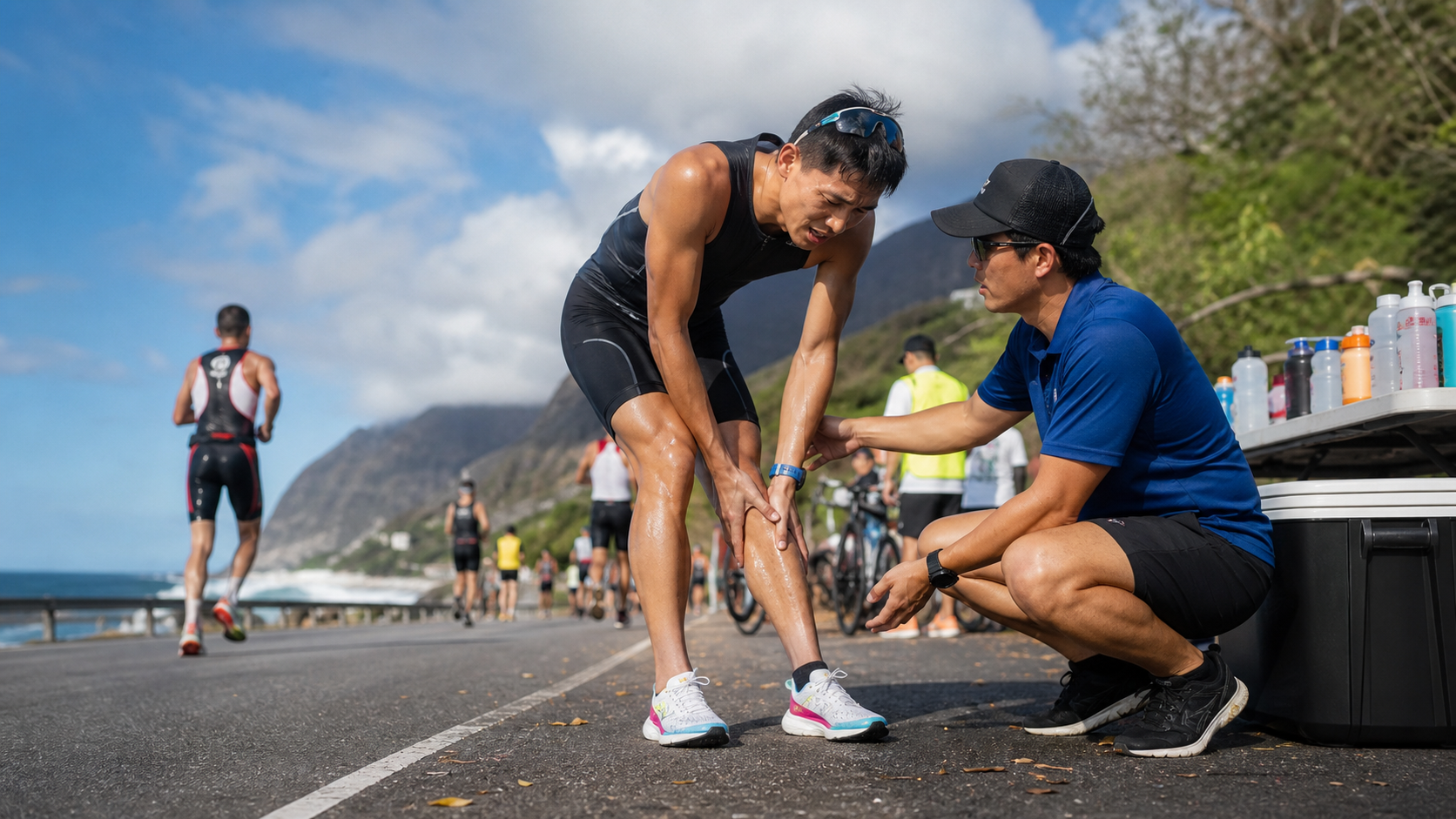
Coach’s Opening: That Calf That Seized Up at the T2 Transition Area
Having coached athletes for so many years, if I had to vote for the “most heartbreaking race scene,” cramps would definitely be in the top three. I’ll never forget one of my athletes—let’s call him A-Kai—who trained an entire training block to prepare for his first 113 half-distance triathlon. His swim was steady, and his pacing on the bike leg was spot on. But the moment he dismounted at T2 and was about to slip on his running shoes, his right calf “snapped” and locked up completely. He was hopping on one foot, his face turning pale. That kind of pain can bring a grown man to tears right next to an aid station.
What made it even more frustrating was that his bike power and heart rate data were all within the planned range, and he had followed his nutrition plan to the letter. So his first question to me after the race was: “Coach, I took my salt tablets and drank plenty of water. Why did I still cramp up?”
That question is the core this article aims to answer. Over the past two decades, the sports science community has quietly turned the table on “what actually causes cramps.” If you’re still stuck on the old belief that “cramps must mean you’re dehydrated or low on salt,” your prevention strategy might be heading in the wrong direction from the start. Today, I’ll speak to you in the practical tone I use with my athletes, laying out the latest scientific consensus, on-course management steps, and the real evidence behind salt tablets and pickle juice—all in one go, and give you a ready-to-use SOP.
Let me give you the bottom line first: Cramping isn’t because you didn’t try hard enough, and it’s mostly not because you slacked off on salt. It’s more like your neuromuscular system “protectively” going haywire under specific intensity and fatigue. Once you understand this, you’ll know what to train, what to supplement, and how to fix it in the moment. I’ll do my best to make every part of this article practical enough for you to implement right away, so you can start making changes as soon as you finish reading.
Foundational Concepts: Is Cramping About “Electrolyte Depletion” or “Neural Dysregulation”?
Old School vs. New School: Two Theories at a Glance
Exercise-induced cramping has a specific scientific term: Exercise-Associated Muscle Cramps (EAMC). For years, two main schools of thought have been at odds over its cause:
| Theory | Core Claim | Strength of Supporting Evidence | Coach’s Plain-English Translation |
|---|---|---|---|
| Dehydration/Electrolyte Depletion Theory (Old School) | Heavy sweating depletes water and sodium, causing electrolyte imbalance that triggers cramps | Weaker; mostly from anecdotal observations and experience; multiple prospective cohort studies don’t support it | “You just didn’t drink enough or eat enough salt”—sounds intuitive, but doesn’t hold up well |
| Altered Neuromuscular Control Theory (New School) | Muscle fatigue causes an imbalance in spinal-level reflexes: signals promoting contraction strengthen while signals inhibiting contraction weaken, leading to over-excited motor neurons firing | Stronger; from laboratory studies using electromyography (EMG) to monitor spinal reflexes | “Muscles get so tired the neural brakes fail”—this is currently the most accepted mainstream explanation |
According to recent literature reviews, evidence supporting the dehydration and electrolyte theory mostly comes from anecdotal clinical observations and case series, while several prospective cohort studies do not support this hypothesis. In contrast, the “altered neuromuscular control theory” is considered the most defensible and highest-level explanation in the current scientific literature (see references at the end). Advances over the past century in understanding EAMC pathophysiology point to: altered neuromuscular excitability as the primary factor, with dehydration and electrolyte loss playing a much more secondary role.
Why Does the “Neural Dysregulation” Explanation Make More Sense?
Let me translate the science into plain language using my observations from coaching athletes. Have you noticed these patterns?
- Cramps almost always happen in the later stages of a race, or when you’re pushing beyond your usual training intensity—when your muscles are at their most fatigued.
- Cramps tend to hit the muscle that worked the hardest and accumulated the most fatigue that day (for triathletes, this is most commonly the calf muscles, hamstrings, and quadriceps).
- Some people load up on salt and drink water until they’re full, yet still cramp; others barely supplement electrolytes at all and have no issues all race.
These observations are hard to explain with “just not enough salt and water,” but they make perfect sense with “fatigue causes reflex imbalance.” When muscles contract continuously at high intensity to the point of fatigue, the excitatory signals from muscle spindles are amplified, while the inhibitory “brake” signals from the Golgi tendon organ are weakened. The motor neuron pool then enters a state of hyper-excitability, and the muscle contracts uncontrollably—that’s a cramp.
So Are Electrolytes Completely Irrelevant? The Coach’s Pragmatic Stance
Here, I want to pump the brakes so we don’t overcorrect. The scientific community saying “electrolytes aren’t the main cause” does not mean “nutrition doesn’t matter.” For endurance sports like triathlon, which involve long durations and heavy sweating, dehydration and sodium loss still:
- Accelerate overall fatigue—and fatigue is the core trigger for cramps, so while electrolytes aren’t the direct trigger, they’re an accomplice.
- Affect gut absorption and how you feel—hyponatremia (too-low blood sodium) is a real and dangerous issue in ultra-distance events.
- Make a noticeable difference in “high sodium-loss” athletes—these athletes have particularly salty sweat, and their clothes develop white salt crystals when dry.
So my coaching stance is clear: Focus your main efforts on “reducing muscle fatigue and increasing the tolerance of the affected area,” while treating hydration and sodium as an important supporting line of defense. Walk on both legs; don’t bet everything on a single cause.
Practical Methods: A Complete SOP for Cramp Prevention and On-Site Management
Now that the concepts are covered, let’s get to the practical stuff. I’ve broken down prevention and management into four phases: season training, the 72 hours before the race, during the race, and when a cramp strikes.
Phase 1: Season Training—Build Your “Cramp-Resistant Physique”
Since the root of cramping is neuromuscular dysregulation under fatigue, the most fundamental prevention is making the target muscle groups more durable at race intensity. This isn’t achieved through supplements; it’s achieved through training.
Below is a sample weekly “cramp-resistance strengthening” plan I often give athletes preparing for 51.5 (Olympic distance) to 113 races. This isn’t a complete triathlon plan; it’s a “layered on top of your existing training” set of key muscle group reinforcements, interspersed throughout the week:
| Weekly Schedule | Training Focus | Example Content | Purpose |
|---|---|---|---|
| Monday | Calf eccentric strengthening | Standing calf raises 3 sets × 12 reps, lowering phase slowed to 3 seconds; progressive single-leg calf raises | Improve gastrocnemius/soleus fatigue resistance and tolerance |
| Wednesday | Brick training | 40 min bike (including race target power) immediately followed by 15–20 min run | Help the neuromuscular system adapt to the fatigue of “running right after riding” |
| Friday | Posterior chain and core | Romanian deadlifts, bridges, single-leg deadlifts; 8–10 min core | Strengthen hamstrings and glutes to share the load off the calves |
| Weekend | Long distance + progressive pacing | Deliberately include a segment near race pace in the later part of a long ride or run | Simulate late-race fatigue and train neural reflex stability |
Key reminders from coaching experience:
- Eccentric (slow lowering) movements are especially important. Cramps often occur when a muscle is lengthened under load (e.g., downhill running, bottom of the pedal stroke). Strengthening eccentric control improves the tolerance of tendon tension receptors.
- Brick training is the triathlete’s core anti-cramp weapon. Many people cramp in the calves during the first 10 minutes of the run out of T2 simply because they rarely run right after riding, so their neuromuscular system hasn’t adapted to that transition. For A-Kai, I added a weekly brick session, and the following year at the same race, he didn’t cramp at all.
- Don’t cram in a last-minute calf workout the week before the race. Strengthening requires 6–8+ weeks of accumulation. The week before the race, you should be tapering to let your body recover.
Phase 2: 72 Hours Before the Race—Anchor Your Nutrition and Strategy
This phase has two goals: get your water and electrolyte “stores” in order, and confirm your race nutrition plan.
Water and Sodium Stores (Not Chugging Water):
- 2–3 days before the race, drink water regularly and normally. Use urine color as your guide—maintain a light yellow. Don’t force yourself to drink until it’s clear (that could actually dilute your blood sodium).
- For summer races in Taiwan (like many midsummer triathlons in the south and east), temperatures and humidity are high. The day before the race, you can moderately increase sodium in your diet—which is easy in Taiwan. A bowl of soupy danzai noodles, a serving of braised snacks (lu wei), or a sports drink can all help. Using Taiwan’s convenient food environment is an easy way to get sodium; there’s no need to buy fancy supplements.
Three Numbers for Your Race Nutrition Plan (Ranges, Not False Precision):
| Nutrition Item | Recommended Range (Per Hour) | Notes for the Taiwan Context |
|---|---|---|
| Water | Approximately 400–800 ml, adjusted for body size, temperature, and sweat rate | Taiwan’s summer heat and humidity usually mean aiming for the upper end |
| Sodium | Approximately 300–700 mg; can go higher for heavy sweaters/“salty sweaters” | A typical commercial salt tablet often falls in the hundreds of milligrams range—check the label |
| Carbohydrates | Approximately 30–60 g (up to 90 g for ultra-distance, requires gut training) | Energy gels, bananas, and aid station food can all be combined |
These numbers must be rehearsed during training. The phrase I remind my athletes of most is: “On race day, don’t use anything you haven’t tried in practice.” New salt tablets, new energy gels, new sports drink flavors—all of them can upset your stomach and create problems instead of solving them.
Phase 3: During the Race—Real-Time Monitoring Strategies
During the race, your job is to “keep fatigue manageable, stick to your nutrition schedule, and stay alert to warning signs.”
- Pacing discipline is your first line of defense. Use power (on the bike) and heart rate (on the run) to stick to your plan, especially on the bike leg—don’t get carried away and hammer. Too many people blow up on the bike and start cramping on the run—because fatigue was spent in advance.
- Stick to your nutrition schedule; don’t wait until you’re thirsty to drink. Set a watch reminder to take small sips every 15–20 minutes and hit your planned sodium amount each hour.
- Watch for “pre-cramp warning signs.” Cramps rarely come without warning. There’s usually a precursor of muscle “twitching, tightness, or a feeling it’s about to lock up.” This is your golden window—immediately slow down, change your cadence, and actively relax that muscle. You can often stop a full-blown cramp in its tracks.
Phase 4: When a Cramp Hits—Five-Step On-Site Emergency Protocol
What do you do when a cramp actually strikes? Memorize these five steps. This is the on-site SOP I require every athlete to know:
- Stop. Don’t push through it. Continuing to exert will only make that over-excited muscle cramp harder, or even cause a strain.
- Passively stretch the cramped muscle—this is the most effective immediate measure. Calf cramp: pull your toes toward you with your hand, or press the ball of your foot against a wall/step and push your heel down to lengthen the gastrocnemius. Hamstring cramp: sit with your leg extended and lean forward to reach for your toes. Quadriceps cramp: stand, grab your ankle, and pull your heel toward your glutes. The principle behind stretching directly aligns with the neural theory—lengthening the muscle stimulates the Golgi tendon organ, re-engaging the weakened inhibitory reflex and helping the nervous system “hit the brakes.”
- Gently massage to relax. While stretching, use your palm to knead the cramped area to help it release, but don’t dig in hard or press aggressively.
- Rehydrate and replenish electrolytes (supportive, not a magic bullet). Drink a little sports drink or a sodium-containing beverage. Be prepared: this will be slow to relieve the current cramp; its main purpose is to help prevent subsequent recurrences and overall dehydration.
- Resume gradually at reduced intensity. After the cramp subsides, don’t immediately sprint back to your target pace. Walk or jog slowly to let the muscle calm down, and only gradually pick up speed once you’re sure the twitching has stopped. If cramps keep recurring, are accompanied by severe pain that won’t subside, or you experience dizziness, nausea, or confusion, stop the race and seek medical attention—conditions like hyponatremia and heat exhaustion require professional management.
Salt Tablets and Pickle Juice: Laying Out the Evidence
These are the two “cramp miracle cures” athletes ask me about most. Let me break them down one by one.
Salt Tablets: Useful, But Don’t Treat Them as a Cramp Cure-All
Let me state my position first: Salt tablets have their place in triathlon nutrition, but their role is “maintaining overall fluid and electrolyte balance, supporting long-duration performance and gut comfort”—not “take one and the cramp goes away.”
Based on the neural theory discussed earlier, the immediate trigger of a cramp is neuromuscular dysregulation. The sodium you swallow needs to enter your bloodstream and affect the muscle level—on a timescale that simply can’t rescue “this second’s cramp.” So:
- For “salty sweat/high sweat-loss” athletes, regular sodium supplementation has the highest value—these people genuinely lose a lot of sodium over a race, and getting it right noticeably improves how they feel and their late-race performance.
- For the average athlete, treat salt tablets as part of your planned nutrition—use the table above to hit your hourly sodium target. Don’t start popping them frantically because you cramped; excess will just upset your stomach.
- Never down salt tablets on an empty stomach or without enough water. High-concentration sodium irritates the gut and can cause nausea.
- Read the product label carefully. Commercial salt tablets vary widely in sodium content per tablet—some are low, some pack a lot into one. Always convert to “actual hourly sodium intake” rather than counting tablets by feel.
Pickle Juice: This One Is Actually a Bit Magical, and the Mechanism Defies Intuition
Pickle juice is a well-known folk remedy in the Western endurance community, and it’s one of the few cramp treatments with “laboratory evidence.” The key point is—the reason it works is completely different from what you’d assume.
Your intuition says: pickle juice is salty, so it must stop cramps by replenishing sodium, right? Wrong. Research has found that drinking a very small amount of pickle juice can shorten cramp duration, and the relief is so fast that “there’s no time for electrolyte replenishment or changes in blood sodium concentration to take effect.” Well-controlled laboratory studies show that pickle juice can shorten cramp duration without changing blood sodium concentration or hydration status.
So how does it actually work? The current mainstream explanation is the oropharyngeal reflex: irritant compounds in pickle juice, like acetic acid, activate TRP ion channels (such as TRPV1 and TRPA1) in the mucous membranes of your mouth and throat. This strong stimulus “ascends” via a neural reflex and inhibits the over-excited alpha motor neuron pool—essentially pressing the nervous system’s “reset button” from your mouth, calming the uncontrolled muscle down.
One classic study showed that compared to water or saline, pickle juice shortened (electrically induced) cramp duration by an average of about 49 seconds—nearly 40% (see references at the end). Other studies have further compared “swishing it in your mouth” versus “actually swallowing it” to investigate whether this oropharyngeal reflex requires actually ingesting it.
Coach’s practical usage recommendations:
- You don’t need much. Because the mechanism is an oropharyngeal reflex, not sodium replenishment, a small sip (on the order of 30–75 ml) is enough to trigger the effect. No need to chug.
- You must test it beforehand. That sour, salty taste, combined with a churning stomach during a race, can make some people nauseous. Test your tolerance during training—don’t try it for the first time on race day.
- It’s a “rescue tool,” not “daily nutrition.” I usually recommend keeping a small bottle of pickle juice or a commercial pickle juice shot in your transition bag, to use when pre-cramp warning signs appear or a cramp has already hit. For regular hydration and electrolytes, stick to your standard plan.
- How to get it in Taiwan: Specialty import supermarkets and some online retailers sell dedicated pickle juice shots. Alternatively, the brine from a regular jar of Western-style pickles works on the same principle. If you really can’t find any, some people improvise with a small sip of a highly acidic stimulus (like lemon juice)—the principle is similar, but the evidence is less direct.
Two Real-Life Scenarios: Different Cramps, Different Solutions
Principles alone can be too abstract. Let me use two contrasting athlete scenarios (illustrative teaching examples; all data set within reasonable ranges) to show you that even though both involve cramping, the causes and solutions are different.
Scenario A: A-Kai’s “Fatigue-Type” Calf Cramp
A-Kai from earlier is the most classic case of “neuromuscular fatigue-type” cramping. His nutrition was actually fine—about 600 ml of water per hour, 500 mg of sodium, energy gels on schedule, and normal urine color. The problem was on the training side: he did almost no brick training during his preparation, and his strength training was minimal. Under the accumulated fatigue of “90 km of riding with heart rate held at moderate-to-high intensity,” his calves gave out the moment he started running out of T2.
The adjustments I made for him were simple but highly effective:
- One fixed brick session per week (bike followed by run) for 8 consecutive weeks.
- Twice-weekly calf eccentric strengthening, doing both standing and seated calf raises (seated targets the soleus, standing targets the gastrocnemius).
- Slightly lowered his power ceiling on the bike leg to save energy for the later stages.
The following year at the same race, he didn’t cramp at all. Note: I never told him to eat more salt. His problem was never a salt deficiency; it was a lack of muscular fatigue resistance and insufficient neuromuscular transition adaptation.
Scenario B: Xiao-Ya’s “Salty Sweat + High Heat” Combined-Type Cramp
Another athlete, Xiao-Ya, had a completely different story. She’s the type who sweats profusely during any exercise, and her workout clothes develop white salt crystals when dry—a classic “salty sweater.” At a hot, humid summer triathlon in Taiwan, she started getting recurrent cramps in her inner thighs and calves in the later part of the bike leg, and once one hit, they kept coming in waves.
Her training was actually solid. The problem was that her nutrition didn’t match her high-loss physiology and the extreme conditions of the day: the temperature felt like 35°C+ with high humidity, and her sweat rate and sodium loss were far above average. But she was only supplementing at the “standard hourly sodium amount,” which meant she was running a chronic deficit, and the dehydration compounded to accelerate overall fatigue.
The adjustments I gave her were different from A-Kai’s:
- Given her salty-sweat physiology, we adjusted her hourly sodium intake toward the upper end and added extra emphasis for hot-weather races.
- The day before the race, she deliberately topped up fluids and sodium (using easily accessible salty foods and sports drinks in Taiwan).
- She kept a pickle juice shot in her transition bag and used it the moment pre-cramp warning signs appeared, as an immediate neural-reflex rescue.
- In hot races, she proactively slowed her pace and used water at every aid station to cool her body surface.
The contrast between these two scenarios is the soul of this entire article: Cramping doesn’t have just one cause. You need to first determine which type you’re closer to before you can treat it correctly. Most people lean toward the “fatigue type” (like A-Kai); a minority with high-loss physiology in extreme environments will be the “combined type” (like Xiao-Ya). If you get the direction wrong, all your effort will be half as effective.
Common Mistakes and Corrections: The Landmines I Most Often Catch with My Athletes
These are the errors I’ve seen and corrected repeatedly over the years. Check how many you’ve hit.
Mistake 1: Blaming All Cramps on “Not Enough Salt” and Frantically Popping Salt Tablets
Correction: The main cause of cramps is neural dysregulation under fatigue, not simply salt deficiency. Frantically taking salt tablets won’t save you in the moment, and excess can irritate the gut, causing nausea and diarrhea. Put your effort into training the fatigue resistance of the affected muscle group and holding your pacing—that’s the real cure.
Mistake 2: Skipping Brick Training but Expecting No Cramps at T2
Correction: The neuromuscular transition from bike to run requires specific adaptation. Schedule at least one brick session per week so your body learns the fatigue pattern of “running immediately after riding.” This is a crucial lesson for triathletes to protect their calves.
Mistake 3: Using a New Nutrition Product for the First Time on Race Day
Correction: Salt tablets, energy gels, pickle juice, sports drink flavors—all of them need to be rehearsed in training until your gut is used to them. “Only use what you’ve practiced” is an iron rule.
Mistake 4: Losing Pacing Discipline on the Bike and Spending Fatigue in Advance
Correction: Use a power meter to strictly maintain bike pacing discipline. The energy you save in the early stages is the capital that keeps you cramp-free and running well in the later stages. A lot of cramping is actually “a pacing problem” disguised as “a nutrition problem.”
Mistake 5: Pushing Through a Cramp or Kneading It Hard
Correction: Stop immediately and do a passive stretch (lengthen the muscle)—this aligns with the scientific principle of the neural inhibitory reflex. Gentle massage is a supportive aid; don’t go toe-to-toe with that cramped muscle.
Mistake 6: Ignoring the “Warning Signs” and Only Reacting When It’s Fully Locked Up
Correction: The twitching, tightness, or “about to lock” sensation in a muscle is your golden window. The moment it appears, slow down, change your cadence, and actively relax. You can often keep a major cramp at bay.
Actionable Advice for Athletes at Different Levels
Finally, let me tier the advice by level so you can find yourself directly.
First-Timers / New Finishers
- Focus on “finishing” and “pacing discipline.” Your biggest cramp risk right now comes from “getting too excited and going out too fast.” Hold a comfortable-to-moderate pace and your cramp odds drop dramatically.
- Add one simple calf raise session and one brick session per week—that’s plenty of protection; no need for complexity.
- Aim for the middle of the nutrition ranges: hydrate regularly each hour, take one salt tablet, eat some easily digestible carbs, and test it all in training.
- Keep a small bottle of pickle juice in your transition bag as insurance, and test the taste beforehand.
Intermediate / Age-Groupers Chasing Results
- Systematically strengthen target muscle groups: eccentric calf work, posterior chain, core—schedule a 6–8+ week cycle.
- Make brick training a regular habit, and deliberately include race pace in the later stages of long sessions to simulate late-race fatigue.
- Fine-tune personalized nutrition: if you’re a salty sweater or have cramped multiple times, push sodium upward and log your sweat and cramp patterns each race to make adjustments.
- Build a complete on-site SOP: warning-sign management, the five-step emergency protocol, pickle juice rescue—drill all of it until it’s reflexive.
Athletes Tackling Ultra-Distance (113/226)
- Cramp prevention is part of “fatigue management”: longer distances mean deeper fatigue, making pacing discipline and energy management doubly important.
- Gut training is non-negotiable: ultra-distance requires higher hourly carbohydrate intake and more sodium loss; both require long training blocks to train your gut.
- Stay alert to hyponatremia: in ultra-distance, “drinking too much plain water without enough sodium” is a real danger. Balance fluids and sodium; don’t just focus on chugging water.
- Layer your defenses: training strength + pacing discipline + regular nutrition + pickle juice rescue—use all four lines of defense together. Don’t bet everything on any single element.
Taiwan Climate Special: How to Adjust for Heat and Humidity
Taiwan’s triathlon scene has one unavoidable characteristic—the heat. From summer races in Kenting, Taitung, Yilan, to central and southern Taiwan, the feels-like temperature easily exceeds 30°C, and humidity often tops 70%. Heat and humidity accelerate your core temperature rise and sweat rate, indirectly pushing fatigue forward and raising cramp risk. Here’s an adjustment comparison table I give athletes for Taiwan’s climate:
| Environmental Condition | Effect on Cramping | Adjustment Strategy |
|---|---|---|
| High heat (feels-like 32°C+) | Core temperature rises rapidly, fatigue accelerates | Proactively slow pace; pour water over head, neck, and wrists at every aid station to cool down |
| High humidity (70%+) | Sweat doesn’t evaporate easily, cooling efficiency drops | Increase hydration frequency; wear breathable, moisture-wicking clothing; don’t force the pace |
| Salty sweat / high-loss physiology | Sodium loss far above average | Push hourly sodium toward the upper end; add salty foods the day before |
| Course with no shade (e.g., coastal sections) | Radiant heat from sun adds up | Wear a hat, apply sunscreen; use heart rate as an upper-limit indicator—if it exceeds, slow down |
One point Taiwanese athletes most often overlook: hot weather isn’t just about sweating more; the critical factor is that rising core temperature directly impairs neuromuscular performance. So in hot races, “proactively slowing down + actively cooling down” is itself a powerful cramp prevention measure. Don’t feel embarrassed about slowing down—the ones who finish strong are the real winners.
Quick Q&A FAQ: The Questions Athletes Throw at Me Most
Q1: Can Bananas Prevent Cramps?
Bananas contain potassium, and many people think they’re an anti-cramp miracle food. Honestly, based on the neural theory, the main cause of cramps isn’t potassium deficiency, so the evidence for “bananas prevent cramps” isn’t strong. But bananas are excellent race carbohydrate fuel—easy to digest and easy to get. From the perspective of “providing energy and delaying fatigue,” they have value. Just don’t treat them as a dedicated cramp cure.
Q2: So Should I Take Salt Tablets or Not?
Whether to take them, and how much, depends on whether you’re a salty sweater and how long and hot the race is. For short, cool-weather races, the need is lower; for long, hot races with salty sweaters, regular sodium supplementation has clear value. The key is treating it as “planned nutrition” on a schedule, not frantically popping them after a cramp.
Q3: If I Drink Pickle Juice During a Cramp, How Fast Will I Feel It?
Because it works through the oropharyngeal neural reflex, it should theoretically act much faster than “relying on sodium replenishment.” Research shows it significantly shortens cramp duration. But everyone responds differently, and it’s not a miracle cure. The most important thing is still to do a passive stretch simultaneously—stretching is the most reliable immediate relief for a cramp; pickle juice is a bonus neural-reflex aid.
Q4: I Don’t Cramp in Training, So Why Do I Cramp in Races?
Because in races, you push harder than usual, at higher intensity, with deeper fatigue, plus the added stress, poor sleep, and hot weather—all stacking up. This perfectly aligns with the neural theory—races push you into fatigue zones you’ve never reached in training, making the neuromuscular brakes more likely to fail. The solution is to simulate race-intensity fatigue in training first (brick sessions, late-session pacing).
Q5: Can Stretching (Pre-Race Static Stretching) Prevent Cramps?
Warming up properly before a race is important, but the evidence for “pre-race static stretching preventing cramps for the whole race” isn’t strong. What’s truly effective is long-term strength and fatigue-resistance training, along with passive stretching at the moment a cramp occurs. Don’t treat a couple of pre-race stretches as a lucky charm.
Q6: Can I Continue Racing After a Cramp?
Most fatigue-type cramps can be resolved with stretching and slowing down, and you can continue. But if cramps keep recurring and won’t stop, severe pain won’t subside, or you experience dizziness, nausea, or confusion, you must stop and seek medical attention. These could be signs of hyponatremia, heat exhaustion, or other conditions requiring professional care. Don’t be stubborn.
Conclusion: Cramps Aren’t a Punishment—They’re Feedback From Your Body
Back to A-Kai from the beginning. The following year, with a new training plan, plenty of brick sessions, and a fully rehearsed nutrition strategy, he finished the same race without a single cramp and gave me a big hug at the finish line. What he did right is essentially the summary of this article: he stopped treating cramps as “salt superstition” and understood them as a neuromuscular system going haywire under fatigue, then systematically tackled them from four angles: training, pacing, nutrition, and on-site management.
Cramps aren’t a punishment from the universe, and they’re not a sign you didn’t push hard enough. They’re more like a feedback signal your body sends under specific fatigue conditions. Understand the science, build the foundation, and prepare your SOP—and you’ll hold that variable firmly in your own hands. At your next race, I hope the thing on your mind at the finish line is your time, not that calf that’s about to lock up.
Bookmark this article and review it before your next race. You’ll already be doing several things right that many others aren’t. See you on the racecourse.
This article is educational content and does not replace individual assessment by a physician, physical therapist, or nutritionist.
References
- Cause of Exercise Associated Muscle Cramps (EAMC) – Altered neuromuscular control, dehydration or electrolyte depletion?(ResearchGate):https://www.researchgate.net/publication/23448412_Cause_of_Exercise_Associated_Muscle_Cramps_EAMC_-_Altered_neuromuscular_control_dehydration_or_electrolyte_depletion
- An Evidence-Based Review of the Pathophysiology, Treatment, and Prevention of Exercise-Associated Muscle Cramps(PMC):https://pmc.ncbi.nlm.nih.gov/articles/PMC8775277/
- Muscle Cramping During Exercise: Causes, Solutions, and Questions Remaining(Sports Medicine, Springer):https://link.springer.com/article/10.1007/s40279-019-01162-1
- Effectiveness of Mouth Rinsing versus Ingesting Pickle Juice for Alleviating Electrically Induced Cramp in Physically Active Adults:https://doi.org/10.3390/app112412096
- Reflex Inhibition of Electrically Induced Muscle Cramps in Hypohydrated Humans(ResearchGate):https://www.researchgate.net/publication/40483827_Reflex_Inhibition_of_Electrically_Induced_Muscle_Cramps_in_Hypohydrated_Humans
Related Reading
- The Truth About Cramps: Latest Research Overturns the Electrolyte Theory
- Cramping During Races: It’s Not Just About Salt Deficiency—Neuromuscular Fatigue Is the Main Culprit
- Causes and Prevention of Cramps: Sodium, Water, and Muscle Fatigue
- Hydration and Electrolytes on the Basketball Court: The Real Reason Behind Fourth-Quarter Cramps
Never Stop 西進武嶺 前後雙機 完整全程錄影 訓練台 實境
8 年前
CT 喇低賽) 武嶺牽車 才是王道 西進牽車四小時內秘訣 攝手位置 如何判斷 防抽筋小秘訣
7 年前
FTL 與 SYB 車隊專訪 西進武嶺 實用攻略分享! 2小時 如何練?!你不知道的眉角!新手準備武嶺必看 EP1 | 實力派女車友 | 精華版 | 公路車 | CTYeh
4 年前
#KOM 夏季登山王之路 比賽實況 #東進武嶺
7 年前
[教學] Premiere 影片 手震 修正 教學 防抖 單眼 影像 GoPro 穩定 Video Stabilization
8 年前
一日北高/長距離團騎 常見問題補充篇 / 組團或跟團的眉角 / 壯車友容易被瘦車友慢性拉爆 / 原來屁股痛可能是這個原因...? / 風場配速法 / 公路車 / CT Yeh
2 年前
一日北高常見問題大集合 | 攻略 | 路線 | 訓練 | 補給 | 自行車 單車 | 一日雙城 | 雙塔 | TWB北高360 | 屁股痛
6 年前
CT 喇低賽) 單車 比賽總是沒照片? 攝影師的觀點大公開 姿勢就是力量! 請加速1.25倍收看
7 年前