The Science of Mid-Exercise Fueling: How Many Carbs Per Hour? A Complete Practical Guide from 60g to 90g
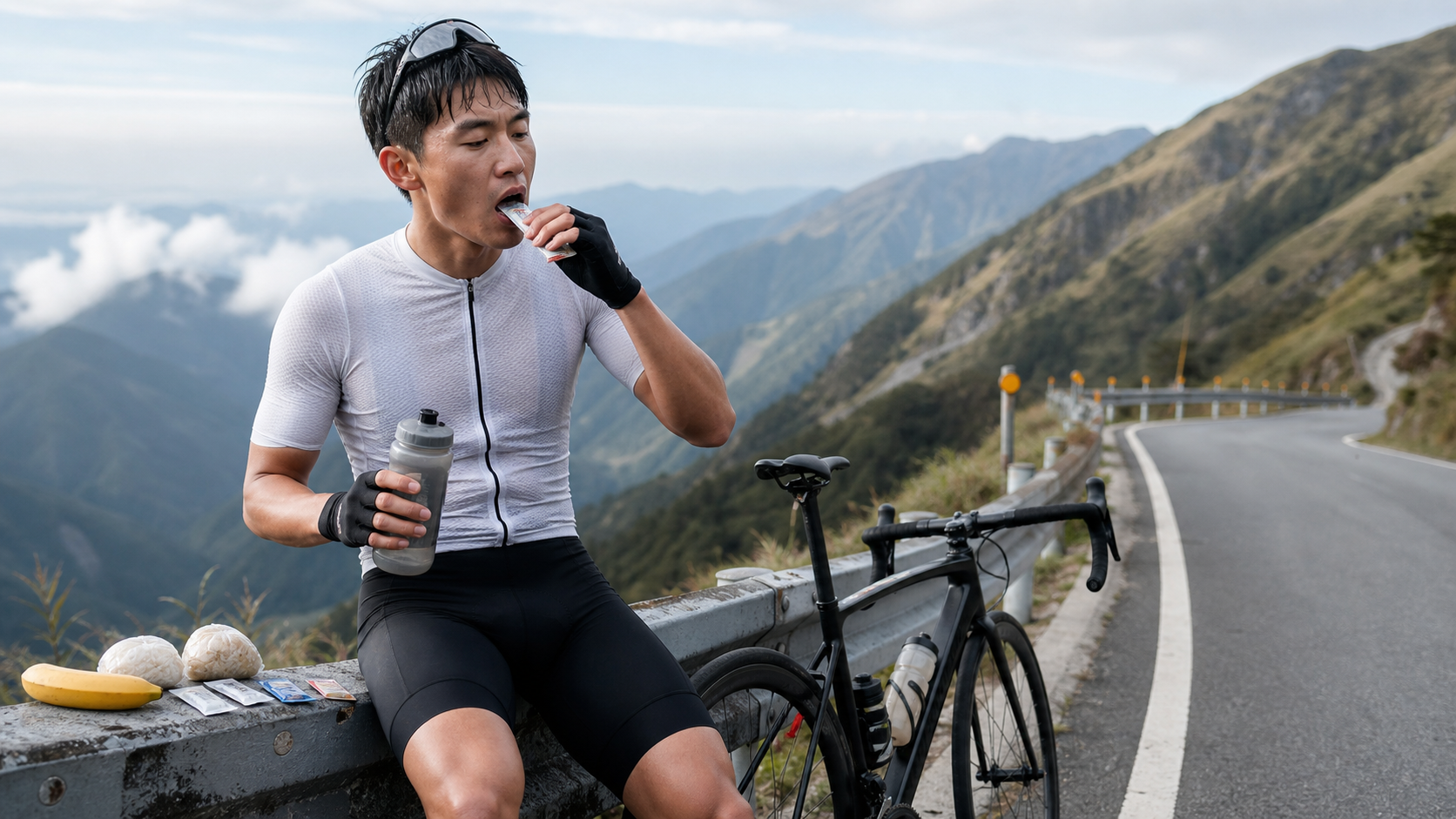
Opening: The Student Who “Blew Up” Ten Kilometers from Wuling
I’ve coached athletes and recreational exercisers for fifteen years. If I had to pick the “most common, most regrettable, yet most easily fixable” mistake, the answer isn’t undertraining—it’s poor fueling.
A few years ago, I guided an amateur cyclist tackling the western ascent of Wuling. His power numbers were solid; he’d built a strong aerobic base riding the riverside bike paths, with an FTP around 3.8 watts per kilogram—quite respectable for an amateur. Before we set off, I repeatedly stressed, “Eat at least 60 grams of carbs per hour.” But he found it a hassle, and over the whole ride, he only had two sips of sports drink at the aid stations and nibbled half a banana. The result? At nearly 3,000 meters of altitude, with over ten kilometers still to go, his heart rate suddenly dropped, his legs felt like lead, his pace fell from 12 km/h to 7 km/h, his face went pale, and he started rambling incoherently.
That wasn’t a fitness problem; that was a textbook “bonk”—glycogen depletion combined with low blood sugar. His engine wasn’t broken; his tank was just empty.
I shoved the remaining energy gels from my pocket into his hands, made him wash them down with water, and had him sit by the roadside for fifteen minutes. Once his blood sugar recovered, he managed to ride the final stretch on his own. Afterwards, he told me, “Coach, I always thought fueling was a detail reserved for pro riders.”
This article aims to take the question of “how many carbs should you actually eat during exercise” from the physiological mechanisms all the way to practical templates, so you can apply it as soon as you get home. It covers the physiological ceiling of carbohydrate intake, why multiple transportable carbohydrates can break through that ceiling, and a per-hour dosing table for different exercise durations and intensities. I’ll also incorporate real-world Taiwanese scenarios—our hot, humid climate, convenience store and street-food fueling options, and common climbing and marathon venues.
Here’s the bottom line for those in a hurry: For exercise under 1 hour, deliberate carb intake is usually unnecessary; for 1 to 2.5 hours, aim for 30 to 60 grams per hour; beyond 2.5 to 3 hours, you can push up to 90 grams per hour, and at high doses, be sure to use a “glucose + fructose” blend.
Foundational Concepts: Why Fuel with Carbs During Exercise?
How Big Is Your Fuel Tank?
The human body stores energy in two main forms: fat and glycogen (the stored form of carbohydrates). Fat is nearly inexhaustible—a normal-weight adult carries tens of thousands of kcal of fat. But the catch is that the higher the exercise intensity, the more the body relies on carbohydrates for fuel, and carbohydrate stores are pitifully small.
For an average adult, total glycogen stores are roughly on this order of magnitude (varies by body size and training status; ranges given below):
| Storage Site | Approximate Amount | Approximate Energy | Characteristics |
|---|---|---|---|
| Muscle glycogen | 300–600 g | 1,200–2,400 kcal | Can only fuel the muscle it’s stored in; cannot be shared with other areas |
| Liver glycogen | 80–120 g | 320–480 kcal | Maintains blood sugar, supplying the whole body and brain |
| Blood glucose | ~4–5 g | ~20 kcal | Extremely small; must be continuously replenished by the liver to stay stable |
See the key point? Liver glycogen is only about 80 to 120 grams, and it has to feed both your brain and your entire body. When you exercise at moderate-to-high intensity for a long time, this small reserve gets drained fast. Once glycogen runs dry and blood sugar can’t hold up, you’ll experience exactly what my student went through: weak muscles, dizziness, loss of focus, low mood—that’s the bonk.
Three Benefits of In-Ride Carb Intake
Consuming carbs during exercise (what we call “exogenous carbohydrate”) delivers three things:
- Maintains blood sugar stability: Keeps your brain and nervous system fueled, preventing dizziness and impaired judgment.
- Spares glycogen: When incoming sugar gets burned, your internal stores last longer.
- Sustains high-intensity output: Lets you keep pedaling and running in the latter stages of an event.
This is why fueling isn’t “a detail only pros need.” As long as your exercise exceeds roughly 60 to 90 minutes, carb intake will genuinely determine whether you finish strong.
The Scientific Core: Where Exactly Is the “Ceiling” for Carb Intake?
This is the most critical section of the entire article—please read it slowly.
The 60g Ceiling: Why Can’t You Absorb More No Matter How Much You Eat?
For a long time, the golden number in sports nutrition was “60 grams per hour.” The reason isn’t that your mouth can’t handle it; it’s that intestinal absorption has a hardware limit.
For glucose to move from the gut into the bloodstream, a transport protein called SGLT1 has to “carry” it across the intestinal wall. This transporter’s capacity is finite—when you flood the system with glucose alone (or maltodextrin, which ultimately breaks down into glucose), SGLT1 quickly becomes saturated, and the absorption rate plateaus at around 60 grams per hour.
What does this mean? Even if you force down 90 grams of pure glucose in an hour, those extra 30 grams won’t be absorbed. They’ll just sit in your gut, causing bloating, nausea, and diarrhea—this is the culprit behind many people’s “stomach discomfort” after fueling. According to a summary by the Gatorade Sports Science Institute, the oxidation rate of a single glucose source is indeed limited by this transport mechanism, making it a long-standing physiological ceiling (source listed at the end).
Breaking the Ceiling: Multiple Transportable Carbohydrates
So what’s the solution? Sports science later uncovered an elegant answer: use two types of sugar that enter through different “gates” simultaneously.
The key point is that fructose doesn’t use SGLT1; it uses a different transporter called GLUT5. This effectively opens a second, independent door in the gut. When you mix glucose and fructose, both absorption pathways work at once without competing, allowing total absorption to be pushed higher.
Research shows that with a glucose-to-fructose ratio of roughly 2:1 and an intake of about 90 grams per hour, carbohydrate oxidation rates can increase by approximately 50% compared to glucose alone (source listed at the end). This is the power of “multiple transportable carbohydrates,” and it’s the scientific foundation for modern endurance fueling jumping from “60 grams” to “90 grams.”
Here’s a real-world analogy: relying on glucose alone is like a highway with only one toll booth open—no matter how much traffic there is, it bottlenecks. Adding fructose is like opening a dedicated express lane, so throughput naturally rises.
The Ratio Changes with Total Intake
Here’s an advanced but practical detail: the optimal glucose-to-fructose ratio shifts depending on the total amount you aim to consume.
- At a target of about 90 grams per hour, the classic 2:1 ratio (roughly 60 g glucose + 30 g fructose) is the sweet spot.
- But if you’re pushing toward higher totals (e.g., some pros experimenting with 100+ grams per hour), the ratio typically moves closer to 1:1, because the fructose gate needs to handle more of the load.
For the vast majority of Taiwanese amateur cyclists and runners, you don’t need to chase the 100+ gram extreme. Treating 90 grams as your ceiling and 2:1 as your formula principle is more than enough.
Don’t Forget: “Oxidation Rate” and “Absorption Rate” Are Two Different Things
Here’s a concept that’s easy to confuse. We’ve been talking about the “absorption ceiling,” but what truly determines whether you can use the fuel is the oxidation rate—the sugar must be absorbed into the blood and then actually “burned” by the muscles to count. Multiple transportable carbohydrates are powerful precisely because they improve both ends: absorption and oxidation. With glucose alone, even if a bit gets absorbed, the oxidation side is already backed up; adding fructose via a separate pathway widens both the front and back ends.
This also explains a real phenomenon: at the same 90 grams, a mixed formula gives you significantly more “actually usable” energy, and your stomach feels better too. This isn’t voodoo; it’s the direct result of transporter protein分工.
Four Variables That Affect How Much You Can “Take In and Use Up”
The same amount of fuel can be tolerated very differently by different people and in different situations. In practice, I remind my athletes to pay attention to these four points:
| Variable | Direction of Impact | Practical Reminder |
|---|---|---|
| Exercise Intensity | The higher the intensity, the less blood flow to the gut, making digestion harder | At high intensity, lean toward liquids and lower concentrations |
| Ambient Temperature | The hotter and more humid, the slower gastric emptying | Be more conservative in Taiwan’s summer; rely more on drinking |
| Gut Training Level | Those who have trained can absorb more and experience less discomfort | Fueling must be “trained” along with your workouts |
| Individual Physiology | Tolerance to fructose and caffeine varies from person to person | Always test it during training first |
Keep this table in mind and you’ll understand: the 90 grams in textbooks is a “potential upper limit,” not “the amount everyone should consume today.” Progressing gradually and tailoring to the individual is the real answer.
Practical Methods: Carbohydrate Dosing Table by Exercise Duration
Now that the theory is covered, let’s look at the most practical part. Below is a practical reference table I’ve compiled from mainstream sports nutrition guidelines (including the framework from ACSM, the American College of Sports Medicine; sources listed at the end) combined with my experience coaching athletes.
Core Dosing Table: Determined by Exercise Duration
| Exercise Duration | Recommended Carbohydrates per Hour | Recommended Carbohydrate Sources | Practical Notes |
|---|---|---|---|
| Less than 45 minutes | Usually no deliberate fueling needed | Plain water primarily | Body glycogen is sufficient; just hydrate |
| 45–75 minutes (high intensity) | Small amounts, or even just “rinsing” | Hold sports drink in mouth | Rinsing with carbs can trick the brain and boost performance |
| 1–2.5 hours | 30–60 grams | Glucose, maltodextrin, sucrose, sports drinks | A single carbohydrate type is sufficient; no need to deliberately mix fructose |
| Over 2.5–3 hours | Up to 90 grams | Glucose + fructose at roughly a 2:1 ratio | High doses require multiple transportable carbohydrates to be absorbed |
The logic of this table is clear: the longer the duration and the more sustained the intensity, the more exogenous carbohydrates you need, and the more refined the carbohydrate “formula” becomes. For short efforts, plain glucose is fine; for long, high-dose efforts, you must rely on a glucose + fructose combination, or your gut will wave the white flag first.
Converting to “Food You Can Visualize”
No matter how many numbers I throw at you, it’s useless if you can’t convert them into food. Below is a breakdown of the carbohydrate content of common fuel sources so you can calculate for yourself:
| Common Fuel Source | Approximate Carbohydrate Content | Notes |
|---|---|---|
| One packet of energy gel | About 20–30 grams | Most commercial gels fall in this range; check the package label |
| One medium banana | About 25–30 grams | Taiwan’s most convenient natural fuel; easy to digest |
| Sports drink, 500 ml | Around 30 grams | Concentration around 6–8%; covers both hydration and carbs |
| One slice of bread | About 15 grams | Useful before a long ride or at aid stations |
| One small pack of gummies / equivalent energy chews | About 20–25 grams | Easy to eat; good for those who dislike gels |
Example calculation: Say you’re planning a 4-hour long ride with a target of 60 grams per hour. That means roughly “one gel (25 g) + one bottle of sports drink (30 g)” per hour, or “one banana (27 g) + half a bottle of sports drink + a few gummies.” Find your rhythm—eat a little every 20 minutes, in small, frequent amounts—which is far better than cramming a huge amount all at once.
The “20-Minute Rhythm Method” I Teach My Athletes
Many people fail at fueling not because they eat too little, but because their timing is wrong—waiting until they’re hungry or out of energy before eating is already too late. Blood sugar and glycogen are a game of “strike first.”
I have all my athletes use a timer or bike computer reminder: take a small bite every 20 minutes, splitting the hourly target into three portions. This has two benefits:
- Less gut burden: Small amounts at a time absorb smoothly without bloating.
- Stable blood sugar: No wild swings, avoiding the rollercoaster of “a big spike after a big dose, then a sharp crash.”
For long-distance sports, my mantra is: “Eat before you’re hungry; once you’re hungry, you’ve already lost.”
Taiwan-Specific Scenarios: Humid Heat, Eating Out, and Convenience Store Fueling
Most sports nutrition textbooks come from the West, but cycling and running in Taiwan is a different environment, so fueling strategies must be localized.
Humid Hot Climate: Don’t Forget Sodium and Water
Taiwan’s summers are hot and humid. Classic venues like the riverside paths, Eastbound Wuling, Taroko, and Sun Moon Lake often feel like 30-plus degrees Celsius. In high heat, you sweat more and lose electrolytes faster. Fueling with carbs alone without water and sodium will still cause problems.
- Hydration: For longer efforts, aim for roughly 400–800 ml per hour, adjusted by sweat rate and temperature. Don’t wait until you’re thirsty to drink.
- Sodium: When sweating heavily, sports drinks or salt tablets can replenish sodium (sodium concentration in sweat varies greatly by individual, roughly from a few hundred to over a thousand milligrams per liter). Drinking plain water without sodium over long durations actually carries a risk of dilutional hyponatremia.
One practical adjustment for hot, humid conditions: High temperatures reduce gut blood flow and slow digestion, so liquid fueling (sports drinks, diluted gel with water) is usually better absorbed than solid food. I often remind athletes running full marathons in the summer to eat fewer dry, hard foods in the second half and rely more on drinking.
Convenience Stores and Eating Out: Taiwan’s Fueling Advantage
Taiwan’s incredibly dense network of convenience stores is actually our fueling secret weapon. As long as a long route passes through a town, fueling options are abundant:
| Convenience Store / Eatery Item | Fueling Purpose | Approximate Carbohydrates |
|---|---|---|
| Onigiri (rice ball) | Easy-to-digest solid carbs for mid-ride fueling | About 35–45 grams |
| Sports drink / isotonic drinks | Covers hydration, carbs, and sodium | About 30 grams per bottle |
| Banana | Natural, easily absorbed, contains potassium | About 25–30 grams |
| Bread / small cake | High-carb, easy to carry | 20–40 grams depending on item |
| Salt candy / salt tablets | Sodium replacement when sweating heavily | — |
For the pre-start meal (2–3 hours before a race or long ride), I suggest my Taiwanese friends eat high-carb foods they’re used to: a bowl of noodles, sweet potato, rice balls, or toast all work. The key is easy to digest, something you’ve eaten before, and familiar to your gut. Never try something new on race day—this is a cardinal sin of fueling, which I’ll cover later.
Comparing Different Fuel Types
The market is full of fueling products, and many athletes stand in the store unsure what to pick. I’ve compiled the pros and cons of common types into a table:
| Type | Pros | Cons | Best For / When |
|---|---|---|---|
| Energy gels | Precise grams, lightweight, fast absorption | Sticky texture, must be taken with water, some people get bloated | Races, advanced athletes who track fueling precisely |
| Sports drinks | Hydrates, fuels, and replaces sodium in one | Limited carb concentration, need to carry a lot | Hot, humid conditions; when heavy hydration is needed |
| Energy chews / gummies | Easy to eat, psychologically feels like a snack | Chewing takes effort, cumbersome in large amounts | Those who dislike gels, or prefer solid textures |
| Natural foods (bananas, rice balls) | Cheap, gentle on the gut, available at convenience stores | Hard to calculate exact grams, bulky | Beginners, convenience store fueling, mid-ride on long routes |
| Maltodextrin powder mixed with water | Can self-adjust concentration and formula, high value | Requires preparation, ratio must be right | Advanced athletes who want to save money and are willing to DIY |
No single type is “best”—only the combination that’s “best for this event, this weather, and this gut.” When I lead groups, I usually recommend preparing two or more types to avoid getting sick of eating the same thing over a long duration.
Common Mistakes and Fixes
After years of coaching athletes, I could write a book on fueling landmines. Below are the most common and most damaging ones.
Mistake One: Waiting Until You’re Hungry to Eat
This is the number one killer, as emphasized earlier. Once your blood sugar drops, it takes ten to twenty minutes for food to kick in, and in that gap, your performance has already collapsed.
Fix: Eat on a fixed schedule, in small, frequent amounts, using a timer as a reminder. Eat before you’re hungry.
Mistake 2: Chugging Pure Glucose for an Hour, Then Your Stomach Explodes
Many people think “more is better” and force down 90 grams of pure glucose or maltodextrin in an hour. The result? SGLT1 transporters are already saturated, and the excess sugar sits in the gut fermenting—bloating, nausea, and diarrhea all follow.
Fix: To hit high doses (60+ grams per hour), you must use a glucose + fructose blend, letting the two absorption pathways share the load. When buying commercial products, check the label—if it says “glucose-fructose,” “maltodextrin + fructose,” or advertises a 2:1 ratio, it’s designed for this purpose.
Mistake 3: Trying a New Product for the First Time on Race Day
People’s gut tolerance varies wildly across brands, flavors, and concentrations. Someone might handle one brand of gel perfectly fine, then get diarrhea from another.
Fix: Every fueling strategy must be rehearsed in training first. There’s a famous saying in sports nutrition: “Nothing new on race day.” Treat your long training rides as fueling dress rehearsals, and note which products sit well and which don’t. The gut is actually “trainable”—consistently fueling during training over time improves its tolerance and absorption efficiency.
Mistake 4: Only Focusing on Carbs, Forgetting Water and Sodium
This mistake is especially deadly in Taiwan’s summer. Carbs, water, and sodium are the three legs of a stool—remove one and it tips over. Overly concentrated sugar water (without enough water) actually slows gastric emptying, making you feel worse.
Fix: Think of fueling as a “carbs + water + electrolytes” combo. Sports drinks are popular precisely because they address all three at once, though their concentration is sometimes too high—for longer efforts, consider diluting them.
Mistake 5: Over-Fueling for Short Workouts
Conversely, if you’re just doing an easy one-hour ride along the river or a 40-minute jog, you don’t need energy gels at all. Loading up on sugar then is just extra calories with no benefit.
Fix: Let duration decide. For under 45 minutes at low intensity, plain water is enough. Save your fuel resources for truly long distances.
Actionable Advice by Experience Level
Sports science’s biggest pitfall is applying “one size fits all.” Here’s what you can do right away, based on your level.
Beginners / Weekend Warriors
Your primary task is to build a “timed fueling” habit—don’t obsess over the numbers.
- For exercise over 1 hour, start taking in 30–40 grams of carbs per hour (a banana plus a few sips of sports drink hits the mark).
- Set a timer on your bike computer or watch to remind you every 20 minutes.
- Eat a highly digestible, high-carb meal 2 hours before heading out.
- In hot weather, remember to hydrate and replace sodium—don’t tough it out.
Aim for “good enough” before “perfect.” Simply “not waiting until you’re hungry to eat” will transform your long-distance experience. I’ve seen countless beginners go from “suffering through the end of every long ride” to “still chatting and laughing with friends” just by learning to fuel on schedule. It’s not that their fitness suddenly improved—it’s that the engine finally had fuel.
Here’s a dead-simple starting point for beginners: Buy a banana and a bottle of sports drink, set a 20-minute alarm, and take a bite and a sip every time it goes off. That’s it. Once you’re used to that rhythm, you can start digging into grams and formulas.
Intermediate / Racing with a Goal
It’s time to fine-tune your dosage and formula.
- Use the core dosage chart above based on duration: aim for 30–60 grams for 1–2.5 hours, and push toward 90 grams for efforts over 2.5–3 hours.
- At high doses, be sure to use products with a 2:1 glucose-to-fructose ratio.
- Practice and log during long training rides: what you ate, when, how your stomach felt, and how you performed.
- Progressively “train your gut”—don’t jump up in grams all at once.
Advanced / Endurance Athletes (Ultra, Ultra-Distance, Multi-Day Events)
- Push toward 80–90 grams per hour or even higher, but this requires long-term, systematic gut training—it can’t be improvised on the spot.
- At very high total intakes, the ratio can shift closer to 1:1.
- For multi-day or ultra-distance events, you’ll need to manage solid-to-liquid ratios, electrolytes, caffeine, and gastric emptying rhythm simultaneously—consider working with a sports dietitian for a personalized plan.
- Remember: the more extreme the fueling strategy, the more it needs repeated testing in a controlled training environment. Never gamble on race day.
A Sample Long-Distance Fueling Plan
Finally, here’s a sample fueling plan for a “4-hour, moderate-to-high intensity long ride” to give you a concrete picture. It’s a starting point I often give advanced athletes—adjust it to your body size and tolerance.
| Time Point | Fuel | Carbs (approx.) | Notes |
|---|---|---|---|
| 2–3 hours before start | High-carb meal (noodles/rice ball/sweet potato) + water | — | Easily digestible, something you’ve eaten before |
| 20 min in | A few sips of sports drink | 10 g | Start early, don’t wait until hungry |
| 40 min in | Half a banana | 13 g | |
| 60 min in | One gel + water | 25 g | ~48 g accumulated in the first hour |
| 80–120 min | Sports drink + chews | ~20 g every 20 min | |
| From 2.5 hours on | Switch to glucose + fructose gels | Push toward 60–75 g/hour | Long haul—increase the dose |
| Throughout | 400–800 ml water per hour, sodium as needed | — | Increase in hot, humid weather |
This is just a template, not gospel. Your optimal plan will be figured out through trial and error in training.
Runner’s Version: Full Marathon Fueling Rhythm
Many runners ask me: “Gels bouncing around in my pocket are annoying—is running fueling harder than cycling?” Yes, it is. Running involves more vertical impact and greater disruption to gut blood flow, so runners need to be more conservative and favor liquid fuels. Here’s roughly the plan I gave a female athlete targeting a sub-4-hour marathon:
| Distance / Time | Fuel | Carbs (approx.) | Reminder |
|---|---|---|---|
| 2 hours before start | An easily digestible breakfast (white toast + banana + a little honey) | — | Avoid high-fiber, high-fat foods—don’t upset the stomach |
| 15 min before start | A few sips of sports drink | 10 g | Get a base layer in before the gun |
| 40–45 min in | First gel + water from aid station | 25 g | Always take gels with water, never dry-swallow |
| Every 40 min | One gel or sports drink | 20–30 g each time | Aim for 40–60 g per hour |
| Every aid station | Small, frequent sips of water/sports drink | — | In hot, humid weather, hit every station—don’t skip |
| After 30 km | If you can manage it, another gel or some sugar | As needed | This is the most likely section for hitting the wall |
Taiwan’s marathons (like Wan Jin Shi, Standard Chartered Taipei, and Taroko) often start at dawn, with heat and humidity rising toward midday—the risk of hitting the wall after 30 km is especially high. Whether you’ve fueled proactively before that point makes a huge difference. My athlete followed this plan, broke four hours, and told me, “This is the first marathon I’ve finished without wanting to collapse on the ground.”
FAQ
Here are the questions I get most often from athletes, all in one place.
Q1: If I’m on a low-carb/keto diet, do I still need to fuel during exercise?
It depends. If you’ve been low-carb long-term and your body has adapted to burning fat, you might last longer on fat during low-intensity, long-duration efforts. But the moment intensity rises (e.g., hill surges, race pace), your body still needs carbs—and fat oxidation has a lower “ceiling” for power output. If you have a specific dietary strategy and a race goal, I’d recommend getting an individualized assessment from a sports dietitian rather than applying general advice. If you have diabetes or blood-sugar-related conditions, discuss any dietary or fueling changes with your doctor first.
Q2: Isn’t fructose supposed to be bad for you? Is it okay to eat during exercise?
The metabolic problems from high daily intake of “added sugars” in sedentary people are one thing; consuming moderate fructose during exercise, when your body is burning through energy at a high rate, is a completely different context. At that point, fructose is rapidly shuttled into energy production—that’s exactly where its value lies in breaking through absorption limits. The key is “timing” and “dose”—using it during exercise doesn’t mean you can chug sugary drinks in everyday life.
Q3: Energy gels, sports drinks, or bananas—which should you choose?
There’s no one-size-fits-all answer; it depends on the situation:
- For convenience and precise gram counting → Energy gels (remember to drink water with them).
- For simultaneous hydration and sodium replenishment → Sports drinks.
- For something natural, gentle on the stomach, and budget-friendly → Bananas, rice balls.
In practice, I almost always recommend “mixing it up”: liquids handle hydration and sodium, while solids or gels provide concentrated carbohydrate intake. Relying on just one type can get boring and can also leave you neglecting other needs.
Q4: Should you use caffeine too?
Moderate caffeine intake can indeed benefit endurance performance (many energy gels contain caffeine), but the right dose varies from person to person and can cause heart palpitations or gastrointestinal discomfort. It must also be tested during training first—don’t try a high-dose caffeinated product for the first time on race day. If you have heart rhythm issues or related conditions, consult your physician before use.
Q5: I’m still getting an upset stomach even after fueling—what should I do?
Check three things first: one is concentration (sugar water that’s too concentrated delays gastric emptying; always pair gels with water); two is timing (are you waiting until you’re too hungry and then cramming in too much at once?); three is gut training (are you progressively practicing absorption during your regular training?). If you’ve ruled these out and still experience repeated severe discomfort, it’s advisable to see a doctor to rule out underlying gastrointestinal issues.
Conclusion: Fueling is a skill that requires “practice”
Let’s return to the athlete who bonked at Wuling at the start of this article. The following year, he took on the challenge again, this time faithfully following his fueling plan—his bike computer beeped every 20 minutes, and he ate when he was supposed to. Not only did he avoid hitting the wall, but he also had enough left in the tank to accelerate in the final 10 kilometers, setting a new personal record. He joked afterward: “Turns out I wasn’t lacking fitness before—I was just starving myself.”
In a nutshell, fueling during exercise comes down to three levels: fuel if the duration is long enough, get the right gram count based on duration, and use the right formula (glucose + fructose) for high doses. Add to that the need to not forget water and sodium in Taiwan’s hot, humid environment, plus the iron rule of “nothing new on race day,” and you’ve covered more than 80% of the key factors.
More importantly—fueling is a skill that requires practice, not something you’re born knowing. Treat every long training session as a dress rehearsal, and your body and gut will gradually learn how and what to absorb. By the time race day arrives, fueling will feel as natural as breathing.
Wishing you a full tank, steady form, and a smiling finish at your next long-distance event. See you at the finish line, and feel free to come back and share your fueling experiences with me.
This article is for educational purposes and cannot replace individual diagnosis and treatment advice from a physician, physical therapist, or nutritionist. If you have diabetes, blood sugar regulation disorders, hypertension, heart disease, or other chronic conditions, your carbohydrate fueling strategy during exercise must be individualized based on your condition and medications. Be sure to discuss it with your primary care physician or nutritionist first, and do not blindly apply general recommendations. In Taiwan, medical access is convenient and National Health Insurance coverage is readily available. If you experience recurring discomfort during exercise (such as dizziness, heart palpitations, unusual fatigue, or confusion), it is recommended to seek medical evaluation promptly rather than pushing through.
References
- Multiple Transportable Carbohydrates And Their Benefits — Gatorade Sports Science Institute: https://www.gssiweb.org/sports-science-exchange/article/sse-108-multiple-transportable-carbohydrates-and-their-benefits
- Dietary Carbohydrate And The Endurance Athlete: Contemporary Perspectives — Gatorade Sports Science Institute: https://www.gssiweb.org/sports-science-exchange/article/dietary-carbohydrate-and-the-endurance-athlete-contemporary-perspectives
- A Step Towards Personalized Sports Nutrition: Carbohydrate Intake During Exercise — Sports Medicine (Springer): https://link.springer.com/article/10.1007/s40279-014-0148-z
- The optimal ratio between glucose and fructose in sports nutrition: https://amacx.com/blogs/news/the-optimal-ratio-between-glucose-and-fructose-in-sports-nutrition
Related Reading
- Training Fueling Strategies: How to Achieve 60–90g of Carbohydrates Per Hour
- 70.3 Fueling Strategies: The Science and Practice of 60–90g of Carbohydrates Per Hour
- Fueling Strategies for Long-Distance Riding: How Many Carbohydrates Per Hour Should You Eat?
- The High-Carbohydrate Era of 90–120g Per Hour: Glucose and Fructose Dual Pathways, Gut Training, and Who Really Needs It
西進武嶺 免費訓練分析服務 Intervals | 練不夠還是練過頭?你哪一種類型選手?AI模型告訴你! | 備戰神器 | 公路車 訓練 | CT Yeh
4 年前
FTL 與 SYB 車隊專訪 西進武嶺 實用攻略分享! 2小時 如何練?!你不知道的眉角!新手準備武嶺必看 EP1 | 實力派女車友 | 精華版 | 公路車 | CTYeh
4 年前
#公路車 #西進武嶺 配速配瓦實驗 坡度分析 四小時內攻略 建大盃 NeverStop #西進武嶺攻略
6 年前
西進武嶺 8000名單車友數據分析 PART1 | 從新手到高手數量/瓦數/推力比/FTP推力比/功率計使用率 大解析 | 公路車 | CTYeh
5 年前
CT暗黑廚房) 車友必備 宇宙無敵鮮蚵湯 幫助訓練恢復 天然食補 好市多 超肥鮮蚵 破PR
7 年前
CT趣訪 西進武嶺 2小時組 EP2 全村的希望 蔣緯緯! 訓練菜單&技巧公開 |公路車 |CT Yeh
4 年前
CT 喇低賽) 武嶺牽車 才是王道 西進牽車四小時內秘訣 攝手位置 如何判斷 防抽筋小秘訣
7 年前
風櫃嘴時間 預測西進武嶺時間?13000名車友統計數據分析告訴你 !
5 年前