Gut Training: Treat Absorption Capacity Like a Muscle to Ingest 30 More Grams of Carbs Per Hour
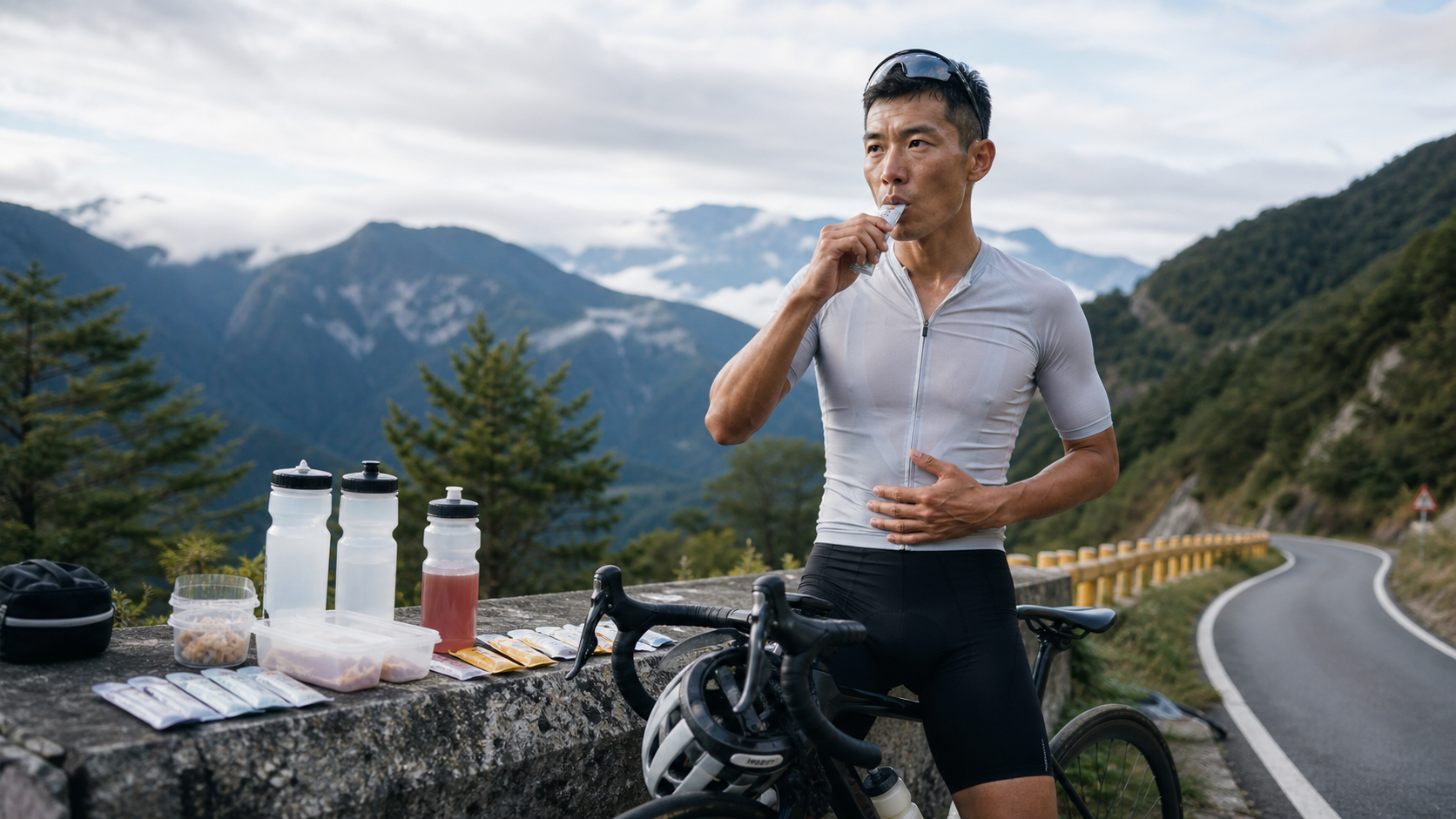
Starting from a Collapse at Cuifeng
A few years ago, I was training a student for the west route up Wuling. His power numbers were impressive—an FTP of 4.2 W/kg, and he could drop many riders on the flats. But on every ride longer than three hours, past Wushe heading toward Cingjing, he would completely fall apart—not from a skyrocketing heart rate or leg cramps, but from nausea, bloating, and the urge to vomit, to the point where he couldn’t even force down any fuel. He told me: “Coach, my legs still have power, but my stomach has already shut down.”
I’ve remembered that line ever since. Because it highlights a truth too many people overlook: in endurance sports lasting over two or three hours, what limits you is often not your heart, lungs, or muscles, but how much carbohydrate your gut can actually deliver into your bloodstream. Your muscles can burn sugar, but only if there’s sugar in the blood to burn; and whether blood glucose can be continuously replenished hinges on the absorption rate of your gut. Once this link fails, even the strongest engine will stall.
I’ve seen too many people blame “insufficient training volume” for bonking on long rides, so they pile on more riding hours and interval sessions, only to collapse at the exact same spot on the next long ride. Because they were upgrading the engine while ignoring the fuel line. The gut is that overlooked fuel line.
Over about ten weeks, I had him do one thing—treat his gut like a muscle and train it. That year, not only did he finish Wuling, but he did the entire ride still able to eat and drink, smiling all the way up. In this article, I want to lay out the full picture of this “gut training” approach—the concepts, the science, the practical protocols, and the common pitfalls. Whether you’re a beginner preparing for your first century ride or a seasoned rider trying to break through a performance ceiling, this is the most underestimated yet highest-return piece of training.
Core Concepts: Ingesting Carbs Isn’t Enough
Your Gut Has Two “Conveyor Belts”
Let’s start with a core mental image. The carbs you eat don’t magically pass through the intestinal wall into your blood; they must be carried across one by one by transporter proteins on the gut lining. Two conveyor belts are most relevant to endurance sports:
- SGLT1: Handles glucose and galactose. This is the main pathway, but it has a critical characteristic—it gets congested.
- GLUT5: Handles fructose. It’s a completely independent route.
Here’s the scientific core of all gut training: when you consume only glucose-based carbs (e.g., pure maltodextrin), the SGLT1 conveyor belt saturates and clogs at around 60 grams per hour. If you eat more, the unabsorbed carbs pile up in the gut, pulling water into the intestinal lumen and fermenting to produce gas—so you start bloating, cramping, and getting diarrhea. That’s the real reason my student collapsed at Cingjing.
But here’s the clever part: fructose uses GLUT5, which is completely unaffected by SGLT1 congestion. So if you give your body both glucose and fructose at the same time, you’re effectively running two conveyor belts simultaneously, pushing total absorption from 60 grams per hour up to 90 grams, and with training even to 100–120 grams per hour.
The measured differences in research are compelling: when consuming glucose alone, the rate at which the body oxidizes (actually uses) exogenous carbs plateaus at about 0.8 grams per minute; but switching to a glucose-plus-fructose combination raises it to about 1.26 grams per minute. In practical terms, that’s more than a 50% increase in energy supply, with better gut comfort to boot. That’s why every high-carb energy gel and drink on the market uses a glucose-to-fructose ratio of roughly 2:1.
I use a simple everyday analogy to make it click for my athletes: SGLT1 is like a single-lane road—during peak hours (60 grams per hour) it’s completely jammed. Sending more cars just means more queuing, and the queued cars (unabsorbed glucose) sit in the gut and start to stink (ferment and produce gas). Fructose’s GLUT5 is another completely independent parallel road; if you divert some of the traffic over, both roads run together, total throughput naturally rises, and neither road gets congested. Once you understand this picture, you’ll see why “piling on the same single sugar” can never break the ceiling, while “splitting traffic between two sugars” is the key.
As a side note, common sucrose (table sugar) is essentially “one glucose + one fructose,” naturally close to the ideal ratio; fruits and honey also contain fructose. So you don’t necessarily need to buy expensive specialized formulas—once you understand the principle, even bananas from a roadside stand in Taiwan or sugary sports drinks from a convenience store can be combined into an effective dual-channel fueling strategy.
Key Concept: Absorption Capacity Is “Trainable”
So why can the gut be “trained”? Because the number and activity of these transporter proteins change with the amount of carbs you consistently consume.
The principles established in sports nutrition (most notably by Asker Jeukendrup’s research team) are: when you consistently consume higher carbohydrate amounts over a period, your body increases the density of transporters like SGLT1 in the gut, speeds up gastric emptying, and improves the efficiency of oxidizing carbs into energy. Both animal and human data point in the same direction—high-carbohydrate dietary exposure selectively upregulates the expression of SGLT1, GLUT2, and GLUT5 in the small intestine.
In plain terms: the more you eat large amounts of carbs during exercise, the more your gut builds additional conveyor belts to handle it. This is the same logic as repeatedly doing resistance training and watching your muscles grow. So I often tell my athletes: “Absorption capacity is a muscle—if you don’t train it, it won’t grow.”
A very practical implication: if you normally train fasted or only drink plain water, then on race day you suddenly try to stuff 90 grams of carbs into your stomach, your gut simply doesn’t have that many conveyor belts—of course it rebels on the spot. Gastrointestinal distress is almost never a constitution problem; it’s a training-deficit problem.
Don’t Overlook the “Gastric Emptying” Hurdle
Carbs go from mouth to blood through two gates: the first is gastric emptying—food must move from the stomach into the small intestine; the second is the small intestine absorption we discussed earlier. Many people only count total carb intake, forgetting that if gastric emptying is too slow, food gets stuck in the stomach, leaving you feeling “full,” sloshy, or even nauseated—before the small intestine ever gets a chance to absorb anything.
Many factors affect gastric emptying rate, but the most practical ones for cyclists are:
- Don’t make it too concentrated. Overly thick syrup (high osmolarity) slows gastric emptying. Properly diluting and taking it with water actually lets carbs reach the small intestine faster for absorption.
- Don’t sustain maximal effort for long periods. The higher the intensity, the slower gastric emptying—which is why it’s not ideal to force down large amounts of solid food during sprints or long climbs.
- Gut training itself also speeds up gastric emptying. That’s the good news—the more consistently you train, the more gastric emptying and small intestine absorption improve together. It’s a whole-system upgrade, not just one isolated component.
So I always remind my athletes: fueling isn’t about “eating as much as possible,” but “delivering as smoothly as possible.” What you’re training is the flow of the entire production line—from stomach to small intestine to blood, all in one seamless motion.
Practical Methods: Six to Twelve Weeks to Build Absorption
Okay, concepts done—now for the most practical part. The principles of gut training are the same as any training: progressive, consistent, measurable, and specific. Here’s the framework I actually use with my athletes.
Step One: Know Where You Are Now
Before increasing your intake, you need to know how much you currently eat per hour and at what point you start feeling uncomfortable. The method is simple: take a 2- to 3-hour training ride and honestly record the carb amount and timing of everything you consume, plus any gut discomfort (bloating, nausea, cramping, urgent bathroom needs).
Most riders who haven’t specifically trained this will honestly discover they’re only taking in 30 to 50 grams per hour—far less than they assumed. This “starting point” is your training baseline.
Step 2: Progressive Overload Plan (The Core)
The table below is a ten-week progressive framework I commonly use, suitable for someone starting at 40–50 grams per hour and aiming to reach 90 grams. Everyone’s body is different; the numbers are a starting point, not gospel. The principle is to only increase once your body has adapted at each stage without gastrointestinal discomfort.
| Week | Carb Target Per Hour | Glucose:Fructose Recommendation | Training Scenario | Key Focus |
|---|---|---|---|---|
| Weeks 1–2 | 50–60 g | Start at 2:1 | 1× 2-hour long ride per week | Establish a regular eating rhythm; set alarms |
| Weeks 3–4 | 60–70 g | 2:1 | 1–2× 2–3 hour rides per week | Start practicing “eating while at high intensity” |
| Weeks 5–6 | 70–80 g | 2:1 | 1–2× 3-hour rides per week | Add race-intensity simulation intervals |
| Weeks 7–8 | 80–90 g | 2:1 | 1× 3–4 hour ride per week | Extend duration; test gut limits |
| Weeks 9–10 | 90 g (or personal max) | 2:1 | Pre-race specific long ride | Full race-day fueling rehearsal |
Several execution details aren’t visible in the plan but determine its success:
- Set alarms and eat on a schedule. I require athletes to fuel every 15 to 20 minutes, rather than waiting until they feel hungry or thirsty. By the time you feel it, your blood sugar and gastric emptying are already behind. Small, frequent feedings are far less taxing on the gut than cramming a large amount at once.
- Always pair with water. If you don’t drink enough water with high-concentration carbs, it can pull fluid into the gut, worsening bloating and diarrhea. Taiwan’s summers are hot and humid; long rides mean heavy sweating, so water and electrolytes are non-negotiable.
- Train the intensity too. This is extremely important. The higher the exercise intensity, the more blood is shunted from the gut to working muscles, reducing gut blood flow, slowing motility, and impairing absorption. So you can’t just practice eating on easy rides—you must practice eating and absorbing at your target race intensity, or your fueling will fall apart the moment you push the pace in a race.
Step 3: “Specialize” Your Food
This is a step many people miss—whatever you use for race fueling, use in training. The gut doesn’t just adapt to total carb intake; it also adapts to specific food forms and brand formulas. If you train all season on Brand A gels and then switch to Brand B handed out by the race organizer on race day, the formula ratios, sweeteners, and osmolality will all differ, and your gut may not cooperate.
So “product testing” is an inseparable part of gut training: during training, try every single item you plan to use in the race—gels, drinks, bars, salt tablets, and even the rice balls, bread, and bananas that Taiwanese riders love—run through the full range, and find the combination your gut tolerates best while still fueling you fast enough.
Case Study: A Simulated Wuling Fueling Schedule
Rather than abstract principles, let me show you how to actually plan it. Going back to the athlete I mentioned at the start, in the later stages of training, I had him do a long ride simulating the “West Route up Wuling,” riding from the Geographic Center Monument all the way to Cingjing. Here’s the fueling schedule we used that day; you can use it directly as a template and adapt it to your own version:
| Time Point | Situation | Fueling Content | Cumulative Carbs for the Hour |
|---|---|---|---|
| 30 min before start | Before warm-up | 1 banana + half a bottle of sports drink | — |
| 0–20 min | Flat warm-up | A sip of energy drink, a sip of water | ~15 g |
| 20–40 min | Entering gentle climb | Half a gel + water | ~40 g |
| 40–60 min | Starting the climb | Half a gel + electrolyte water | ~60 g |
| 60–90 min | Mid-climb | Small sips of energy drink + 1 banana | ~90 g/hr |
| After 90 min | Steep section to Cingjing | Switch back to easy-to-consume gels, same frequency | Maintain 85–90 g/hr |
The point isn’t the numbers themselves, but the rhythm: something goes in every 15 to 20 minutes, always paired with water, and the higher the intensity gets in the later stages, the more you should choose liquid or gel fuels that are “easy to take in and absorb,” rather than chewing on a dry bar at that moment. That day, he didn’t feel nauseous at all, and when we reached Cingjing, he joked that his stomach felt far better than before—that’s evidence the gut training was working.
Know Your Fuel: Quick Carb Reference
Many athletes initially can’t even calculate how many carbs are in what they’re eating, so fueling is naturally off. Below is a table of approximate carb content for common fuels (actual values depend on each product’s label; brands vary widely):
| Fuel Item | Approximate Carbs Per Serving | Notes |
|---|---|---|
| Standard energy gel | 20–30 g | High-calorie versions can reach 40 g |
| One bottle of energy drink (500 ml) | 30–40 g | Concentration varies a lot; check the label |
| Energy bar | 20–40 g | Higher in fat and fiber; digests slower |
| Banana (medium) | ~25–30 g | A natural choice that’s easy to find and digest |
| Onigiri (rice ball) | ~35–45 g | Good for a flavor change mid-ride, but savory ones are more palatable over time |
| One slice of white toast | ~12–15 g | Readily available at convenience stores |
Once you understand this table, you’ll see: hitting 90 grams per hour is roughly equal to three gels, or one bottle of energy drink plus a banana plus half a bar. That’s a significant load for someone untrained, which is exactly why you need several weeks of progressive adaptation.
Taiwan has an inherent advantage: one of the highest convenience store densities in the world. On long routes like the Around East Taiwan, Taipei–Kaohsiung, or Wuling, 7-Eleven and FamilyMart are almost never far away, so you don’t necessarily need to carry a full day’s worth of fuel. But this also creates a trap—anything you buy on the fly is something your gut hasn’t trained on. So the smart approach is: during regular training, buy the same things at convenience stores that you’ll eat in the race, and incorporate convenience store fuel into your specialized testing.
The Taiwan Context: Gut and Fueling in Hot, Humid Weather
The principles of gut training apply universally, but Taiwan has several local conditions worth highlighting because they directly affect your fueling strategy.
Heat and Humidity Make Everything Harder
Taiwan’s summers routinely exceed 32°C with 70–80% humidity, and sweat rates on long rides are staggering. Heavy sweating diverts more blood to the skin for cooling, further compressing gut blood flow, making absorption worse than on cooler days. This is why many people are especially prone to nausea and loss of appetite on summer long rides—it’s not that you’ve gotten weaker; the environment has turned up the difficulty on your gut.
Three countermeasures:
- Fluids and electrolytes must keep pace with carbs. In hot, humid conditions, you lose a lot of sodium and potassium. Replacing sugar without electrolytes will make the gut more uncomfortable and increase cramping risk. Salt tablets or electrolyte drinks should be part of the fueling plan.
- Shift a higher proportion to liquid fuels. The hotter it is, the harder solid food is to swallow. Converting some carbs to easy-to-consume forms like energy drinks and gels also improves absorption.
- Avoid the hottest hours for long rides. In Taiwan’s summer, schedule long rides in the early morning—both for safety and to make your fueling rehearsal closer to the time window of most events.
How to Manage Daily Carbs When Eating Out
Most people in Taiwan eat out, which isn’t necessarily bad for “daily carb intake”—rice, noodles, porridge, bread, and fruit are all easy to find. The key is to be intentional about carb intake around training: eat a good amount of easily digestible carbs (white rice, noodles, etc.) before a long ride, and within 30 to 60 minutes after finishing, replenish carbs plus some protein to aid recovery. You don’t need expensive imported supplements; a bowl of sweet potato porridge or a tuna onigiri with unsweetened soy milk works perfectly well.
Medical Care Is Accessible—Don’t Tough It Out
As mentioned earlier, if you repeatedly experience severe gastrointestinal symptoms during exercise, don’t play the tough guy. Under Taiwan’s National Health Insurance, seeing a gastroenterologist is low-barrier and affordable. Letting a professional evaluate unusual symptoms is always safer than self-diagnosing online. Gut training is meant to make you stronger, not to trade your health for performance.
Common Mistakes and Fixes
Having coached students for so many years, I’ve compiled the most common gut-training pitfalls for you—find where you fit and correct them directly.
Mistake 1: Not practicing eating in training, then cramming on race day
This is the most classic and most brutal one. If your gut hasn’t been trained for high carbohydrate intake, forcing it on race day will end exactly like my student at the beginning—a total meltdown. Fix: Fueling practice is just as important as bike training. Start practicing at least 6 weeks in advance.
Mistake 2: Only consuming glucose-based products, ignoring fructose ratios
Many people only use maltodextrin and glucose for fueling, which means SGLT1 transporters get jammed early—you can’t absorb more no matter how much you eat, and you end up bloated. Fix: Choose a multi-carb formula with roughly a 2:1 glucose-to-fructose ratio, or if mixing your own, factor in fructose sources (such as sucrose, fructose, or fruit).
Mistake 3: Drinking too little water, carbohydrate concentration too high
Deliberately limiting water intake to avoid bathroom stops actually disrupts gut osmotic balance, causing bloating and diarrhea. This is especially dangerous in Taiwan’s summers. Fix: Pair carbohydrate intake with adequate fluids, and make sure to top up electrolytes on long rides—don’t let your fueling turn into a blob of syrup stuck in your stomach.
Mistake 4: Only practicing eating on easy rides
Just because you can eat on an easy ride doesn’t mean you can eat at race intensity. When intensity goes up, blood flow to the gut decreases and absorption drops. Fix: Schedule “high-intensity intervals with fueling” into your training plan, so your gut gets used to working even when blood flow is being diverted elsewhere.
Mistake 5: Progressing too fast, increasing volume too quickly
If you’re eating 50 grams this week and want to jump straight to 90 grams next week, your gut won’t keep up and will rebel. Fix: Once you’ve adapted to each stage without discomfort, add roughly 10 grams at a time. Patience is key.
Special Reminder: Gut discomfort isn’t always just “lack of training”
If you’ve already gotten the progression, ratios, and hydration right, yet you still experience repeated severe abdominal pain, blood in stool, persistent diarrhea, or unexplained weight loss during exercise, then this is beyond what training can fix—please seek medical attention to rule out irritable bowel syndrome, inflammatory bowel disease, or other gastrointestinal issues. In Taiwan, gastroenterology (digestive medicine) clinics are easily accessible and covered by NHI—don’t tough it out like an athlete on your own. Abnormal signals from your body always take priority over your training plan.
Making Progress Visible with a “Fueling Log”
The most common reason gut training gets abandoned is that progress is “invisible.” You can see power, heart rate, and speed on the bike, but has your gut gotten stronger? Without numbers, it’s hard to feel a sense of achievement. That’s why I strongly recommend every serious student keep a simple fueling log—turn it into measurable training.
After every long ride, just spend three minutes jotting down these columns:
| Column | What to Record | Why It Matters |
|---|---|---|
| Date / Duration / Weather | Objective conditions | Numbers differ in hot, humid weather—don’t compare directly with cool days |
| Carbohydrates per hour | Actual grams consumed | This is your “training load” |
| Fuel types | Which products were used | Find the combination your gut tolerates best |
| Gut sensation | Rate 1–5 (1 = comfortable, 5 = very uncomfortable) | The basis for deciding whether to increase the amount |
| Late-ride feel | Whether you had energy or hit the wall | Verifies whether fueling actually helped in the later stages |
After a few weeks of accumulation, you’ll clearly see your own curve: the week 70 grams starts feeling comfortable is your body’s green light to push toward 80; the week you increase and your gut scores a 4, step back and hold steady for another week. This log lets you stop guessing by feel and start making decisions with data—and that’s exactly the essence of training your gut “like a muscle”: load, record, progress, improve.
A realistic reminder: progress won’t be linear. Physiological state, sleep, stress, and for women, the menstrual cycle can all make one particular long ride’s gut performance especially poor. Don’t write off the entire training approach because of a single bad day—look at the trend over weeks, not single data points.
Actionable Advice for Readers at Different Levels
Everyone starts from a different point, so I’ve split the advice into three tiers—just find where you fit.
If You’re a Beginner (First time attempting 100 km / Your first long-distance event)
Your goal isn’t 90 grams per hour—it’s to first establish a habit of “eating on a schedule.”
- Do one baseline session first to figure out how much you currently eat per hour.
- Aim for 40 to 60 grams per hour—that’s plenty, no need to be greedy.
- Set a timer to take a small bite and a sip of water every 20 minutes.
- Use foods your gut is most comfortable with (bananas and onigiri rice balls are great)—don’t chase high-concentration energy gels from the start.
- Remember: The biggest killer of beginner finishers is “forgetting to eat” and “eating too late,” not lacking fancy tricks.
Here’s a super concrete “first eat-while-riding practice” script—just follow it: pick a cool weekend morning, ride a flat 2-hour route, eat a banana before you leave, and set your phone to chime every 20 minutes. Every time the alarm goes off, whether you’re hungry or not, take a small bite of fuel (banana, energy gel, or sugary sports drink all work) with two sips of water. You’ll take in roughly 80 to 120 grams of carbs over the ride, and write down your gut sensation when you get home. You’ll be surprised how much better the second half feels just from “not letting yourself get hungry.” That ride is day one of your gut training.
If You’re an Intermediate Rider (Looking to break through your PR, tackling Wuling-class climbs)
You need to start doing serious gut training and product testing.
- Following the ten-week progressive plan above, push your target to 80 to 90 grams per hour.
- Definitely practice “eating at high intensity,” because long climbs mean high effort and reduced gut blood flow.
- Test every single product you plan to use on race day until you know it inside out—no surprises left to chance.
- 2 to 3 weeks before race day, do at least one full fueling rehearsal long ride, exactly mirroring race conditions.
If You’re a Veteran / Competitive Athlete (Looking to squeeze out that last few percent)
Your goal is pushing your absorption ceiling toward 100 to 120 grams.
- This requires longer-term (several months) high-carbohydrate training exposure to keep upregulating transporter protein density.
- Consider more precise monitoring of gut responses, or even individualized adjustments with a coach or sports nutritionist.
- Remember that the absorption ceiling varies from person to person—not everyone is suited to push 120 grams. Finding your own “absorbable and comfortable” sweet spot matters more.
- At the advanced level, pay attention to dental health and weight management—long-term high sugar intake has other implications. High-sugar fueling during exercise is for energy supply, which is a different matter from whether you should cut sugar in your daily diet—don’t conflate the two; but after races and outside training sessions, do return to a balanced diet.
An advanced observation point for veterans: once you push your hourly carbs above 90 grams, what determines your performance is often no longer “can you eat even more,” but “how much does your intensity drop in the final stretch.” Across a few high-intensity long rides, cross-reference your fueling log—under the same workout plan, did the ride where you fueled 100 grams show a clearly higher average power in the final hour than the 80-gram ride, with less heart rate drift? If yes, that amount is genuinely effective for you; if not, and your gut is more burdened instead, then your sweet spot is probably between 80 and 90—no need to chase numbers for the sake of numbers. In the end, training is about finding the amount that suits you best, not the largest amount.
Frequently Asked Questions (FAQ)
Q: How long does gut training take before I see results?
Generally speaking, you’ll see noticeable improvement within 6 to 12 weeks. Progressing from 60 grams per hour to 90 grams is a reasonable and achievable goal for most amateur riders; however, individual variation is large, so don’t compare your pace with others.
Q: Do I need to eat more carbs on rest days when I’m not riding?
No, there’s no need to deliberately binge on carbs on rest days for gut training. The key is to give your gut a large carbohydrate stimulus “during exercise” — that’s the most effective training signal. Just maintain a balanced diet on regular days.
Q: Can I just buy high-end energy gels and solve everything at once?
Products can help, but if your gut hasn’t been trained, even the most advanced gel won’t be absorbed properly. Train your gut first, then let good products deliver their value — the order can’t be reversed.
Q: Is gut training different for women?
The basic physiological mechanisms are the same, and the principles apply equally. Some people may experience slightly different gastrointestinal sensitivity at different phases of the menstrual cycle, so it’s recommended to keep records, identify patterns, and consult a professional if necessary.
Q: Can people with diabetes or other chronic conditions do this?
This article discusses fueling strategies for the general healthy exercising population. If you have diabetes, heart disease, hypertension, or any chronic condition, high-carbohydrate fueling and prolonged exercise must be individually assessed — be sure to discuss this with your physician or dietitian first, and don’t directly apply the numbers meant for the general population. Blood glucose management itself requires professional supervision; don’t force general athletes’ fueling amounts onto yourself.
Q: Do I need gut training for short rides that finish within an hour?
Not really. The value of gut training mainly lies in prolonged exercise exceeding 2 hours, because that’s when glycogen gradually runs low and the rate of exogenous carbohydrate delivery becomes the limiting factor. For rides within an hour, your body’s glycogen stores are usually sufficient, and the fueling focus should instead be on hydration. So gut training is “exclusively for long-distance” homework.
Q: Can the fructose ratio be pushed even higher? For example, 1:1?
Recent research has indeed explored the possibility of higher ratios and higher total amounts, but for the vast majority of amateur riders, a glucose-to-fructose ratio of about 2:1 remains the most stable and least error-prone starting point. If the fructose ratio is pushed too high, some people are more prone to bloating or diarrhea, because GLUT5 also has its processing limits. Rather than chasing extreme formulas, it’s better to solidly train the 2:1 amount first.
Q: Should I do “carbohydrate loading” the day before a race?
That’s a separate topic on its own; the key is to increase carbohydrate intake 1 to 3 days before the race to fill muscle glycogen stores. It complements gut training: carbohydrate loading is “the fuel tank before departure,” while gut training is “the refueling speed on the road.” If you take care of both, long-distance performance will be stable. However, the details of carbohydrate loading should also be carried out with professional advice, especially for those with chronic conditions.
Conclusion: The Most Underrated Piece of Training
Let’s return to that athlete from the beginning. He later told me that gut training completely overturned his understanding — it turned out that what he had always thought of as “not enough fitness” was, in large part, actually “not enough absorption.” Once he could steadily deliver energy into his bloodstream, the long climbs that used to make him fall apart suddenly became manageable.
I want to pass this concept on to you, the one reading this article right now: Stop treating your gut as an uncontrollable black box. It’s a trainable muscle, and the return on investment is astonishingly high. You don’t need to buy a more expensive bike, nor do you need to push your FTP up a few more watts. You just need to start consciously and progressively training your absorption capacity, and a few weeks later, you’ll suddenly realize on some long ride: “Wait, why am I still this strong?”
At that moment, you’ll understand why I say gut training is the most underrated piece of the endurance-sports puzzle. It requires no talent, no big spending — it only requires you to consciously and patiently build it up week after week. Starting with your next long ride today, set an alarm, prepare your fuel, and keep honest records — train your absorption capacity like a muscle. Your next long ride will thank the you who chose to start now.
This article is educational content and does not replace individual diagnosis and treatment advice from physicians, physical therapists, or dietitians. If you have any chronic conditions or experience abnormal gastrointestinal symptoms during exercise, please seek medical attention early and obtain professional individualized assessment.
References
- Gatorade Sports Science Institute — Multiple Transportable Carbohydrates And Their Benefits: https://www.gssiweb.org/sports-science-exchange/article/sse-108-multiple-transportable-carbohydrates-and-their-benefits
- Training the Gut for Athletes (Sports Medicine, Springer): https://link.springer.com/article/10.1007/s40279-017-0690-6
- Fructose and Sucrose Intake Increase Exogenous Carbohydrate Oxidation during Exercise (PMC): https://www.ncbi.nlm.nih.gov/pmc/articles/PMC5331598/
- The Role of SGLT1 and GLUT2 in Intestinal Glucose Transport and Sensing (PMC): https://www.ncbi.nlm.nih.gov/pmc/articles/PMC3935955/
- Fructose co-ingestion to increase carbohydrate availability in athletes (PMC): https://www.ncbi.nlm.nih.gov/pmc/articles/PMC6852172/
Related Reading
- Gut Training: Treat Your Gut as a Trainable Organ So You Can Still Eat in the Second Half
- Gut Training for Triathlon Fueling: Train Your Gut Like a Muscle
- Gut Training: An Evidence-Based Method to Expand Carbohydrate Absorption Capacity in Two Weeks
- How Gut Training Improves Carbohydrate Absorption Rate: Research on SGLT1 Transporter Upregulation
FTL 與 SYB 車隊專訪 西進武嶺 實用攻略分享! 2小時 如何練?!你不知道的眉角!新手準備武嶺必看 EP1 | 實力派女車友 | 精華版 | 公路車 | CTYeh
4 年前
CT 喇低賽) 武嶺牽車 才是王道 西進牽車四小時內秘訣 攝手位置 如何判斷 防抽筋小秘訣
7 年前
CT趣訪 西進武嶺 2小時組 EP2 全村的希望 蔣緯緯! 訓練菜單&技巧公開 |公路車 |CT Yeh
4 年前
Never Stop 西進武嶺 前後雙機 完整全程錄影 訓練台 實境
8 年前
一日北高常見問題大集合 | 攻略 | 路線 | 訓練 | 補給 | 自行車 單車 | 一日雙城 | 雙塔 | TWB北高360 | 屁股痛
6 年前
#公路車 #西進武嶺 配速配瓦實驗 坡度分析 四小時內攻略 建大盃 NeverStop #西進武嶺攻略
6 年前
西進武嶺 免費訓練分析服務 Intervals | 練不夠還是練過頭?你哪一種類型選手?AI模型告訴你! | 備戰神器 | 公路車 訓練 | CT Yeh
4 年前
靠單車減肥35公斤 心得分享與整理
7 年前