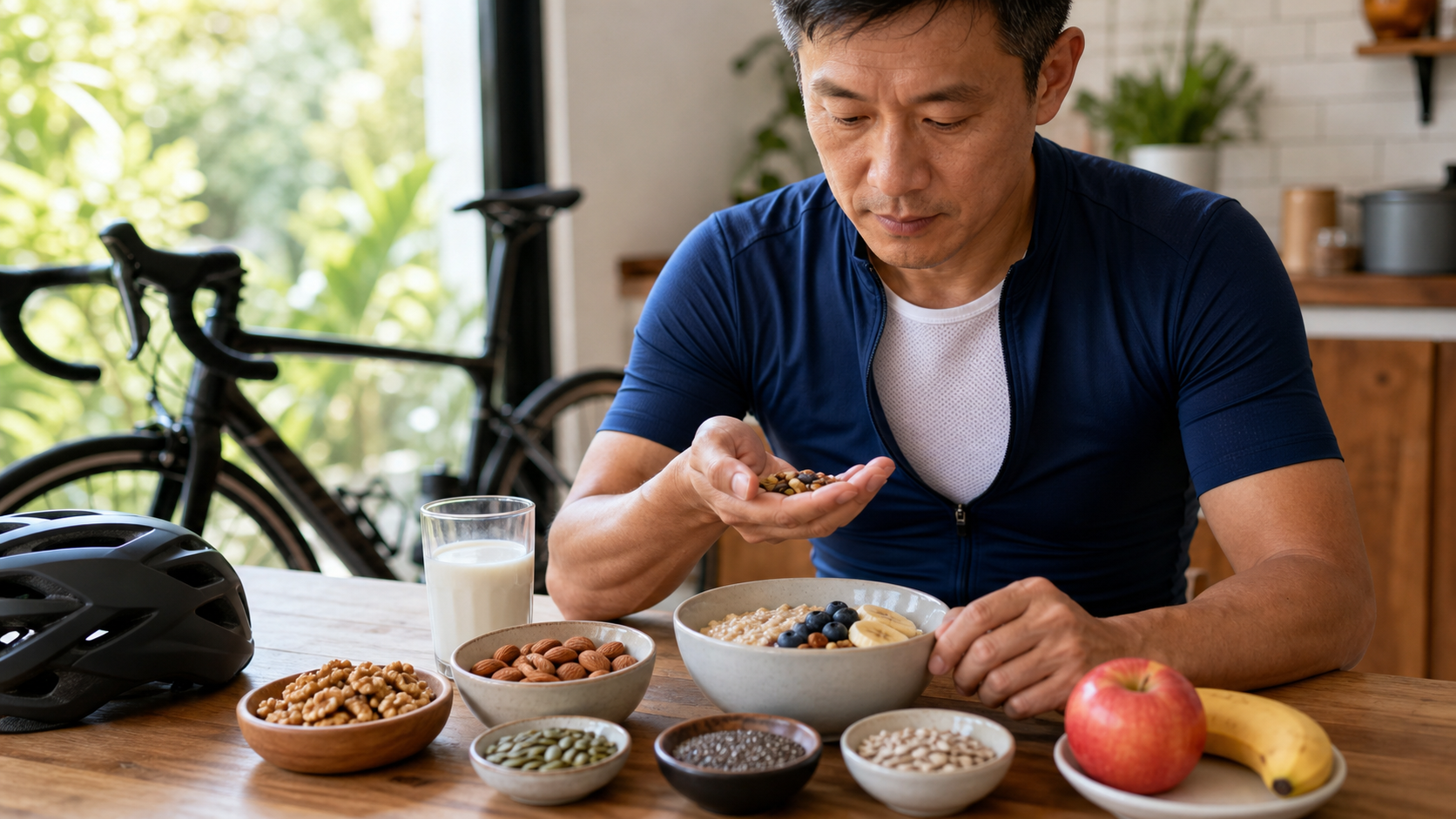
Starting with a Pack of Convenience-Store Mixed Nuts
A few years ago, I was working with a 42-year-old amateur cyclist—let’s call him A-Zhe. A-Zhe rode about 200 kilometers a week, weighed 72 kilograms, and had a steady power output. The only thing bothering him was his lipid panel: high triglycerides and borderline-low HDL (good cholesterol). He told me, “Coach, I almost never eat fried food, and I have oatmeal for breakfast every day. Why are my lipids still like this?”
I asked him to send me photos of a week’s worth of meals. After reviewing them, I noticed two things: first, he had almost completely eliminated “healthy fats” from his plate, afraid of gaining weight; second, in his office drawer, he had a big jar of seasoned mixed nuts. Whenever he felt a craving, he’d grab a huge handful, and while watching TV he’d keep eating until he couldn’t stop—easily consuming three or four servings or more a day.
That’s the topic I want to talk about today—nuts and seeds, these “healthy fats,” are actually great teammates for athletes, but they’re also a double-edged sword. Used correctly, they help protect your cardiovascular system, prolong satiety, and supply the minerals you need for post-training recovery; used incorrectly, they quietly blow up your calorie budget while making you think you’re eating something healthy.
The adjustment A-Zhe made wasn’t “giving up nuts” but “learning how to eat nuts.” Three months later, his triglycerides had clearly dropped, HDL went up, and he said his hunger was more stable and he no longer binge-ate cookies in the afternoon. This article is a complete write-up of the logic I walked through with A-Zhe and many athletes since.
Bottom line first: nuts are not the enemy—portion size and choices are what matter. Master the concept of “one small handful,” and you’re already halfway there.
Concepts and Scientific Basis: Why Athletes Need Healthy Fats
Fat Isn’t the Enemy—“Which Fat” Is What Matters
In the past, many people panicked at the mention of fat, thinking that eating oil means gaining weight or harming the cardiovascular system. But this lumps all types of fat together. For endurance athletes, fat actually plays three key roles:
- Energy source: During long-duration, low-to-moderate-intensity riding or running, fat oxidation is one of the primary energy pathways. Well-trained athletes have better fat metabolism efficiency, which is why you shouldn’t demonize fat entirely.
- Raw material for cells and hormones: Sex hormones, cell membranes, and the transport of fat-soluble vitamins (A, D, E, K) all require fat. Long-term extremely low-fat diets are detrimental to both recovery and endocrine function.
- Anti-inflammatory and cardiovascular protection: This is where nuts and seeds shine the brightest.
Nuts are rich in unsaturated fats—including monounsaturated and polyunsaturated fatty acids. According to the Mayo Clinic and the Harvard T.H. Chan School of Public Health’s Nutrition Source, regularly incorporating nuts into a low-saturated-fat diet can help improve arterial health, reduce inflammation associated with heart disease, and may lower the risk of blood clots that can lead to heart attacks and strokes.
Where Exactly Is the “Nutritional Density” of Nuts?
Nutritional density refers to “how much nutrition is packed into each unit of calories.” Nuts and seeds excel in this regard—in one small handful, you get all of the following:
- Quality unsaturated fats (cardiovascular-friendly)
- Plant-based protein (about 4 to 7 grams per serving, depending on the type)
- Dietary fiber (promotes satiety, stabilizes blood sugar, supports gut health)
- Minerals: magnesium, zinc, potassium, and some calcium (especially important after heavy sweating in athletes)
- Vitamin E and polyphenol antioxidants (to combat training-induced oxidative stress)
From my perspective as someone who coaches athletes, the two most practical points are magnesium and anti-inflammatory fats. Taiwan’s summers are hot and humid—a long ride or run can easily cause you to sweat one to two liters. You lose a lot of electrolytes like magnesium and potassium, and magnesium is linked to muscle relaxation, cramping, and sleep quality. Nuts happen to be a very convenient source of magnesium.
Different Nuts Have Different Fat Profiles
Many people don’t know this: the fat composition of different nuts varies considerably.
- Almonds, cashews: Lean toward monounsaturated fats, with good fiber and vitamin E profiles.
- Walnuts: Very unique—their fat composition leans toward polyunsaturated fats, especially rich in plant-based omega-3 (alpha-linolenic acid, ALA).
According to multiple nutritional data sources, walnuts are among the few nuts containing significant amounts of omega-3 (ALA). One ounce (about 28 grams, one small handful) contains roughly 2.5 grams of ALA—already exceeding the recommended intake for adult men (about 1.6 g/day) and women (about 1.1 g/day). That’s why, when it comes to cardiovascular health, I especially like having athletes include walnuts in their meal plans.
Why “Healthy Fats” Matter Especially for Endurance Athletes
Let me add a bit more scientific context so you’ll be more willing to incorporate nuts into your daily routine. Endurance athletes’ bodies exist in a long-term cycle of “repeated inflammation, repeated repair”: every long ride, every long run, every interval session causes micro-damage and oxidative stress in the muscles, and then the body spends time repairing and getting stronger. This process itself is good—it’s the mechanism by which we get stronger. But if your overall diet leans pro-inflammatory (lots of refined sugar, fried foods, processed foods), the repair environment worsens.
Nuts and seeds play the role of “helping tip the balance toward anti-inflammation.” Their unsaturated fats, vitamin E, polyphenol antioxidants, plus the ALA in walnuts, together form a combination that’s friendly to cardiovascular health and inflammation. Harvard’s Nutrition Source and the Mayo Clinic both point out that regular nut consumption is associated with lower inflammatory markers and better vascular health.
I want to emphasize the word “associated”—this is what epidemiological observations and dietary studies show, not that eating nuts cures disease or guarantees you won’t get sick. Diet is a long-term, holistic project; nuts are one very cost-effective piece of the puzzle, but they’re not a magic pill.
Protein and Satiety: The Often-Overlooked Side
Many people think of nuts only as “fat” and forget they’re also a decent source of plant-based protein. A small handful of nuts provides about 4 to 7 grams of protein depending on the type, and combined with fiber and fat, the three together create strong satiety. This is especially useful for two types of people:
- Those trying to manage weight: A small handful of nuts as an afternoon snack can often carry you through to dinner, preventing you from mindlessly eating more high-sugar snacks.
- Athletes who are plant-based or reducing red meat: Nuts and seeds are a convenient way to get plant protein, healthy fats, and minerals all at once.
Portion Control: Turning “One Small Handful” into Muscle Memory
If there’s only one thing you remember from this article, I hope it’s this: the health benefits of nuts are built on portion size. Nuts are very calorie-dense, and it’s easy to overeat without realizing it.
How Much Is One Serving?
A standard serving of nuts in nutritional guidelines is approximately one ounce (about 28 grams)—that’s one small handful, or about two tablespoons of nut butter. The FDA-approved health claim states that eating about 1.5 ounces (about 42 grams) of most nuts per day, as part of a diet low in saturated fat and cholesterol, may reduce the risk of heart disease.
So you can use a very practical daily range: for most people and most athletic populations, one small handful to one and a half handfuls (about 28 to 42 grams) per day is a reasonable range. Athletes with high training volume and high calorie needs can go a bit higher, but the key is “eating mindfully,” not leaving the whole jar next to you for unlimited snacking.
Common Nut Calorie and Nutrition Comparison Table
Below are approximate values per ounce (about 28 grams, about one small handful). Actual values vary by brand, roasting method, and seasoning—use these numbers for proportion reference:
| Nut Type | Calories (approx. kcal) | Fat Profile | Key Nutrients | Best Suited For |
|---|---|---|---|---|
| Almonds | About 160–165 | Mostly monounsaturated | About 4 g fiber, vitamin E, about 80 mg calcium | Portion control, satiety |
| Walnuts | About 180–185 | Polyunsaturated, rich in ALA omega-3 | Plant-based omega-3 | Cardiovascular health, anti-inflammation |
| Cashews | About 155–160 | Monounsaturated | Magnesium, zinc, iron | Creamy texture, meal addition |
| Pistachios | About 155–160 | Monounsaturated | Protein, potassium, requires shelling | Slowing down eating pace |
| Peanuts (technically legumes) | About 160 | Monounsaturated | High protein, niacin | Budget-friendly, protein supplement |
You’ll notice calories all fall between 150 and 185 kcal. In other words, two or three “accidental” extra handfuls can easily add 400 to 500 kcal—equivalent to half an hour of riding for nothing.
Using “Containers” and “Pre-Portioning” to Fight Mindless Eating
The most effective way to control portions isn’t willpower—it’s environmental design. Here are practical tips I give my athletes:
- Pre-portion: Once a week, divide the whole jar of nuts into small handfuls in ziplock bags or small containers. Take one pack when you want to eat, and stop when it’s gone.
- Use a small bowl, not the whole jar: Pour the amount you want into a small bowl and put the jar away. Behavioral researchers know: “what you see is what you eat.”
- Choose varieties that need shelling: Eat pistachios in their shells—the shelling action naturally slows you down and gives your satiety signals more time to kick in.
- Pair with water or unsweetened tea: Eating while drinking helps you feel satisfied faster.
What One Serving of Nuts Can “Replace”
I often tell my athletes that nuts shouldn’t be an “extra” snack added on top—they should ideally replace something less ideal:
| Situation | Common Choice | Swap to Nuts |
|---|---|---|
| Afternoon craving | Cookies, chips, sugary drinks | One small handful of plain almonds + unsweetened tea |
| Breakfast | Only refined carbs | Sprinkle walnut pieces over oatmeal or plain yogurt |
| Post-training snack | Only sugary sports drinks | Banana + one small handful of nuts, for carbs and minerals |
| Bland salad | Lots of dressing | Sprinkle pumpkin seeds or sunflower seeds for texture and healthy fats |
Selection Logic: Which Pack Should You Grab at the Convenience Store
In Taiwan, buying nuts is incredibly convenient—convenience stores, supermarkets, traditional markets, and baking supply shops all carry them. But that also means there are plenty of pitfalls. Here are the selection principles I actually teach when shopping with my athletes.
Plain First, Stay Away from “Heavy Salt, Heavy Sugar, Heavy Oil”
The first rule of selection: choose plain, unseasoned nuts whenever possible. The Mayo Clinic’s advice is clear—choose raw or dry-roasted nuts over oil-fried ones; choose unsalted, unsweetened varieties, because extra salt or sugar can offset the heart benefits of nuts.
When flipping to the ingredient list and nutrition label, I ask my athletes to check three things:
- Sodium content: Seasoned nuts often have shockingly high sodium, which isn’t friendly to people who need to watch their blood pressure.
- Added sugar or syrup: Honey-roasted, salted, and caramel flavors often have a lot of sugar and oil added.
- Fried or roasted: Fried nuts get an extra coating of oil, making them higher in calories.
Watch Out for These “Nuts in Disguise”
- Coated or candied nuts: Essentially closer to candy.
- Nut bars/energy bars: Some are genuinely good, but many have lots of syrup and chocolate added—they look healthy but are really desserts. Always check the label.
- Nut drinks/nut milk: Some commercial versions are very high in sugar—don’t drink them like unsweetened soy milk.
- Mixed dried fruit and nut packs: Dried fruit itself is high in sugar; if the ratio is off, the sugar can dominate.
Seeds: Small but Mighty
Besides nuts, seeds are also worth adding to your menu, and they’re usually more budget-friendly:
| Seed Type | Highlights | Practical Ways to Eat |
|---|---|---|
| Chia seeds | Fiber, expands in water for satiety, contains ALA | Soak in water or add to yogurt, oatmeal |
| Flaxseeds | Plant-based omega-3, lignans; best ground | Grind and sprinkle on meals for better absorption |
| Pumpkin seeds | Magnesium, zinc (zinc is linked to immunity and recovery) | As a snack or sprinkled on salads |
| Sunflower seeds | Vitamin E, healthy fats | Sprinkle on bread, salads |
One important tip: whole flaxseeds often pass through your system “intact”—it’s best to buy them pre-ground or grind them yourself so you actually absorb the nutrients.
Quick Reference: “Role Positioning” of Various Nuts and Seeds
I like to help athletes remember things by assigning “roles,” so you’re not drawing a blank when choosing. The table below organizes the positioning of common items:
| Item | Role | One-Line Memory |
|---|---|---|
| Walnuts | Omega-3 mainstay | Top choice for cardiovascular health and anti-inflammation |
| Cashews | Texture star | Creamy and delicious, but easy to overeat |
| Almonds | All-around defender | Good fiber, calcium, and vitamin E—best for portion control |
| Pistachios | Slow-eating master | Shelling naturally slows you down |
| Peanuts | Budget protein | Cheap, high protein—choose plain |
| Pumpkin seeds | Mineral supplement | Magnesium and zinc combo, great for training recovery |
| Chia seeds | Fiber and satiety | Expands in water, stabilizes blood sugar |
| Flaxseeds | Plant omega-3 supplement | Remember to grind for absorption |
There’s no “best” answer in this table—only “which role is most useful for you right now.” Want cardiovascular support? Give walnuts more playing time. Need minerals? Add pumpkin seeds. Want more satiety? Use almonds or chia seeds. Rotate through them, and you’ll get different benefits across the board.
Storage Also Affects Quality
Nuts are rich in unsaturated fats, which means they’re prone to oxidation and rancidity (that stale oil smell). Taiwan’s hot, humid climate makes this even more of an issue. A few suggestions:
- After opening, seal and refrigerate or freeze to significantly extend shelf life and reduce rancidity.
- Don’t stockpile too much at once—buying “small packs, finish quickly” keeps nuts fresher than “one big jar, eat slowly.”
- If you smell rancidity or taste bitterness, don’t eat them—oxidized oils are actually harmful to health.
Common Mistakes and Corrections
In all my years coaching athletes, the mistakes I’ve seen on the nut front basically fall into the categories below. Check whether any apply to you.
Mistake 1: Treating Nuts as “Unlimited Healthy Food”
This was A-Zhe’s original problem. Thinking that because something is healthy, you can eat unlimited amounts—resulting in three or four servings and 700–800 kcal a day without realizing it.
Correction: First accept the fact that “nuts are high-calorie food.” Use pre-portioning and small bowls to control intake, keeping your daily total at one small handful to one and a half handfuls.
Mistake 2: Eating Only Seasoned Nuts
Loving salted, honey, or mustard flavors means sodium and sugar are off the charts, canceling out the benefits.
Correction: Make plain nuts your staple; treat flavored varieties as “occasional treats,” not daily staples.
Mistake 3: Afraid of Fat, So Cutting It Out Completely
Some athletes trying to lose weight overcorrect and eliminate all fats, resulting in getting hungry faster, cravings, worse recovery, and even hormonal issues.
Correction: Keep healthy fats—just control portions. The satiety from one small handful of nuts often helps you avoid overeating later.
Mistake 4: Eating Only One Type of Nut
Eating only almonds or only peanuts makes your nutrition more one-dimensional.
Correction: Rotate varieties or eat plain mixed nuts so different fat profiles and minerals complement each other. In particular, make sure walnuts get in the rotation for plant-based omega-3.
Mistake 5: Eating Large Amounts of Nuts Before Training as Fuel
Nuts are high in fat and fiber and digest slowly. Eating a lot before a race or high-intensity training can cause gastrointestinal discomfort.
Correction: Nuts are better suited as daily snacks and post-training recovery meals paired with carbs, not as immediate pre-race fuel. Before a race, stick to easily digestible carbs.
Mistake 6: Forcing Yourself to Eat Nuts Despite an Allergy
Nut and peanut allergies can be severe, even life-threatening, for some people. Some people force themselves to eat something they’re allergic to “for health.”
Correction: If you’ve ever had an allergic reaction (skin, respiratory, lip swelling, etc.), avoid them and get checked by a doctor—don’t self-experiment. In such cases, healthy fats can come from other sources like avocado, olive oil, and fatty fish.
Mistake 7: Using Nuts to “Replace Meals”
Occasionally I encounter extreme cases where athletes, when busy, just eat nuts for an entire meal. Although nuts are nutrient-dense, they’re low in carbs. Using them as a full meal long-term means you won’t replenish the glycogen needed for training, and both performance and recovery will suffer.
Correction: Nuts are positioned as “snacks” or “part of a meal,” not “meal replacements.” Athletic populations still need sufficient carbs (rice, noodles, sweet potatoes, fruit) as their primary energy source.
Another Case Study: Xiao-Min, Who Took Nuts in the Wrong Direction
A-Zhe was the classic “ate too much” case. Let me share a case in the opposite direction so you can see the other end of the spectrum.
Xiao-Min is a 35-year-old recreational runner who runs three to four times a week, with a goal of breaking four hours in the marathon. She’s very disciplined. To control her weight, she kept her diet extremely tight—almost no fats at all, and no nuts whatsoever, because “they’re too high in calories.” On the surface, her weight was well managed, but when she came to see me, her complaints were: slow recovery after long runs, constant fatigue, irregular menstrual cycles, and low mood.
I looked at her diet—healthy fat intake was nearly zero. I didn’t ask her to overhaul everything immediately. I only made one small adjustment: add a small handful of walnut pieces and a teaspoon of chia seeds to her plain yogurt at breakfast. Just that one change added healthy fats, omega-3, fiber, and minerals to her day, with only about 100+ extra kcal.
A few weeks later, she reported that her hunger was more stable, she no longer craved snacks in the afternoon, and her recovery after long runs felt somewhat better. I want to emphasize—nuts alone won’t solve all problems. Her fatigue and menstrual issues could involve many other factors (whether total calories are sufficient, iron status, sleep, stress, etc.), and I also recommended she see a doctor for evaluation. But this small case illustrates: being overly afraid of fat is counterproductive for athletes. Healthy fats aren’t a question of whether to eat them—it’s a question of how and how much.
Actionable Advice for Readers at Different Levels
The nut topic applies to everyone from beginners to elites, but the entry point can differ.
General Fitness Enthusiasts / Those Just Starting to Eat Healthier
- Goal: One small handful (about 28 grams) of plain nuts per day, replacing one less-than-ideal snack.
- Method: Pre-portion a week’s worth on the weekend, and keep some at the office and some at home.
- Choice: Start with the easiest-to-find plain almonds or mixed nuts. Remember to check sodium and sugar.
- Mindset: You don’t need to be perfect. Just accomplish these two steps—“swap seasoned nuts for plain” and “swap unlimited for one small handful”—and you’re doing great.
Intermediate Athletes with Regular Training (5–10 hours per week)
- Goal: One small handful to one and a half handfuls per day, deliberately including walnuts for omega-3.
- Timing: For a post-training snack, use “banana + one small handful of nuts” to get both carbs and minerals; for daily cravings, replace refined snacks with nuts.
- Variety: Rotate nuts and seeds—pumpkin seeds for magnesium and zinc, chia/flaxseeds for fiber and ALA.
- Monitoring: If you’re managing weight, remember to count nut calories into your daily total—don’t treat them as “healthy food that doesn’t need counting.”
Advanced / High-Training-Volume Athletes
- Goal: Portions can increase slightly based on total calorie needs, but still eat mindfully and pre-portioned to avoid going overboard.
- Recovery-oriented: Treat nuts and seeds as sources of minerals (magnesium, zinc) and antioxidants (vitamin E, polyphenols) to help combat the oxidative stress and inflammation of high training volume.
- Individualization: If you have specific needs regarding lipids, blood pressure, digestion, or weight, consider working with a sports nutritionist to tailor a plan based on your training schedule.
Reminders for Special Populations
- Those with chronic conditions (diabetes, hypertension, heart disease, kidney disease, etc.): Nuts are generally cardiovascular-friendly, but portion size, sodium, potassium, and phosphorus may all need individualized adjustment (for example, those with impaired kidney function should be mindful of potassium and phosphorus in nuts). Be sure to discuss with your physician or nutritionist—don’t just follow online advice and consume large amounts on your own. Taiwan’s National Health Insurance makes medical visits convenient; if you have relevant medical history, include dietary adjustments in your follow-up discussions.
- Those losing weight: Nuts are both a good friend and a calorie trap—the key is replacement, not addition.
- Sensitive digestion: Eating too many nuts and seeds at once—with their fiber and fat—can cause bloating or discomfort. Increase gradually.
How to Arrange a Week: A Ready-to-Copy Example
The table below is a simple template I often give to intermediate athletes. You can apply it directly and adjust to taste. Portions are based on “one small handful ≈ 28 grams.”
| Time | Suggestion | Notes |
|---|---|---|
| Breakfast | Oatmeal/yogurt + walnut pieces or chia seeds | For omega-3 and fiber |
| Mid-morning craving | One small handful of plain almonds | Replaces cookies |
| Post-training | Banana + one small handful of mixed nuts | Carbs + minerals |
| Dinner salad | Sprinkle pumpkin seeds/sunflower seeds | Adds texture, reduces dressing |
| Daily total | About one small handful to one and a half handfuls | Keep within calorie budget |
The point isn’t to follow every slot—it’s to grasp a few principles: plain first, walnuts for omega-3, pre-portioned amounts, and replacing less-than-ideal snacks whenever possible.
Taiwan-Specific Context: How to Make It Work for Those Who Eat Out
Taiwan has a very high rate of eating out. Many people worry, “I eat all three meals out—how do I fit nuts in?” Actually, it’s simpler than you think:
- Convenience stores are everywhere: Look for “plain, unseasoned” small packs of nuts, and read the nutrition label for sodium and sugar. One small pack at a time—natural portion control.
- Supplement at breakfast shops/buffet restaurants: Eating out often lacks healthy fats. Bring your own small handful of nuts to fill the gap—more cost-effective and healthier than buying sugary nut drinks.
- Replace bubble tea and snacks: When you crave bubble tea or cookies in the afternoon, eat a small handful of nuts with unsweetened tea first. Often, that “I want to eat something” urge passes.
- Humidity and storage: Taiwan is very humid. After opening, refrigerate and finish quickly to avoid rancidity.
After a long summer ride or run, don’t forget that nuts and seeds are also a convenient way to replenish magnesium and zinc. Combined with adequate fluids and electrolytes, they support recovery and sleep.
Practical Ways to Fit Nuts into Your “Calorie Budget”
Many athletes ask me, “Coach, how exactly do I calculate nut calories without going overboard?” I usually don’t ask people to obsess over every single nut, but there’s a simple concept called the “calorie budget” that’s the most practical way to think about nuts.
Imagine your daily calories as a bank account. On high-training days, your account balance is higher, so an extra small handful of nuts is fine. On rest days or low-training days, the balance is lower, so you need to be more careful. Because nuts are calorie-dense, they’re perfect for flexible adjustment—“a bit more on training days, a bit less on rest days.”
Here’s a simplified example to give you a feel (numbers are illustrative only; actual values depend on body weight and training volume):
| Scenario | Recommended Nut Amount | Approximate Calories | Reason |
|---|---|---|---|
| Heavy training day (long ride/run) | One to one and a half handfuls (about 42 g) | About 250–280 kcal | Higher needs, recovery required |
| Regular training day | One small handful (about 28 g) | About 160–185 kcal | Daily maintenance |
| Rest day/cutting phase | Half to one small handful | About 80–160 kcal | Lower balance, need restraint |
The point isn’t to memorize these numbers—it’s to build the intuition of “eat a bit more when the balance is high, eat a bit less when the balance is low.” This is more aligned with real life than rigidly “28 grams every day,” and it’s easier to sustain long-term.
Weekend Meal Prep: Nuts for the Week in Ten Minutes
Finally, here’s a quick SOP you can execute right away. This is what I ask my athletes to do in ten minutes on the weekend:
- Buy plain: Buy about a week’s worth at once—plain, unseasoned, small packs or bulk.
- Portion: Use small ziplock bags or compartment containers—one small handful (about 28 g) per compartment, divided into seven to ten portions.
- Place strategically: Keep a few portions in the office drawer, a few at home, and one in your gym bag as backup.
- Refrigerate for freshness: Seal and refrigerate or freeze the rest of the large bag to prevent rancidity in Taiwan’s humid heat.
- Plan pairings: Think about what each portion will “pair with or replace”—pair with yogurt, pair with banana, replace cookies.
Just these five steps turn the two core principles—“portion control” and “smart choices”—into daily habits that don’t require willpower. That’s the approach that can last a lifetime.
FAQ
Q: Will nuts make me gain weight?
A: The key is total quantity. Nuts are calorie-dense, but research shows that people who eat nuts regularly and in moderation aren’t necessarily heavier—in fact, the high satiety may help control food intake. The key is “replacement” rather than “addition,” and keeping portions at one small handful to one and a half handfuls.
Q: Are walnuts healthier than almonds?
A: It’s not about one beating the other—each has its strengths. Walnuts are outstanding for plant-based omega-3 (ALA); almonds excel in fiber, vitamin E, and calcium. Rotating or eating plain mixed nuts is ideal.
Q: How much should I eat per day?
A: For most people, one small handful (about 28 g) to one and a half handfuls (about 42 g) is a very reasonable range. Those with high training volume can increase slightly based on calorie needs, but still eat mindfully.
Q: Are peanuts considered nuts?
A: Strictly speaking, peanuts are legumes, not tree nuts, but their nutritional role is similar. Plain, unseasoned peanuts are also a good budget-friendly source of protein and healthy fats.
Q: Is nut butter okay?
A: Yes—choose products that are “pure nuts, no added sugar or oil.” Two tablespoons is roughly one serving. It’s convenient spread on whole-wheat toast or stirred into oatmeal, but portion size still matters.
Q: Which is better, seeds or nuts?
A: They complement each other—you don’t have to choose one. Seeds are usually more budget-friendly. Pumpkin seeds provide magnesium and zinc; chia and flaxseeds provide fiber and ALA. Include both in your routine.
Q: Will eating nuts at night cause digestive issues or affect sleep?
A: One small handful is usually fine—the magnesium in nuts may actually help with relaxation and sleep. But if you have a sensitive stomach, eating too many high-fiber, high-fat nuts and seeds at once can cause bloating. Before bed, don’t eat a large amount—stick to one small handful and chew thoroughly.
Q: Are raw nuts better than roasted ones?
A: Both are fine. The key is “plain, not fried, not heavily seasoned.” Dry-roasted (no oil) nuts have better flavor and are less prone to moisture—a very practical choice. Raw nuts retain more of their original flavor. What you want to avoid are “fried” and “heavy salt/sugar” processed versions.
Q: Can I use nuts as fuel during a long ride/run?
A: Not recommended as “immediate mid-activity fuel.” Nuts digest slowly and are high in fat and fiber. During exercise, blood flow to the GI tract is reduced, making discomfort likely. Mid-activity fuel should be easily digestible carbs (energy gels, bananas, sports drinks). Save nuts for meals a few hours before exercise or post-training recovery meals.
Q: Can children or elderly people eat nuts?
A: Yes, but with two caveats. Whole nuts pose a choking hazard for young children—grind them or use nut butter instead. For elderly people with poor dentition or swallowing issues, be careful as well, and pay attention to any chronic disease dietary restrictions. When in doubt, consult a physician or nutritionist.
Conclusion: Make One Small Handful of Nuts Your Teammate
Back to A-Zhe’s story. He didn’t do anything revolutionary with his diet afterward. He simply swapped “unlimited seasoned nuts” for “pre-portioned small handfuls of plain nuts with walnuts,” and placed them at the right times—as snacks, as part of post-training recovery meals. A few months later, his lipids improved, his hunger was more stable, and his training recovery felt better.
Nuts and seeds—these healthy fats—are truly great teammates for athletes: nutrient-dense, cardiovascular-friendly, mineral-rich, and convenient. But their value is entirely built on how you eat them—portion control, plain first, smart choices, proper storage.
Next time you walk into a convenience store, I hope you can naturally pick up that small pack of plain nuts, thinking to yourself, “Just one small handful.” This small habit, accumulated over the long term, will be one of the most cost-effective investments in your training career.
This article is educational content and cannot replace individual diagnosis and treatment advice from a physician, physical therapist, or nutritionist.
References
- Nuts and your heart: Eating nuts for heart health — Mayo Clinic:https://www.mayoclinic.org/diseases-conditions/heart-disease/in-depth/nuts/art-20046635
- Nuts for the Heart — The Nutrition Source, Harvard University:https://nutritionsource.hsph.harvard.edu/nuts-for-the-heart/
- 4 health benefits of walnuts and how much you should eat — UC Davis Health:https://health.ucdavis.edu/blog/good-food/4-health-benefits-of-walnuts-and-how-much-you-should-eat/2024/02
- Quick-start guide to nuts and seeds — Harvard Health:https://www.health.harvard.edu/diet-and-nutrition/quick-start-guide-to-nuts-and-seeds
Related Reading
- Processed Foods and Athletes: The Price of Convenience, or a Smart Trade-Off?
- Protein and Recovery: Timing, Dosage, and Sources—A Complete Practical Guide from a Triathlon Coach
- The Complete Guide to Fat: The Misunderstood Essential Nutrient—Functions, Saturated vs. Unsaturated, and the Real Needs of Athletes
- Weight Loss and Body Composition Management: Scientific Fat Loss for Athletes—Energy Deficit, Preserving Muscle, and Timing Choices
靠單車減肥35公斤 心得分享與整理
7 年前
CT暗黑廚房) 車友必備 宇宙無敵鮮蚵湯 幫助訓練恢復 天然食補 好市多 超肥鮮蚵 破PR
7 年前
一日北高/長距離團騎 常見問題補充篇 / 組團或跟團的眉角 / 壯車友容易被瘦車友慢性拉爆 / 原來屁股痛可能是這個原因...? / 風場配速法 / 公路車 / CT Yeh
2 年前
西進武嶺 免費訓練分析服務 Intervals | 練不夠還是練過頭?你哪一種類型選手?AI模型告訴你! | 備戰神器 | 公路車 訓練 | CT Yeh
4 年前
單車 一日北高 ( 雙城 ) 肥宅雙人瘋狂行 紀錄片 REACTO
10 年前
16/02/16 - 夜訪中社路 緩慢進步中
10 年前
4K 東眼山 x 水蜜桃冰沙 百人單車約騎! 操完再吃冰 多爽快
7 年前
用了AirTag 單車就不怕被偷?盲點大測試 結果… |公路車|CT Yeh
5 年前