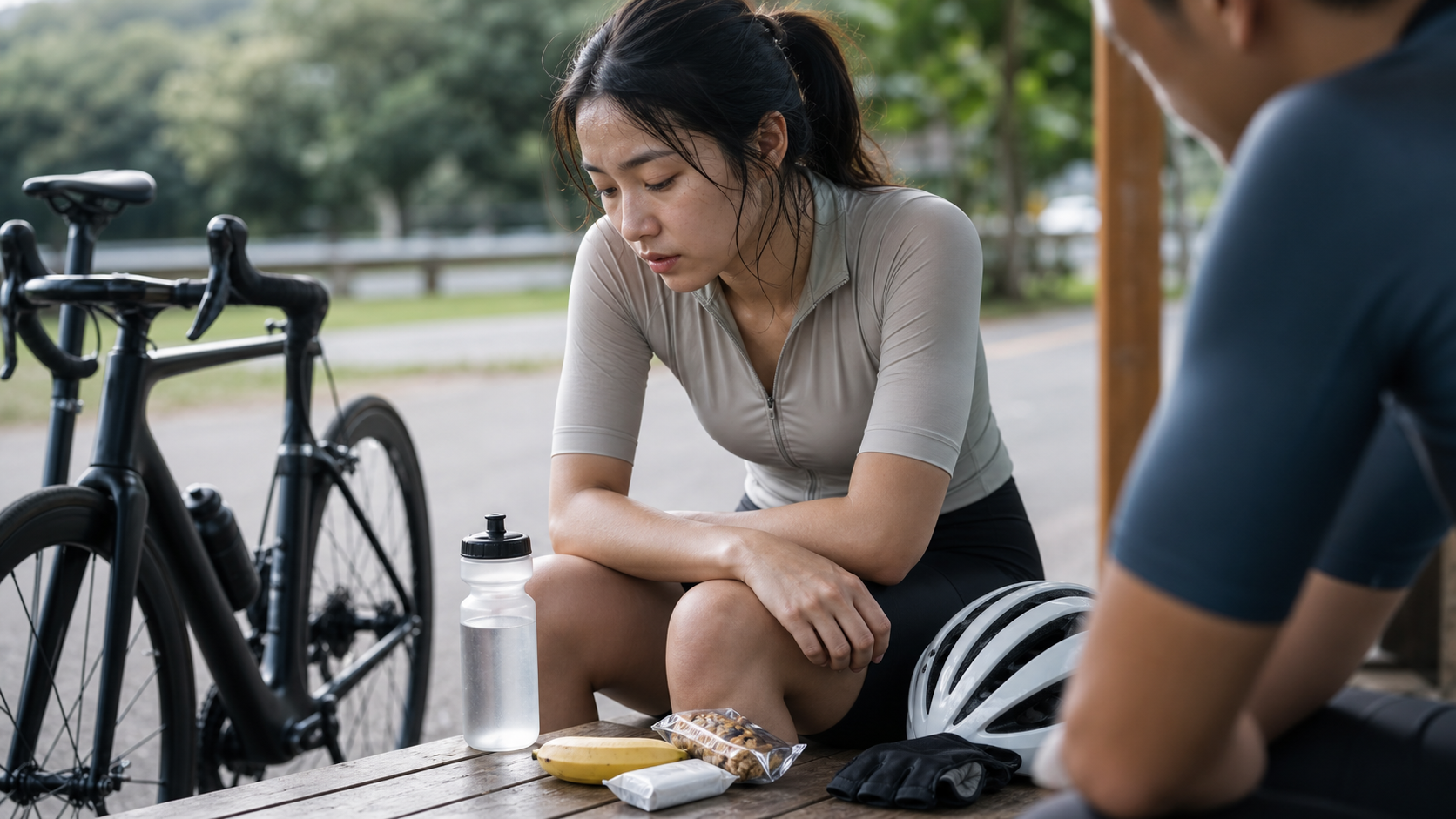
Starting with a “Very Disciplined” Athlete
Over the years of coaching, I’ve met all kinds of athletes. Some come to me because their weight has plateaued, some want to break their personal record on Wuling, and others simply want to ride farther and longer. But the ones who truly keep me up at night aren’t the “lazy” athletes—they’re the ones who look too disciplined.
A few years ago, I coached a female cyclist—let’s call her A. She trained seriously, never missed a workout, and her body fat dropped quickly and impressively. She was the kind of athlete every coach loves. But I slowly started noticing a few things: she never ate during long rides, saying she “wasn’t hungry”; during group ride breaks while everyone devoured meat buns, she only drank black coffee; she began frequently complaining of cold hands and feet, lack of power on climbs, and her period hadn’t come for months—and she told me, “Doesn’t that just mean my body fat is low enough?” Her power numbers were dropping instead of rising, and in a 100 km ride she should have completed easily, she completely fell apart on the climbs.
At that moment, alarm bells went off in my head. She wasn’t underperforming because she wasn’t trying hard enough—she was taking in far less energy than her body needed to support her training and daily life. This is the core issue known in sports medicine as “Relative Energy Deficiency in Sport (RED-S),” and behind it often lies an unspoken eating disorder.
In this article, I want to talk from a coach’s perspective about the risks and recognition of eating disorders in athletes. This isn’t meant to scare you, but to help you recognize the signs early—in yourself or someone around you—and seek help sooner. In my experience, the earlier the intervention, the greater the chance of recovery and the smaller the cost.
Foundational Concepts: Eating Disorders in Athletes Are Different from the General Population
Why Are Athletes a High-Risk Group?
First, let’s address a common misconception: disordered eating is not “a disease that only affects teenage girls obsessed with looks.” In the sports world, it often hides especially well under the guise of “discipline,” “professionalism,” and “pursuit of performance,” making it even harder to detect.
There are several structural reasons why athletes are a high-risk group:
- The “lighter equals faster” myth: In endurance sports like cycling, long-distance running, and triathlon, power-to-weight ratio (W/kg) does affect climbing performance. As a result, many people treat “losing weight” as an endlessly escalating goal, ignoring that once weight drops past a certain point, what’s lost is muscle and bone density—and performance collapses instead.
- A substitute for control: Training and eating are among the few things athletes can “completely control.” When other aspects of life feel out of control (school, work, competition pressure), some people project that need for control onto food, using extreme dieting to gain a sense of “I still have a grip on something.”
- Coach and peer culture: A careless comment like “you look a bit rounder lately” can be the trigger. The intense focus on body shape, body fat, and diet within training circles constantly reinforces the message that “thin equals good.”
- Exercise itself suppresses appetite: After high-intensity or prolonged training, appetite actually decreases in the short term, making “not eating enough” feel natural and hard to notice.
From “Disordered Eating” to “Eating Disorders” Is a Continuous Spectrum
I often emphasize to my athletes that this isn’t a simple “sick / not sick” dichotomy—it’s a continuous spectrum:
- At one end is completely normal, flexible eating that allows enjoyment of food.
- In the middle is “disordered eating behaviors”: for example, obsessively counting calories, feeling guilty about certain foods, chronically eating very little, deliberately not refueling after training, or using extreme methods to purge (such as self-induced vomiting or laxative abuse). This range may not meet clinical diagnostic criteria, but it’s already harming the body and mind.
- At the other end are clinically diagnosable “eating disorders,” such as anorexia nervosa, bulimia nervosa, and binge eating disorder. These fall under psychiatric/psychosomatic medicine and require intervention by a professional medical team.
The key point is: you don’t need to wait for a “diagnosis” to deserve care. Signals at any point on the spectrum are worth pausing to examine.
Low Energy Availability (LEA) and RED-S
Here I want to introduce a core scientific concept—Energy Availability (EA). In plain terms:
The energy you take in, minus the energy expended through exercise, is what’s left for your body to maintain basic functions (heartbeat, immunity, hormones, repair, bone building, etc.).
When this “remaining energy” is chronically insufficient, it’s called Low Energy Availability (LEA). And in a consensus statement first published by the International Olympic Committee (IOC) in 2014 and updated in 2018 and 2023, the cascade of physiological impairments caused by prolonged LEA is collectively termed Relative Energy Deficiency in Sport (RED-S / REDs).
According to the IOC consensus statement, RED-S affects far more systems than just menstruation and bones, including: decreased metabolic rate, immune function, protein synthesis (muscle repair), cardiovascular health, gastrointestinal function, and mental health. It’s not exclusive to women—a growing body of research shows that male athletes can also experience decreased testosterone, bone loss, and declining performance due to LEA.
It’s worth noting that LEA doesn’t always stem from disordered eating. Sometimes it’s simply “accidentally not eating enough”—a sudden spike in training volume without a corresponding increase in food intake can also lead to LEA. But disordered eating is one of the most common and most stubborn causes of LEA, and the two are often intertwined.
The Female Athlete Triad
Before the broader framework of RED-S, sports medicine first focused on the Female Athlete Triad, which refers to the interconnection of three conditions:
- Low energy availability (often accompanied by disordered eating)
- Menstrual dysfunction (such as irregular periods or amenorrhea)
- Impaired bone health (decreased bone density, increased risk of stress fractures)
These three are closely linked: not eating enough → hormonal disruption, decreased estrogen → loss of menstruation → rapid bone loss. I often remind my female athletes: “Your period isn’t a nuisance you can do without—it’s the dashboard showing whether your body has enough energy.” When it disappears, it may be your body sending out a distress signal.
What’s Actually Happening Inside the Body? (The Mechanism in Plain Language)
Many athletes ask me: “How can eating a little less affect my period, bones, and immune system so much?” I often use this analogy: the body is like a factory experiencing a power shortage.
When energy is chronically insufficient, the body activates “power-saving mode”—it has to decide where to allocate its limited energy first. Life-sustaining functions like heartbeat, breathing, and brain function always take priority. As for “non-essential” functions like reproduction (menstruation, hormones), bone building, immunity, and muscle repair, they get drastically scaled back or even shut down. That’s why people with LEA experience loss of menstruation, bone loss, recurrent colds, and slower recovery—it’s not a coincidence, but a rational trade-off the body makes under an energy deficit.
This also explains a phenomenon many find puzzling: why do people who eat less and train harder actually perform worse? Because when the energy for repair and synthesis is cut, the damage from each training session never gets fully repaired. Training stops being “a stimulus for progress” and becomes “accumulating damage.” This is the cruelest part of RED-S—it turns “effort” into “self-consumption.”
What the Data Says: How Common Is This?
Many people assume eating disorders in the sports world are “extremely rare cases,” but the actual prevalence may be higher than you think. The following data comes from literature and organizations I found with clear sources (links provided at the end). I’ve kept the original ranges without over-precise extrapolation:
| Population | Relevant Findings (Range) |
|---|---|
| Adolescent athletes | Prevalence of disordered eating behaviors up to approximately 18–20% |
| Collegiate athletes | Prevalence of disordered eating behaviors up to approximately 25% |
| Female athletes (broadly defined) | Proportion exhibiting disordered eating behaviors ranges from approximately 15% to 62% across studies |
| Ultramarathon runners | In one study of 306 ultramarathon runners, approximately 44% were assessed as at risk for the Female Athlete Triad, and about one-third exhibited disordered eating behaviors |
Key takeaways:
- The ranges are wide because different studies use very different definitions, screening tools, and sports. This also reminds us: the numbers themselves aren’t the point—trends and signals are.
- Endurance sports and weight-class/aesthetic sports (long-distance running, cycling, swimming, gymnastics, dance, lightweight rowing, etc.) carry higher risk. The literature clearly indicates that irregular menstruation is more prevalent in endurance sports and increases with rising training intensity and declining nutritional status.
- These numbers remind coaches and training partners: statistically, someone in your training circle is almost certainly struggling somewhere on the spectrum—they just haven’t said it out loud.
Practical Recognition: 9 Warning Signs Coaches and Partners Should Watch For
This is the part I most want to teach everyone on the ground. You don’t need to be a doctor to learn to “recognize the signals.” I’ve divided the warning signs into three categories: eating behaviors, physical signals, and psychological/social signals.
Warning Signs Classification Table
| Category | Common Warning Signs | Why It Matters |
|---|---|---|
| Eating Behaviors | Deliberately not refueling during long training, strong guilt about food, categorizing food as “good/bad,” frequently skipping meals, extreme calorie counting, frequently going to the bathroom after meals | Reflects not just “eating less,” but a broken relationship with food |
| Eating Behaviors | Continuously increasing training volume without increasing food intake, suddenly “cutting out” entire food groups (carbs, fats), regularly replacing meals with coffee/meal replacements | These are typical pathways into LEA |
| Physical Signals | Irregular or absent menstruation in women, chronically cold hands and feet, unexplained fatigue, slower recovery, recurrent illness and colds | All are outward manifestations of insufficient energy and hormones |
| Physical Signals | Power/pacing declining instead of rising, “sudden loss of power” on climbs, stress fractures or recurring minor injuries, dizziness and heart palpitations, hair loss | Performance collapse and recurrent injuries are often red flags for RED-S |
| Psychological/Social | Extreme anxiety about “one extra bite,” refusing to eat with others, constantly talking about weight/body fat, mood swinging with weight numbers, excessive self-blame | Psychological changes often appear earlier than weight numbers |
A Practical Mnemonic: Power Drops, Period Stops, Injuries Mount
If I had to give frontline coaches one memorable phrase, it would be: when an athlete simultaneously shows “persistently declining power or pacing, abnormal menstruation in women, and recurrent injuries or frequent illness,” RED-S should be on your radar—reach out proactively. These three things together are far more meaningful than any single body-fat number.
What Coaches Absolutely Must Not Do
I want to seriously remind my fellow coaches and training partners that some “good intentions” are actually harmful:
- Never publicly comment on anyone’s weight, body fat, or body shape—even as a compliment like “you look great, so slim.”
- Don’t treat weight as a public training KPI, especially announcing numbers in group settings.
- Don’t encourage “training hungry” or “fasted long rides for fat loss” as a routine practice.
- Don’t play psychologist or nutritionist and make diagnoses yourself—your role is to “notice, care, and refer.”
Common Mistakes and Corrections
In all my years of coaching, I’ve seen too many “well-intentioned but misguided” approaches. Here are the most common mistakes and how I would correct them.
Mistake 1: Treating “Lighter Equals Faster” as Gospel
Common phrase on the ground: “If I just lose 3 more kilos, I’ll definitely PR on Wuling.”
The problem: Power-to-weight ratio does matter, but it’s a ratio of “power ÷ weight.” When you undereat to lose weight, what you lose is often muscle and available energy—the numerator (power) collapses, and the ratio doesn’t improve—it gets worse. I saw this firsthand with A: her body fat looked great, but her power kept sliding.
The correction: Shift the goal from “lighter” to “stronger and sustainable long-term.” If weight loss is truly needed, it should be done under the joint supervision of a nutritionist and coach, with small weekly increments, preserving training quality and normal menstruation—not as an endless downward spiral.
Mistake 2: Pushing “Clean Eating” to the Extreme
Common phrase on the ground: “Carbs are the root of all evil—I’ve cut them all out.”
The problem: Endurance sports rely heavily on carbohydrates as fuel. The 2023 IOC update specifically notes that low carbohydrate availability is itself a major driver of LEA and RED-S. Demonizing an entire food group is a common starting point for disordered eating.
The correction: Carbohydrates are an endurance athlete’s friend, not enemy. You need adequate carb intake before and after training and during long rides. Instead of “cutting things out,” learn to “eat well when you should.”
Mistake 3: Increasing Training Without Increasing Food
Common phrase on the ground: “I doubled my mileage this month and my weight dropped on its own—awesome.”
The problem: This is the most typical path into LEA, and the person often doesn’t realize it because “getting thinner” is seen as a good thing.
The correction: When training volume increases, food intake must increase in tandem. I ask my athletes to pay special attention to refueling and meal portions during volume weeks, and to use “performance, sleep, menstruation, mood, and recovery speed” as a comprehensive dashboard for whether energy is sufficient—not just the scale.
Mistake 4: Toughing It Out with Willpower and Refusing Help
Common phrase on the ground: “I can just control it myself—no need to see a doctor.”
The problem: Eating disorders have a strong psychological component and are very difficult to self-correct through willpower alone. The longer it goes on, the harder it becomes to reverse physiological damage like bone loss and hormonal disruption.
The correction: Normalize seeking help. Just as you’d see an orthopedist for knee pain, going to a professional team when your relationship with food is broken is a mature and brave choice, not a sign of weakness.
Actionable Advice for Readers at Different Levels
Everyone stands at a different point on the spectrum, so the first step differs for each person. I’ve divided readers into three roles with tailored advice.
If You Suspect Yourself
- Do an honest self-assessment first (see the self-reflection questions in the FAQ below)—without judgment, just observation.
- Restore a basic eating structure: three regular meals, refueling before and after training, no deliberate meal skipping. This is the most fundamental yet most effective step.
- Treat “menstruation, sleep, mood, and recovery” as your dashboard, not just your weight.
- Proactively seek professional help: rather than spiraling with online anxiety, book an appointment with a psychiatrist/family medicine doctor, or talk to a sports nutritionist. In Taiwan, medical access is convenient and National Health Insurance coverage is high—that’s our advantage, so use it.
- Tell someone you trust. Fighting alone is the environment eating disorders thrive in; being seen is the beginning of recovery.
If You’re a Coach or Training Partner
- Watch your mouth: don’t comment on body shape, don’t announce weights publicly, don’t advocate training hungry.
- Create a safe refueling culture: proactively bring food on group rides, encourage everyone to eat together, make “eating well” a matter of course.
- Express concern privately and gently: use “I’ve been a bit worried about your recovery lately” rather than “are you not eating?”—focus on feelings and health, not weight.
- Know your boundaries: your job is to notice, accompany, and refer—diagnosis and treatment are for professionals.
- Prepare a list of help resources (see next section) so you can hand it over immediately when needed.
If You’re a Parent or Partner
- Don’t use food as reward or punishment, and don’t comment on portion sizes or body shape at the dinner table.
- Watch for life signals: refusing to eat out, frequently going to the bathroom after meals, obsessive calorie tracking, mood swings tied to weight.
- Express care, not control: “I love you for who you are, not your weight.”
- Accompany them to medical appointments: proactively helping with registration and going along can significantly lower the psychological barrier to seeking help.
Local Resources for Help and Medical Care in Taiwan
I want to be specific here, because “knowing you should seek help” and “knowing where to seek help” are two different things. Here are accessible directions in Taiwan (actual departments and services are subject to each institution’s announcements):
- Psychiatry / Mental Health: Eating disorders (anorexia, bulimia, etc.) fall under psychiatric care in Taiwan. Most regional hospitals and medical centers have relevant outpatient clinics, and some have dedicated eating disorder clinics or integrated clinics.
- Family Medicine: If you’re unsure which department to book, family medicine is a great starting point—they can do initial assessment and referral.
- Obstetrics/Gynecology / Endocrinology & Metabolism: For menstrual irregularities, hormonal and bone issues in women, these departments can help with examination and follow-up.
- Sports Nutritionists / Nutrition Clinics: Help rebuild a normal and sufficient eating structure, especially suitable for those who “aren’t eating enough but haven’t reached disease level.”
- Clinical Psychologists / Counseling: Address psychological issues related to food, body image, and control.
- Mental Health Support Hotlines: If feeling low or in crisis, you can call national mental health support hotlines (such as the 1925安心專線) for immediate assistance.
Make good use of NHI and referrals: Medical access in Taiwan is highly convenient, and most of the above services are covered by National Health Insurance. I often tell my athletes: booking one appointment and talking to a doctor doesn’t mean “you’ve been labeled”—it means you’ve done a responsible health check for yourself.
Friendly reminder: This article provides general directions, not specific recommendations. Actual departments, clinic names, and services are subject to the latest announcements from each medical institution and physician advice.
Practical Reminders for the Taiwan Context
Bringing international research back to daily life in Taiwan, I’d like to add a few localized observations:
- The double-edged sword of eating-out culture: Taiwan’s convenient food options are a plus—readily available energy sources abound (convenience store onigiri, soy milk, fruit, and bento boxes are all great fuel). The downside is that calorie labeling can make people who over-calculate even more anxious. My advice is to think in terms of “portions and balance” rather than “calorie numbers.”
- The hidden cost of hot, humid weather: In Taiwan’s summers, cycling and running cause heavy sweating, depleting energy and electrolytes. If you’re also deliberately eating less, you’re even more likely to fall into LEA. In hot weather training, refuel more aggressively, not more conservatively.
- Refueling plans for common routes: For long climbs or long-distance routes like Wuling, Fengguizui, and Beiyi, refueling points along the way are limited, making pre-ride and mid-ride carbohydrate and hydration planning especially important. Treat “eating fuel” as part of your training plan, not as “lacking willpower.”
- Comparison pressure in social media culture: With all the tracking and check-in culture, it’s easy to get sucked into comparing body fat and weight with others. Remind yourself: your goal is long-term health and enjoying the sport, not a number on social media.
- The barrier to seeking medical care is lower than you think: Many athletes get stuck on the psychological hurdle of “is seeing a psychiatrist a big deal?” I often say that Taiwan’s medical accessibility is our blessing—easy to book, most services covered by NHI, and family medicine serves as a buffer entry point. Treat it like a “health checkup,” not “getting labeled,” and the psychological burden becomes much lighter.
- Give yourself a safe comparison target: If you must compare, compare with “yourself from three months ago” on recovery ability, sleep quality, and whether you can still enjoy a meal after a ride—not with strangers on social media whose health status you know nothing about.
FAQ
Q1: I just want to lose fat and get faster—does that count as an eating disorder?
Simply wanting to lose fat doesn’t equal an eating disorder. The key lies in the method and your psychological state: if during the process you can still eat flexibly, refuel after training, maintain a normal period, stay emotionally stable, and keep performance steady or improving, it’s usually healthy. But if you experience strong guilt about food, deliberately train hungry, lose your period, see performance collapse, or have mood swings tied to weight, it’s time to be alert and seek professional evaluation.
Q2: A simple self-reflection checklist?
Honestly ask yourself these questions (the more “yes” answers, the more worthwhile it is to talk to a professional):
- Do I often feel anxious or guilty about “one extra bite”?
- Do I deliberately avoid refueling during training to burn more?
- Has my period become irregular or stopped (for women)?
- Have I been feeling cold, tired, slow to recover, or getting sick easily lately?
- Has my power/pacing inexplicably declined?
- Do I refuse social meals or gatherings because of my weight?
- Is my mood highly tied to the number on the scale?
This checklist is not a diagnostic tool—it’s a guide to help you decide whether to go talk to a professional.
Q3: Can men get RED-S too?
Yes. RED-S is not exclusive to women. Men with prolonged LEA can also experience decreased testosterone, reduced libido, bone loss, poorer recovery, and declining performance. Recent IOC updates have particularly emphasized that evidence of LEA in men is accumulating. Male athletes should never dismiss their own signals because “this is a women’s issue.”
Q4: If I suspect a teammate has a problem, should I say something directly?
I recommend private, gentle, and focused on health and feelings—not public confrontation or commenting on weight. You could say, “I’ve been a bit worried about you lately and wanted to check in,” and have help resources ready. Your role is to accompany and refer, not diagnose.
Q5: Can I still train seriously after recovery?
Yes, and you’ll often be stronger. When energy supply returns to normal, hormones, bone density, recovery, and performance tend to come back together. Many athletes achieve better results after properly addressing their eating and energy issues. Health and performance aren’t opposites—in the long run, they’re on the same side.
Q6: Is there an easy way to gauge Low Energy Availability (LEA)?
Sports science uses the concept of “energy availability” to quantify it, but that requires precise calculation of food intake, exercise expenditure, and body weight—not practical for most people. I prefer teaching athletes to use daily signals: whether you have energy before training, how quickly you recover after, sleep quality, mood stability, menstrual regularity for women, and whether you feel inexplicably cold. If several of these decline simultaneously, it usually means you’re not fueling enough. Rather than obsessing over precise numbers, treat these signals as early warnings.
A More Complete Case Study: From Collapse to Returning to the Race
Besides A from the beginning, I’d like to share the journey of a male athlete, B, because many people assume “this is a women’s problem”—it isn’t.
B was a very driven amateur triathlete. One season, to chase an age-group result, he ramped up his weekly training volume while aggressively restricting his diet. In just two months, he dropped nearly 6 kg. At first, his performance did improve, and he was thrilled. But over the following weeks, things took a sharp turn: his morning resting heart rate rose abnormally, he was exhausted even after 8 hours of sleep, his climbing power dropped significantly, he cramped and had to withdraw from a practice race, and he caught two colds in a row. He came to me and asked, “Coach, I’m leaner than ever—why am I so weak?”
Instead of immediately adding more training, I asked him to do a few things: restore three meals and training refueling, temporarily reduce training intensity, track sleep and morning heart rate, and book a family medicine appointment for basic checks. After evaluation, the doctor also referred him to a nutrition clinic to help rebuild an adequate eating structure.
The table below is the rough timeline I walked through with him (conceptual illustration only—everyone’s recovery pace differs, so defer to professional assessment):
| Stage | General Approach | Common Physical Feedback |
|---|---|---|
| Step 1: Stop the bleeding | Restore three meals and pre/post-training refueling, reduce training intensity, prioritize sleep | Energy and mood stabilize first; morning heart rate begins to drop |
| Step 2: Rebuild structure | Work with nutrition clinic to ensure adequate daily energy and carbs | Faster recovery; no more excessive fatigue after training |
| Step 3: Progressive return | Gradually add intensity and volume back, with adequate energy | Power/pacing gradually recovers |
| Step 4: Long-term maintenance | Establish the habit of “increase training, increase food intake in tandem” | Performance surpasses previous levels, more stable, fewer injuries |
B eventually not only regained his power but achieved a better age-group result the following year than ever before. One thing he told me has stayed with me: “Turns out I wasn’t not trying hard enough—I was starving myself while trying hard.” I want to dedicate that sentence to every athlete out there toughing it out.
A “Notice—Accompany—Refer” Process Reference for Coaches
Finally, I’ve condensed the practical on-the-ground approach into a simple process table for fellow coaches to keep:
| Stage | What You Should Do | What You Should NOT Do |
|---|---|---|
| Notice | Watch for red flags like “power drops, period stops, injuries mount”; observe eating and emotional signals | Publicly comment, call people out, use weight as conversation material |
| Accompany | Show private, gentle concern focused on health and feelings; make the person feel safe | Interrogate, lecture, or play psychologist and make judgments |
| Refer | Hand over help resources (psychiatry / family medicine / nutrition clinic / mental health hotline) | Discourage or downplay seeking help (“just tough it out”) |
| Support | Adjust training plans and refueling culture; accompany long-term recovery | Expect “instant recovery” or push performance during the recovery period |
Conclusion: Making Food a Friend Again
Back to A from the beginning. I never said another word about her weight. Instead, I told her honestly: “I’m worried about your recovery and your body. I want to go with you to see a professional.” She resisted at first, but eventually she went to the clinic and started working with a nutritionist. It wasn’t easy—there were setbacks and struggles—but a year and a half later, her period returned, her power slowly climbed back, and most importantly—she could sit down to a meal with friends again without being consumed by guilt.
I want to tell every athlete, coach, and family member reading this: pursuing progress is a good thing, but when “discipline” starts harming your period, your bones, your mood, and your relationship with food and people, it’s no longer discipline—it’s a signal that needs to be gently caught.
Food is fuel, it’s repair, and it’s one of life’s pleasures. Don’t let it become an enemy. Recognize the signals early, seek help early, and you’ll find that health and strength were never an either/or choice.
If, by the time you finish reading this, a face comes to mind—maybe a teammate, maybe yourself—that’s not a coincidence. Please save this article and pass it on, at the right moment, in a gentle way. Sometimes, the moment someone is ready to be caught comes from another person being willing to speak up with care first. That’s what I’ve wanted to protect more than any results sheet in all my years of coaching—because the original purpose of sport is to help us live better, longer, and happier, not to slowly exhaust ourselves to nothing.
Disclaimer: This article is educational content and cannot replace individual diagnosis and treatment advice from physicians, physical therapists, or nutritionists. Eating disorders are health issues requiring professional medical team intervention. If you or someone around you shows related warning signs, please seek individualized help from psychiatry, family medicine, nutrition, or psychological professionals as early as possible. The case studies in this article are contextualized adaptations for illustrative purposes; data is cited from the references at the end.
References
- International Olympic Committee — IOC publishes new Consensus Statement on Relative Energy Deficiency in Sport (REDs):https://www.olympics.com/ioc/news/ioc-publishes-new-consensus-statement-on-relative-energy-deficiency-in-sport-reds-to-protect-athlete-health
- 2023 IOC consensus statement on Relative Energy Deficiency in Sport (REDs) — PubMed:https://pubmed.ncbi.nlm.nih.gov/37752011/
- IOC Consensus Statement on RED-S: 2018 Update (IJSNEM):https://journals.humankinetics.com/view/journals/ijsnem/28/4/article-p316.xml
- Female Athlete Triad — StatPearls, NCBI Bookshelf:https://www.ncbi.nlm.nih.gov/books/NBK430787/
- Ultra-Marathon Athletes at Risk for the Female Athlete Triad — NCBI PMC:https://www.ncbi.nlm.nih.gov/pmc/articles/PMC4564455/
- Relative Energy Deficiency in Sport (RED-S) — National Eating Disorders Association (NEDA):https://www.nationaleatingdisorders.org/relative-energy-deficiency-in-sport-red-s/
Related Reading
- Eating Disorders in Cycling: Recognizing the Warning Signs and Seeking Help
- When Exercise Becomes a Prison: On the Road to Recovery from Eating Disorders, Is Exercise a Cure or a Poison?
- Warning Signs of Eating Disorders and Relative Energy Deficiency in Athletes: How to Self-Detect, Support Others, and When to Seek Help
- Relative Energy Deficiency (RED-S): Causes, Warning Signs, Effects on Bone and Endocrine Health, and How to Seek Help
CT 喇低賽) 單車 比賽總是沒照片? 攝影師的觀點大公開 姿勢就是力量! 請加速1.25倍收看
7 年前
靠單車減肥35公斤 心得分享與整理
7 年前
4K 東眼山 x 水蜜桃冰沙 百人單車約騎! 操完再吃冰 多爽快
7 年前
CT暗黑廚房) 車友必備 宇宙無敵鮮蚵湯 幫助訓練恢復 天然食補 好市多 超肥鮮蚵 破PR
7 年前
一日北高/長距離團騎 常見問題補充篇 / 組團或跟團的眉角 / 壯車友容易被瘦車友慢性拉爆 / 原來屁股痛可能是這個原因...? / 風場配速法 / 公路車 / CT Yeh
2 年前
水金九不厭五分 10度寒流冷到不願停!feat. 卡卡 / 公路車 / CT Yeh
6 個月前
JJSC南台灣單車走春三日行 DAY 1 / 強度 x 美食 x 節慶體驗 / 公路車 CT Yeh
5 個月前
#公路車 #Fitting 靠人工智慧APP 幫你調整單車
6 年前