Athlete Water Intoxication and Overhydration: The Hidden Killer of Hyponatremia, and How to Hydrate Properly
Foreword: The Student Who Collapsed Before the Finish Line Wasn’t Suffering from Heatstroke
I’ve been training athletes and general fitness enthusiasts for about fifteen years now. Over the years, the hydration question I get asked most is almost always, “Coach, am I drinking too little?” Very few people ask, “Could I be drinking too much?”
But the case that left the deepest impression on me was precisely one where drinking too much caused the problem.
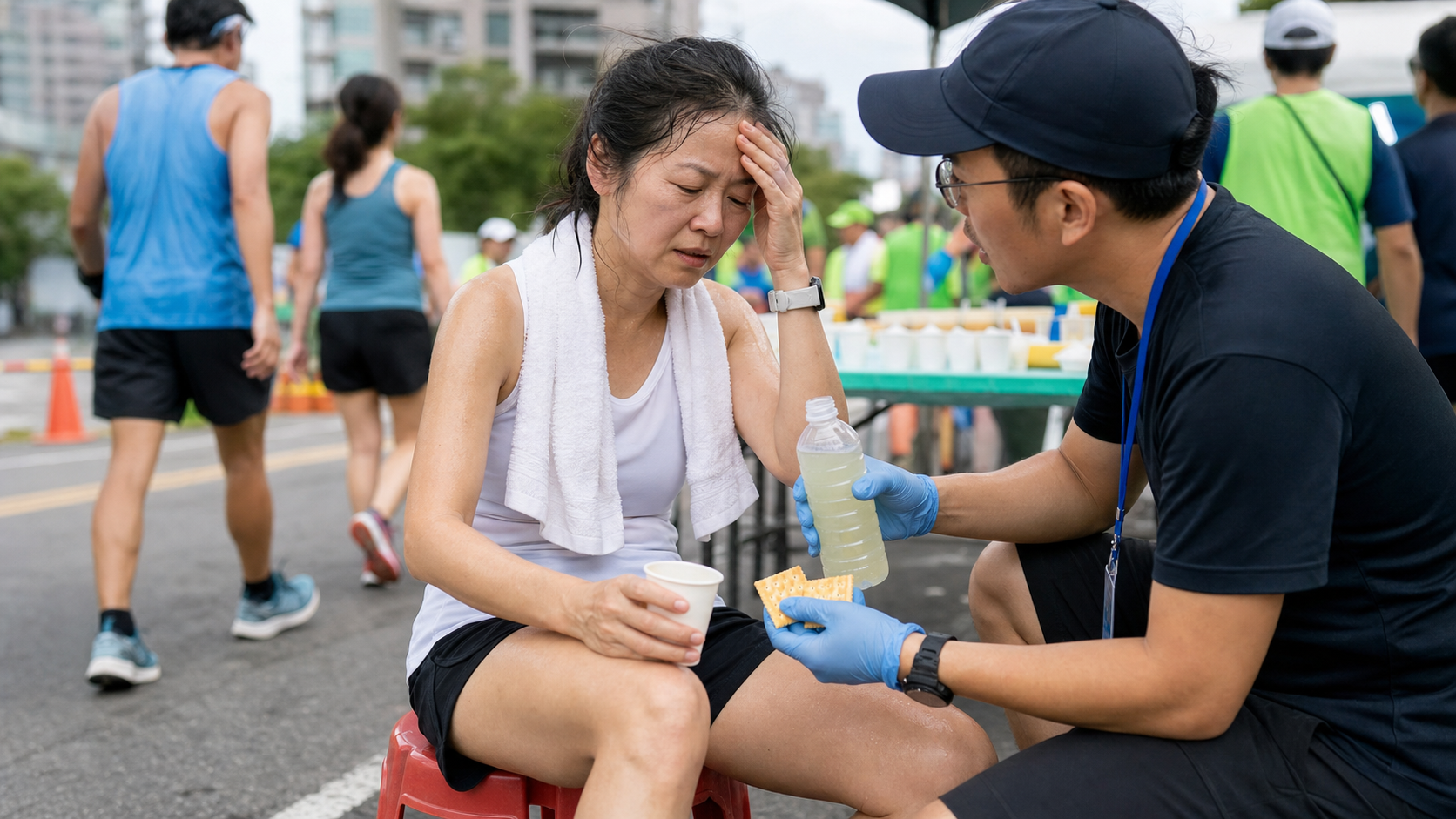
A few years ago, at a late-summer urban half marathon, I was accompanying a female student in her early forties running her first half marathon. She was extremely diligent, and throughout her training period she had taken “drink plenty of water, don’t get dehydrated” as her golden rule. The temperature on race day wasn’t extreme, but because she was nervous, she stopped at every aid station and gulped down several cups of water, and she also carried a large bottle of plain water with her, drinking as she ran. Around the thirty-kilometer mark, she started saying she had a bad headache, felt nauseous, was a bit unsteady on her feet, and her face looked slightly puffy. Everyone around her instinctively reacted with “heatstroke—give her more water fast,” and nearly tried to push more water on her.
The moment I looked at her, something seemed off—her skin wasn’t hot, there was no obvious dry feeling of dehydration; instead, she looked more “swollen” than at the start, plus she had nausea, headache, and her consciousness seemed a bit dull. This didn’t look like dehydration; it looked more like hyponatremia caused by overhydration. We immediately stopped giving her water, had her sit down, gave her salty crackers and a sports drink with salt content, and sent her to the hospital for observation. A blood test later confirmed that her blood sodium was indeed low.
This incident shook me deeply: in Taiwan, people are highly alert to “dehydration and heatstroke,” but there is almost no awareness that “drinking too much water can also be fatal.” In this long article today, I want to lay out clearly this severely underestimated risk—Exercise-Associated Hyponatremia (EAH), commonly known as “water intoxication” during exercise.
Bottom line first: for the vast majority of exercisers, the safest hydration strategy is not “drink as much as you can,” but rather drink to thirst. This is backed by international consensus and the updated guidelines from the Wilderness Medical Society.
1. What Is Water Intoxication? First, Let’s Clarify Hyponatremia
Blood Sodium Is No Small Matter—It Controls Your Cells
Sodium is one of the most important electrolytes in the blood, responsible for maintaining the osmotic balance of body fluids. Simply put, sodium determines whether water stays in the blood vessels, outside the cells, or moves into the cells.
Normal blood sodium concentration is approximately 135–145 mmol/L. When blood sodium drops below 135 mmol/L, it is medically defined as hyponatremia. When hyponatremia occurs during exercise or within 24 hours after exercise, it is called Exercise-Associated Hyponatremia (EAH).
When blood sodium is “diluted” by large amounts of water and falls, blood osmotic pressure decreases, and water moves into cells according to the osmotic gradient. Most cells in the body can hold up for a while, but brain cells are enclosed in a hard skull with no room to expand. Once brain cells absorb water and swell, it causes cerebral edema, compressing intracranial structures—this is precisely the key reason severe hyponatremia can be fatal.
Why Is It Called “Water Intoxication”?
“Water intoxication” is a colloquial but vivid term. It emphasizes not that water itself is toxic, but that consuming an amount of water in a short period that exceeds the kidneys’ ability to excrete it dilutes the sodium in the blood, producing intoxication-like symptoms from cellular swelling.
According to the literature on EAH, overhydration during exercise—especially consuming large volumes of hypotonic fluids such as plain water or sports drinks—is the primary cause of all forms of EAH. In other words, it’s not about ingesting some strange substance; it’s simply “plain water, taken to excess.”
Severity Grading (A Rough Concept for You)
| Blood Sodium Range (mmol/L) | General Description | Common Manifestations (range varies by individual) |
|---|---|---|
| 135–145 | Normal | No abnormalities |
| 130–134 | Mildly low | Possible mild nausea, head fullness, fatigue; easily overlooked |
| 120–129 | Moderately low | Headache, vomiting, confusion, unsteady gait, swelling of hands and feet |
| Below 120 | Severe | Seizures, loss of consciousness, coma, respiratory distress; a medical emergency |
The thresholds and symptoms in the table are general principles. In reality, each person’s tolerance for the same blood sodium level varies greatly, and the speed of the drop also has a major impact. This table is meant to help you build a concept, not to serve as a self-diagnosis tool.
“Acute Drop” Is More Dangerous Than the “Absolute Number”
Here’s a key point many people overlook: with the same blood sodium of 128 mmol/L, a person whose level has dropped slowly over several days and an exerciser whose level has plummeted within a few hours face vastly different levels of danger.
Why? Because when brain cells face a “chronic, gradual” drop in blood sodium, they activate a protective mechanism, expelling some solutes from inside the cells to reduce the osmotic gradient between the inside and outside of the cells, thereby avoiding massive water absorption and swelling. This adaptation takes time.
But exercise-associated hyponatremia often occurs rapidly within a few hours—the body doesn’t have time to activate this buffer, and brain cells are directly flooded with excess water. This is why a healthy person with normal blood sodium on routine blood tests can, after chugging large amounts of water during a race, develop severe cerebral edema symptoms even at a stage where blood sodium “doesn’t look that low yet.”
I use an analogy to help students understand: chronic hyponatremia is like water rising slowly—you have time to move; acute hyponatremia is like a dam bursting instantly—you don’t even have time to react. Water intoxication on the sports field belongs to the latter.
Antidiuretic Hormone (ADH)—The Key Driver That Locks Water in the Body
To understand why the body is especially prone to retaining water during exercise, you need to know a hormone: antidiuretic hormone (ADH, also known as vasopressin). Its role, simply put, is to “tell the kidneys to excrete less water and keep water in the body.”
Under normal circumstances, when your blood is diluted (blood sodium is low), the body should “turn off” ADH, allowing the kidneys to excrete more water and flush out the excess to restore blood sodium. This is a clever automatic balance.
The problem is that strenuous or prolonged exercise itself is a stressor that stimulates inappropriate ADH secretion. Nausea, pain, stress, prolonged endurance exercise, and other factors can all cause ADH to keep being secreted “when it shouldn’t be.” The result: even though you already have too much water and low blood sodium, your body is still desperately locking water in and unable to excrete it. If you then keep drinking more water, it’s like pouring fuel on the fire.
This also explains a common question—“I’m clearly urinating, so how could I get water intoxication?” Because ADH reduces your excretion efficiency; even if you pass some urine, it still can’t keep up with the amount you’re drinking in.
2. Why “Drink More Water to Be Safe” Is a Dangerous Myth
The Historical Baggage of Old Ideas
Over the past few decades, sports hydration education has almost universally emphasized “don’t wait until you’re thirsty to drink, because by the time you’re thirsty, you’re already dehydrated.” This message makes sense in extreme heat, ultra-long durations, high intensity, and heavy sweating scenarios, but it has been oversimplified and taken to the extreme, turning into a slogan of “keep drinking during exercise—the more, the better.”
The problem is that this slogan ignores the risk at the other end. When a person’s drinking rate exceeds the body’s excretion rate, excess water stays in the body and dilutes blood sodium. This is especially likely to happen in:
- Slower exercisers who spend a long time on the course (e.g., beginner runners finishing a full marathon in five or six hours), who have plenty of time to drink at every aid station.
- Beginners who are nervous or scared by health education into deliberately chugging water.
- Smaller individuals, women, and those who sweat relatively little but still drink heavily.
A Key Counterintuitive Point: EAH Is Most Common in Those Who “Drink Too Much,” Not Those Who “Run Too Fast and Sweat Too Much”
This point must be remembered: many EAH cases show body weight that increases, not decreases, after a race. Because the water they drank exceeds the amount lost through sweating and urination, the water accumulates in the body. So on site, “weighing more after the race than at the start” is an important clue to overhydration.
Why Sports Drinks Are Not a Guaranteed Shield
Many people assume, “I’m drinking sports drinks with electrolytes, so I can’t get hyponatremia.” This is another common misconception. The sodium concentration in commercial sports drinks is typically still far lower than that of blood. When you chug large amounts of sports drinks, the sodium you take in isn’t enough to offset the dilution effect of the water you’re consuming, which can still pull your blood sodium down. Sports drinks can delay, but cannot guarantee immunity from, hyponatremia caused by overhydration.
Who Is at High Risk? Check Yourself Against This List
Over years of coaching, I’ve identified several groups that need to be especially vigilant. See how many of these apply to you:
| Risk Factor | Why It Increases Risk |
|---|---|
| Long time on the course (slow finishers) | Plenty of time to drink at every aid station, leading to cumulative excess |
| Smaller build, lighter weight | The same excess water has a more pronounced dilution effect |
| Female | On average, smaller body size and total fluid volume; statistically higher risk |
| Overly influenced by “drink lots of water” pre-race advice | Psychologically forces excessive drinking, overriding body signals |
| Low sweat rate but still drinking heavily | Intake exceeds output, leading to water retention |
| Nausea from humid weather or race anxiety | Nausea stimulates ADH, making it harder to excrete water |
| Taking certain medications or having medical conditions | Affects the body’s water excretion and sodium balance |
If you check three or more of these, it doesn’t mean you’ll definitely have a problem—it’s a reminder that: when it comes to hydration, you need to be more restrained than others, rely more on your body’s signals, and pay closer attention to sodium intake.
A Case of “Well-Intentioned Harm”
Let me share a scenario that left a strong impression on me. A female trainee weighing about 52 kg was running her first full marathon, at a slower pace, expecting to finish in around six hours. Before the race, she told me, “Coach, I’m really afraid of dehydration, so I’ve decided to drink two full cups of water at every aid station. No slacking off.”
I stopped her right there, because that statement hit several high-risk factors at once: small build, slow pace, female, deliberate overdrinking, ignoring thirst signals. I asked her to change her approach to “drink only when thirsty, skip stations if not thirsty, and remember to eat salty foods,” and I put salt tablets and electrolyte-containing fuel in her supply bag. She finished the race successfully, and her post-race weight was slightly lighter than her starting weight (within normal range), with no headache or nausea.
I often use this case to remind my trainees: Hyponatremia most often targets the “diligent, obedient students who desperately hydrate,” not those who slack off and drink too little. That’s what makes it so counterintuitive and so heartbreaking.
3. Recognizing Water Intoxication: Symptoms, Timing, and “How It Differs from Heatstroke”
This is the section I believe is most urgent to teach everyone in Taiwan—because the early symptoms of hyponatremia and heatstroke (heat exhaustion/heat stroke) overlap heavily, yet the treatment directions can be completely opposite. Getting it wrong (continuing to push water on someone with hyponatremia) can push them into even more dangerous territory.
Common Symptoms (Mild to Severe)
- Mild: Nausea, feeling like vomiting, head fullness or headache, fatigue, decreased concentration.
- Moderate: Vomiting, pronounced headache, confusion, unsteady gait, swelling sensation in fingers and toes, short-term memory impairment.
- Severe: Seizures, loss of consciousness, coma, respiratory distress. This is a medical emergency requiring immediate hospitalization.
Hyponatremia vs. Dehydration/Heatstroke: How to Roughly Tell Them Apart?
| Observation Point | Suggests “Overhydration/Hyponatremia” | Suggests “Dehydration/Heat Injury” |
|---|---|---|
| Hydration behavior | Drinking large amounts continuously throughout | Barely drinking, insufficient intake |
| Weight change | Post-race weight same or higher | Post-race weight significantly lower |
| Skin/swelling | Swelling sensation in hands, feet, face | Dry skin, dry mouth, sunken eyes |
| Urination | May still have urine output or dilute urine | Low urine output, dark color |
| Core body temperature | Not necessarily elevated | Often significantly elevated (heat stroke) |
| Response to “drink more water” | Symptoms worsen | Improves with moderate rehydration |
Important reminder: This comparison table is meant to help with on-site initial assessment and direction for seeking help, not for you to self-diagnose on the roadside. A true diagnosis requires a blood test to check sodium levels. If there is any altered consciousness, seizures, or severe vomiting, treat it as an emergency and call an ambulance immediately.
Practical Tips for the Field in Taiwan
Taiwan’s summers are hot and humid, and many races and cycling events take place in such muggy conditions. The first instinct for organizers and athletes alike is often “quick, drink more water.” I want everyone to also add “could it be from drinking too much?” to their checklist. When an athlete is nauseous, has a headache, and is unsteady on their feet, and they’ve been chugging water the whole time, don’t rush to give them more water; have them stop drinking, give them salty food, and get them to medical evaluation as soon as possible. Taiwan has excellent healthcare accessibility and convenient NHI coverage—it’s better to go to the hospital for a blood test to confirm, rather than gamble on the roadside.
4. Core Principle of Proper Hydration: Drink to Thirst
After all these risks, the key question remains: “So how exactly should I drink?”
What the International Consensus Says
According to the updated clinical guidelines from the Wilderness Medical Society and the conclusions of the 3rd International Exercise-Associated Hyponatremia Consensus Conference: drinking according to thirst is sufficient to prevent both dehydration and overhydration.
In other words, the body’s thirst mechanism is actually a highly effective real-time sensor. Instead of memorizing “how many milliliters per hour,” it’s better to use your body’s thirst signals as the pacemaker for hydration.
More notably, the guidelines explicitly state: there is no single fixed hourly drinking volume that fits everyone’s needs across varying temperature, humidity, sweat rate, body weight, intensity, and duration; rigidly prescribing a fixed drinking range is not only inappropriate, it can even be dangerous. This is why I rarely give my trainees a rigid rule like “you must drink X milliliters every 15 minutes.”
Why “Thirst” Is an Underrated Sensor
Many people think, “Thirst is a lagging indicator—by the time you’re thirsty, it’s too late,” so they desperately pre-load water. But I want to defend thirst.
The body’s thirst mechanism is a highly sensitive osmoregulation system refined over a long evolutionary history. When blood becomes slightly more concentrated (sodium rises slightly, indicating insufficient water), the hypothalamus detects it and makes you feel thirsty, driving you to drink; when blood is diluted (excess water), the thirst sensation fades, and you naturally don’t want to drink more. This is a two-way automatic balance that prevents both “too dry” and “too wet.”
The statement “waiting until you’re thirsty is too late” holds some truth in the rare scenarios of extreme, massive, rapid dehydration, but when over-applied to all situations, it ironically causes people to overlook the other extreme—overhydration. For the vast majority of athletes and the vast majority of situations, following your thirst will keep you away from both dehydration and water intoxication. That’s the core logic behind the international consensus supporting “drink to thirst.”
A Comparison of the Two Extremes
Putting “too little” and “too much” side by side makes it clearer why “just right” is the goal:
| Aspect | Too Little (Dehydration) | Just Right (Drink to Thirst) | Too Much (Water Intoxication) |
|---|---|---|---|
| Blood sodium trend | More concentrated, may rise | Maintained stable | Diluted, drops |
| Post-race weight | Significantly lower | Slightly lower to about the same | Same or higher |
| Subjective feeling | Dry mouth, fatigue, elevated heart rate | Comfortable, good endurance | Nausea, head fullness, swelling |
| Danger level | Heat injury, performance decline | Safest | Brain edema, potentially fatal |
| Correction direction | Drink more per thirst + add sodium | Maintain | Stop drinking, take sodium, seek medical help |
The most important takeaway from this table is: The goal is not to “max out” your intake, but to keep yourself in the middle column. And the most reliable way to stay in the middle is to honestly follow your thirst.
Practical Application of “Drink to Thirst”
“Drink to thirst” doesn’t mean you ignore everything and wait until you’re about to collapse from thirst before drinking. Its spirit is:
- Drink when thirsty, stop when no longer thirsty—don’t force yourself to drink just to “hit a target.”
- Don’t chug large amounts at once; take small sips in intervals to give your kidneys time to process.
- For long-duration, high-sweat activities, pair with sodium-containing fuel (salty foods, electrolyte drinks), rather than just plain water.
- Be aware of individual differences: if you sweat a lot, are larger, or it’s hot, you’ll naturally be thirstier and drink more; conversely, drink less. This is all perfectly normal.
A Simple Contextual Hydration Reference
The table below is a starting point reference I give to my athletes, emphasizing “flexibility” — everything should be guided by your body’s feedback:
| Scenario | Hydration Pace (General Principle) | Electrolytes/Sodium | Special Notes |
|---|---|---|---|
| 30–60 minutes, cool weather | Drink only when thirsty; plain water is usually sufficient | Usually no extra supplementation needed | Don’t drink just for the sake of drinking |
| 60–90 minutes, slightly hot with sweating | Take small sips based on thirst | Electrolyte drinks can be considered | Avoid chugging an entire bottle in a short time |
| Over 90 minutes, hot and humid with heavy sweating | Hydrate based on thirst, paired with salty foods | Sodium supplementation is recommended | Watch for warning signs like swelling or nausea |
| Very long duration (>3–4 hours) | Hydrate based on thirst; avoid drinking several cups at every stop | A sodium source is essential | Compare body weight changes after the race |
The table deliberately avoids specifying “milliliters per hour,” because that is exactly the approach this guide argues against. Your thirst, the weather, and your sweat rate are the main factors.
For Advanced Athletes: Know Your Sweat Rate
For those who train regularly and want to be more precise, I recommend doing a simple sweat rate test: weigh yourself before and after training (with your bladder emptied as much as possible and wearing consistent clothing), and record how much water you drank during the session. The weight loss plus the water consumed roughly equals your sweat volume. This helps you understand your sweating tendency under specific weather conditions, but it is meant to help you “know yourself,” not to “force yourself to hit a certain number.” Those who know they sweat less should be especially careful not to over-hydrate due to public health slogans.
Sodium Supplementation: The Hidden Piece of the Puzzle for Long-Duration Activities
Many people only think about “replacing water” but forget about “replacing sodium.” When activity duration extends and sweat volume is high, replacing only water without sodium is essentially diluting your blood sodium. At that point, getting both water and sodium into the body simultaneously is the complete strategy.
Sodium sources don’t need to be fancy — Taiwan’s environment is actually quite convenient:
| Sodium Source | Practical Notes | Suitable Scenarios |
|---|---|---|
| Electrolyte sports drinks | Easily available at convenience stores | Medium-to-long duration, hot and humid sweating |
| Salt tablets / electrolyte tablets | Easy to carry, clear dosage | Ultra-long distances, heavy sweaters |
| Salty foods (salted crackers, onigiri, salty energy bars) | Provides carbohydrates as a bonus, easier on the stomach | Long-distance fueling, long cycling rides |
| Salty soup or high-sodium meals after exercise | Convenient with Taiwan’s dining options; a bowl of salty soup can replenish a lot | Post-race recovery |
The key to sodium supplementation is “easily accessible, supplement as needed,” not consuming a large amount of salt all at once. If you have conditions requiring sodium control such as hypertension, heart disease, or kidney disease, your sodium supplementation strategy must be discussed with your physician or dietitian first — do not self-prescribe large amounts of salt.
Taiwan’s hot, humid summers and convenient food options are actually our advantage: long-distance routes often pass convenience stores, and an onigiri paired with an electrolyte drink is a very practical “water + sodium + carbs” combination. Rather than memorizing milliliter numbers, make this rhythm of drinking based on thirst and supplementing sodium along the way a habit.
5. Common Mistakes and Corrections: What I Most Often Correct On-Site
Mistake 1: Treating “Drink Fully at Every Stop” as Discipline
Many beginner runners and cyclists treat “stopping at every aid station and drinking several cups” as a sign of responsibility. In reality, for those spending a long time on the course, this is the classic path to accumulating excess fluid and heading toward hyponatremia.
Correction: Aid stations are places to “refuel when needed,” not places to “check in and chug.” If you’re not thirsty, skip the station, or just take a small sip to moisten your mouth.
Mistake 2: Replacing Only Water, No Sodium at All
Prolonged sweating causes the loss of both water and sodium. If you only drink plain water the entire way, you’re simultaneously hydrating and diluting your blood sodium.
Correction: For long-duration, hot, and heavily sweaty activities, make sure sodium-containing fuel is readily available — salty foods, salt tablets, and electrolyte drinks all work. Taiwan has a high density of convenience stores, and long cycling or running routes often pass them, making it easy to grab something salty or a sports drink when needed.
Mistake 3: Treating Every Discomfort as “Dehydration/Heatstroke”
As with the earlier case study, this is the most dangerous misjudgment. Forcing more water on someone who has been chugging water and is now experiencing headache and nausea can make things worse.
Correction: Include “could this be from drinking too much?” in your assessment. If body weight is stable or increasing, hands and feet are swollen, and they’ve been drinking heavily throughout — these clues point to overhydration. Stop giving water, provide salt, and seek medical attention.
Mistake 4: “Pre-loading” by Chugging Huge Amounts Before the Race
Some people get nervous before a race and chug several hundred milliliters or even over a liter of water one to two hours beforehand to “store it up.” Not only does this not work (excess is excreted), but it can also leave you with a lower baseline blood sodium right from the start.
Correction: Normal hydration before the race is sufficient — there’s no need for “pre-emptive” chugging. If your urine is light yellow and you don’t feel thirsty before the race, you’re adequately hydrated.
Mistake 5: Ignoring the Effects of Specific Medications and Health Conditions
Certain medications (such as some diuretics, or drugs that affect water excretion or antidiuretic hormone) and certain medical conditions can affect the body’s ability to handle water and sodium, altering the risk of hyponatremia.
Correction: If you have a chronic condition (such as hypertension, heart disease, kidney or endocrine issues) or are on long-term medication, please discuss individualized recommendations with your physician or pharmacist before planning your hydration strategy for long endurance events — don’t just apply general guidelines.
Mistake 6: “Pushing Through to the Finish” When Symptoms Appear
Some highly competitive athletes, when headache or nausea sets in, think “I’ll push a little longer and deal with it after finishing.” But if hyponatremia worsens to the point of cerebral edema, things can change quickly — the window between mild discomfort and seizures or unconsciousness is not always long.
Correction: If you suspect hyponatremia and symptoms are worsening, stopping, seeking help, and going to the hospital is always more important than toughing it out to finish. Milestones can be chased another time; you only have one life.
5-2. On-Site Emergency Response: What to Do When Hyponatremia Is Suspected
This section is specifically for runners, cyclists, aid station volunteers, and event staff. When someone around you has been chugging water all event, shows headache, nausea, dulled consciousness, and swollen hands and feet, and hyponatremia is highly suspected:
- Immediately stop giving them water. This is the most counterintuitive yet most critical step. Don’t hand them more water — it could accelerate deterioration.
- Have them stop exercising and sit or lie on their side to rest, avoiding further fluid loss or aggravation of the situation.
- If they are conscious and able to swallow, provide sodium-containing food or a more concentrated electrolyte supplement (salty foods, salt tablets, sports drinks) to help bring blood sodium back up.
- Closely monitor consciousness and breathing. If confusion worsens, seizures occur, vomiting becomes continuous, or breathing becomes abnormal, call 119 immediately for transport to the hospital.
- When seeking medical care, proactively tell the medical staff: “This person drank large amounts of water throughout the event; we suspect hyponatremia” — so the medical team can assess in the right direction from the start (blood draw to check sodium).
Special emphasis: Diagnosis and formal treatment must be handled by medical professionals. Severe hyponatremia may require specific hospital interventions — this is absolutely not something that can be solved by roadside salt water. The steps above are “the right direction before hospital transport,” not a substitute for medical care. Taiwan has accessible healthcare and convenient NHI coverage — don’t hesitate, don’t gamble with luck.
6. Actionable Advice for Readers at Different Levels
Sports science’s biggest fear is a “one-size-fits-all” approach. The same hydration advice can save one person’s life and end another’s. Below, I break the recommendations into three groups.
For Beginners / General Exercisers
- The core principle is just one sentence: drink when thirsty; no need to force it when you’re not.
- Don’t be held hostage by the slogan “more water is safest”; drinking too much water can also cause problems.
- For 30–60 minutes of general exercise, plain water taken according to thirst is plenty — no need to buy special electrolyte drinks.
- If you’re doing your first half marathon, marathon, or long-distance event, specifically remind yourself not to chug at every aid station.
- If you experience headache, nausea, or swelling in hands and feet while having been drinking heavily all event, stop, don’t drink more, and seek help from staff or medical services.
For Intermediate Athletes (Regular Training, Frequent Race Participation)
- Do a sweat rate test to understand your sweating tendency in Taiwan’s summer — but use it to “understand yourself,” not to “force yourself to hit targets.”
- Pair long-duration activities with sodium-containing fuel; don’t rely only on plain water.
- Learn to use post-race body weight changes to review your hydration strategy: if you weigh more after the race, you drank too much — adjust next time.
- Practice the rhythm of “hydrating based on thirst” until it becomes an automatic habit, rather than relying on your bike computer to memorize milliliter numbers.
For Advanced / Ultra-Distance Athletes
- You spend the most time on the course, so your cumulative risk from overhydration is the highest—you actually need to be more restrained.
- Establish a complete sodium replenishment plan (salt tablets, electrolyte drinks, salty foods), adjusting based on thirst and sweat rate.
- Your team or support crew should also understand the warning signs of hyponatremia, and avoid reflexively handing you water when you’re feeling unwell.
- If the event takes place in Taiwan’s sweltering summer heat, in addition to preventing heatstroke, also include hyponatremia in your team’s emergency response checklist.
VII. Frequently Asked Questions (FAQ)
Q1: I don’t exercise much. Can I still get water intoxication?
For everyday exercise and people who drink according to thirst, the chance of severe EAH is very low. The risk is mainly concentrated in situations involving long-duration exercise combined with deliberately forcing large amounts of fluids. You don’t need to panic—just avoid overcorrecting by chugging water excessively.
Q2: So should I drink less water and tough it out?
No. The key is the middle path of drinking to thirst—drink when thirsty, don’t force it when not. Enduring thirst to the point of dehydration is equally wrong. Both extremes should be avoided.
Q3: If I drink sports drinks, I won’t get hyponatremia, right?
Not necessarily. Most sports drinks still have a lower sodium concentration than blood, so chugging large amounts can still dilute blood sodium. Sports drinks help, but they’re not a free pass—you still need to control the amount based on thirst.
Q4: How can I quickly tell if I’m hydrating properly?
A simple indicator is urine color: pale yellow usually means adequate hydration; very dark may mean you’re low; while being nearly colorless and urinating frequently over a long period may actually signal you’re overdoing it. Combining this with whether you feel thirsty gives a more accurate picture.
Q5: In Taiwan, what should I do if I suspect I or a teammate has hyponatremia?
Stop drinking water, consume salty foods, and seek medical attention promptly. Taiwan has convenient healthcare with accessible National Health Insurance. If there’s altered consciousness, severe vomiting, or seizures, call 119 immediately. A confirmed hyponatremia diagnosis requires a blood test—don’t just guess on-site and leave it untreated.
Q6: Taiwan’s summers are so hot and humid—shouldn’t I drink more water to prevent heatstroke?
Preventing heatstroke is important, but “preventing heatstroke” doesn’t equal “unlimited water intake.” In hot, humid conditions, you will indeed be thirstier and need more fluids, but it’s still about drinking to thirst and pairing it with sodium, not forcing fluids regardless of your body’s signals. True heat-injury prevention also relies on reducing exercise intensity, finding shade, dousing with water to cool off, and avoiding the hottest hours—hydration is just one piece, not a case of “more is better.”
Q7: I have high blood pressure and take medication. What should I watch out for with hydration and sodium?
People with hypertension, heart disease, kidney disease, or endocrine disorders have different fluid and sodium balance needs, and certain medications can also affect this. These readers shouldn’t directly apply general hydration and sodium guidelines. Please discuss individualized recommendations with your primary care physician or nutritionist before planning long-duration endurance exercise. Only by considering medication, diet, and exercise together can you stay safe.
Q8: After a race, how can I review whether I hydrated correctly?
The most practical method is comparing your weight before and after the race (keeping clothing and timing as consistent as possible): being slightly lighter or about the same afterward usually means your hydration pace was reasonable; being noticeably heavier afterward often means you drank too much; being significantly lighter with persistent thirst and low urine output suggests you drank too little. Use this feedback to fine-tune your “drink to thirst” feel race after race.
VIII. Distilling It All Into One Sentence
If you can only remember one thing from this long article, I hope it’s this:
Hydration isn’t about drinking more—it’s about getting it “just right”; and the most reliable signal for “just right” is your thirst.
In Taiwan, our awareness of dehydration and heatstroke is already quite strong. What we need to add now is an understanding of “overhydration.” Water intoxication (exercise-associated hyponatremia) is relatively rare, but when severe, it can be fatal—and it most often targets people who are “conscientious, obedient, and determined to drink plenty of water”—which is also what makes it most heartbreaking.
Please take these principles back to your training and racing: drink to thirst, replenish sodium over long durations, monitor post-race weight, and seek immediate medical attention if consciousness changes. Taking care of this small matter of hydration is what allows you to safely pursue every milestone.
References
- Wilderness Medical Society updated guidelines (AAFP summary): https://www.aafp.org/pubs/afp/issues/2021/0215/p252.html
- Exercise-associated hyponatremia (Wikipedia overview): https://en.wikipedia.org/wiki/Exercise-associated_hyponatremia
- “Drink to thirst” related coverage (ScienceDaily): https://www.sciencedaily.com/releases/2020/03/200318143737.htm
- Exercise-Associated Hyponatremia: 2017 Update (PMC): https://pmc.ncbi.nlm.nih.gov/articles/PMC5334560/
This article is for educational purposes and does not replace individual diagnosis and treatment advice from a physician, physical therapist, or nutritionist. If you have chronic conditions, take long-term medication, or have special health circumstances, please consult a qualified medical professional before planning your hydration and training strategies.
Related Reading
- Exercise and Hyponatremia: Drinking Too Much Water Is Actually More Deadly Than Dehydration
- Exercise-Associated Hyponatremia: The Fatal Mistake of Drinking Until You’re Poisoned
- Hyponatremia in Ultramarathons: The Dangers of Overhydration and the Importance of Electrolyte Balance
- Exercise-Associated Hyponatremia (EAH): Hydration Mistakes and Prevention for Endurance Events Over 4 Hours
CT暗黑廚房) 車友必備 宇宙無敵鮮蚵湯 幫助訓練恢復 天然食補 好市多 超肥鮮蚵 破PR
7 年前
西進武嶺 免費訓練分析服務 Intervals | 練不夠還是練過頭?你哪一種類型選手?AI模型告訴你! | 備戰神器 | 公路車 訓練 | CT Yeh
4 年前
水金九不厭五分 10度寒流冷到不願停!feat. 卡卡 / 公路車 / CT Yeh
6 個月前
2018 田中馬拉松 全程健跑 VR 360 環景錄影 體驗現場狂野加油氣氛! Insta 360
7 年前
CT 喇低賽) 武嶺牽車 才是王道 西進牽車四小時內秘訣 攝手位置 如何判斷 防抽筋小秘訣
7 年前
雨戰! 西進武嶺員工旅遊 加料 各路段大數據分析 | 同事端出5公斤的公路車來挑戰!? EP1
4 年前
#公路車 #Vo2Max #最大攝氧量 測驗 體驗 | 心肺測試
6 年前
2016/05/13 單車 冷水坑下滑
10 年前