Cycling and Your "Chassis": A Complete Guide to Exercise and Pelvic Floor Health—Incontinence Isn't Taboo, It's Trainable
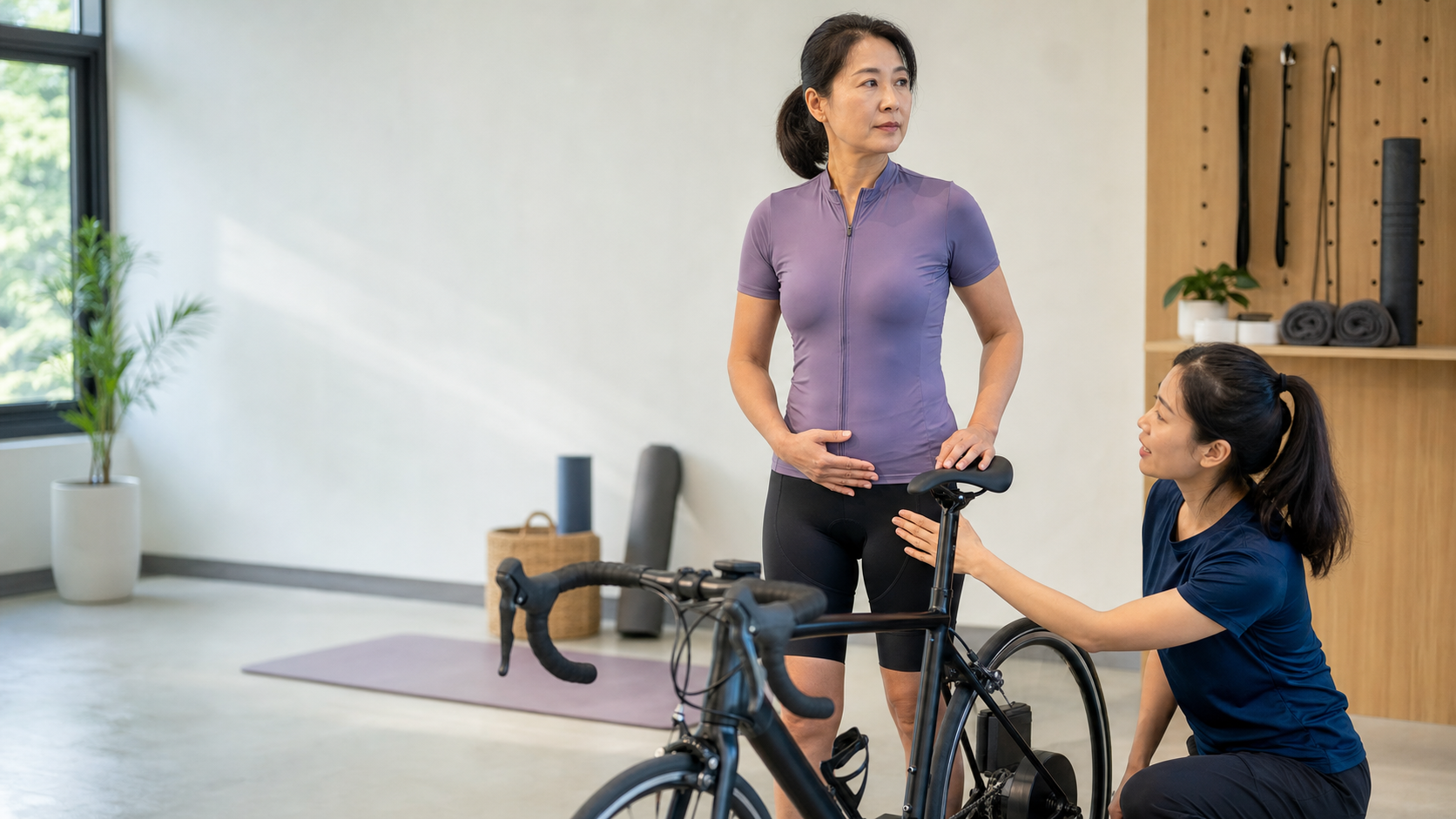
Starting with a Student Who Was Afraid to Jump Rope
I once coached a female student in her early forties—let’s call her Sister A. She was the kind of student you’d want more of in a group class: punctual, diligent, never complaining. But one day, during a circuit of jumping jacks and burpees, I noticed she’d subtly brace herself on every landing, her movements getting smaller, and she’d switch to marching in place halfway through. During a break, I asked her privately. She blushed, hesitated for a long time, and finally said: “Coach, I leak urine every time I jump, especially when I cough or laugh. It’s been like this since my second child was born. I thought it was normal.”
That phrase, “I thought it was normal,” I’ve heard too many times over the past fifteen years. Runners leaking during a sprint to the half-marathon finish line, lifters leaking on their heaviest deadlift rep, cyclists feeling numbness in the crotch after long rides, women around menopause leaking from a simple sneeze—everyone silently endures it, thinking it’s age, childbirth, “a woman’s fate,” or feeling too ashamed to see a doctor.
I want to put the most important sentence right up front: Leaking urine during exercise is common, but “common” doesn’t equal “normal,” and it certainly doesn’t mean “you just have to endure it.” The pelvic floor is a group of muscles that can be trained, just like you can train your biceps or glutes. And the level of evidence is quite high—this isn’t just my personal experience; it’s a conclusion supported by systematic literature. Today, I want to explain this “chassis project”—the pelvic floor—from start to finish, in the same way I’d talk to my students.
Let me clarify the positioning first: This article is educational content to help you understand and self-care, but it cannot replace individual diagnosis and treatment advice from a physician, physical therapist, or nutritionist. If symptoms are severe or accompanied by pain, blood in urine, or sudden worsening, please seek medical attention.
Foundational Concepts: What the Pelvic Floor Actually Is and Does
A Hammock Supporting Your Entire Core
Imagine your pelvis is a bowl. The bottom of the bowl isn’t hard bone, but a “hammock” woven from muscles and fascia, stretching from the pubic bone to the tailbone, attaching to the sit bones on both sides. This hammock is the pelvic floor muscle group, primarily comprising the levator ani (including the puborectalis, pubococcygeus, and iliococcygeus muscles) and the coccygeus muscle.
Every day, it quietly does four major jobs:
- Support: Holds up the bladder, uterus (in women), rectum, and other pelvic organs, keeping them from dropping.
- Sphincteric: Helps control the opening and closing of the urethra and anus, allowing you to hold urine, hold in gas, and control urgent bowel movements.
- Stability: It’s the “floor” of the core, working with the diaphragm (ceiling), transversus abdominis, and multifidus (the four walls) to form an intra-abdominal pressure container. Every squat, deadlift, or time you pick up a child, this container is working.
- Sexual & Circulation: Participates in sexual response and assists venous return from the pelvis.
Why Athletes Should Pay Even More Attention to It
Here’s a key point many people don’t realize: The pelvic floor doesn’t only have problems when it’s “too weak”—it also has problems when it’s “too tight, can’t relax, or doesn’t coordinate with breathing.”
Every time you exert force—lifting weights, jumping, landing from a run, or even straining during a bowel movement—the pressure inside your abdominal cavity (intra-abdominal pressure) spikes instantly, pushing downward toward the pelvic floor. Ideally, the diaphragm, abdominal muscles, and pelvic floor work as a team, contracting together at the moment of exertion, containing the pressure, and then releasing it smoothly. But if this team doesn’t coordinate well, the pressure “leaks” out—leaking downward means urinary incontinence or prolapse; leaking forward may be related to diastasis recti or hernias.
So the core of pelvic floor health isn’t “squeeze as hard as you can,” but rather contracting with the right force at the right time, and being able to fully relax. I’ll emphasize this repeatedly later, because it’s where most people go wrong.
Incontinence and Pelvic Floor Dysfunction: Know Your Opponent
Let’s first clarify the common conditions, because “treatment” must match “type”:
| Type | Typical Scenario | Main Mechanism | Response to Exercise Therapy |
|---|---|---|---|
| Stress Urinary Incontinence (SUI) | Leaking when coughing, sneezing, laughing, jumping, lifting heavy objects | Sudden increase in abdominal pressure, insufficient urethral closure force | Best response, pelvic floor training is first-line |
| Urge Urinary Incontinence (UUI) | Sudden strong urge to urinate, leaking before reaching the toilet | Overactive bladder | Training + bladder behavior therapy, moderate response |
| Mixed (MUI) | Both of the above | Both mechanisms present | Training helps, needs individualization |
| Pelvic Organ Prolapse | Feeling of heaviness, sensation of a bulge in the vagina | Relaxation of supporting structures | Mild cases can improve with training; severe cases need medical evaluation |
According to a Cochrane systematic review (covering 31 trials, approximately 1,817 women), pelvic floor muscle training (PFMT) has high-quality evidence supporting its curative effect on stress urinary incontinence and is recommended as first-line conservative treatment. In plain language: for the type that “leaks when you exert force,” properly training the pelvic floor is an evidence-based approach that should be tried first, rather than jumping straight to medication or surgery.
This is also the sense of hope I most want to convey: Most stress incontinence is a “training problem,” not a “broken” problem.
Men Have Pelvic Floors Too—Don’t Think It’s Not Your Concern
Many male readers might think this is “a women’s issue.” Wrong. Men have the same complete pelvic floor muscle group. After prostate surgery, with chronic cough, prolonged sitting, straining from constipation, and in those doing high-volume, high-intensity training, pelvic floor dysfunction can occur, manifesting as dribbling, perineal pain, dull ache around the sit bones, or even sexual dysfunction. Perineal compression issues in cyclists are also not gender-specific (I’ll cover this in a dedicated section below).
I once worked with a male cyclist in his fifties—let’s call him Brother B—a veteran who routinely rode over a hundred kilometers on weekends. He didn’t come to me about leaking, but complained of “interrupted urination and a dull perineal ache after riding,” even suspecting prostate problems. He first went to a urologist to rule out organic issues, then came back and we examined his riding posture and pelvic floor together. We found he’d been riding for years in a low, forward-leaning position with the saddle nose tilted up pressing into his perineum, plus a habit of breath-holding when bracing his core, leaving his pelvic floor in a state of “chronically tight but unable to relax.” After adjusting the saddle and learning relaxation and breathing coordination, the dull ache improved significantly within a few weeks. Brother B’s story reminds me: Men’s pelvic floor issues are often mistaken for prostate problems or “aging,” when many are actually addressable through posture and muscle coordination.
Two Life Stages Often Overlooked: Postpartum and Menopause
Postpartum is the time when the pelvic floor needs the gentlest care. During pregnancy, the pelvic floor bears months of weight and hormonal relaxation effects; vaginal delivery further stretches it, making postpartum leaking and a feeling of heaviness quite common. My principle is: Don’t rush back to high-impact training after childbirth. Start with gentle breathing coordination and low-intensity pelvic floor awakening. After lochia has cleared, the body has recovered, and ideally after professional assessment (many hospitals and clinics in Taiwan offer postpartum pelvic floor rehabilitation), then gradually add back running, jumping, and weights. Returning to high-impact activity too early and too aggressively is the most common cause I’ve seen of postpartum leaking becoming a long-term problem.
Around menopause, declining estrogen thins the urogenital tissues and reduces elasticity. Many women first experience or see worsening of leaking during this stage. Pelvic floor training remains effective, but requires more patience and consistency. If accompanied by significant urinary tract dryness, recurrent infections, or severe symptoms, individualized evaluation and management by an OB/GYN is important—don’t tough it out alone.
Practical Method One: Doing Kegels Correctly (Most People Actually Do Them Wrong)
First, Learn to “Find” the Muscle
Everyone has heard of Kegel exercises, but in my actual coaching experience, seven or eight out of ten people get them wrong at first. The most common mistakes: holding your breath, clenching your glutes, sucking in your belly, squeezing your thighs, and turning red in the face—these are all “compensations,” and the actual pelvic floor barely moves.
Some cues to help you find the right muscles (for self-awareness, not for practicing while urinating):
- Imagine you’re holding in gas. That feeling of drawing inward and upward is the posterior pelvic floor.
- Women can imagine gently holding and lifting a small blueberry with the vagina; men can imagine shortening the base of the penis toward the belly and slightly lifting the testicles.
- During contraction, your glutes, thighs, and abdomen should barely move, and you should keep breathing without holding your breath. Place a hand on your belly to check—your belly shouldn’t bulge or strain when you contract the pelvic floor.
If you simply can’t find it, or if contracting causes pain, that’s a good signal to see a doctor—in Taiwan, OB/GYN, urology, and rehabilitation departments all have specialized pelvic floor physical therapy. Some facilities offer “biofeedback” devices that show your contraction strength on a screen in real time, which is very helpful for people who “practice but feel nothing.”
Train Both Types of Contractions: Slow-Twitch and Fast-Twitch
The pelvic floor contains both endurance (slow-twitch) and explosive (fast-twitch) fibers, so training should cover both:
- Long contractions (endurance): Contract and hold for as long as you can maintain steadily (e.g., 3–5 seconds), gradually working up to 8–10 seconds. After each contraction, fully relax for an equal amount of time. Relaxation is just as important as contraction.
- Quick contractions (reaction): Contract forcefully and release immediately, training your ability to “react in time”—which is exactly what you need in the instant of a cough or sneeze.
A Four-Week Beginner Program You Can Follow
Here’s a progressive program I often give beginners, done 3 times a day (morning, noon, evening—one set each, easy to fit into daily life). Treat it as a starting point and adjust based on your actual ability—stop at mild fatigue; if you’re sore in the lower abdomen or perineum the next day, you’ve overdone it.
| Week | Long Contractions (hold seconds × reps) | Quick Contractions (reps) | Daily Sets | Notes |
|---|---|---|---|---|
| Week 1 | 3 sec × 8 reps, 3 sec contract/relax | 8 quick reps | 3 sets | Focus on “finding and doing it correctly,” not on duration |
| Week 2 | 5 sec × 8 reps | 10 quick reps | 3 sets | Start increasing hold time |
| Week 3 | 6–8 sec × 10 reps | 10 quick reps | 3 sets | Try different positions (lying → sitting → standing) |
| Week 4 | 8–10 sec × 10 reps | 12 quick reps | 3 sets | Add “functional” scenarios (see below) |
Most literature and clinical experience indicate that pelvic floor training typically requires consistent practice for at least 6 to 12 weeks before noticeable results appear. It’s like training any muscle—it takes time, so don’t give up after two or three days without feeling anything. This is a project that requires patience.
Progressing from “Static Practice” to “Functional Use”
Being able to squeeze hard while lying down doesn’t mean you can use it when running or jumping. The real goal is for the pelvic floor to react automatically and promptly in daily life and athletic situations. Advanced approaches:
- The Knack (pre-contraction technique): Actively pre-contract the pelvic floor before coughing, sneezing, lifting heavy objects, or standing up, then exert force. This is the most practical technique for stress incontinence—many people see dramatic improvement in daily leaking just from learning this one skill.
- Position progression: Practice contracting and relaxing while lying → sitting → standing → squatting → lunging. Difficulty increases with each position.
- Integrate with breathing: Learn to “exert on exhale and lift the pelvic floor with the breath,” tying it into the rhythm of your squats and deadlifts.
A “Symptoms vs. How to Train” Reference Chart
Many people get stuck on “should I train contraction or relaxation?” This chart organizes the first-step direction for common scenarios (for understanding only; individual assessment is still recommended):
| Your Main Concern | Likely Direction | First Step | Special Reminder |
|---|---|---|---|
| Leaking when coughing/jumping, no pain | Strength/coordination insufficiency | Train contractions + The Knack | Usually best response |
| Sudden urgency, can’t make it in time | Overactive bladder | Training + urge suppression/delayed voiding behavior therapy | Reduce caffeine, urinate on a schedule |
| Persistent pelvic/perineal pain, pain with intercourse | Possibly over-tight | See a doctor first, learn relaxation, not contraction | Random Kegels may make it worse |
| Noticeable heaviness or bulge sensation | Relaxed supporting structures | Get medical evaluation for prolapse severity | Don’t do high-impact training on your own if severe |
| Difficulty with bowel movements, frequent straining | Coordination/constipation issues | Address constipation first, learn relaxed defecation | Fiber + water + don’t hold it in |
Caffeine, Hydration, and the Bladder: Everyday Considerations for People in Taiwan
Taiwan’s bubble tea and coffee culture means many people consume a fair amount of caffeine daily. Caffeine and some sugary or carbonated drinks can irritate the bladder, making urgency more pronounced. If you have urge or mixed incontinence, try reducing caffeine and observe for two weeks—you’ll often notice a difference. Another common misconception is “drink less water to avoid leaking”—this actually concentrates the urine, further irritating the bladder, and can also lead to constipation. The right approach is regular, moderate hydration, not deliberate dehydration. Taiwan’s summers are hot and humid with heavy sweating, so athletes especially need to pay attention to hydration and electrolyte balance—dehydration itself affects focus and performance.
Practical Method Two: Integrating Breathing, Core, and Overall Training
Stop “Sucking in Your Belly” So Hard
Many people, when they hear “train your core,” immediately suck in their belly and hold their breath. This isn’t friendly to the pelvic floor. Chronically pushing intra-abdominal pressure downward without releasing it can actually worsen prolapse and leaking.
I much prefer coordinating “diaphragmatic breathing (belly breathing)” with the pelvic floor:
- On inhalation, the diaphragm descends, the belly and ribcage expand naturally, and the pelvic floor also slightly descends and relaxes.
- On exhalation, the diaphragm rises, and the transversus abdominis and pelvic floor naturally and gently contract and lift together.
This “breathing–pelvic floor” rhythm turns Kegels from an isolated exercise into a system that silently operates within all your movements. You can apply a simple principle in weight training: “Exhale with effort, lightly contract the pelvic floor”—for example, on the way up from a squat or the pull of a deadlift, coordinate exhalation with a light pelvic floor contraction.
Don’t Neglect the Glutes and Hips
Clinically, I see many people with pelvic floor issues who also have weak glutes and poor hip mobility. The pelvic floor isn’t an island; it’s closely related to the gluteus maximus, deep hip rotators, and adductors. Getting good at glute bridges, clamshells, squats, and hip hinges often improves pelvic floor function as well. A strong butt is a good neighbor to the pelvic floor.
A Sample Week Integrating the Pelvic Floor into Your Training
Many people ask me: “I already have running, lifting, and cycling scheduled. Adding pelvic floor training on top feels exhausting, right?” Actually, you don’t need to treat it as a separate program—instead, weave it into your existing week. Here’s a sample for someone with “mild symptoms who wants to train and improve simultaneously” (adjust intensity based on your condition):
| Day | Main Training | Pelvic Floor Integration Focus |
|---|---|---|
| Monday | Lower body lifting (squats, deadlifts) | “Exhale + lightly contract pelvic floor” on each rise; 2 quick contractions between sets |
| Tuesday | Easy ride or rest | 1 set of long contractions while commuting/sitting; check saddle pressure |
| Wednesday | Jog or intervals | Pre-contract before starting (The Knack); 1 set of relaxation breathing after |
| Thursday | Upper body/core | Breathing coordination practice, focusing on “full relaxation” |
| Friday | Rest/stretching | Hip stretching + pelvic floor relaxation, no forceful contractions |
| Saturday | Long ride | Stand off the saddle every 15–20 minutes; check for numbness afterward |
| Sunday | Complete rest | 1 set of long contractions lying down before bed, with full contract/relax |
The philosophy of this arrangement: Contraction days and relaxation days coexist, and functional contractions are tied into movements—not squeezing hard every day. Overtraining the pelvic floor, like overtraining any muscle, leads to fatigue, tightness, and can actually make things worse. Less is more; consistency is what matters.
A Bit of Physiology: Why “Coordination” Matters More Than “Force”
Pelvic floor strength certainly matters, but its true value lies in timing. A healthy pelvic floor automatically contracts first, in that instant when abdominal pressure rises, lifting and supporting the urethra upward and forward to maintain closure. This is a reflex that barely requires conscious thought. The problem in stress incontinence often isn’t “absolute strength is too low,” but rather this reflex has become slow, weak, or out of sync with breathing and exertion. This also explains why The Knack (active pre-contraction) is so effective—it’s essentially “manually compensating” for that slowed reflex, and through repeated practice, teaching the body to re-automate it. So when you train your pelvic floor, remember the goal isn’t “squeeze out maximum force,” but “react smoothly at the right time, then fully let go.” Once this concept is internalized, you’ll find your training efficiency is completely different.
Special Section for Cyclists: Saddles, Perineum, and Numbness
This is especially important in our cycling-focused community, so it gets its own section.
During long rides, your body weight presses on the perineum, an area rich in nerves and blood vessels. Research indicates that low handlebar positions and a large forward trunk lean increase perineal pressure and reduce sensation and blood flow in the area; prolonged riding, infrequent position changes, and higher body weight are also risk factors. Symptoms include numbness, tingling, and temporary loss of sensation in the crotch; long-term, this may be related to compression of the pudendal nerve and impaired circulation. For female cyclists, traditional saddles can also affect blood flow to the external genitalia.
This doesn’t mean “cycling damages the pelvic floor, so don’t ride.” Exercise itself is extremely beneficial for overall health and weight management—the key is managing the pressure. Practical advice for cyclists:
| Adjustment | Specific Action | Purpose |
|---|---|---|
| Saddle choice | Choose a saddle with a central cut-out or no-nose design, width matching your sit bone spacing | Shift pressure from perineal soft tissue back to the sit bones |
| Saddle angle | Nose slightly down or level, avoid tilting up into the perineum | Reduce pressure on the anterior perineum |
| Handlebar height | Raise appropriately, reduce excessive forward lean | Lower perineal pressure, improve sensation and blood flow |
| Dynamic riding | On long rides, stand off the saddle for a few seconds every 15–20 minutes, change hand positions | Restore blood flow, avoid sustained compression |
| Professional fitting | Get a professional bike fit | Address root causes individually |
If you experience numbness or pain that persists for hours or even days after a ride, that’s a clear signal to see a doctor—don’t tough it out.
Common Mistakes and Corrections: The Eight Things I Correct Most Often
- Holding your breath and squeezing hard. Fix: Keep breathing throughout; lightly contract on the exhale.
- Only training contraction, never relaxation. Fix: Relaxation time should be at least equal to contraction time; train the ability to “fully let go.”
- Practicing while urinating as a daily routine. That’s only a one-time “find the muscle” test; doing it regularly can interfere with normal voiding reflexes. Don’t make it a program.
- Aggressively increasing volume, wanting quick results. The pelvic floor is muscle; overuse causes fatigue, tightness, and can even make leaking worse. Prefer small amounts, frequent sessions, steady progress.
- Only training statically, not functionally. Fix: You must progress to standing, squatting, and jumping scenarios, plus The Knack.
- Assuming “it must be too weak.” A subset of people have a pelvic floor that is “over-tight and can’t relax (high-tone).” The more they do Kegels, the worse it gets; these people actually need to learn relaxation and stretching. If you have pelvic pain, pain with intercourse, or difficulty urinating/defecating, get evaluated first before deciding whether to train contractions.
- Ignoring constipation. In Taiwan, with lots of eating out, fruit/vegetable and water intake is often insufficient. Chronic straining from constipation is a chronic insult to the pelvic floor. More fiber, adequate water, and regular bowel habits are severely underrated pelvic floor maintenance.
- Giving up after two weeks with no results. Fix: Give it 6–12 weeks, and track leaking episodes as an objective progress indicator.
Frequently Asked Questions (FAQ): Questions My Students Ask Me Most
Q1: How long until Kegels show results?
It’s like training any muscle—it requires consistency and patience. Most people need 6 to 12 weeks of regular practice before noticing clear changes; some take longer. The key is “consistency” and “doing it correctly,” not having one particularly intense day. I recommend using “leaking episodes per week” as an objective indicator rather than relying on feeling alone.
Q2: Can I practice while urinating?
That’s only for a one-time “confirmation that you’ve found the muscle”—don’t make it a daily routine. Repeatedly interrupting urine flow can interfere with normal voiding reflexes and be counterproductive. Once you’ve found the sensation, practice outside of urination.
Q3: Are vaginal cones, electrical stimulation, and biofeedback devices on the market useful?
These are adjunct tools. Biofeedback (real-time display of contraction strength on a screen) is especially helpful for people who “practice but feel nothing,” and is typically used under professional guidance in medical facilities. As for home devices you buy yourself, results vary by individual. I recommend getting a professional assessment first to confirm you’re suitable, especially if you have pelvic pain or prolapse—be cautious.
Q4: Can I continue lifting and cycling?
Yes, and exercise is very important for overall health. The key is to train the “breathing–pelvic floor coordination” well, avoid chronic breath-holding and straining, and manage saddle pressure on the bike. If you have noticeable symptoms, reduce impact first, build the foundation, then gradually add intensity back.
Q5: I only leak during exercise, not in daily life. Do I need to address it?
Yes. “Leaking only during jumping, sprinting, or heavy lifting” is a classic early sign of stress incontinence, and intervention at this stage usually works best. If left alone, with age, childbirth, and menopause, it often expands into daily situations. Training early is the most cost-effective investment.
Q6: Could this actually be something else?
It’s possible. Blood in urine, fever, severe pain, sudden major worsening, obvious prolapse/heaviness, or complete difficulty urinating are not in the “just train it away” category. Please see a doctor to rule out infection, stones, neurological, or other issues. The self-care advice in this article is for general concerns where serious problems have already been ruled out.
Action Recommendations for Readers at Different Levels
If You Have No Symptoms and Want Prevention/Maintenance
- Make “breathing–pelvic floor” coordination a habit; lightly contract on exhale during lifting—no need for a separate heavy Kegel program.
- Take care of bowel habits (fiber, water), manage weight, and don’t ignore chronic coughs.
- Cyclists: get your saddle and fit right, and stand off the saddle on long rides.
If You Have Occasional Leaking or Mild Symptoms
- Start with the four-week beginner program above, focusing on doing it correctly and The Knack.
- Use your phone to track “leaking episodes per week” and compare after six weeks.
- Reduce the volume or impact of high-impact training (jump rope, burpees, running landings) until the pelvic floor catches up, then add back. In Taiwan’s hot, humid summers, an air-conditioned gym or early morning/evening sessions are good practice times—avoid dehydration affecting bladder sensitivity.
If Symptoms Are Significant and Affect Daily Life
- See a doctor first. Under Taiwan’s National Health Insurance, OB/GYN, urology, and rehabilitation departments can all evaluate you; some hospitals offer pelvic floor physical therapy and biofeedback. This isn’t shameful—it’s a mature, well-established medical service.
- Let a professional determine whether you’re “too weak” or “too tight,” to avoid making things worse by training blindly.
- If accompanied by pain, blood in urine, sudden worsening, or a noticeable heaviness/prolapse sensation, seek medical attention promptly to rule out other conditions.
Special Note: If You Have a Chronic Condition
If you have diabetes, hypertension, heart disease, or neurological conditions, these can affect urinary function and exercise safety. Any new exercise program should be discussed with your physician first and individualized—the general principles in this article cannot replace your medical team’s advice. Medications (e.g., certain diuretics, blood pressure drugs) can also affect urination; these should be evaluated by your doctor. Never stop or adjust medication on your own.
How to Know If You’re Improving: Three Objective Methods
The worst thing in training is “going by feel.” Feelings can deceive, especially with an invisible muscle like the pelvic floor. I ask students to track progress with these three objective methods, reviewing every six weeks:
- Voiding/leak diary. Record for 3 consecutive days: when you drink, how much, how many times you urinate, how many leaks, and in what situations (cough? jump? sudden urge?). This diary not only shows progress but also helps you and your doctor determine which type of leaking you have—I consider it the highest value-for-effort tool.
- Situation test. Pick a movement where you consistently leak (e.g., 20 consecutive jump ropes, or three hard coughs). Test it every two weeks under the same conditions, recording whether you leak and how much. Conditions must be consistent (similar bladder fullness, same movement) for comparison to be meaningful.
- Contraction seconds and reps. Record the “long contraction hold time” you can maintain steadily and the number of “consecutive correct quick contractions.” This reflects strength and endurance progress. But remember, seconds aren’t the only goal—whether you can “use it in daily life” matters more.
Another benefit of writing these down: on days when you feel like “nothing’s improving, I want to quit,” flipping back to your diary from six weeks ago often shows you’ve actually come a long way. Pelvic floor training progress is quiet, slow, and cumulative—the numbers will remember the changes you can’t feel yourself.
Debunking Several Widely Circulated Myths
- Myth 1: “Just keep squeezing and it’ll get better.” Wrong. Over-contraction without relaxation can actually create over-tight pelvic floor problems. Relaxation is as important as contraction.
- Myth 2: “This is a women’s issue; only women who’ve had children get it.” Wrong. Men, those who haven’t given birth, and athletes can all have pelvic floor dysfunction. Stress incontinence rates are actually not low among high-impact athletes (e.g., gymnastics, jumping sports).
- Myth 3: “Leaking is aging; you just have to accept it.” Wrong. Age is a risk factor, yes, but abundant evidence shows conservative training can improve symptoms. Many older adults see significant quality-of-life improvements after training.
- Myth 4: “Surgery is fastest; no need to train.” Surgery has its indications and role, but pelvic floor training is recommended as first-line conservative treatment for stress incontinence and should generally be tried first. Whether surgery is needed is an individual decision for your doctor.
A Daily Integration Checklist (Stick It on the Fridge)
- Do a small set of pelvic floor contractions/relaxations morning, noon, and evening (can be done at red lights, brushing teeth, or commuting—no one will notice).
- Pre-contract (The Knack) before coughing, sneezing, or lifting heavy objects.
- On the exhale during lifting, lightly contract the pelvic floor.
- Get enough water and fiber daily; don’t hold in bowel movements or strain for long periods.
- On long rides, stand off the saddle and change hand positions every 15–20 minutes.
- Record leaking episodes once a week; review progress after six weeks.
- Pain, blood in urine, persistent numbness, or prolapse sensation—see a doctor.
Conclusion: Turning “Hard to Talk About” into “Trainable”
Back to Sister A from the beginning. I didn’t give her any magic tricks—I just taught her to find the muscle, learn The Knack, tie Kegels into her breathing, and asked her to get a rehabilitation assessment first to confirm the direction. About two months later, she told me: “Coach, I did jump rope last week without leaking.” That smile meant more to me than any PR (personal record).
The pelvic floor is the body’s most silent muscle group. It supports your core and your daily dignity, yet almost never takes credit. I sincerely hope this article helps you understand two things: First, leaking during exercise is common, but it can be improved—you don’t have to silently endure it. Second, the method matters—not squeezing desperately, but using the right force at the right time, and learning to relax.
If you’re struggling with this, start today by “finding that muscle,” and don’t be afraid to walk into a clinic. Your chassis deserves to be well cared for.
Important Statement: This article is educational content and cannot replace individual diagnosis and treatment advice from a physician, physical therapist, or nutritionist. If you have pelvic pain, blood in urine, sudden worsening of symptoms, or a chronic condition, please seek professional medical evaluation and individualized guidance.
References
- Pelvic floor muscle training versus no treatment, or inactive control treatments, for urinary incontinence in women: a Cochrane systematic review (PMC abstract version): https://pmc.ncbi.nlm.nih.gov/articles/PMC6428911/
- Pelvic floor muscle training versus no treatment… a short version Cochrane systematic review with meta-analysis (PubMed): https://pubmed.ncbi.nlm.nih.gov/25408383/
- Saddle Pressures Factors in Road and Off-Road Cyclists of Both Genders: A Narrative Review (PMC): https://pmc.ncbi.nlm.nih.gov/articles/PMC10299674/
- Strategies for Reducing the Impact of Cycling on the Perineum in Healthy Males: Systematic Review and Meta-analysis (PMC): https://pmc.ncbi.nlm.nih.gov/articles/PMC7846539/
- Self-Assessment of Lower Urinary Tract Condition in Female Competitive Cyclists (PMC): https://www.ncbi.nlm.nih.gov/pmc/articles/PMC11202815/
Related Reading
- Pelvic Floor Pressure in Running: Urinary Leakage Issues and Intervention Research for Female Runners
- Urinary Issues in Female Runners: Pelvic Floor Muscle Training for Leaking During Running
- Postpartum Exercise Recovery Guide: From Pelvic Floor to Returning to the Track, Step by Step Reclaiming Your Body
- Complete Guide to Hip and Pelvic Health: Mobility, Stability, and Pain—The Core Foundation for Athletes
Never Stop 西進武嶺 前後雙機 完整全程錄影 訓練台 實境
8 年前
一日北高常見問題大集合 | 攻略 | 路線 | 訓練 | 補給 | 自行車 單車 | 一日雙城 | 雙塔 | TWB北高360 | 屁股痛
6 年前
[教學] Premiere 影片 手震 修正 教學 防抖 單眼 影像 GoPro 穩定 Video Stabilization
8 年前
一日北高/長距離團騎 常見問題補充篇 / 組團或跟團的眉角 / 壯車友容易被瘦車友慢性拉爆 / 原來屁股痛可能是這個原因...? / 風場配速法 / 公路車 / CT Yeh
2 年前
靠單車減肥35公斤 心得分享與整理
7 年前
摔車後補裝備: 好市多新款單車安全帽& Specialized Romin 北高整路屁股都不痛的坐墊 | 一千元居然有MIPS | CT Yeh | 公路車
4 年前
滑雪新手們慘摔學習全紀錄(請開字幕),滑雪好好玩 | Snowboard + Ski | 岩原 スキー場 | 滑雪APP使用 | GoPro Max
6 年前
單車 重低音 藍芽喇叭 音質實測 SoundBot SB525 Real Sound Test
8 年前