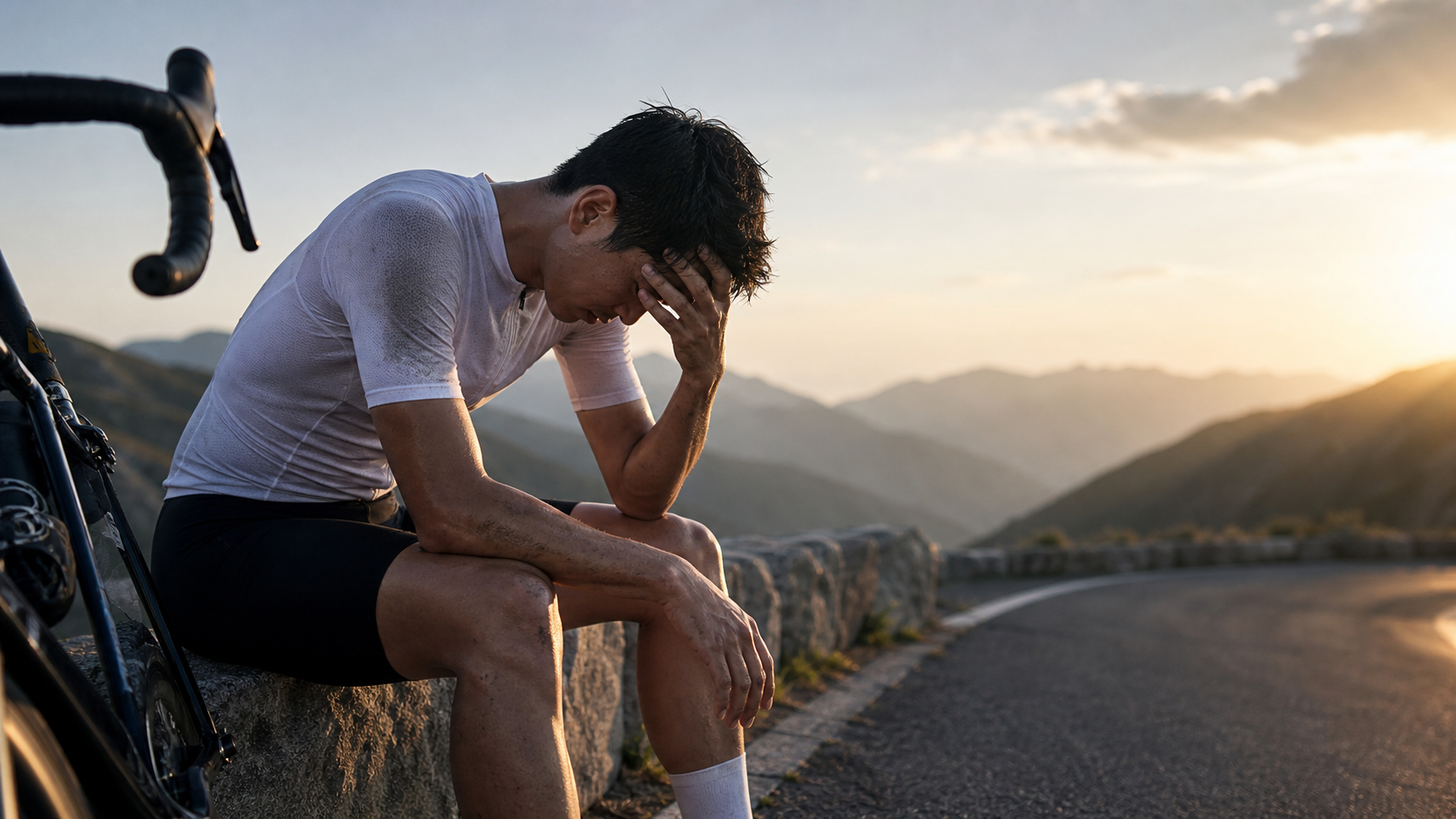
Opening: The Athlete Who Cried at the Summit of Wuling
In my 15 years of coaching athletes, the moment that left the deepest impression wasn’t a record broken. It was an athlete who, after finishing the western ascent of Wuling, hugged his bike computer at the finish line and cried so hard he couldn’t speak. Everyone around him assumed they were tears of joy, of achieving a goal. Only I knew they were emotions that had been dammed up for eight full months, finally bursting through.
He was an engineer working in the Hsinchu Science Park, 35 years old, pouring almost all his after-work time into training. I monitored his power, his weight, his climbing data closely, and the progress was impressive—FTP up from 210 watts to 265 watts, weight down from 78 kg to 71 kg. But I missed one thing: during those eight months, he wasn’t sleeping well, barely spoke to his wife, and had started to hate every ride. Yet he didn’t dare tell anyone, because “I’ve invested so much, how can I complain about being tired?”
Those tears at the finish line were actually a delayed distress signal. Since then, my definition of “training an athlete” has completely changed. The body is the part we can most easily quantify and boast about; but what truly determines whether someone can stay in this sport long-term and find joy in it is often that invisible, least-talked-about element—mental health.
In this article, I want to seriously discuss the psychological challenges athletes face, why seeking help is so difficult, and what we can do before things get worse. Whether you’re a competitor aiming for the podium or a casual rider on the riverside paths on weekends, this content is relevant to you.
1. Debunking a Myth First: Athletes Are Not a Psychologically Superior Group
Many people assume that athletes who can handle high-intensity training and perform under competition pressure must have exceptional mental toughness and resilience. This is a dangerous misconception.
According to the International Olympic Committee (IOC) consensus statement on athlete mental health published in 2019, and multiple large systematic reviews, elite athletes face roughly the same risk of common mental disorders like anxiety and depression as the general population, and in some situations, the risk is even higher. In other words, athletes are not immune to psychological issues because of their physical strength; on the contrary, they operate in an environment filled with unique stressors.
Here are some approximate figures compiled from the literature worth remembering (ranges are given as they vary by study population and methodology):
- Across multiple studies, the proportion of athletes meeting clinical cut-offs for anxiety and/or depression is around 20 percent.
- The rate of psychological distress among male and female athletes is approximately 17 percent.
- Gender differences are significant: female athletes self-report higher levels of anxiety and depression than males; simultaneously, women are also more willing to seek help proactively.
- A meta-analysis of retired elite athletes even indicated that at certain points after retirement, the prevalence of anxiety and depression could be more than double that of the general population.
This last point is particularly important and most often overlooked: the end of a sports career, being forced to stop training due to injury, or the period when one’s identity is stripped away from being an “athlete,” is often when psychological vulnerability peaks. I’ve seen too many people who held up fine during competition, only to completely fall apart after hanging up their number plate or suffering a major injury.
Key reminder: If even the most physically fit group isn’t immune to mental health issues, then the mindset of “I’m strong enough, I don’t need to worry about this” is itself a risk factor.
2. Unique Psychological Stressors for Athletes: It’s Not “Overthinking,” It’s Genuinely Hard
Athletes face the same pressures as everyone else—work, family, finances, relationships. But on top of that, they carry several additional layers of weight that only those inside the circle truly understand. I’ve compiled the stressors I’ve observed over the years into a table. You can check how many apply to you.
Table 1: Common Psychological Stressors and Typical Manifestations in Athletes
| Stressor Category | Specific Situations | Common Psychological/Behavioral Manifestations |
|---|---|---|
| Performance Pressure | Race results, rankings, PRs, coach and sponsor expectations | Pre-race insomnia, excessive nervousness, fear of failure so strong they avoid signing up |
| Identity | “I = my athletic performance,” not knowing who they are without it | Intense loss, emptiness, depression after injury or retirement |
| Injury and Rehabilitation | Fractures, tendinitis, overtraining syndrome, slow recovery | Anxiety, irritability, loss of confidence in recovery, secretly returning to training early |
| Overtraining and Imbalance | Training volume chronically exceeding recovery, sleep and life squeezed | Chronic fatigue, low motivation, aversion to training |
| Social Media and Comparison | Constantly comparing against others’ data, mileage, medals | Declining self-worth, more training leads to more anxiety, more comparison leads to less happiness |
| Help-Seeking Stigma | “Speaking up means weakness,” “Will my coach think I’m not good enough?” | Enduring silently, toughing it out alone, suppressing the problem until it explodes |
| Life Transitions | Advancing in school, changing jobs, having children, family caregiving | Guilt over squeezed time, being pulled between training and life |
I often show this table to my athletes because it has a very therapeutic effect: it lets people know “these aren’t just my problems alone.” When an anxious person realizes their situation can be named, categorized, and understood, that sense of isolation loosens by half.
A Closer Look at “Athletic Identity”
In Taiwan, I’ve met many people who came from sports-focused classes or school teams since their student days. From their teenage years, their life’s coordinate axis has been almost singular: how well they perform. When that axis breaks due to injury, being cut, or simply age, they experience a profound collapse of “who am I.”
The average office worker’s identity is usually more multifaceted—you’re an engineer, a father, a member of a club, someone who plays guitar. But highly committed athletes tend to put all their eggs in the “athlete” basket. When that basket breaks, everything shatters.
So now when I coach athletes, especially the very driven ones, I deliberately remind them: outside of sport, please preserve a part of yourself. This isn’t telling you not to be serious; it’s buying psychological insurance for your future self.
3. The Scientific Foundation: What’s Actually Happening with Stress, Recovery, and the Brain
To understand why overtraining harms not just the body but also the mind, we need to look at a core concept: the stress-recovery balance.
Training is essentially “planned stress.” You give the body a stimulus (training load), and the body becomes stronger during recovery (supercompensation). This logic holds physiologically, and it holds psychologically too—appropriate challenges help people grow, provide a sense of accomplishment, and improve mood. Exercise is indeed an excellent natural antidepressant; there’s no doubt about that.
But the problem lies in “dosage.” When stress (training + life + emotions) chronically exceeds the capacity for recovery (sleep + nutrition + mental rest), the balance tips toward breakdown. At that point, the body sends a series of signals:
- Resting heart rate abnormally elevated or depressed (e.g., usual morning pulse of 52 bpm, suddenly above 60 bpm for several days)
- Heart rate variability (HRV) continuously declining
- Poorer sleep quality, waking up more tired
- Perceived exertion (RPE) noticeably higher for the same training
- Low mood, irritability, loss of motivation
Here’s a key concept: psychological symptoms and physiological fatigue are often two sides of the same coin. In Overtraining Syndrome, low mood, loss of motivation, and irritability are core symptoms. So when an athlete tells me, “I just don’t want to train lately, I’m annoyed just looking at my bike,” I don’t rush to scold them for being lazy. Instead, I ask: How have you been sleeping? Anything going on in your life?—because this is often the body and mind simultaneously signaling “I need rest.”
Table 2: Healthy Fatigue vs. Warning Signs of Overtraining/Low Mood
| Observation Aspect | Normal Training Fatigue (self-resolving) | Needs Vigilance, Possibly Adjustment or Help |
|---|---|---|
| Duration | A few days, improves with rest | No improvement after more than two weeks, or worsening |
| Motivation | Wants to train after adequate rest | Completely unmotivated for things once loved |
| Mood | Occasionally irritable, generally stable | Persistently low, helpless, easily tearful or irritable |
| Sleep | Occasional poor sleep | Chronic insomnia or hypersomnia, waking up more tired |
| Appetite | Generally normal | Significant changes, binge eating or loss of appetite |
| Daily Functioning | Work and relationships normal | Impacts work, relationships, daily functioning |
| Thoughts | Still has expectations for the future | Thoughts of “I wish I could just disappear” or “they’d be better off without me” |
Please take that last row seriously. If you or someone around you has any thoughts of self-harm or not wanting to live, this is not a matter of “willpower”—it’s a signal that professional help is needed immediately. In Taiwan, you can call the Ministry of Health and Welfare’s安心專線 (Comfort Line) at 1925 (still love me), or 1995 (Life Line). These are 24-hour, free, and confidential resources.
4. Practical Methods: Daily Mental Health Maintenance
Now that we’ve covered the concepts, let’s get to the most practical part—as a coach, what I actually do with my athletes to prevent mental health problems. These methods don’t require you to be a professional athlete; recreational enthusiasts can absolutely use them.
4-1 Establish Your “Mental Morning Check” Habit
Many people measure their morning pulse and check HRV daily, but never spend ten seconds checking their “mood pulse.” I recommend adding a super simple self-rating alongside your existing physiological monitoring:
- How is your mood today, on a scale of 1 to 10? (10 being best)
- How did you sleep last night, on a scale of 1 to 10?
- How is your willingness to train today, on a scale of 1 to 10?
Track this consistently for two weeks, and you’ll see trends. If your mood score drops below 4 for several consecutive days, that’s just like an abnormal morning pulse—your body waving at you: time to adjust. The power of this method lies in “quantification”—it turns the vague “I feel a bit off lately” into a visible curve, making it harder to deceive yourself and easier to make decisions.
4-2 Training Plans Need Space for “Psychological Decompression”
A good training plan doesn’t just schedule intensity; it schedules breathing room. When I periodize for my athletes, I deliberately include these designs:
- At least one full rest day per week, and it’s the kind of rest where you “don’t look at data, don’t log anything.”
- A deload week every 3 to 4 weeks, reducing training volume to 50-60% of normal, allowing both body and mind to recover together.
- Reserve time for “fun rides/fun runs”: no power meter, no pace, just purely enjoying Taiwan’s riverside paths, country roads, and mountain scenery. This kind of purposeless exercise is the best psychological recharging.
Table 3: Example Weekly Training Rhythm Balancing Body and Mind (for a mid-level cycling enthusiast)
| Day | Training Content | Psychological Care Focus |
|---|---|---|
| Monday | Complete rest | No data, sleep in, spend time with family |
| Tuesday | Aerobic endurance 60–90 min (Zone 2) | Listen to a podcast while riding, focus on relaxation |
| Wednesday | Interval training (threshold or VO2max) | Set intention of “do your best” before session, don’t obsess over numbers |
| Thursday | Easy recovery ride 40 min | Fun ride, choose a favorite route |
| Friday | Strength training + core | Change the exercise modality to avoid monotony |
| Saturday | Long endurance (group ride) | Emphasize social connection, have breakfast together |
| Sunday | Moderate intensity or rest (depending on state) | If mood score is low, decisively switch to rest |
Please note the rightmost column. The same training plan, with the added dimension of “psychological care focus,” completely changes the quality and sustainability of training. Those who can stay in this sport long-term are usually not the most hardcore, but the ones who know how to take care of themselves.
4-3 Practice “Speaking Kindly to Yourself”
Athletes’ self-talk is often brutal. “You’re just not trying hard enough,” “Everyone else can do it, who are you to complain about being tired”—if these words came from someone else, you’d think they were being awful. Yet we say them to ourselves every day.
I ask my athletes to do an exercise: write down the harshest thing you say to yourself, then imagine your best friend was in the same situation—what would you say to them? You’ll find we’re always much gentler with our friends. Give some of that gentleness to yourself too.
5. Seeking Help: Why It’s So Hard, and How to Start the Conversation
Throughout sports culture, “seeking help” has long been stigmatized. Too many people believe “speaking up equals weakness” or “seeing a psychologist means something is wrong with me.” This mindset has harmed many people who could have been caught earlier.
The psychological barriers to seeking help mainly lie in three areas:
- Fear of being looked down upon: Worrying that coaches or teammates will think they’re not good enough or mentally weak.
- Fear of affecting selection or evaluation: Especially in competitive environments, fearing that admitting vulnerability will get them labeled.
- Not knowing who to ask or how to say it: Not even sure if “this counts as a problem.”
I want to tell you honestly: being willing to seek help is a sign of strength, not weakness. A person who can recognize their own state and proactively seek resources is far more mature and wiser than someone who toughs it out until they break down. Research also shows that female athletes seek help at significantly higher rates than males, which is often precisely why they receive help earlier. Guys, this is something we really need to learn.
How Can You Seek Help in Taiwan?
The good news is that Taiwan’s healthcare environment is relatively friendly and accessible.
- Psychosomatic/Psychiatry outpatient clinics: Covered by National Health Insurance. Making an appointment is as normal as seeing a doctor for a cold. The physician will assess whether further assistance is needed. Seeing a psychosomatic specialist doesn’t mean you’re “crazy,” just like seeing an orthopedist doesn’t mean you’re crippled.
- Clinical psychologists/Counseling psychologists: Available at many hospitals, clinics, and counseling centers. Talk therapy is very helpful for stress, anxiety, and low mood.
- Community Mental Health Centers in each city/county: Offer free or low-cost counseling resources.
- 24-hour hotlines: 安心專線 (Comfort Line) 1925, 生命線 (Life Line) 1995, 張老師 (Teacher Chang) 1980.
- Campus resources: Students can utilize their school’s counseling center, usually free and confidential.
If Someone Around You Needs Help, How Can You Support Them?
- Listen first; don’t rush to give advice or lecture. A simple “It sounds like you’ve been going through a really tough time lately” is more helpful than ten “You just need to think more positively.”
- Don’t invalidate their feelings. Don’t say “You have it so good, what do you have to be sad about?” This only makes people shut down further.
- Help them find resources, don’t decide for them. You can say, “Do you want me to go with you to check it out?”
- If someone reveals thoughts of self-harm, take it seriously and don’t carry it alone. Accompany them in calling 1925 or assist them in getting medical help.
Three Scripts for Starting the Conversation
Many people get stuck at “I know I should say something, but I really don’t know how to bring it up.” Here are three practical sentences you can use:
- To a coach: “Coach, something’s been off with me lately. It’s not that my body can’t handle the training, it’s that I’m feeling stuck mentally. I wanted to talk to you about whether we should adjust things.”
- To family: “I’ve been feeling pretty down lately. I might need you to be around a bit more, and I’m also thinking about whether I should see a psychosomatic specialist.”
- To a doctor: “I’ve been sleeping poorly for over two weeks, feeling unmotivated, and I’ve lost interest in sports I used to love. I’d like you to take a look.”
Breaking “seeking help” down into a concrete sentence lowers the barrier significantly. You don’t need to explain everything perfectly or coherently. The moment you’re willing to speak up, you’re already halfway there.
6. Real-Life Scenarios: Three Different Faces of Psychological Challenges
No matter how much theory we cover, nothing beats looking at a few relatable situations. The following case scenarios are adapted for educational purposes; all data are within common general ranges and do not refer to specific individuals.
Case 1: The Triathlete Who Crashed During Race Prep
小昀 (pseudonym), 42, was preparing for her first 113 half-ironman. She was training over 12 hours a week across swimming, cycling, and running, while also holding a full-time job and raising two kids. Six weeks before the race, she started waking up at 3 or 4 a.m. and couldn’t get back to sleep. Her morning pulse spiked from her usual 58 bpm to 68 bpm. During runs, even at the same pace, she felt like she was suffocating and her legs felt like lead.
When she came to me, her first words were, “Coach, am I just too weak?” I didn’t answer that question. Instead, I asked her to retrospectively fill in her “mood scores” for the past two weeks—the result was nine consecutive days at 3 or below. This wasn’t weakness. This was classic overload combined with sleep deprivation.
The first thing we did wasn’t adding training; it was cutting a third of her volume, mandating seven hours of sleep per night, and asking her to see a psychosomatic specialist to rule out other issues. Three weeks later, her morning pulse was back to around 60 bpm, her mood scores returned to 6 or 7, and she ultimately finished the race successfully. She later told me: “I realized that ‘taking a step back’ isn’t giving up; it’s how you go further.”
Case 2: The Teenage Rider Spiraling After Injury
阿哲, 17, was a rider in a sports-focused class. A crash caused a broken collarbone, and the doctor ordered eight weeks of rest. For most people, resting a fracture is normal. But for a teenager whose entire self-worth was tied to his results, those eight weeks felt like the end of the world. He stopped answering teammates’ calls, became irritable with his family, his grades plummeted, and he even said things like, “I can’t ride anyway, what’s the point of all this training?”
The key here is that the injury triggered not just a physical shutdown, but a collapse of identity. What we did (coach, parents, athletic trainer) included: keeping him involved with the team during rehab (helping with logging, riding alongside, acting as a junior coach), arranging for him to talk with a senior athlete who had returned from a major injury, and having the school counselor step in when his emotions got stuck. When he returned to racing, he said that injury was the first time he realized “I’m not just a cycling machine.”
Case 3: The Veteran Enthusiast Lost After Retirement
老陳, 58, had been cycling for twenty years and was a legend in his club. Due to knee degeneration, his doctor strongly advised a significant reduction in volume. For him, “not being able to ride like before” felt like a part of himself had died. He became withdrawn, rarely went out, and his family described him as “deflated.”
This is a very typical, yet rarely discussed, career transition loss. The solution isn’t telling him to “look on the bright side,” but helping him find a new role and meaning: he’s now the club’s route guide and mentor for new riders, passing down twenty years of experience. The form of exercise changed, but that passion found a new outlet. He often says: “Before, I chased speed. Now I chase the look on a newbie’s face when they conquer Wuling for the first time.”
These three cases all tell you the same thing: psychological challenges come in countless forms, but the core often revolves around “am I still me?” And the solution often isn’t “try harder,” but “redefine.”
7. Coaching and Club Culture: The Environment Is the Strongest Prevention
The IOC consensus statement contains a very important point that often gets overshadowed by individual-level discussions: improving athlete mental health requires more than individual self-help; it requires optimizing the environment in which they train, sleep, and compete. In other words, a good team culture is itself the strongest preventive measure.
If you’re a coach or a core member of a club, you hold significant influence. Here’s my comparison of healthy versus unhealthy team cultures:
Table 4: Healthy vs. Harmful Sports Team Culture
| Aspect | Harmful Culture | Healthy Culture |
|---|---|---|
| Attitude toward fatigue | “Complaining about being tired means you’re not committed enough” | “Speaking up when tired is responsible” |
| Attitude toward rest | Rest is seen as laziness | Rest is seen as part of training |
| Attitude toward emotions | Men don’t cry, suck it up | Emotions can be expressed and discussed |
| Attitude toward seeking help | Seeing a psychologist = something’s wrong | Seeing a professional = smart self-care |
| Attitude toward failure | Lose and you’re scrutinized until you’re afraid to try again | Learn from failure, mistakes are allowed |
| Communication style | Only talks about data and results | Also cares about how the “person” is doing |
If you’re someone with influence in a team, I want to ask you one thing: occasionally put down the bike computer and the data, and ask your teammate, “How have you been doing lately?” That simple question might pull someone back from the edge more than any perfect training plan. Culture isn’t a slogan; it’s built drop by drop through how you choose to respond to others’ vulnerability.
8. Common Mistakes and Corrections
Over the years, I’ve seen (and made) quite a few mistakes regarding mental health. I’m listing them here so you can avoid some unnecessary detours.
Mistake 1: Treating Emotional Problems as “Lack of Willpower”
Correction: Depression and anxiety are not “you’re not strong enough,” just like nearsightedness isn’t “you didn’t try hard enough to see.” They have physiological foundations and require understanding and assistance, not blame and pressure.
Mistake 2: Numbing Emotions with “More Training”
Many people, when feeling down, choose to train like crazy to escape. It might work short-term (exercise does release feel-good chemicals), but if the root issue is overtraining or emotional problems, adding more training only pushes the balance further toward collapse. Correction: First distinguish between “the restlessness that needs movement” and “the exhaustion that needs rest and help.”
Mistake 3: Never Resting, Treating Rest as a Sin
Correction: Rest is part of training, not laziness. Real gains happen during recovery, not in the moment you’re gritting your teeth. Learning to rest guilt-free is a skill.
Mistake 4: Toughing It Out Alone Until You Explode
Correction: Mental health is like injury—the earlier you intervene, the easier it is to treat. A minor strain needs a few days of ice and rest; if you push through it, it becomes a tear requiring surgery. Emotions are the same. Don’t wait until you break down at the finish line.
Mistake 5: Comparing Yourself to Others on Social Media
Correction: What you see is everyone’s highlight reel, not their full story. Your only opponent is yesterday’s you. When you’re feeling anxious, temporarily turning off the apps that fuel constant comparison can have surprising effects.
9. Actionable Advice for Readers at Different Levels
If You’re a “General Recreational Athlete”
Your biggest risk is often “exercising for health, but becoming more anxious the more you exercise.” Remember your original intention: you ride and run to have a happier, healthier life, not to lose to someone on a data chart.
- Start with the “three mental morning check questions,” spending ten seconds a day checking in on yourself.
- Reserve at least one “fun exercise” session, purely enjoying it without looking at the watch.
- Treat exercise as a part of life, not the entirety of it.
If You’re an “Advanced/Competitive Participant”
Your biggest risk is physical and mental imbalance from over-commitment, especially during race preparation.
- Ensure your training plan includes deload weeks and complete rest days.
- Monitor both physiological (morning pulse, HRV) and psychological (mood score) curves simultaneously.
- Reserve a “decompression period” after races: the emptiness after a major event is normal. Don’t rush into the next goal; give yourself a few days to transition.
If You’re a “Competitive Athlete/Highly Committed Individual”
Your biggest risks are overly singular identity and the stigma of seeking help.
- Deliberately cultivate another identity outside of sport (academics, work, hobbies, relationships).
- Treat psychological counseling as normal professional support, just like seeing an athletic trainer or nutritionist, not something you only do “if something’s wrong.”
- Build a support circle you trust and can speak truthfully with: coach, family, teammates, or professionals—at least one.
A “30-Day Mental Maintenance” Starter for Everyone
No matter your level, if you don’t know where to start, begin with these 30 days: Week one, only do the “three mental morning check questions” to build the habit of awareness; week two, add one weekly fun exercise session without looking at data; week three, proactively talk to a trusted person about your real state recently; week four, review your mood curve for the month and see if anything needs adjustment. This isn’t about turning you into a psychology expert; it’s about making “taking care of yourself” as natural as measuring your morning pulse. After a month, you’ll find that awareness itself is therapeutic—when you start taking your own state seriously, many small problems won’t have the chance to become big ones.
10. Frequently Asked Questions (FAQ)
Q1: I’m just a weekend rider. Is this really relevant to me?
Yes, it is. Mental health issues don’t discriminate by competitive level. Many recreational enthusiasts actually suffer more silently because they lack professional support while holding themselves to high standards. The methods in this article apply to you just as much.
Q2: Doesn’t exercise naturally improve mood? Why would there still be problems?
Moderate exercise is indeed an excellent mood regulator. But “dosage” is critical. Excessive exercise, exercise devoid of joy, or exercise done with the purpose of escape can actually increase psychological burden. The key is balance, not quantity.
Q3: How do I tell if I’m just tired or if I actually need to see a doctor?
Refer to Table 2. Simple principle: if the state of low mood, insomnia, or loss of motivation persists for more than two weeks and affects daily functioning, or if you have any thoughts of not wanting to live, seek professional help immediately. Stop self-diagnosing.
Q4: Will seeing a psychosomatic specialist in Taiwan leave a record or affect my job?
Medical records are protected by medical privacy laws. Seeing a psychosomatic specialist is normal medical behavior, just like any other specialty. Compared to toughing it out until a major problem develops, early intervention actually protects your life and career. If you have specific concerns, ask the physician directly.
Q5: My family keeps saying I’m addicted to exercise and treats me like a patient. What should I do?
Don’t get defensive right away. Look at Table 2 together with your family and honestly assess your state: is exercise affecting your work, relationships, or sleep? If yes, it’s worth taking seriously. If not, you can use the table to communicate with your family and reduce misunderstandings.
Q6: Taiwan’s summers are hot and humid, and training is miserable. Is this related to psychology too?
Yes. Taiwan’s high heat and humidity don’t just increase physiological burden; they also raise psychological fatigue—the same training has a noticeably higher RPE in the scorching heat, and over time, frustration and aversion easily accumulate. In summer, you can move intensity sessions to early morning or evening, make good use of indoor trainers, or simply treat summer as a “maintenance and relaxation” season. Don’t fight yourself. Adjusting expectations according to the season is itself psychological care.
Q7: I often eat out and have irregular meals. Can this affect my mood?
It can. Large swings in blood sugar, or chronic insufficient energy intake (especially during deliberate weight loss), can make emotions more unstable, irritable, or low. Eating out is convenient in Taiwan, but be careful not to stay in a state of “insufficient calories combined with hard training.” If you’re losing weight and feeling particularly down, these two things are likely related. Consult a nutritionist and physician; don’t tough it out alone.
Conclusion: Take Care of the Person First, Then the Athlete
Let’s return to that athlete who cried at the summit of Wuling. He later took a month off, saw a psychosomatic specialist, and started talking to his wife again. He still rides today, just slower and with more smiles. Ironically, his performance improved again after he relaxed. But that’s secondary—the most important thing is that he fell back in love with the sport and rediscovered the person beyond the bike.
The most important lesson these 15 years have taught me is this: before being an “athlete,” he is first a human being. We spend so much effort training the body, yet we often forget that carrying this body, bearing these pressures, and enjoying these joys is a heart that needs to be well cared for.
If you take away only one sentence from reading this today, I hope it’s this: Seeking help is not weakness; it is the gentlest and bravest care you can give yourself. May you, on your journey toward progress, grow stronger in body and freer in mind.
This article is for educational purposes and does not replace individual diagnosis and treatment advice from physicians, physical therapists, or nutritionists. If you or someone around you is experiencing psychological distress, please seek professional help; in Taiwan, you can call the 安心專線 (Comfort Line) at 1925 or the 生命線 (Life Line) at 1995, both 24-hour free and confidential resources.
References
- Rice SM, et al. The Mental Health of Elite Athletes: A Narrative Systematic Review. Sports Medicine. https://link.springer.com/article/10.1007/s40279-016-0492-2
- Prevalence of anxiety and depression in former elite athletes: a systematic review and meta-analysis. PubMed. https://pubmed.ncbi.nlm.nih.gov/39720148/
- Mental health in elite athletes: International Olympic Committee consensus statement (2019). https://stillmed.olympics.com/media/Documents/Athletes/Medical-Scientific/Consensus-Statements/2019_Mental-health-in-elite-athletes.pdf
- IOC Sport Mental Health Assessment Tool 1 (SMHAT-1) and Recognition Tool 1 (SMHRT-1). PMC. https://pmc.ncbi.nlm.nih.gov/articles/PMC7788187/
Related Reading
- Pain in Sport: Can Pain Tolerance Be Trained? A Complete Breakdown from Science to Practice
- The Science of Psychological Resilience in Sports Performance: The Mind Isn’t a Gift, It’s a Muscle You Can Train
- Exercise and Stress Management: A Coach’s Guide to Riding Stress Back into a Controllable Range with Physiology and Daily Exercise Prescriptions
- More Than Just Fuel: Athlete Mental Health, the Gut-Brain Axis, and Nutritional Psychiatry
FTL 與 SYB 車隊專訪 西進武嶺 實用攻略分享! 2小時 如何練?!你不知道的眉角!新手準備武嶺必看 EP1 | 實力派女車友 | 精華版 | 公路車 | CTYeh
4 年前
Never Stop 西進武嶺 前後雙機 完整全程錄影 訓練台 實境
8 年前
風櫃嘴時間 預測西進武嶺時間?13000名車友統計數據分析告訴你 !
5 年前
西進武嶺 世界紀錄挑戰!破2:30 ?!一群人推著一個夢上山 直播精華版 / ft. 張翰允 & 台視主播魏于恬 & KPLUS / #cycling 公路車 CT Yeh
2 個月前
雨戰! 西進武嶺員工旅遊 加料 各路段大數據分析 | 同事端出5公斤的公路車來挑戰!? EP1
4 年前
CT Talk) 數據面窺看 武嶺大神們 平時的備戰 共通點 (娛樂性質XD)
7 年前
西進武嶺 免費訓練分析服務 Intervals | 練不夠還是練過頭?你哪一種類型選手?AI模型告訴你! | 備戰神器 | 公路車 訓練 | CT Yeh
4 年前
如果Pogačar騎西進武嶺可以多快?會破2嗎?各種情況深度推估探討 / 公路車 / CT Yeh
2 年前