Your Feet Are the Foundation of Your Sport: A Complete Coach's Guide from Foot Function, Flat Feet and High Arches to Insoles
Starting with a Pair of Feet That Still Hurt No Matter How Many Shoes Were Swapped
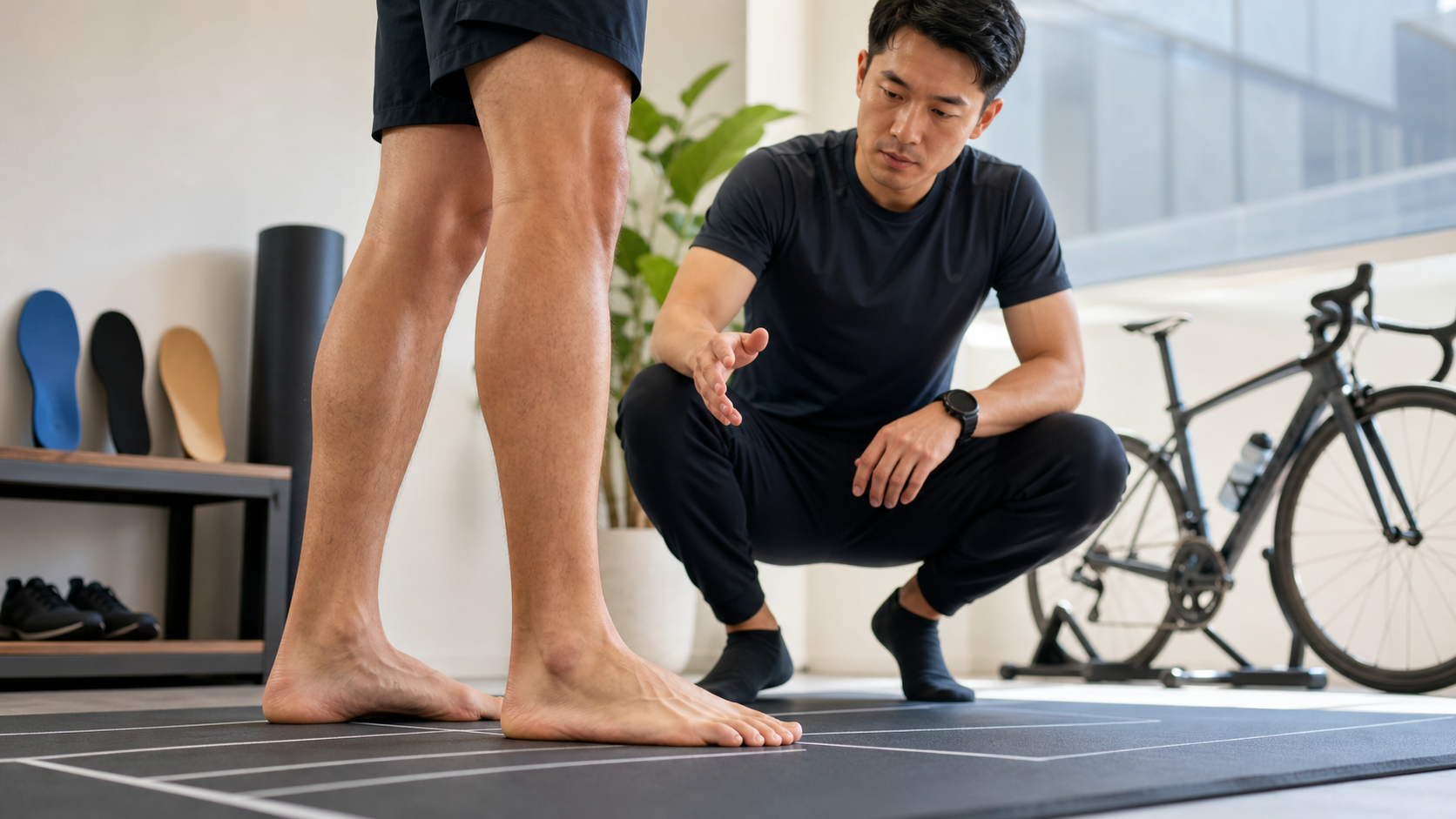
In my fifteenth year of coaching athletes, I’ve gradually developed a habit: whenever someone comes to me about running pain, cycling knee stiffness, or calf cramps after climbing Hehuan Mountain, the first thing I do isn’t look at their training plan—it’s ask them to take off their shoes and socks, stand on the floor, and let me look at the feet that carry their body weight every single day.
I’ll never forget an engineer in his early forties—let’s call him A-Hong. He’d been running for about two years, gradually building his weekly mileage from 20 kilometers to 40. After signing up for the Taipei Marathon, he started training seriously, and then every footstrike on his left foot felt like stepping on a thumbtack—especially that first step out of bed in the morning. He went through three pairs of so-called “top-tier cushioning” shoes and bought a popular carbon-plated pair online, but the pain just moved around without ever truly going away.
I had him stand up, examined his heels from behind, then asked him to stand on one leg, rise onto his toes, and squat down. All told, it took less than ten minutes. The conclusion was simple: he had a pair of flexible but completely unused flat feet, combined with extremely tight posterior calves and a foot core that was barely doing any work. He spent a fortune swapping shoes but never spent ten minutes taking care of the feet themselves.
In this article, I want to lay out clearly the observations and methods I’ve gathered over the years on “sports and foot health.” We’ll talk about how the foot actually works, whether flat feet and high arches are really problems, whether you should use insoles, and most importantly—what you can start doing today. Whether you’re commuting on a UBike, running along the riverside on weekends, or a veteran preparing to conquer Wuling, your feet deserve to be taken seriously.
Let me start with something I often tell my athletes: Shoes are tools; your feet are the engine. Tools can be replaced, but a broken engine is hard to swap out.
The Foot Is Not a Rigid Board but a Precision Suspension System
Many people think of the foot as just a board that holds up the body, but it’s actually the opposite. A single foot has 26 bones, 33 joints, over 100 ligaments, and an entire layer of intrinsic foot muscles that we never feel in daily life yet are incredibly important. Together, the bones in both feet account for about a quarter of all the bones in the body. A structure this intricate was never meant to be a static pad.
The Three Roles of the Arch
I usually break down the function of the arch into three roles, and athletes get it right away:
First, the shock absorber. When your heel strikes the ground, the arch collapses slightly to absorb impact and soften the ground reaction force. During running, the ground reaction force at each step is roughly 2 to 3 times body weight. For a 70-kilogram person running a full marathon, the cumulative impact the feet must absorb is staggering. This “downward motion” of the arch collapsing—pronation—is normal and necessary as a shock-absorbing mechanism, not a bad thing.
Second, the spring. After the arch collapses, it needs to spring back, releasing the elastic potential energy stored in the plantar fascia and tendons to propel you forward. This is also why a shoe that’s “too soft and absorbs all the energy” actually makes running harder—it silences the spring.
Third, the lever. At the moment of push-off, the arch must stiffen and firm up again, turning the entire foot into a rigid lever to transmit force into the ground. This “stiffening” process is called supination.
So a healthy foot is one that can switch rapidly between “soft” and “hard”: soft enough to absorb shock on landing, and hard enough to generate power at push-off. Almost all problems come from this switch getting stuck—either staying too soft and never rebounding (common in functional flat feet) or staying too rigid and never softening (common in high-arched feet).
Pronation Isn’t a Crime—Excess or Insufficiency Is the Real Issue
In recent years, sports science has significantly revised its view on pronation. In the past, running shoe marketing treated “overpronation” like a disease, pushing everyone to buy corrective shoes. But the current consensus across multiple studies is: the link between moderate pronation and injury risk is actually not as strong as once thought. One study tracking runners with different foot types over a year found that moderate pronation did not significantly increase injury rates.
This matters a lot for the general reader, because it means: you don’t need to panic and buy corrective shoes just because you’ve “heard” you pronate. What you should actually worry about are extreme cases, along with the pain and compensation patterns that come with them.
I often use this analogy: pronation is like a car’s suspension compressing. Suspension compression is supposed to happen—it’s part of shock absorption. What you’d worry about is “not compressing at all” (too stiff, jarring ride) or “bottoming out and never rebounding” (too soft, losing support). The vast middle range of normal behavior isn’t a problem at all. Treating all pronation as a defect is like rushing to the mechanic just because you saw the suspension move—you’ve got the wrong idea.
The Plantar Fascia: The Spring You’ve Stepped On for Decades but Rarely Think About
The plantar fascia is a thick band of connective tissue running from the heel to the ball of the foot. Together with the Achilles tendon and calf muscles, it forms an elastic system. There’s an elegant mechanism called the windlass mechanism: when you push off and your big toe dorsiflexes, the plantar fascia tightens, automatically raising and stiffening the arch to help transmit force. This is why big toe mobility and plantar fascia health are so closely linked. Long-term wear of narrow-toed shoes that squeeze the big toe and prevent it from moving will compromise this mechanism. Once you understand this, you’ll see why I emphasize toe mobility training so much—it’s not a gimmick; it’s maintaining a precision spring system.
Flat Feet and High Arches: First, Figure Out Which Type You Are
Human arch height can broadly be divided into three categories. Based on rough epidemiological data: about 60% of people have medium arches (the ideal type), about 20% have high arches (pes cavus), and the rest fall into the low-arch to flat-foot range. Note that different studies vary widely due to measurement methods (static standing, footprints, imaging), with prevalence reports ranging anywhere from 15% to 30%, so these numbers are just to give you a general idea—don’t treat them as precise values.
The table below is one I commonly use in class to help athletes quickly identify which type they are and what tendencies each type has:
| Item | Flat Feet (Low Arch) | Medium Arch (Ideal) | High Arch (Pes Cavus) |
|---|---|---|---|
| Arch appearance | Inner side nearly touches the ground when standing | Noticeable but not exaggerated curve | Inner side arches up, clearly off the ground |
| Foot characteristics | Softer, greater mobility | Balanced softness and firmness, flexible switching | Stiffer, poorer shock absorption |
| Wet footprint | Almost the entire sole prints | A gap in the middle | Large blank area in the middle, two separate blocks |
| Common tendencies | Overpronation, high load on plantar fascia and tibialis posterior | Evenly distributed | Concentrated impact, high pressure on lateral ankle and bones |
| Problems likely to occur | Plantar fasciitis, medial tibial stress syndrome | Fairly even, no particular bias | Stress fractures, lateral ankle sprains, metatarsalgia |
A “Wet Footprint Test” You Can Do at Home
This is one of my favorite tricks to teach because it costs nothing and is intuitive. Wet the bottom of your foot, step onto a piece of cardboard or a dark floor tile, and look at the imprint:
- A clear inward curve in the middle → probably a medium arch.
- Almost the entire sole prints, with little or no gap → low arch or flat feet.
- Only a thin line in the middle, or even the forefoot and heel appearing as two separate blocks → high arch.
But I must emphasize: the wet footprint only shows “static appearance,” not “function.” Many people’s footprints look very flat, but the moment they stand on one leg or rise onto their toes, the arch immediately lifts—this is called flexible (functional) flat feet, and it’s usually not a problem. What truly warrants attention is rigid flat feet: no matter how you stand or rise onto your toes, the arch won’t lift, or it’s accompanied by pain or deformity. That’s when you need to seek medical evaluation.
Flexibility vs. Stiffness: A More Important Distinction Than Height
I often tell my students that whether your arch is “high” or not isn’t as important as you think. “Whether it moves, and whether moving it hurts,” is what really matters. A foot that looks flat but can flexibly switch between soft and firm, without pain or swelling, is far healthier than a foot that looks perfect but is stiff and tight.
The assessment is simple, and you can try it at home:
- Sit with your foot dangling, and observe the arch height.
- Stand up, with both feet on the ground, and look again.
- Stand on one foot and rise onto your toes.
If you have an arch when sitting, it flattens when standing, and pulls back up when you rise onto your toes, your foot is “flexible and mobile”—that’s good news. If your arch stays rigidly in place regardless of the position, or if any step causes significant pain, mark it down as “needs professional evaluation.”
Foot Type and Injury: Don’t Blame the Foundation as the Sole Culprit
I want to be very honest about one thing here, because there’s too much absolutist talk about foot types out there.
Based on current scientific evidence, the relationship between foot type and injury is mixed and inconsistent. Because high-arched feet are structurally stiffer with poor shock absorption, they have been associated with a higher risk of stress fractures in the tibia and femur in some studies. Flat feet with overpronation are often linked to plantar fasciitis and medial tibial stress syndrome (commonly known as “shin splints”)—but at the same time, many studies find no significant correlation.
So my stance has always been: Foot type is a “risk tendency,” not a “destiny.” What truly determines whether you get injured is often the sum of these factors:
- Training load increasing too quickly (this is the most common injury cause I’ve seen, bar none).
- Insufficient strength and mobility, where the feet and calves can’t handle the load.
- Shoes and terrain not suited to your current physical condition.
- Inadequate recovery, with sleep and nutrition lagging behind.
In other words, even if you’re naturally flat-footed or high-arched, you can run long and healthy as long as your training plan is sensible and you strengthen your feet and calves. Conversely, a foot with a “perfect arch” will still get injured if you stubbornly try to jump your weekly mileage from 20 km to 60 km in three months. The foundation matters, but how you build the house matters more.
Should You Use Insoles? My Three Principles for Deciding
Insoles (arch supports, orthotics) are probably the thing my students ask me about most. The answer isn’t “yes” or “no,” but “it depends.” I use three principles to decide.
Principle 1: Consider Them Only for Symptoms or Functional Issues, Not for Prevention
Regarding whether isolated “arch support” can actually prevent injuries, large-scale evidence reviews are quite conservative—for “asymptomatic, average people,” additional arch support has limited benefit in preventing injury. It’s not that wearing them guarantees you’ll get hurt less. So if your feet don’t hurt right now and running and cycling feel good, I usually don’t recommend buying corrective insoles for “maintenance.” Put that money toward strength training instead—the return on investment is much higher.
The situations where insoles are truly worth considering are when symptoms already exist and an assessment shows that foot function genuinely needs assistance, such as:
- Acute plantar fasciitis, where temporarily offloading plantar pressure is needed.
- Rigid flat feet or obvious structural issues, where a medical professional recommends their use.
- High-arched feet with poor shock absorption, needing extra cushioning to reduce impact.
Principle 2: Insoles Are a “Crutch,” Not a “Treatment”
I like to use the crutch analogy for insoles. Using a crutch after an ankle sprain makes perfect sense, but you wouldn’t use one for life—the goal is to heal the foot and throw the crutch away. The same goes for insoles: they can help offload pressure and buy you time during a symptomatic period, but if you wear insoles and completely skip foot strength training, your feet will only become more dependent on external support and weaker over time.
That’s why I always give my students who use insoles a foot training program to run alongside them. The insoles handle “no pain right now,” and the training handles “no pain later.”
Principle 3: Custom Doesn’t Always Beat Off-the-Shelf
Many people assume you have to spend a lot of money on custom orthotics for them to work. But current evidence doesn’t consistently prove that custom orthotics are significantly better than good-quality off-the-shelf arch supports for “general use.” Off-the-shelf options are cheap, easy to get, and sufficient for many people. If you’ve tried an off-the-shelf option for a few weeks and it really doesn’t fit, or you have a clear structural issue, then consider seeing a foot and ankle specialist or physical therapist for a custom assessment. This order is more economical and more rational.
Here’s a decision table for insoles for your reference:
| Your Situation | Recommended Action | Notes |
|---|---|---|
| No symptoms, running and cycling feel fine | Skip insoles for now; invest resources in foot and calf strength | The benefit of wearing them “for prevention” is limited |
| Acute plantar fasciitis | Can use arch supports short-term to offload pressure + active stretching and training | Insoles are a crutch, not a treatment |
| Flexible flat feet, occasional soreness | First strengthen the intrinsic foot muscles and tibialis posterior; use insoles as needed | Most don’t need long-term reliance |
| Rigid flat feet / structural deformity | Seek medical evaluation; may need custom orthotics | Requires professional judgment |
| High-arched feet, poor shock absorption, prone to bone injuries | Choose well-cushioned shoes; add cushioning insoles if necessary | The focus is on reducing impact |
| No improvement after weeks with off-the-shelf insoles | Then consider a custom orthotic evaluation | Order: off-the-shelf first, custom later |
Practical Methods: A Foot Training Program Anyone Can Start
After all that theory, here’s what I consider the most valuable part of this article—something you can start doing today. The core logic I use to train my students’ feet is simple: retrain those feet from “passive pads” back into “active engines.”
Four Foundational Exercises
1. Short Foot Exercise (Arch Shaping)
This is the foundation of all foot training. Sitting or standing, with the sole flat on the ground, imagine “gently pulling” the base of your big toe toward your heel, letting the arch rise slightly—but don’t curl your toes or arch your back. This works the intrinsic muscles in the sole of your foot that are usually asleep. It’s normal if it’s hard to get the feel at first; it took me two weeks to master it back in the day. Hold for 5 seconds, do 10 reps, 2 to 3 sets a day.
2. Toe Spreading and Towel Curls
Lay a towel flat on the floor and use your toes to scrunch it toward you, little by little. Or practice lifting your big toe up while pressing the other four toes down, then reverse. These seemingly boring exercises rebuild your “sense of control” over your toes, which is especially useful for city dwellers who’ve worn closed-toe shoes for so long that their toes barely move anymore.
3. Calf Raises (Calf and Ankle Strength)
Hold onto a wall or table, slowly rise onto your toes, then lower back down. The key is “slow,” especially the lowering phase. The posterior calf muscles (gastrocnemius and soleus) are important allies of the arch, and strengthening them greatly helps both prevention and rehabilitation of plantar fasciitis. For an advanced version, do single-leg calf raises.
4. Single-Leg Balance
Stand on one leg for 30 seconds. Once you’re steady, close your eyes or stand on a soft pad to increase the difficulty. This trains the proprioception and stability of the entire foot and ankle joint, and is a key ability for preventing sprains and falls. Brushing your teeth, waiting for the bus, or waiting for the microwave are all great opportunities to sneak in some practice.
A 12-Week Progressive Program
The table below is the beginner progression I give to general athletes. You can follow it. The overarching principle is “never provoke pain”—if it hurts, step back a level.
| Week | Short Foot | Calf Raises | Single-Leg Balance | Towel Curls/Toe Control | Notes |
|---|---|---|---|---|---|
| Weeks 1–2 | 10 reps × 2 sets daily | Double-leg 15 reps × 2 | 30 sec per side × 2 | 1 set daily | Build the feel first; prioritize form over volume |
| Weeks 3–4 | 10 reps × 3 sets daily | Double-leg 20 reps × 2 | 45 sec per side × 2 | 2 sets daily | Start demanding movement quality |
| Weeks 5–8 | Standing 12 reps × 3 sets | Single-leg 8 reps × 2 | Eyes closed 30 sec per side | 2 sets daily | Add single-leg and eyes-closed challenges |
| Weeks 9–12 | Standing + slight squat 12 reps × 3 | Single-leg 12 reps × 3 | Soft pad single-leg 45 sec | 1 set every other day | Transition to running/cycling-specific demands |
This program only takes 10 to 15 minutes a day, but after three months, many of my students report less foot soreness, more stable foot strikes when running, and even reduced fatigue from standing all day. The foot, as your foundation, has an astonishingly high return on investment.
Complementary Stretching and Relaxation
Beyond training, releasing tight tissues is equally important, especially for plantar fasciitis and high-arched feet. I usually ask my clients to do three things consistently:
- Plantar ball rolling: While seated, roll a massage ball or golf ball under your foot, slowly rolling back and forth along the arch, 1 to 2 minutes per side. Best done before bed.
- Calf stretch: Facing a wall in a lunge position, keep the rear heel down and leg straight to feel a stretch in the back of the calf, hold for 30 seconds; then bend the knee slightly and repeat (targeting the deeper soleus muscle). Tight calves directly pull on the plantar fascia.
- Toe and ankle circles: Spend one minute daily rotating the ankle joint and moving the toes to maintain overall foot and ankle mobility.
Stretching is not about “the more pain, the better.” It should be a feeling of “tightness being released, but not sharp pain.”
Three Real-World Case Studies: Different Feet, Different Solutions
After covering the concepts and training plans, I want to use three typical scenarios that combine traits from multiple clients to show you that “even with the same foot problem, the approach can be very different.” This is why I always emphasize individualization over applying a one-size-fits-all formula.
Case 1: A Riverside Runner with Flexible Flat Feet
Min, in her thirties, is an elementary school teacher who runs 5 to 8 km along the Dajia Riverside Park on weekends. She always thought she “couldn’t run because of flat feet,” but after running for a while, the inner side of her right sole would ache. When I examined her, she was a classic case of flexible flat feet—she had an arch when sitting, it collapsed when standing, and it returned when she rose onto her toes. Her structure was completely normal; the problem was that her foot core and posterior tibial muscle were too weak to support the mileage she wanted to add.
I didn’t have her buy any insoles. I only gave her a twelve-week foot training plan, focusing on foot shortening and single-leg calf raises, and cut her weekly mileage progression in half. Eight weeks later, her foot soreness had almost disappeared. She was surprised herself: “So it’s not that I can’t run—it’s that my feet were weak.” This type of person makes up a large portion of my clients. What they need most is training, not corrective devices.
Case 2: A High-Arched Hiker with Recurrent Shin Pain
Kai, in his forties, loves mountain ridge traverses and often hikes five to six hours on weekends. He has clearly high-arched, stiff feet. His main complaint was pain on the front-outer side of his lower leg and shin after long hikes, and once a doctor even warned him to watch for a stress reaction.
The core problem with high-arched feet is poor shock absorption and concentrated impact, so his treatment logic was completely opposite to Min’s: besides strengthening the foot and calf muscles, I placed more emphasis on “impact management”—choosing shoes with adequate cushioning, adding shock-absorbing insoles when necessary, controlling stride length and speed on descents, and increasing single-hike distance much more slowly. I also asked him to follow up with an orthopedic doctor to rule out a stress fracture. Eventually, his shin pain frequency dropped significantly, and he developed a habit of foot and ankle stretching before and after long hikes. With the same type of foot issue, flat-footed individuals focus on “strengthening,” while high-arched individuals focus on “cushioning and moderation.”
Case 3: A Sedentary First-Time Half-Marathon Runner Who Ramped Up Too Fast
The third case is a variation of the earlier-mentioned Hong—many people fit this profile: they sit in an office all day, their foot function has long since deteriorated, they sign up for a race, and then aggressively increase their mileage within three months, only for their soles or Achilles tendons to protest. The problem for these people is not the foot type, but “insufficient adaptation time.” Bones, fascia, and tendons adapt far more slowly than the cardiovascular system. Your heart and lungs might feel like you can keep running, but your plantar fascia isn’t ready yet. The solution is simple: slow down the progression, add foot and calf strengthening, and give the tissues time.
The common takeaway from these three cases is: First figure out “what kind of foot and what kind of problem” you have, then decide whether you need to strengthen, cushion, or simply slow down. This is precisely the value of a professional assessment.
Common Mistakes and Corrections
Over the years, I’ve seen too many people take detours when it comes to foot health. Here are the misconceptions and practices I most often need to correct with my clients.
Mistake 1: Constantly Switching Shoes at the First Sign of Pain, Without Training the Feet
Just like Hong at the beginning. Shoes are certainly important, but if the engine (the feet and calves) is weak, tight, and immobile, buying more expensive shoes will only delay the problem. Correction: Choose shoes that are “well-fitting, comfortable, and suitable for your current needs,” and put more effort into foot and calf training.
Mistake 2: Spiking Training Volume
I can’t stress this enough—this is the most common cause of injury. Many people get excited after signing up for a race and double their weekly mileage within a week. Correction: Follow the principle of progression, keeping weekly training volume increases to around 10%, giving your body time to adapt. The bones, fascia, and tendons of the foot adapt much slower than the cardiovascular system. Especially for those with high arches, where bone stress is concentrated, be extra careful about stress fractures.
Mistake 3: Treating “Pronation” as the Enemy and Buying Corrective Shoes Randomly
As mentioned earlier, moderate pronation does not equal injury. If a store clerk tells you that you “overpronate” and you rush to buy corrective shoes, you might actually make your feet weaker over time. Correction: Unless you have symptoms and have been assessed, there’s no need to correct for the sake of correcting.
Mistake 4: Ignoring the “Sensation” in Your Toes and Soles
Wearing shoes that are too tight and too stiff for long periods means your toes don’t move and the sensation in your soles becomes dull. Correction: Walk barefoot more often at home, choose shoes with a wide toe box (forefoot space) so your toes can spread naturally, and regularly do toe-control exercises.
Mistake 5: Pushing Through Pain Even When Walking Hurts
This is the worst thing you can do with plantar fasciitis. Correction: During the acute phase when pain is significant, reduce activity appropriately, stretch, and see a doctor if necessary. Don’t comfort yourself with “it’ll get better if I just push through the pain.”
Taiwan-Specific Context: Climate, Eating Out, Terrain, and Medical Care
When talking about foot health, we can’t ignore our own living environment.
Humid, hot climate and sweating: Taiwan’s summers are humid and hot, making feet prone to stuffiness and heavy sweating. Prolonged moisture after exercise is a breeding ground for fungi (athlete’s foot), and the skin breakdown caused by athlete’s foot can be an entry point for infection. Recommendation: Change out of wet socks and dry your feet as soon as possible after exercise, choose breathable socks and shoes, and rotate your shoes so they have time to dry. Friends with diabetes should especially check their feet daily—no small wound should be taken lightly, because with poor blood sugar control, foot wounds heal slowly and the risk of infection is high.
Eating out, body weight, and nutrition: Eating out in Taiwan is convenient, but it’s also easy to consume too much oil and sodium. If your weight creeps up, the pressure on your arches with every step increases. For foot health (especially flat feet and plantar fasciitis), maintaining a reasonable body weight is a very practical step. Bone and fascia health also requires adequate protein, calcium, and vitamin D. Although Taiwan gets plenty of sunshine, indoor workers may not get enough. A balanced diet and moderate sun exposure are especially important for the high-arched group prone to stress fractures—but this is general advice; for individual needs, please consult a nutritionist or physician.
Common training venues: Riverside bike paths, school PU tracks, and mountain trails each have their own characteristics. Hard asphalt has high impact and is less friendly to high-arched feet; mountain trails have varied terrain and require greater ankle stability; PU tracks are relatively forgiving, but don’t let the easy surface tempt you into overtraining. Long climbs like Wuling or Fengguizui are another kind of challenge for cyclists’ ankles and calves—maintaining a fixed pedaling angle for extended periods can cause foot numbness or discomfort. Paying attention to insole and cleat adjustments on cycling shoes, as well as foot stretching after getting off the bike, is worthwhile.
National health insurance and medical care: Easy access to medical care in Taiwan is a blessing. If you have any of the following conditions, don’t guess on your own—see a rehabilitation specialist, orthopedist, or foot and ankle specialist: a rigid arch that won’t move, obvious deformity, persistent pain lasting several weeks, pain at night or at rest, or pain accompanied by swelling and heat. A physical therapist can perform a complete gait and functional assessment, which is far more effective than reading a pile of contradictory information online.
Actionable Advice for Readers at Different Levels
Finally, here’s a clear starting point based on your current situation.
For Complete Beginners / General Sedentary Office Workers
- Start with the wet footprint test to get a general idea of your foot type.
- Begin with weeks 1–2 of the twelve-week plan, spending 10 minutes daily on foot shortening, calf raises, and single-leg balance.
- Pick a pair of well-fitting, comfortable everyday shoes with enough toe-box space—no need to chase any special features.
- Walk barefoot more at home to reawaken the sensation in your feet.
- If you have no symptoms, there’s no need to buy insoles.
For Advanced Runners / Weekend Cyclists
- Formally schedule foot and calf training into your weekly plan, treating it as a foundation as important as your core.
- Follow the principle of progression with your training volume, especially resisting the urge to spike mileage during race preparation.
- Be aware of your foot type tendencies: flat-footed individuals should focus on the posterior tibial muscle and foot core, while high-arched individuals should prioritize cushioning and impact management.
- Take recurring minor pains (sole, shin, metatarsal) seriously—don’t wait until they become major injuries.
- Decide on insoles based on symptoms and assessment, not for prevention.
For Those with Pain or Structural Concerns
- If your arch is stiff and cannot be moved, visibly deformed, or pain persists for several weeks, seek medical evaluation first.
- Follow an individualized plan from a rehabilitation department/physical therapist, combining training with insoles (if needed).
- Those with diabetes, circulatory, or neurological issues should be more cautious with foot care—check daily and never ignore wounds.
- Do not self-diagnose or self-prescribe based on online information; individual conditions vary greatly.
FAQ
These are the questions I am most frequently asked in classes and clinical consultations, compiled here for you.
Q1: I have flat feet—does that mean I’m not suited for running or cycling?
No. The vast majority of flat feet are flexible and structurally normal. As long as you strengthen your feet and calves and progress your training volume gradually, you can run just as long and just as well. What truly requires attention is rigid flatfoot or cases accompanied by painful deformities—those need medical evaluation. Don’t let the label “flat feet” hold you back.
Q2: Do barefoot shoes (five-toe shoes, minimalist shoes) help foot health?
The core concept of barefoot or minimalist shoes—letting toes move freely and engaging foot muscles more—is sound, but the transition must be very gradual. I’ve seen too many people impulsively switch to minimalist shoes without reducing mileage, only to end up with calf and plantar injuries. If you want to try them, treat it as a training adaptation that takes months, starting with walking and short distances rather than immediately going for long runs.
Q3: Is “worst pain with the first step in the morning” characteristic of plantar fasciitis?
It’s a very typical presentation. After the plantar fascia shortens overnight, the first step in the morning—or standing up after prolonged sitting—hurts the most, then eases somewhat after walking around. That’s a common scenario. The treatment principles are stretching (calves and plantar fascia), relaxation, short-term use of arch supports to offload pressure if needed, plus foot strengthening exercises. If it doesn’t improve after several weeks or is severe, seek medical attention.
Q4: My child looks flat-footed—should I be worried, and should I buy corrective shoes?
Children’s arches are still developing, and flat-looking feet during the toddler stage are very common. Most arches form naturally around preschool age, and corrective shoes are usually unnecessary. However, if your child easily complains of pain when walking, falls abnormally often, or has visibly stiff or deformed feet, take them to a pediatric orthopedic or rehabilitation specialist. This falls within the scope of professional judgment—don’t decide on your own.
Q5: Should I try on shoes in the morning or evening? How do I gauge sizing?
I recommend trying shoes in the evening or after exercise, because feet swell slightly after a day of activity, and sizing at that time is less likely to be too tight. For athletic shoes, leave about one thumb’s width of space in the forefoot, and make sure the width is sufficient so your toes can spread naturally. A proper fit and comfort always take priority over brand or functional labels.
The table below gives you a quick reference for “when to handle it yourself versus when to see a professional”:
| Situation | Recommendation |
|---|---|
| Mild plantar soreness after exercise that resolves with rest | Self-management: stretching, relaxation, strengthening, controlling training volume |
| Pain with the first step in the morning that eases with walking | Suspected plantar fasciitis; try self-management first, see a doctor if no improvement in weeks |
| Arch is stiff and cannot be moved, or visibly deformed | Seek medical evaluation (rehabilitation/orthopedics/foot and ankle specialist) |
| Pain even at rest or at night, with localized swelling and heat | See a doctor promptly to rule out stress fractures or other issues |
| Diabetes with a foot wound or numbness | Must see a doctor without delay |
Conclusion: Build the Foundation First, and the House Will Stand Tall
Back to A-Hong from the beginning. In the end, he didn’t spend more money on new shoes. Instead, he dutifully completed twelve weeks of foot training, combined with calf stretching and a re-planned training volume, and that “thumbtack” in his sole gradually disappeared—he successfully finished his first full marathon. One thing he said to me left a deep impression: “I’ve been decorating the house all along, but I forgot the foundation was leaking.”
I want to pass those same words on to you reading this article. Your feet silently absorb tens of thousands of impact landings for you every day, never complaining, yet they deserve ten minutes of your serious attention daily. Take care of the foundation first, and your athletic life will be built both high and long.
Foot arch type is determined by genetics, but foot function can be trained. Rather than agonizing over whether you’re flat-arched or high-arched, why not take off your shoes and socks tonight, step onto the floor, and start your first set of short-foot exercises.
This article is educational content and does not replace individualized diagnosis and treatment advice from physicians, physical therapists, or nutritionists. If you have persistent pain, structural deformities, or chronic conditions such as diabetes or cardiovascular disease, be sure to discuss your exercise and foot care plan individually with professional medical personnel before proceeding.
References
- Biology Insights — What Percentage of the Population Has Flat Feet?: https://biologyinsights.com/what-percentage-of-the-population-has-flat-feet/
- Cawley Physical Therapy — Foot Arch Types: https://www.cawleypt.net/2020/01/foot-arch-types/
- RunRepeat — The Truth About Arch Support: A Meta Analysis: https://runrepeat.com/arch-support-study
- Runners Connect — How Does Your Arch Height Affect Your Shoe Choice and Injury Risk: https://runnersconnect.net/high-arches-flate-feet-and-running-injuries/
- Cleveland Clinic — Overpronation: What It Is, Causes & Treatment: https://my.clevelandclinic.org/health/diseases/22474-overpronation
Related Reading
- Flat Feet vs. High Arches: Different Impacts on Running and Cycling, and General Principles for Insole Adjustments
- Running Insoles and Arch Support: How to Choose the Right Insole for You
- The Science of Shoes: From Barefoot to Carbon-Plated, How a Pair of Shoes Rewrites Your Running
- Road Running Shoe Buying Guide: Correctly Matching Foot Type (Flat, Normal, High Arch) with Shoe Models
單車 一日北高 ( 雙城 ) 肥宅雙人瘋狂行 紀錄片 REACTO
10 年前
#公路車 #Fitting 靠人工智慧APP 幫你調整單車
6 年前
滑雪新手們慘摔學習全紀錄(請開字幕),滑雪好好玩 | Snowboard + Ski | 岩原 スキー場 | 滑雪APP使用 | GoPro Max
6 年前
一日北高常見問題大集合 | 攻略 | 路線 | 訓練 | 補給 | 自行車 單車 | 一日雙城 | 雙塔 | TWB北高360 | 屁股痛
6 年前
太平山單車員工旅遊 | 這樣玩CP值最高!| 公路車
5 年前
單車AI教練!全新 ChatGPT4o 幫你分析訓練成果!排武嶺課表,分析騎車姿勢! 太神了! / 公路車 / CT Yeh / feat. 緯緯
2 年前
摔車後補裝備: 好市多新款單車安全帽& Specialized Romin 北高整路屁股都不痛的坐墊 | 一千元居然有MIPS | CT Yeh | 公路車
4 年前
單車 重低音 藍芽喇叭 音質實測 SoundBot SB525 Real Sound Test
8 年前