Your Ears Are Working Hard During Exercise Too: A Complete Guide to Hearing Protection for Cycling, Running, and Swimming
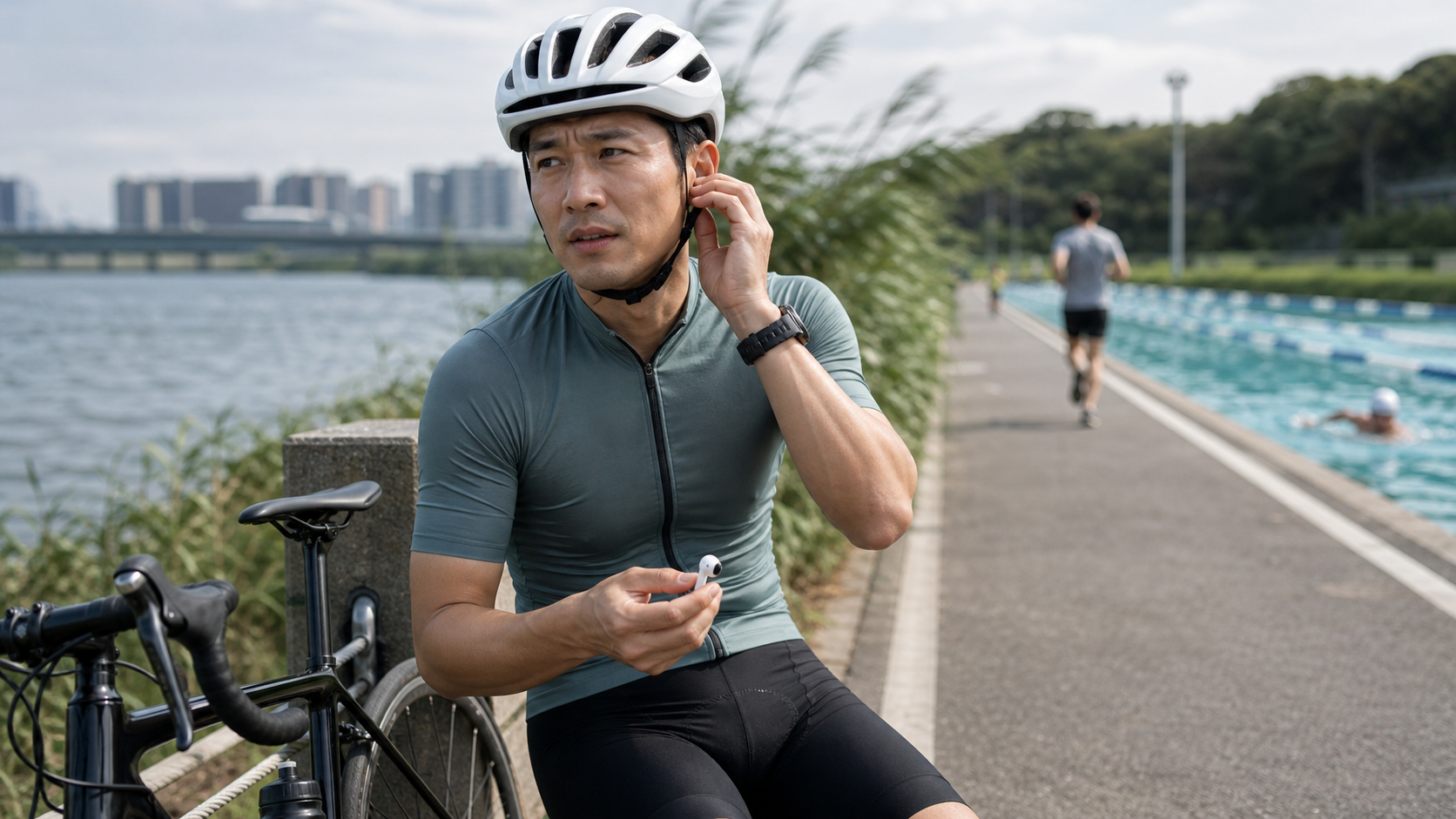
Opening: The student with “ringing ears”
In fifteen years of coaching, my athletes’ injury list has included knees, lower backs, and Achilles tendons—but almost no one ever put “ears” on it. Until one year, an amateur cyclist in his early forties who rode two to three hundred kilometers a week along the riverside came to see me. He wasn’t complaining about his legs; instead, he asked quietly: “Coach, after long rides lately, my right ear rings, and it only fades by the next morning. Is that normal?”
I didn’t answer whether it was normal right away. Instead, I asked him a few things first: Do you listen to music while riding? What kind of earphones do you use? How loud is the volume? How fast do you usually ride, how much headwind do you face, and do you wear a full-face or open-face helmet? The picture that emerged was typical—he had been wearing in-ear earphones for years, cranking the volume almost to maximum to drown out the wind noise rushing into his ears at 30-plus km/h. On top of that, he preferred training long distances on open, windy stretches like the West Coast Expressway, which meant his ears were effectively marinating in a double assault of “wind noise + high-volume music” for hours at a time.
His ringing (tinnitus) wasn’t some mystical phenomenon—it was the inner ear’s hair cells protesting. In this article, I want to lay out clearly, in one go, the ideas I’ve repeated over the years when talking to athletes about hearing protection: Exercise itself doesn’t damage your ears, but the context of exercise—wind, earphones, water, environmental noise—often accumulates damage without you feeling a thing. And this kind of damage has a cruel characteristic: it’s almost irreversible. A worn-out muscle grows back; a damaged hair cell doesn’t.
For those in a hurry, here’s the bottom line: keep earphone volume below 60 percent, don’t listen continuously for more than an hour at a time, drain water out of your ears after swimming, and see a doctor if you have persistent tinnitus or a clogged feeling in your hearing. We’ll unpack the rest slowly.
Concepts and scientific foundations: How ears get worn down by “volume × time”
Decibels, dose, and that brutal exchange rate
Many people think hearing damage only happens when something is “too loud,” but the real keyword is “dose”—the accumulation of volume level × exposure time. This is actually very similar to the concept of training load: you don’t get injured from a single climb, but long-term overload without recovery will break your body down. The ears are the same.
Two references are commonly cited internationally. The World Health Organization (WHO) safe listening guidelines state: at an average volume of 80 decibels, you can safely listen for about 40 hours per week; but if you push the volume to 90 decibels, your safe allowance drops to only about 4 hours per week. (Source: WHO Safe Listening, linked at the end.) You read that right—a mere 10-decibel increase cuts safe listening time from 40 hours a week down to 4 hours, a tenfold reduction.
Occupational safety uses a stricter yardstick. The U.S. National Institute for Occupational Safety and Health (NIOSH) recommends an exposure limit of 85 decibels as the baseline, time-weighted over 8 hours, using what’s called the “3-dB exchange rate”: every 3-decibel increase doubles the sound energy, so the safe exposure time is cut in half. (Source: NIOSH/CDC, linked at the end.)
Laying that exchange rate out makes it more tangible:
| Volume (approximate real-world equivalent) | Safe exposure time (NIOSH 3-dB exchange rate concept) |
|---|---|
| 85 dB (noisy city street, traffic) | About 8 hours |
| 88 dB (motorcycles roaring past, gym weight-room music) | About 4 hours |
| 91 dB (lawn mower, some spin classes) | About 2 hours |
| 94 dB (scooter passing close by, chainsaw in the distance) | About 1 hour |
| 97 dB (edge of a nightclub, outskirts of a large concert) | About 30 minutes |
| 100 dB (earphones at full volume, chainsaw up close) | About 15 minutes |
The table above is a conceptual conversion to give you a feel for it; actual safe times vary by individual and environment. The key is the trend: decibels are on a logarithmic scale—something that sounds only “a little louder” can represent several times more energy and damage risk.
Inner ear hair cells: Once damaged, they don’t grow back
We hear sound thanks to rows of hair cells inside the cochlea of the inner ear. Sound waves make them sway, converting mechanical signals into neural electrical signals sent to the brain. The problem is that mammalian cochlear hair cells essentially do not regenerate. Prolonged or intense high-volume exposure damages and kills these cells, and once they die, hearing at that frequency range is permanently lost.
This is completely different from muscles or liver cells, which repair and regenerate. That’s why I often tell my athletes: Your ears are one of the few organs on your body that you can only conserve—you can’t retrain them. You can train your cardiovascular system, your strength, your flexibility, but you can’t train back dead hair cells.
I like to use the “savings account” analogy: the hearing you’re born with is like a fixed deposit, and noise exposure is making withdrawals—except this account only pays out, never takes in, earns no interest, and offers no loans. When you’re young and spend lavishly (loud volume, long listening sessions, no protection), the balance doesn’t show it at first, but every overexposure is a deduction. By the time you hit middle age and the balance runs low, you realize “not hearing clearly” is the result of spending it all early. This is also why the sports science community’s stance on hearing protection is almost unanimously “prevention”—because once you withdraw, it can’t be put back.
Three warning terms to remember
- Temporary threshold shift (temporarily dulled hearing): After leaving a noisy environment, you feel your ears are stuffy, and people sound like they’re speaking through a layer; it usually recovers within hours to the next day. This is your ear showing you a yellow card—it means your recent exposure has exceeded the limit.
- Tinnitus: Hearing buzzing, hissing, or cicada-like sounds with no external source. Brief tinnitus after exercise is often linked to excessive noise exposure; if it becomes persistent, see a doctor.
- Noise-induced hearing loss: After long-term accumulation, a dip typically appears first in the higher frequencies (around 3000 to 6000 Hz). The tricky part is that this frequency range isn’t obvious in everyday conversation—many people don’t notice until they “can’t hear the TV clearly and keep asking people to repeat themselves,” by which point a significant amount has often already been lost.
When you see a yellow card, deal with it—don’t wait for the red card. Temporary threshold shift and post-exercise tinnitus are your body showing you a yellow card.
“Hidden hearing loss”: Normal hearing tests, yet increasingly hard to hear
In recent years, a concept gaining growing attention in the sports hearing world is “hidden hearing loss.” Traditional hearing tests measure “whether you can hear a pure tone at a certain volume,” but there’s a type of damage where pure-tone hearing tests still come back normal, yet you find it increasingly hard to understand speech in noisy environments (e.g., at a bustling restaurant, gym, or banquet—when there’s a crowd, you can’t catch what the other person is saying).
This phenomenon is thought to be related to damage to the connections (synapses) between the cochlea and the auditory nerve, and it may accumulate long before traditional hearing tests show any abnormality. The implication for athletes is straightforward: Don’t assume “my hearing test is normal” and use your ears carelessly. Finding it increasingly difficult in noisy environments and constantly asking “what did you say?” is itself a signal worth taking seriously. This is also why I keep emphasizing “prevention”—because by the time a test shows a problem, damage has often been accumulating for a long time.
Why are ears more vulnerable during exercise?
There’s another detail that’s often overlooked: during intense exercise, with blood flow redistributed and certain conditions (such as dehydration or high ambient heat), the inner ear’s microcirculation is itself under stress. The inner ear is nourished by tiny blood vessels and is highly sensitive to ischemia and hypoxia. When you’re doing long-distance exercise in the heat while simultaneously blasting high-volume sound into your ears, you’re putting pressure on the inner ear at the very moment it most needs to be treated gently. With Taiwan summers frequently hitting 30-plus degrees Celsius and high humidity, this reminder is especially practical: during prolonged exercise in high heat, keep the volume even more conservative.
A Daily Volume Reference Chart to Help You Build “Volume Awareness”
Many people have no concept of decibels, so I’ll use everyday sounds to help you calibrate what “a certain number of decibels feels like”:
| Approximate Volume | Real-Life Equivalent | Feeling |
|---|---|---|
| 30 dB | Quiet library, bedroom late at night | Very quiet |
| 50 to 60 dB | Normal conversation, office | Comfortable, can tolerate for long periods |
| 70 dB | Busy restaurant, vacuum cleaner | A bit noisy but harmless |
| 80 to 85 dB | Busy city street traffic, gym music | Time to start watching exposure duration |
| 90 to 95 dB | Motorcycles roaring past, some indoor cycling classes | Prolonged listening can cause damage; earplugs are better |
| 100 dB and above | Headphones at max volume, chainsaw, in front of concert speakers | Can cause damage in a short time |
The point of remembering this chart is: When your environment is already above 85 dB (you have to raise your voice to be heard by someone next to you), if you’re wearing headphones and trying to “drown it out,” your volume is bound to enter the danger zone. In that situation, the right move is noise cancellation, moving away, or wearing earplugs—not turning your own volume up.
Breaking Down Exercise Scenarios: Wind, Headphones, and Water Each Have Their Own Traps
Scenario One: Cycling—The Severely Underestimated “Wind Noise”
This is the concept I most want to help fellow cyclists build: When riding, the biggest hearing risk is often not the music, but the wind.
When you’re cruising at 30-some km/h on flat roads, or even hitting 50 to 60 km/h on descents, the wind noise rushing into your ears can be considerable—especially with strong crosswinds or on open stretches (like the West Coast Expressway, coastal routes, or riverside dike tops). Many people crank up their headphone volume to hear navigation or music clearly, so their ears take on the double load of “wind noise + high-volume music” at the same time. That student with the ringing right ear I mentioned earlier is a classic case.
What’s even trickier is the safety issue. Taiwan’s riding environment has complex road conditions, lots of scooters, and lots of trucks. If both ears are plugged with in-ear headphones and the volume is loud, you won’t hear vehicles approaching from behind, horns, or warnings from riding companions. My stance is clear:
- On open roads with traffic, I strongly advise against wearing headphones in both ears. Leave at least one ear open to the environment.
- If you really need navigation or music, prioritize bone-conduction headphones or open-ear headphones—they don’t seal the ear canal and preserve ambient sound; or wear only one earbud with the volume kept low.
- Make good use of the helmet itself and wind-deflecting accessories to reduce wind noise: a well-fitted helmet, and controlling your speed on sections that require full attention to the road rather than chasing top speed, all help.
Let me add another point many people haven’t considered: Wind noise has a different frequency profile than music. Against a background of wind noise, your ears tend to “push the music volume up until you can hear it clearly,” so your actual exposure gets elevated without you even realizing it. That’s why many long-distance riders “didn’t think the music was that loud” but end up with tinnitus after the ride. The solution isn’t to turn off the music entirely, but to switch to open-ear/bone-conduction, keep the volume at 60%, and pause the music when you truly need to focus (descents, intersections, traffic). Many popular routes in Taiwan—like Yangjin Highway, Fengguizui, Beiyi, and the east approach to Wuling—have long descents and traffic. On these sections, I always recommend giving your full attention back to the road.
Scenario Two: Headphone Volume—The Golden Rule of 60% and 60 Minutes
On treadmills, in indoor cycling classes, running, or on a home trainer, headphones are practically standard gear for modern exercisers. Here I’ll teach you two easy-to-remember, actionable principles.
The first is the “60% volume” principle. Consumer devices at maximum volume can put headphone output in the dangerous 100 to 110 dB range; keeping the volume at about 60% of maximum usually brings actual output back to the relatively safe 75 to 85 dB range. The WHO’s safe listening recommendation is also to keep volume below 60% of maximum. (Source at the end of this article.)
The second is the “60/60 rule.” A widely circulated, easy-to-remember beginner principle: Volume no higher than 60% of maximum, and no more than 60 minutes of continuous listening at a time. After a full hour, give your ears a break. This isn’t a precise medical prescription, but a practical rule that gives ordinary people “a baseline to hold onto.”
Here’s a self-check table mapped to exercise scenarios:
| Scenario | Common Mistake | Recommended Approach |
|---|---|---|
| Treadmill / indoor cycling class (environment is already loud) | Turning volume up to drown out ambient noise | Use noise-cancelling headphones to “reduce ambient noise” rather than “adding your own volume”; still keep volume at 60% |
| Outdoor cycling (with traffic) | Both ears in-ear, high volume | Bone-conduction/open-ear or single earbud; preserve ambient sound |
| Home trainer / weight training (quiet environment) | Habitually turning volume up high | When the environment is quiet, you don’t need high volume to hear clearly—keep it low |
| Long listening sessions (over two hours) | Listening straight through without breaks | Every 45 to 60 minutes, give your ears a few minutes of rest |
One super practical self-check method: When wearing headphones, if someone next to you is talking and you have to pause the music or take the headphones off to hear them, your volume is too loud. The right volume is one where you can still “incidentally” hear someone calling you nearby.
Most phones (iOS/Android) have built-in headphone volume monitoring and “headphone safety” features that track your listening dose and alert you when you exceed limits. I often ask students to turn this feature on and let the data be the gatekeeper—far more reliable than going by feel.
How to Choose Among Different Headphone/Earplug Types? A Comparison Chart
Exercisers often agonize over headphone choices, so I’ve laid out the common types side by side. You can match them to your “primary exercise scenario”:
| Type | Seals Ear Canal | Preserves Ambient Sound | Suitable Scenarios | Things to Watch Out For |
|---|---|---|---|---|
| In-ear (silicone tips) | Yes | Poor | Quiet indoor settings, trainer, home | Sealing the ear canal makes it easy to unknowingly turn volume up; not suitable for outdoor riding with traffic |
| Semi-in-ear (not deeply inserted) | Partial | Moderate | Commuting, light outdoor use | Poor isolation may actually tempt you to turn volume up |
| Open-ear (hangs on ear, no plug) | No | Good | Outdoor running, cycling | Can be drowned out in noisy environments; don’t crank volume to compensate |
| Bone-conduction | No | Good | Outdoor cycling, running (safety-first) | Still has a volume ceiling; weaker low-frequency response |
| Active Noise Cancelling (ANC) headphones | Yes | Adjustable (transparency mode) | Noisy gyms, commuting | Great for “reducing ambient noise,” but don’t turn your own volume back up |
| Balanced/filtered earplugs | Yes (pure protection) | Preserves speech proportionally | Indoor cycling classes, concerts, extremely loud venues | No music playback—pure protection tools, worth owning |
My general rule is simple: Prioritize exercise safety and environmental awareness (choose open-ear/bone-conduction outdoors), keep closed designs for quiet environments, and use noise-cancelling or filtered earplugs as a “subtractive” measure in loud venues. Don’t let your headphone choice become an accomplice to unknowingly turning the volume up.
Scenario Three: Swimming and In-Water—It’s Not Noise, It’s “Water” and “Pressure”
For swimming and triathlon water training, the hearing risk takes a different form. The main culprits are water and pressure.
- Water in the ear canal and infection (commonly called “swimmer’s ear”): If water from pools or open water gets into the ear canal and doesn’t drain out, the damp, warm environment can easily cause inflammation of the outer ear canal. In Taiwan’s hot, humid summers, this is especially common. Symptoms include ear pain, itching, a plugged feeling, and even discharge.
- Improper ear cleaning: Many people feel water in their ears after swimming and aggressively dig with cotton swabs, which instead pushes earwax deeper and scratches the ear canal skin, making infection more likely. Earwax is actually a protective layer—it doesn’t need to be cleaned out daily.
- Underwater pressure (ear pressure equalization during freediving or scuba diving): While regular swimming rarely involves this, if you freedive or scuba dive without properly equalizing ear pressure (equalization maneuvers), you can damage the middle ear or eardrum. For this, you must receive training from a professional instructor.
A practical checklist for swimmers and triathletes:
- After swimming, tilt your head to one side and hop on one foot a few times, or gently wipe the outer ear with the corner of a towel, letting water drain naturally—don’t dig inward.
- If you’re prone to recurrent swimmer’s ear, consider well-fitted swimming earplugs; pay extra attention before and after open-water training.
- If you feel a plugged or painful ear canal for more than a day or two, or have discharge or reduced hearing, see an ENT doctor. In Taiwan, seeing an ENT via National Health Insurance is convenient and affordable—don’t put it off on your own.
Practical Training Plans and Action Strategies for Different Groups
The table below is how I treat “hearing protection” as a form of training, with different groups focusing on different priorities.
| Group | Primary Risk | Core Actions (Every Session) | Regular Check-ups |
|---|---|---|---|
| Riverside/Road Cyclists | Wind noise + traffic safety + headphone volume | Don’t plug both ears in traffic; use open-ear/bone conduction; volume at 60% | See a doctor if tinnitus or fullness occurs; optional annual hearing screening |
| Gym/Spinning Class Goers | Loud studio volume + cranking up their own earphones | Use noise cancellation to reduce ambient noise, not increase your own volume; 60/60 rule | Be alert if ear fullness lasts past the next day after class |
| Runners (Outdoor/Treadmill) | Prolonged headphone use | Take a break every 45 to 60 minutes; keep one ear open outdoors for surroundings | Keep phone’s listening dosage feature enabled to monitor |
| Swimmers/Triathletes | Water ingress infection + ear digging + water pressure | Tilt head to drain water, don’t dig; use swim earplugs when necessary | See an ENT for recurring swimmer’s ear |
| Older Exercisers | Existing hearing loss compounded | Be more conservative with volume; prioritize open-ear headphones to retain ambient sound | Regular hearing tests; early assessment for hearing aid needs |
Three Levels of Action Recommendations
Beginners (Establish the Baseline First)
- Today, set your phone’s headphone volume to below 60% of maximum, and enable the “Headphone Safety/Listening Dosage” feature.
- Remember the 60/60 rule: volume at 60%, and no more than 60 minutes per session.
- During outdoor exercise, keep at least one ear open to your surroundings—protect both your safety and your hearing.
Intermediate (Start Managing Quantitatively)
- Use your phone’s listening dosage data to track your actual weekly exposure, treating it like you would your training load.
- Invest in a pair of open-ear or bone-conduction earphones as your primary gear for outdoor exercise, and save in-ear models for quiet environments.
- Keep a “yellow card log”: whenever you experience tinnitus or ear fullness after a workout, note the circumstances (wind conditions, volume level, listening duration) to identify your personal threshold.
Advanced/Coaches and Group Leaders (Make It a Team Culture)
- When leading group rides or classes, actively promote “don’t plug both ears on open roads”—it’s about safety and hearing alike.
- When choosing studio sound systems or volume levels, take your students’ hearing seriously; you don’t need deafening volume to prove intensity.
- Encourage students to include an annual hearing screening alongside their regular health check-ups.
Common Mistakes and Corrections: Six Things I Correct Most Often
Mistake 1: “Turn the volume up louder to drown out ambient noise.”
Correction: You’ve got it backwards. When it’s noisy, what you should do is reduce the ambient noise reaching your ears (noise-cancelling earphones, choosing a quieter venue, earplugs), not stack your own volume on top—that only makes things worse.
Mistake 2: “My ears feel a bit plugged; it’ll pass, no need to worry.”
Correction: Post-exercise ear fullness or temporarily dulled hearing is a yellow card from your body, signaling you’ve just exceeded your limit. An occasional episode is a lesson learned, but if it happens frequently, your listening habits need a complete overhaul.
Mistake 3: “Digging your ears aggressively after swimming.”
Correction: Cotton swabs push earwax deeper and scratch the ear canal, actually increasing the risk of infection. Tilt your head to let the water drain and gently wipe the outer ear—earwax is a protective layer.
Mistake 4: “Plugging both ears with earphones at high volume while riding outdoors.”
Correction: This is simultaneously a hearing risk and a traffic safety risk. Keep your ears open for vehicles approaching from behind, horns, and fellow riders.
Mistake 5: “Tinnitus will go away on its own if I just tough it out.”
Correction: Brief tinnitus might subside, but persistent tinnitus or sudden hearing loss in one ear could be a sign you need prompt medical attention (sudden sensorineural hearing loss, for instance, has a golden treatment window). ENT clinics are easily accessible in Taiwan—don’t delay.
Mistake 6: “I’m still young; I’ll worry about hearing loss later.”
Correction: Noise-induced hearing loss is cumulative and irreversible. Excessive exposure in your youth will come back to haunt you in middle age as “I can’t hear clearly.” This is one of the few health issues where prevention is vastly more effective than treatment.
Practical Reminders for Taiwan’s Local Context
- Hot, humid climate: Taiwan’s summers are muggy and damp, making swimmer’s ear and ear canal inflammation relatively common. Water-sports enthusiasts should pay special attention to drainage and keeping the ears dry.
- No miracle foods for your ears: Don’t fall for claims that certain foods can “nourish” your ears. What actually works is a balanced diet, controlling the three highs (blood pressure, blood sugar, blood lipids), not smoking, and regular exercise to maintain overall vascular health. The inner ear is nourished by microcapillaries—when your cardiovascular health is good, your ears usually benefit too.
- Take advantage of accessible healthcare: Taiwan has a high density of ENT clinics with NHI coverage. For ear fullness, pain, tinnitus, or declining hearing, go see a doctor—don’t play doctor yourself.
- Common venue noise: Music in some spinning studios, gyms, and night running events is excessively loud. You have every right to protect yourself—wearing earplugs or standing farther away is perfectly fine.
- The overlap between commuting and exercise: Many Taiwanese workers use “commuting by U-bike” or “running as transportation” to double as exercise. That’s a good habit, but don’t forget that commute routes have the densest traffic and the most chaotic noise—exactly when you should keep your ears open to the environment. Manage your listening habits during exercise and commuting safety together.
- A paid hearing screening is well worth it: If you’re an athlete who wears earphones for long periods, or you already suspect some hearing loss, many ENT clinics and hearing centers offer hearing tests. Think of it as a “physical exam for your ears.” For a few hundred to a bit over a thousand NT dollars, you get a baseline reading to compare against in the future. Early detection and early protection are far more cost-effective than trying to fix things later.
Case Notes from Three Real-Life Scenarios
Enough numbers—let me share three cases I’ve actually worked with (the situations are real, but details have been de-identified). You might see yourself in one of them.
Case 1: The Spinning-Addicted Office Worker
An office worker in her thirties took four to five spinning classes a week and liked to stand near the speakers to “feel the rhythm.” When she came to me, her complaint was “my ears feel stuffy after class, with a bit of tinnitus—it usually takes a night’s sleep to clear up.” I knew the problem immediately: the studio volume was already high, and she chose the spot closest to the speakers, meaning she was getting high-dose exposure several times a week. My advice was simple: move to a spot farther from the speakers, carry a pair of musician-grade balanced earplugs (which reduce volume proportionally without muffling sound quality), and treat “post-class ear fullness” as a self-monitoring indicator of exceeding her dose. Two to three weeks later, she reported that the ear fullness and tinnitus had almost completely disappeared, and her workout quality was completely unaffected. This shows: protecting your hearing doesn’t mean giving up the exercise you love—you just need to adjust how you’re exposed.
Case 2: The Runner Who Commuted by Running
A runner was in the habit of “using running as transportation” while commuting, wearing in-ear earphones at high volume every day, running for at least an hour at a time, accumulating a considerable weekly dose. He had no obvious symptoms, but during a hearing screening at his company’s annual health check, he was flagged for a slight decline in the high-frequency range. He was alarmed and came to ask me what to do. The bad news is that what’s lost can’t be recovered; the good news is that protecting your hearing from now on can significantly slow further deterioration. I helped him do three things: lower the volume from nearly max to 60%, give his ears a rest every 45 minutes, and switch to open-ear earphones for outdoor commuting (which also solved his safety concern about not hearing scooters approaching from behind). I often use this case to remind my students: many people are “asymptomatic”—by the time you feel something, the damage has often been accumulating for a long time, so don’t wait for symptoms to appear before taking action.
Case 3: The Triathlete with Recurring Swimmer’s Ear
An amateur triathlete experienced recurring inflammation of the ear canal every summer during intensive swim training, with pain severe enough to disrupt his training. He initially thought it was a pool water quality issue. Upon closer questioning, the key turned out to be his habit of “using cotton swabs to dry the water out” after swimming—the more he dug, the worse it got. The fix: after swimming, switch to tilting the head to drain water + gently wiping the outer ear with a towel, never digging deep; on training days when water tends to get in, wear well-fitted swim earplugs; and if inflammation does occur, see an ENT promptly and follow the prescribed medication rather than self-medicating with random over-the-counter drops. After that summer, his recurring inflammation improved significantly. The lesson from this case: many ear problems aren’t caused by the exercise itself, but by incorrect post-exercise care.
Frequently Asked Questions (FAQ)
Q: Do noise-cancelling headphones protect or damage your hearing?
A: Noise cancellation itself is a protective tool—it helps lower ambient noise so you don’t need to crank up the volume to drown out a noisy background. The real risk isn’t the noise-cancelling feature itself, but how loud you set the volume and how long you listen while wearing them. Using noise cancellation to “reduce environmental noise without raising your own volume” is the right approach.
Q: Are bone-conduction headphones completely safe for hearing?
A: The advantage of bone-conduction headphones is that they don’t seal the ear canal and preserve environmental awareness (which is great for outdoor cycling and running safety), but they still deliver energy into the auditory system. Listening too loud or for too long carries the same risks. They’re not a “get-out-of-jail-free card for unlimited listening”—the principles of volume and duration still apply.
Q: Should I see a doctor for brief tinnitus after exercise?
A: Occasional tinnitus that disappears within a few hours is usually a warning sign that “this exposure exceeded the limit.” Learn from it and adjust next time. However, if tinnitus persists for more than a week, is noticeably one-sided, or is accompanied by hearing loss or dizziness, seek medical attention promptly—don’t try to diagnose yourself.
Q: Won’t wearing earplugs during exercise make me miss danger cues?
A: It depends on the setting and the type of earplug. On open roads with traffic, I don’t recommend completely sealing both ears. But in indoor cycling classes, concerts, or extremely noisy indoor environments, wearing “balanced/filtered earplugs” that reduce volume proportionally while still letting you hear voices and cues is excellent protection. Choose the right earplug for the right setting.
Q: I have a lot of earwax. Should I get it cleaned regularly?
A: Earwax is a protective layer—most people don’t need to actively clean it. Over-cleaning can scratch the ear canal and increase infection risk. If earwax builds up to the point of affecting your hearing or causing a blocked, uncomfortable feeling, leave it to an ENT specialist. Don’t aggressively dig at it yourself with cotton swabs or ear picks.
Q: My hearing is already damaged. Is exercise still meaningful?
A: Absolutely meaningful. Hearing that’s already lost can’t be restored, but protecting what remains and preventing further deterioration is never too late. Moreover, the cardiovascular health maintained through regular exercise is also beneficial to the microcirculation of the inner ear. The key is to use the right methods from now on.
A Simple “Ear Edition” Self-Check
Treat the following questions as your quarterly self-assessment. If you answer “yes” to any of them, it’s worth making serious adjustments or seeing a doctor:
- When exercising with earphones, can I barely hear people talking next to me?
- Do I often experience tinnitus or a plugged feeling in my ears after exercise that only resolves the next day?
- Do I frequently wear earphones in both ears at high volume on roads with traffic?
- Do I experience recurring plugged, painful, or itchy ears after swimming?
- Lately, do I need to turn the TV up louder or often ask people to repeat themselves?
- Have I ever experienced sudden hearing loss in one ear, or persistent tinnitus lasting more than a week?
If you answer “yes” to question 6, don’t wait—see a doctor immediately. Sudden hearing loss has what’s called a golden treatment window; the earlier you intervene, the better the chances of recovery. It’s one of the few ear conditions where “speed is critical.” And if you’ve hit one or two of these questions for several consecutive quarters, it means this isn’t a one-off—it’s a sign that your listening habits need a full overhaul. Adjust volume, headphone type, listening duration, and post-exercise care, one item at a time.
Conclusion: Build “Hearing for a Lifetime” Into Your Daily Routine
Back to the rider with the buzzing right ear from the beginning. I asked him to switch to open-ear headphones, keep the volume at 60 percent, avoid the most exposed crosswind sections on long rides, and turn on the listening-dose monitoring feature on his phone. A few weeks later, he told me the buzzing was gone after rides. This isn’t advanced sports science—it’s simply treating your ears as an organ that “gets tired, can break, and can’t be repaired once damaged.”
We put so much effort into training our cardio, strength, and pacing, all in pursuit of enjoying sports for a lifetime. But if we trade the music or speed thrill during exercise for not being able to hear our kids clearly, or the birds and the wind, in middle age—that’s really not worth it. Hearing protection isn’t a buzzkill; it’s what lets you keep loving your sport for the long haul, clearly and completely.
Starting today: volume at 60 percent, no more than 60 minutes per session, keep one ear open outdoors, don’t dig in your ears after swimming, and see a doctor if anything seems off. These five small habits are the most cost-effective gift you can give your future self.
Build It Into Your Training Cycle
Finally, I want to help you “institutionalize” hearing protection into your training life, so it doesn’t just become knowledge you read and forget. Do it across three time scales:
Before every workout—take three seconds to confirm your headphone volume is below 60 percent, choose the right headphones for outdoor use (preserving environmental awareness), and stay mindful of water drainage on swim days.
During your weekly review—while you’re checking training volume, pace, and heart rate, also glance at the “listening dose” data on your phone. Just as you’d care about whether your weekly mileage spiked, also pay attention to how much volume your ears absorbed this week. If tinnitus or ear fullness occurs on any given day, log it in your “yellow card journal.” Over time, you’ll know exactly where your threshold lies.
At your annual checkup—include a hearing screening and establish/update your hearing baseline. For athletes who wear headphones long-term, this one has astonishing cost-effectiveness.
Once these three scales become habits, hearing protection is no longer an extra burden but a seamlessly integrated part of your training. You’ll find that the best endurance athletes never care only about “whether I win this race”—they care about “whether I can enjoy this sport healthily and fully for a lifetime.” Your ears deserve a place on that long-term list.
This article is for educational purposes and does not replace individual diagnosis or treatment advice from physicians, physical therapists, or nutritionists. If you have persistent tinnitus, sudden hearing loss in one ear, ear pain, or ear discharge, seek medical attention promptly.
References
- World Health Organization — Deafness and hearing loss: Safe listening: https://www.who.int/news-room/questions-and-answers/item/deafness-and-hearing-loss-safe-listening
- CDC / NIOSH — Understand Noise Exposure (85 dB recommended exposure limit and 3 dB exchange rate): https://www.cdc.gov/niosh/noise/prevent/understand.html
Related Reading
- Hearing Protection for Cyclists: The Long-Term Impact of High-Speed Wind Noise on Hearing and How to Protect Yourself
- Cycling and Music: Should You Wear Headphones While Riding? Balancing Safety and Enjoyment
- Road Cycling Noise Pollution and Rider Health: The Impact of Long-Term Traffic Noise Exposure on Cardiovascular Health
- Training and Competition for Athletes with Hearing Impairment: Communication Adjustments, Safety Considerations, and an Introduction to the Deaflympics
大家都在開箱的...單車用藍芽對講耳機真的有幫助嗎? SENA BiKom 20 長距離旅遊 & 海鷗繞圈賽 實際體驗心得 / 公路車 / CT Yeh
9 個月前
單車 重低音 藍芽喇叭 音質實測 SoundBot SB525 Real Sound Test
8 年前
洗單車神器 吹水機! 實際洗車用用看 暴力洗鍊條大法 | 公路車 | CT Yeh
4 年前
Never Stop 西進武嶺 前後雙機 完整全程錄影 訓練台 實境
8 年前
「悲情男車友」創作單曲 爆笑MV / 公路車 / CT Yeh / 4K劇情版
7 個月前
水金九不厭五分 10度寒流冷到不願停!feat. 卡卡 / 公路車 / CT Yeh
6 個月前
#公路車 #Vo2Max #最大攝氧量 測驗 體驗 | 心肺測試
6 年前
3C開箱) SoundBot 老車升級智慧音響 SB360 藍芽 免持 接收器 Aux in 手機 汽車音響 美國聲霸
7 年前