Long-Term Management of Exercise and Obesity: A Coach's Sustainable, Injury-Free Weight Loss Strategy
Starting with a Client’s First Session
I’ve been coaching for fifteen years and have seen clients of all shapes and sizes with all kinds of goals. But the ones who leave the deepest impression aren’t necessarily those who start out lean and just want to shave five minutes off their time—they’re the ones who walk in with a guarded look, feeling like “exercise has nothing to do with someone built like me.”
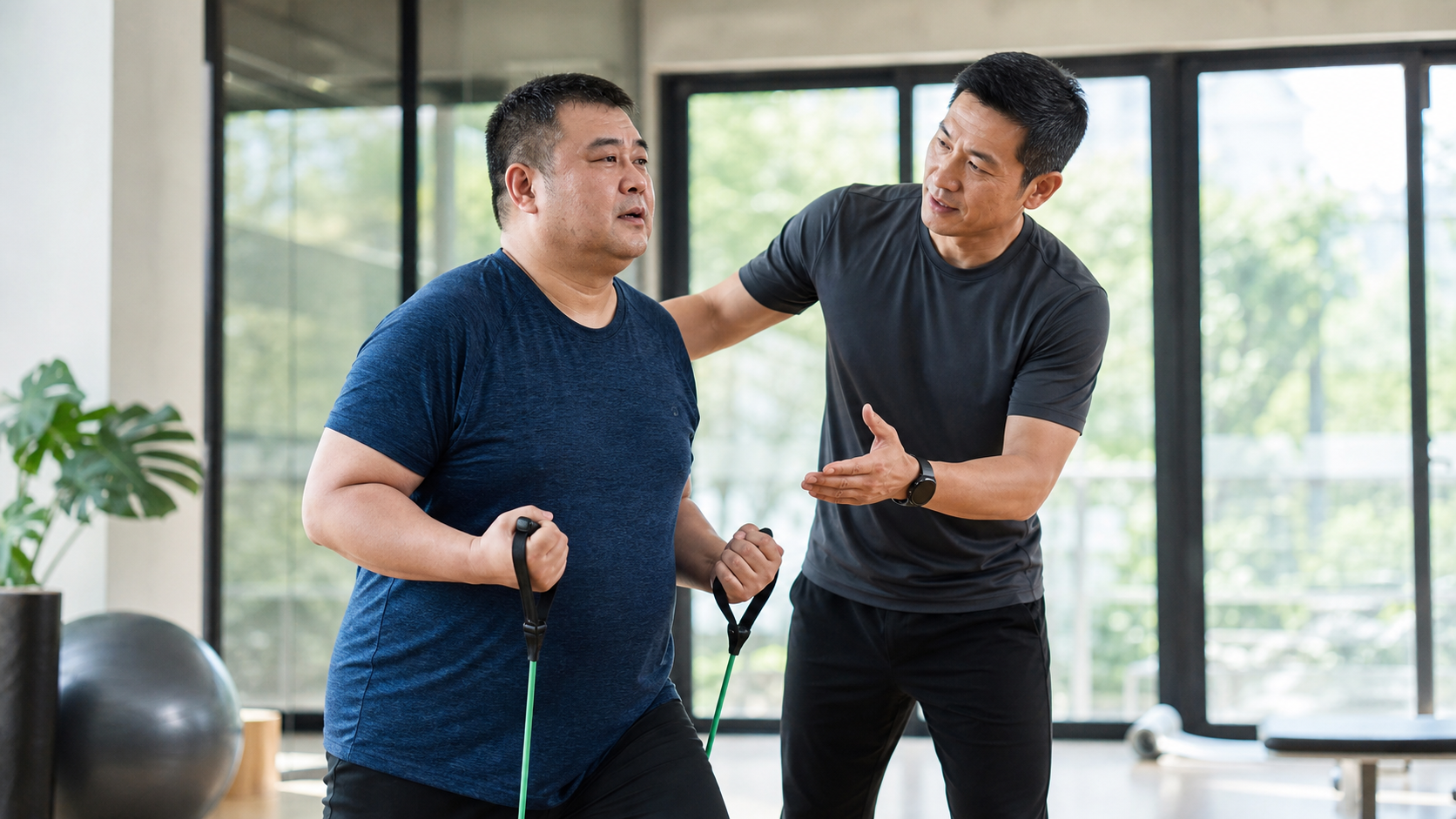
A few years ago, there was a guy I’ll call A-Rong. At our first meeting, he weighed close to 100 kilograms. His knees hurt the moment he squatted, his blood pressure was elevated, and his doctor had already warned him in the clinic that if he didn’t start moving, he’d need medication. The first thing he said to me was: “Coach, I’ve tried gym memberships before. Two weeks on the treadmill and my knees gave out. Maybe I’m just not cut out for exercise?”
I’ve heard that sentence far too many times. The problem has never been “not being cut out for exercise”—it’s that we often use the wrong methods and the wrong dosage, turning something that should serve us for a lifetime into a short-lived act of self-punishment. A-Rong went on to spend about fourteen months getting his weight down to around 82 kilograms. His knees stopped hurting, and his blood pressure stabilized under his doctor’s monitoring. But more importantly—three years later, he’s still moving. That’s the real weight behind the phrase “long-term management.”
What I want to talk about in this article isn’t “how to lose ten kilos in three months”—I wouldn’t write a single headline like that. What I want to talk about is this: when someone’s body carries more weight, higher joint loads, and maybe some metabolic or cardiovascular red flags, what kind of exercise strategy should we use so they can keep moving sustainably, stay as injury-free as possible, and genuinely improve their health on a multi-year timescale. This is an ultramarathon, not a sprint.
Getting the Mindset Right First: What Role Does Exercise Actually Play in Obesity Management?
The Main Battleground for Weight Loss Is the Kitchen; Exercise Is the Key to Holding the Line
I have to be honest from the start: if the goal is “a lower number on the scale,” energy restriction through diet is the main driver. Exercise alone typically produces far less weight loss than people imagine. This isn’t a knock on exercise—it’s about setting the right expectations. A lot of people exercise for three weeks, step on the scale, see no change, and give up in despair. The problem starts with the wrong expectation from day one.
According to the World Health Organization’s (WHO) 2020 physical activity guidelines, adults should accumulate at least 150 to 300 minutes of moderate-intensity aerobic activity per week, or 75 to 150 minutes of vigorous-intensity aerobic activity, plus muscle-strengthening activities involving all major muscle groups on two or more days per week. On the specific issue of weight management, the evidence shows that “higher activity volumes” are what correlate with better body fat and weight control. Relying only on the lower bound of the guidelines will produce more limited weight-loss results for people who are already obese.
If you put exercise in its proper place, its role actually breaks down like this:
- Weight-loss phase (numbers going down): Dietary energy deficit is the lead; exercise is the supporting actor. Pooled research indicates that exercise combined with a calorie-restricted diet produces roughly 20% more weight loss than diet alone—an additive effect.
- Maintenance phase (not regaining): Here, exercise flips into the lead role. Multiple lines of evidence show that people who successfully maintain their weight loss generally accumulate about 200 to 300 minutes of moderate-intensity activity per week. Exercise’s greatest value is helping you defend the results you worked so hard to achieve—not letting them snap back like a yo-yo.
- Throughout (health and function): Whether or not the number moves, exercise is improving blood sugar control, blood pressure, cardiorespiratory fitness, muscle mass, and psychological state. These benefits don’t have to wait for the weight to drop—I always tell every client this early on, because it’s what sustains their confidence during plateaus when the scale stalls.
Why People with Obesity Need “Low Injury Risk First, Then Intensity”
For every extra kilogram of body weight, the force on the knee joint during walking can be amplified severalfold—and during running, it’s even more extreme. A 100-kilogram person who goes straight into running subjects their knees, hips, and ankles to repeated impact far beyond what their current tendons, ligaments, and cartilage can handle. A-Rong’s “knees that gave out after two weeks” weren’t a sign that he couldn’t do it—it was the wrong dosage and the wrong impact.
So my first principle when working with people with obesity is always: build the “exercise habit” and “baseline strength” using low-impact, sustainable methods first, then gradually talk about intensity and impact. If you get the order backwards, injury is almost inevitable—and the training break caused by a single injury is often the starting point of the whole plan collapsing.
Practical Approach: A Sustainable, Low-Injury Exercise Strategy
I break long-term exercise management for people with obesity into four pillars: low-impact cardio, strength training, daily activity (NEAT), and recovery and sleep. If any one of the four is missing, the long-term picture will tilt.
Pillar One: Low-Impact Cardio—First Aim for Duration, Then Intensity
For people carrying more weight, these are my go-to entry-level cardio tools. What they all share is low joint impact, the ability to sustain them for long periods, and easily adjustable intensity:
| Cardio Modality | Joint Impact | Beginner-Friendliness | Notes for the Taiwan Context |
|---|---|---|---|
| Indoor cycling / road cycling | Very low | High | Saddle bears the weight, no knee pounding; escape summer heat and humidity in an air-conditioned studio |
| Brisk walking / fitness walking | Low to moderate | Very high | Riverside trails, school tracks, and parks are everywhere; lowest barrier to entry |
| Swimming / water walking | Extremely low | Moderate | Buoyancy unloads body weight; top choice for those with knee pain, though it requires a pool and swimming ability |
| Elliptical trainer | Very low | High | Common in gyms; mimics running motion without landing impact |
| Rowing machine | Low | Moderate | Full-body involvement, burns a lot; but form must be taught correctly or it can hurt the lower back |
I usually have heavier beginners start with cycling (indoor spin or outdoor road bike) or brisk walking. Cycling is especially well-suited to Taiwan—when summer heat and humidity become unbearable, you can retreat to an air-conditioned spin studio; in cooler months, head to riverside paths or gentle mountain slopes. The knees never have to absorb landing impact, and intensity can be precisely controlled with watts or heart rate.
How do you gauge intensity? I don’t like having beginners stare at complicated heart-rate zone charts and work themselves into anxiety. The most practical entry-level tool is the “talk test”:
- Can chat comfortably but singing would leave you breathless → That’s roughly moderate intensity—exactly where entry-level cardio should live.
- Can only manage short sentences, speech breaks up → That’s higher intensity; avoid it in the beginner phase and add it in stages once your base fitness is built.
- Can sing along effortlessly → Too easy; add a little more.
If a client is willing to wear a heart-rate monitor, moderate intensity roughly corresponds to 60% to 70% of maximum heart rate. A rough estimate for max heart rate is “220 minus age,” but that’s only a very crude reference—individual variation is huge, and real-world testing and perceived effort always take priority. For a 50-year-old, moderate intensity falls roughly in the 100 to 120 bpm range, but remember that’s a range, not an exact value.
Pillar 2: Strength Training — Preserve Muscle, Preserve Your Metabolism and Joints
Many people think that weight loss only requires cardio, which is a huge misconception. Under an energy deficit, without the stimulus of strength training, part of the weight you lose will come from muscle — and muscle is both your metabolic engine and your joints’ natural protective gear. Muscle loss lowers your basal metabolic rate, makes long-term maintenance harder, and leaves your knees and hips without support, making them more prone to pain.
For beginners with obesity, my strength training principles are:
- Start with bodyweight and machine-assisted movements, without rushing into heavy loads and highly technical exercises (e.g., jumping straight into barbell squats and deadlifts).
- Prioritize lower body and core training, because they directly relate to daily functions like walking, climbing stairs, and sitting-to-standing, as well as knee and hip protection.
- Perform movements within a pain-free range of motion; people with knee pain can start with chair-assisted sit-to-stands instead of forcing a deep squat.
Below is the Phase 1 strength template I often give to beginner clients with obesity, done twice a week, focusing on safe and easy-to-learn movements:
| Exercise | Target Area | Sets × Reps | Beginner Alternative / Regression |
|---|---|---|---|
| Sit-to-Stand (Chair-Assisted Squat) | Thighs, Glutes | 3 × 8-12 | Use a higher chair, hold onto armrests |
| Wall Push-Up | Chest, Shoulders, Arms | 3 × 8-12 | Hands on wall; the more upright the angle, the easier |
| Seated Row (Resistance Band / Machine) | Upper Back | 3 × 10-15 | Loop the band around a door handle |
| Glute Bridge (Supine Hip Lift) | Glutes, Core | 3 × 10-15 | Start with a small range of motion, no need to push high |
| Plank (Knees Down Allowed) | Core | 3 × 20-40 seconds | Drop to knees to reduce difficulty |
Increase intensity gradually as your fitness improves. The principle is: “First get the form right, then achieve full range of motion, then talk about adding weight.” If each set feels somewhat challenging but you can still maintain proper form, that’s the right weight.
Pillar 3: Treat “Daily Activity Level” as a Hidden Weapon
In exercise science, there’s an often-overlooked term called NEAT (Non-Exercise Activity Thermogenesis). In plain terms, it’s all the physical activity you do in a day that isn’t “formal exercise”: walking, climbing stairs, doing chores, standing while on the phone, walking the dog. For sedentary people, raising NEAT can accumulate more daily energy expenditure than a single workout session — and it carries almost no injury risk and doesn’t consume your willpower budget for “dedicated exercise time.”
The NEAT prescriptions I give clients are usually these down-to-earth actions:
- Get off public transport one or two stops early and walk, or park your scooter farther away.
- Take the stairs instead of the elevator whenever possible (provided your knees don’t hurt; if they do, take the elevator).
- Every 45 to 60 minutes of sitting, stand up and move around, pour a glass of water, or walk to the restroom.
- After dinner, take a 20-minute walk with your family along the riverside or around the neighborhood — it’s good for your health and your relationships.
Pillar 4: Recovery and Sleep — The Most Underrated Pillar
Insufficient sleep disrupts appetite-related hormones, increases cravings for high-calorie foods, impairs post-exercise recovery, and raises injury risk. I’ve seen too many people with packed training schedules and controlled diets who stall completely because they sleep less than six hours a night and are under chronic stress — and their weight doesn’t budge. Recovery isn’t laziness; recovery is part of training. Give your body time to repair, and you’ll go further.
Putting the Four Pillars Together: A Phased Weekly Schedule
Principles alone are too abstract, so here are three sample weekly schedules for different starting points. Please note these are general templates, not personal prescriptions; if you have cardiovascular or metabolic conditions or old joint injuries, consult a physician and a professional coach for individualized adjustments.
Phase 1: Habit-Building Period (First 4 to 8 Weeks)
The goal is simple — get your body used to “moving regularly” and build foundational strength, with zero focus on intensity or numbers.
| Day | Content | Time / Intensity |
|---|---|---|
| Monday | Low-impact cardio (stationary bike / brisk walking) | 20-30 minutes, conversational pace |
| Tuesday | Phase 1 strength template | ~30 minutes |
| Wednesday | Rest or walk | Easy 20-minute walk |
| Thursday | Low-impact cardio | 20-30 minutes |
| Friday | Phase 1 strength template | ~30 minutes |
| Saturday | Longer recreational activity (suburban cycling / swimming) | 30-40 minutes, easy |
| Sunday | Complete rest | Prioritize sleep and recovery |
The success metric for this phase is not body weight, but “did I show up consistently these 4 to 8 weeks?” I often tell clients: if you can prove to yourself that you can exercise consistently in this phase, you’re already halfway there.
Phase 2: Capacity-Building Period (Around Months 2 to 4)
Once habits are stable and movements are familiar, gradually build up total weekly cardio volume, working toward the weight-maintenance goal of accumulating 200 to 300 minutes of moderate-intensity exercise per week.
| Day | Content | Time / Intensity |
|---|---|---|
| Monday | Moderate-intensity cardio | 40-50 minutes |
| Tuesday | Strength training (can progress weight / movements) | 40 minutes |
| Wednesday | Low-intensity cardio (recovery) | 30 minutes, easy |
| Thursday | Moderate-intensity cardio | 40-50 minutes |
| Friday | Strength training | 40 minutes |
| Saturday | Longer cardio (long-distance cycling / hiking) | 60-90 minutes, easy |
| Sunday | Complete rest | Recovery |
Phase 3: Long-Term Maintenance (After Habits Are Solid)
The focus of this phase is integrating exercise into your life so it’s sustainable for a lifetime — not endlessly adding volume until you burn out. Adjust content flexibly based on personal preference and lifestyle, as long as you maintain sufficient weekly cardio volume plus two strength sessions, and keep activities you enjoy (e.g., weekend group rides). The key to sustainability is often “this is something I still enjoy doing.”
How to Read Heart Rate Zones: A Reference Chart for Those Who Wear a Watch
Earlier I mentioned the “talk test” as the best tool for beginners, but many clients who buy a sports watch want more detail. Here’s a general heart rate zone reference chart, using “220 minus age” to estimate maximum heart rate (HRmax) as the baseline. One more reminder: this is a rough general range, not a precise prescription — individual variation is large, and actual testing and perceived exertion always take priority over formulas.
| Zone | % of HRmax | Perceived Exertion / Talk Test | Use in Obesity Management |
|---|---|---|---|
| Very Light (Warm-up / Recovery) | 50-60% | Can sing while talking | Warm-up, cool-down, recovery days |
| Moderate (Fat Utilization Zone) | 60-70% | Can chat, but singing makes you breathless | Main battleground for beginner cardio, sustainable for long durations |
| Moderate-High Intensity | 70-80% | Can only speak short phrases | Add periodically after building a base |
| High Intensity | 80-90% | Barely able to speak | Avoid in the beginner phase; use sparingly for advanced trainees |
For example, a 40-year-old client has an estimated HRmax of about 180 bpm, so moderate intensity falls around 108 to 126 bpm; a 60-year-old client has an HRmax of about 160 bpm, with moderate intensity around 96 to 112 bpm. Beginners should spend the vast majority of their time in the moderate-intensity zone, steadily accumulating minutes over time rather than trying to spike their heart rate to the max every session. If you take heart or blood pressure medication, please note that certain drugs (such as beta-blockers) can suppress the heart rate response during exercise, making the formula completely inaccurate — in such cases, rely on perceived exertion and seek guidance from your physician.
The Matter of Calories: A Realistic Sense of Scale
Many people overestimate the calories burned by exercise, and also overestimate the deficit that exercise alone can create. I give my clients a rough order-of-magnitude reference to help them build a sense of reality (actual expenditure varies greatly depending on body weight, intensity, and efficiency; this is only an order of magnitude):
| Activity (about 30 minutes) | Approximate Expenditure | Reality Check |
|---|---|---|
| Easy walking | About 100–200 kcal | Roughly equal to one full-sugar hand-shaken drink |
| Moderate-intensity cycling | About 200–300 kcal | A serving of fried food or half a bento box will undo it |
| Moderate-intensity swimming | About 200–300 kcal | Burns a fair amount, but don’t use that as an excuse to binge |
Understanding this table will make two things clear: First, exercise can hardly “burn off” a binge-eating episode, so restraint on the diet side cannot be skipped; second, the real value of exercise is not those few hundred calories, but its comprehensive improvements to blood sugar, blood pressure, muscles, cardiorespiratory fitness, and mood, as well as its critical role in preventing weight regain during the maintenance phase. Treat exercise as a “health investment” rather than an “indulgence pass”—only then will your mindset stay healthy and sustainable.
A Complete Case Over Fourteen Months: How A-Rong Got Through It
Returning to A-Rong from the beginning, I want to break down his fourteen months, because almost every turning point corresponds to the principles discussed earlier. (The following scenario is a teaching recap; the data are described within a reasonable range and are not an exact medical record.)
Months 0–2 (Habit-building phase): I didn’t let him touch the treadmill at all. He came twice a week to do chair-assisted sit-to-stands and wall push-ups, and on the other days he did slow walking along the riverside near his home, 20 minutes at a time, at an intensity where he could still talk on the phone. In the first six weeks, he didn’t lose a single kilogram and even considered giving up. I told him: “You haven’t missed a session in these six weeks—that’s your proof of winning. The weight will come later.” He stayed, half-convinced.
Months 3–6 (Capacity-building phase): Once the habit was stable, I had him transition from walking to indoor spinning—because his knees had always been his weak point, and seated, weight-supported cycling suited him best. At the same time, we made changes on the diet side, with only three key points: full-sugar hand-shaken drinks switched to sugar-free, a serving of protein first at every meal, and white rice cut in half. With just these three changes, plus cycling built up to about 180–200 minutes per week, his weight began to steadily trend downward—his waistline showed results first, and the number on the scale followed. During this period, he learned to “look at the four-week trend, not the single day.”
Months 7–10 (Plateau and breakthrough): This was the most critical stretch. His weight stalled for nearly a month, and he became anxious again. We reviewed things together and found two problems: first, on weekends he often “binged because he had exercised,” driven by a compensation mindset; second, his sleep was poor—he was working long hours and sleeping less than six hours a night. Instead of adding more training, we first addressed sleep and weekend eating. After the adjustments, his weight started moving downward again. Many solutions to a plateau are not in “training more,” but in filling in the other pieces of the puzzle—diet, sleep, and stress.
Months 11–14 (Wrap-up and transition to maintenance): His weight settled around 82 kg, his waistline visibly shrank, and his blood pressure steadily improved under his doctor’s monitoring. More importantly, he fell in love with cycling and began inviting colleagues for long rides along the riverside. At this stage, my job had shifted from “supervising the training plan” to “accompanying him in making exercise part of his life.”
There is nothing magical about this case. It is simply a combination of the principles discussed: low-impact start, gradual progression, taking care of diet and sleep together, evaluating by trend rather than single-day readings, and turning exercise into a hobby. It is replicable, but it requires time and patience.
Common Mistakes and Corrections: The Pitfalls I See Most Often in My Clients
Over these fifteen years, the failure patterns I’ve observed are highly repetitive. Laying out these pitfalls clearly is more useful than any magical training plan.
Mistake 1: Starting Too Hard and Increasing Volume Too Fast
Symptoms: Full of enthusiasm in week one, exercising an hour every day at maximum intensity. Result: In weeks two and three—knee pain, plantar pain, extreme fatigue, then quitting and giving up.
Correction: Follow the progressive principle of “increase weekly volume by no more than about 10%.” Better to go slower than to get injured once. Body tissues (tendons, ligaments, cartilage) adapt much more slowly than the cardiorespiratory system, and people with higher body weight need to give them even more time. You’re not competing with anyone else; you’re partnering with the version of yourself who is still moving three years from now.
Mistake 2: Doing Only Cardio and No Strength Training at All
Symptoms: Running and cycling hard, losing weight, but ending up with loose, sagging contours, a metabolism that slows down more and more, and joints that actually hurt more easily. Correction: Be sure to schedule two strength-training sessions per week to preserve muscle. This is the foundation for maintaining metabolism and protecting joints—there is no shortcut.
Mistake 3: Treating the Scale as the Only Scorecard
Symptoms: Weighing yourself every day; if the number doesn’t move or bounces up, you have an emotional breakdown and dismiss all your efforts. Correction: Body weight fluctuates one to two kilograms daily due to water, sodium, menstrual cycle, and bowel movements—looking at a single-day number is like looking at noise. I ask my clients to look at these indicators instead:
- Weigh once a week at a fixed time (e.g., weekday mornings after using the restroom), and look at the four-week trend rather than a single day.
- Waist circumference changes (measuring with a tape at navel height)—this tracks visceral fat more closely than body weight.
- How tight or loose your clothes feel.
- Exercise performance: the same cycling distance feels easier, climbing stairs no longer leaves you winded, and the weight you can lift increases.
These non-scale indicators often keep improving even during a “false plateau” on the scale, and they are the key to sustaining confidence.
Mistake 4: Using Exercise to “Offset” Binge Eating, Falling into a Compensation Mindset
Symptoms: “I exercised today, so I can eat this piece of cake.” The result is that the calories burned in one session are nowhere near enough to offset the amount consumed in one binge. Correction: Treat exercise and diet as two independent health habits managed separately—don’t let them negotiate with or pay off each other. The value of exercise goes far beyond burning those few hundred calories.
Mistake 5: Ignoring Warning Signs of Pain, Mistaking “Pain” for “Effectiveness”
Symptoms: Pushing through sharp joint pain with a “no pain, no gain” attitude. Correction: The soreness after exercise (usually appearing a day or two later, symmetrical on both sides, and gradually subsiding) is mostly normal; but sharp, stabbing joint pain, unilateral, worsening with movement, or accompanied by swelling is a red light to stop immediately and seek medical evaluation. In Taiwan, it’s very convenient to see orthopedics, rehabilitation medicine, or sports medicine clinics, and it’s covered by National Health Insurance—don’t tough it out and let it become a chronic injury.
Local Taiwan Practicalities: Climate, Eating Out, and the Healthcare Environment
No matter how good the strategy, it’s meaningless if it can’t be implemented. There are several very Taiwanese real-world situations that I always work through with my clients.
What to Do About the Heat and Humidity
Taiwan’s summers are hot and humid. Exercising outdoors at noon not only reduces effectiveness but also carries risks of heatstroke and cardiovascular strain—especially for people with higher body weight or potential blood pressure issues. My recommendations:
- Avoid the high-temperature window from 10 a.m. to 4 p.m., and exercise in the early morning or evening instead.
- When the heat is unbearable, move exercise indoors: spinning studios, gyms, and air-conditioned swimming pools are all good options.
- Hydrate proactively—don’t wait until you’re thirsty; for prolonged exercise with heavy sweating, moderately supplement with electrolyte-containing drinks.
The Dietary Reality for People Who Eat Out
Eating out is convenient in Taiwan, but it often comes with high oil, high sodium, lots of refined carbohydrates, and few vegetables. I don’t ask my clients to cook every meal at home (most people can’t), but instead give them principles that work even when eating out:
- Ensure a serving of protein at every meal (legumes, fish, eggs, meat)—available at buffet restaurants and bento shops alike.
- Order an extra serving of blanched or braised vegetables to make up the fiber.
- Sugary drinks are a hidden calorie trap—switch hand-shaken drinks to sugar-free or simply swap to water/sugar-free tea. This single change often yields surprising results.
- Refined carbohydrates (white rice, noodles) are fine in moderation—no need for extreme elimination; what matters most is what you can sustain long-term.
These are general dietary directions; for individual nutritional needs (especially for those with chronic conditions), please consult a registered dietitian for a personalized plan.
How to Start with a Chronic Condition
I want to emphasize this point seriously. If you have diabetes, high blood pressure, heart disease, joint conditions, or are significantly overweight and have been inactive for a long time, please get a medical evaluation first, obtain your doctor’s clearance before starting an exercise program, and inform both your doctor and coach about your medications and medical history.
- Some blood sugar-lowering and blood pressure medications can affect your blood sugar and heart rate responses during exercise, which requires professional adjustments.
- Exercise can be a powerful tool for managing blood sugar and blood pressure, but it must be individualized, with intensity and methods tailored to you.
- What I discuss here are general educational principles, not a diagnosis or prescription for any individual. Your medical team is the one who should be overseeing your safety.
Taiwan’s healthcare accessibility is actually quite good—NHI outpatient clinics, rehabilitation departments, and sports medicine departments are not difficult to book. Make good use of this environment and let professionals safeguard your safety.
Actionable Advice for Readers at Different Levels
Finally, I’ll divide the recommendations into three groups based on your starting point, so you know the next step by the time you finish reading today.
If You Are a Complete Beginner Who “Doesn’t Exercise at All”
- Your only goal this week: get moving three times, 15 to 20 minutes of easy brisk walking or indoor cycling each session. Keep the intensity low enough that you can chat comfortably.
- Don’t look at the scale. First, prove to yourself that “I can show up consistently.”
- If you have a chronic condition or are significantly overweight, book a doctor’s evaluation first.
- Remember: Starting is ten thousand times more important than being perfect.
If You Are Intermediate—“Have Some Foundation but Often Quit Halfway”
- Examine your past failure patterns—they are usually “going too hard too fast” or “only watching the scale.” Use the common mistakes above to self-correct.
- Gradually build your weekly aerobic activity toward 200 minutes or more, and add two strength-training sessions per week.
- Establish non-scale tracking metrics (waist circumference, exercise performance), and evaluate yourself with trends rather than single-day numbers.
If You Have Already Successfully Lost Weight and Are Maintaining
- Your biggest enemy now is regaining the weight, and exercise is the main tool for holding the line. Maintaining about 200 to 300 minutes of activity per week is a common trait among many successful maintainers.
- Find an exercise you genuinely enjoy and can do for a lifetime (for many people, that’s cycling), and make it part of your life rather than a chore.
- Allow yourself flexibility. Missing a weekly target occasionally is not a collapse—long-term consistency is what determines the outcome.
Conclusion: What You Need Is a Method That Can Walk with You for a Lifetime
Back to A-Rong from the beginning. What made me most proud was never the eighteen kilograms—it was a weekend morning three years later when he texted me: “Coach, today I rounded up a few colleagues and rode forty kilometers along the riverside. It was awesome.”
At that moment, I knew exercise was no longer his enemy, nor a chore, but a part of his life. That is the end point of “long-term management”—not a number on the scale, but internalizing exercise into a lifestyle you are willing to sustain for the rest of your life.
Long-term management of obesity is an ultramarathon. It doesn’t require a three-month burst, but years of sustainability, staying injury-free, and gradual accumulation. Be kind to your body, give it time, and choose a way you can do and enjoy. Slow, but never stopping—you will go further than you ever imagined.
Frequently Asked Questions (FAQ)
Q1: I’m very heavy. Can I start running right away?
My advice is not yet. At a higher body weight, the impact of running is hard on the knees, hips, and ankles, and it’s easy to get injured before you’ve built the habit. Start with low-impact options like cycling, brisk walking, or swimming to build a foundation. Once your weight drops somewhat and your lower-body strength is established, if you still want to run, progress gradually with a “walk-run interval” approach. When the order is right, running becomes a gift rather than an injury.
Q2: Do I have to join a gym or hire a coach? What if I don’t have the budget?
Absolutely not. The brisk walking, bodyweight strength training, and resistance band exercises in this article can be done at home or in a park at nearly zero cost. If you have the budget and want your form checked and individualized adjustments, hiring a professional coach is certainly faster and safer; but not having a budget is never a reason not to start. The riverside, the track, and the park are your free gym.
Q3: Can I just control my diet and skip exercise?
In the short term, diet alone can lower your weight, but you’ll lose more muscle, your metabolism will drop lower and lower, and without exercise during the maintenance phase, the chance of regaining weight rises significantly. The value of exercise in “holding your results” and “overall health” cannot be replaced by diet. Doing both together is the long-term solution.
Q4: I can only squeeze in two or three sessions a week. Is that even useful?
Yes, it is—and it’s far better than “doing nothing.” Rather than chasing a perfect schedule you can’t sustain and then giving up, first stabilize two or three sessions. Consistency matters far more than the intensity of any single session. First, hold steady at the frequency you can manage, then gradually add more when you have the capacity.
Q5: I’m very sore after exercise. Does that mean it’s working and I should push through?
Muscle soreness one to two days after exercise (bilateral, symmetrical, and gradually subsiding) is a normal adaptation—no need to stop training because of it, but it also doesn’t mean “the sorer, the more effective.” What you should truly watch for is sharp, one-sided, or progressively worsening joint pain—that’s a red light. Stop and see a doctor rather than pushing through.
Additional Conclusion: Put “Lifelong Sustainability” First in Every Decision
If you take away only one sentence from this long article, I hope it’s this: Before you decide to adopt any strategy, ask yourself, “Can I do this for five years?” Extreme dieting, forcing two hours of hard training every day, treating exercise as punishment—these might produce short-term numbers, but almost no one can sustain them, and a method that can’t be sustained is, in the long run, the same as useless.
Choose a way you can do, enjoy doing, and that your body won’t protest against, and accumulate slowly. Three years from now, the you who is still cycling along the riverside, still moving, with stable health markers, will thank the you who didn’t rush today.
This article is educational content and cannot replace individualized diagnosis and treatment advice from a physician, physical therapist, or nutritionist. If you have a chronic condition, joint injury, or any physical discomfort, please consult a qualified medical professional for an individualized assessment before starting an exercise program.
References
- World Health Organization — WHO Guidelines on Physical Activity and Sedentary Behaviour (adults recommended 150–300 minutes of moderate-intensity activity per week; higher activity levels needed for weight management): https://www.ncbi.nlm.nih.gov/books/NBK566046/
- WHO 2020 guidelines on physical activity and sedentary behaviour (PMC full text): https://pmc.ncbi.nlm.nih.gov/articles/PMC7719906/
- Obesity Medicine Association — How much physical activity is needed for weight loss, weight loss maintenance, and weight gain prevention (approximately 200–300 minutes per week needed to maintain weight loss): https://obesitymedicine.org/blog/how-much-physical-activity-is-needed-for-weight-loss-weight-loss-maintenance-and-weight-gain-prevention/
- Physical Activity, Sedentary Behaviour, and Obesity (NCBI Bookshelf, additive effects of combining exercise and diet): https://www.ncbi.nlm.nih.gov/books/NBK565813/
- Aerobic Exercise and Weight Loss in Adults: A Systematic Review and Dose-Response Meta-Analysis (dose-response relationship between aerobic exercise dose and body weight, waist circumference, and body fat): https://www.ncbi.nlm.nih.gov/pmc/articles/PMC11672165/
Related Reading
- The Truth About Exercise and Weight Management: Can Exercise Actually Help You Lose Weight? A Coach Breaks Down the Division of Labor Between Exercise and Diet
- The Truth About Exercise and Weight Management: Can Exercise Help You Lose Weight? A Coach Explains Compensation Mechanisms and the Division of Labor with Diet
- Weight Cycling and Metabolic Adaptation in Athletes: The Cost of Repeated Weight Loss and Truly Sustainable Weight Management
- Athlete Nutrition and Long-Term Health: Keeping You Riding Strong for 30 Years — Sustainable Eating and Chronic Disease Prevention
靠單車減肥35公斤 心得分享與整理
7 年前
西進武嶺 免費訓練分析服務 Intervals | 練不夠還是練過頭?你哪一種類型選手?AI模型告訴你! | 備戰神器 | 公路車 訓練 | CT Yeh
4 年前
一日北高/長距離團騎 常見問題補充篇 / 組團或跟團的眉角 / 壯車友容易被瘦車友慢性拉爆 / 原來屁股痛可能是這個原因...? / 風場配速法 / 公路車 / CT Yeh
2 年前
CT暗黑廚房) 車友必備 宇宙無敵鮮蚵湯 幫助訓練恢復 天然食補 好市多 超肥鮮蚵 破PR
7 年前
一日北高常見問題大集合 | 攻略 | 路線 | 訓練 | 補給 | 自行車 單車 | 一日雙城 | 雙塔 | TWB北高360 | 屁股痛
6 年前
16/02/16 - 夜訪中社路 緩慢進步中
10 年前
近視雷射三個月後悔嗎?單車族/工程師必看,Smart TransPRK 術後血淚史與後遺症全公開 / CT Yeh
4 個月前
CT趣訪 西進武嶺 2小時組 EP2 全村的希望 蔣緯緯! 訓練菜單&技巧公開 |公路車 |CT Yeh
4 年前