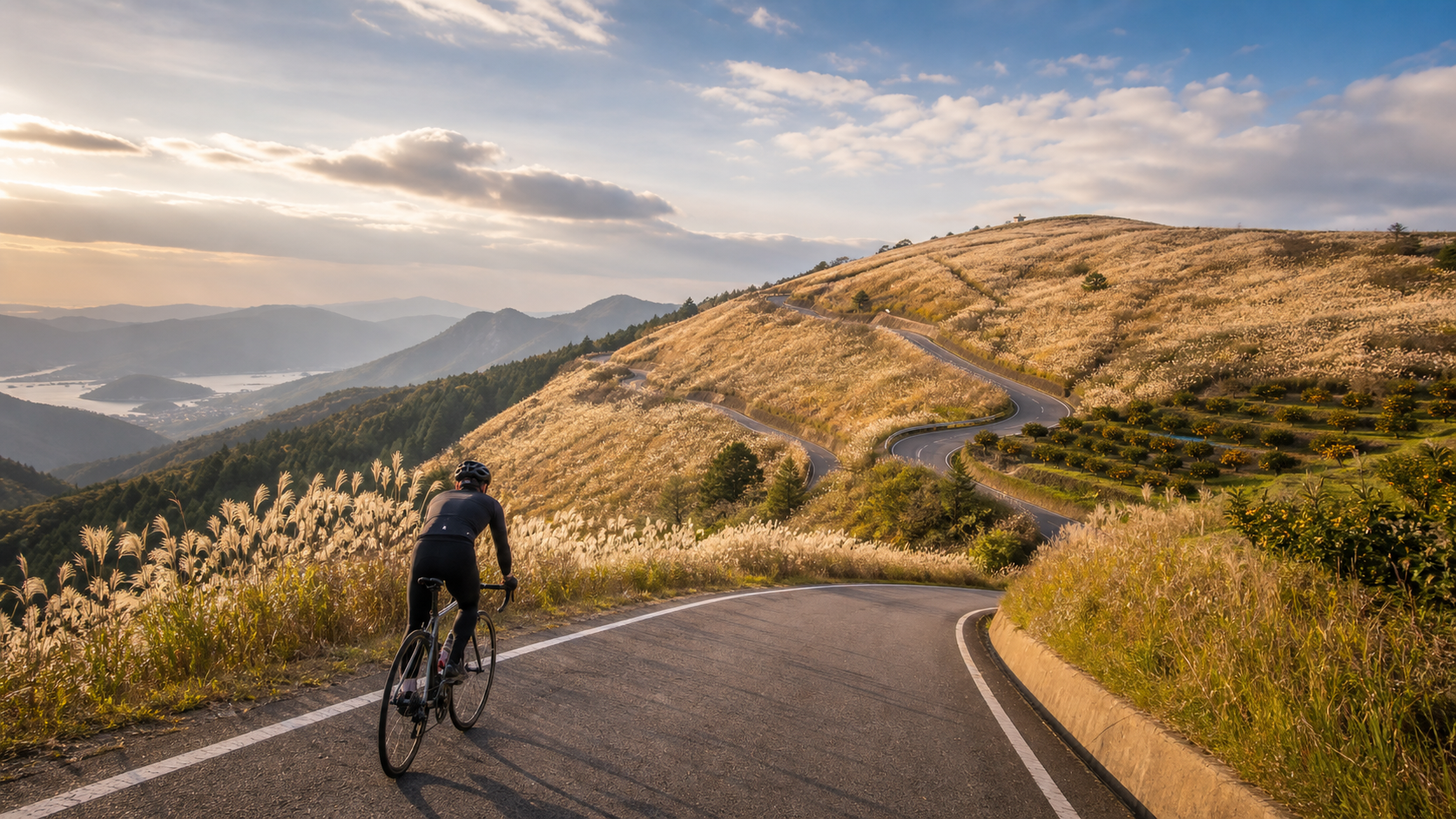
Some climbs are for the sake of performance; some climbs are for the sake of scenery. And Prefectural Route 19, leading to Mt. Oishi Highland (Oishi-kogen) in Wakayama, exists for that expanse of silver grass that surges into a golden sea in the wind.
This road, which locals call the “Alpe d’Huez of Wakayama,” stretches 6.7 kilometers with 361 meters of elevation gain and an average gradient of 5.4%, winding upward through hairpin turns, carrying you from the satoyama countryside along the Arida River to a highland about 870 meters above sea level. The name borrows from a Tour de France legend, yet its character is entirely the gentle spirit of Wakayama’s Kii mountains. This piece isn’t about pacing charts—I want to show you—that vast expanse of silver grass at the summit, the most magnificent in the Kansai region, and whether it’s truly worth those 6.7 kilometers of pedaling.
Starting from a River Valley
The story of Mt. Oishi Highland begins in the valley of the Arida River.
The Arida River is a famous river in Wakayama, with citrus groves flourishing along its banks—the “Arida mikan” grown here is one of Japan’s top citrus-producing regions. Riding along the valley road before the climb begins, you’re flanked by terraced citrus orchards, orange-yellow fruit hanging among the green leaves, the air seemingly carrying a hint of citrus fragrance. This is the most quintessential countryside scenery of Kii Province: warm, bountiful, blessed by sunlight.
Then, the road turns into the mountains and begins to tilt. The citrus orchards gradually fall behind, replaced by forests deepening in green. The climb up Mt. Oishi Highland begins, quietly, without fanfare.
Spiraling Upward: The Hairpin Turns That Make You Look Back
“The Alpe d’Huez of Wakayama”—the heart of this title lies in that series of hairpin turns.
The real Alpe d’Huez has 21 numbered hairpin bends, the most famous climbing stage in the Tour de France. Mt. Oishi Highland certainly doesn’t have that many, but its spiraling posture does bear some resemblance. With every bend you climb, the road doubles back, lifting you higher.
One reason I particularly love hairpin climbs is—you can look back.
At every switchback, you can see the road you just climbed, winding like a ribbon across the slope below you. That sense of accomplishment—“I’ve already climbed this high”—is something a straight climb can never give you. You’re no longer just burying your head and grinding; you can witness your own effort accumulating, loop after loop, on the mountainside.
The gradient isn’t brutal; the 5.4% average leaves you room to look up and take in the scenery. Citrus orchards, satoyama, the distant river valley—all unfolding layer by layer as you gain altitude. The higher you climb, the wider the view, until—you reach that sea of grass.
The Summit: A Singing Golden Sea
At the top of Mt. Oishi Highland lies a vast silver grass prairie of about 13 hectares.
Those who haven’t seen it with their own eyes can hardly imagine the scene. At an elevation of about 870 meters, the summit suddenly opens up from the forest, no longer obstructed—only an entire, endless expanse of silver grass, undulating and surging in unison in the wind, like a sea shimmering between silver and gold.
Autumn is when it’s most beautiful. In October, the silver grass plumes are silvery-white, catching the sunlight in fine glimmers; by November, the low sun of dawn and dusk dyes the entire prairie gold, and when the wind blows, golden waves roll from one end to the other, rustling softly. The sound is gentle, yet it fills the entire mountaintop—as if the whole prairie were singing softly to you.
On the prairie stands a massive rock called “Hokami-iwa (火上岩),” a landmark of the area. Climb up it, and you can survey the entire highland and the distant mountains and sea in 360 degrees. On clear days, the view stretches far, far away, with the layered ridges of the Kii Peninsula spreading across the horizon.
The first time I climbed Mt. Oishi Highland was an evening in November. After finishing those 6.7 kilometers, I leaned my bike to the side and walked into that waist-high silver grass. The setting sun hung low, the entire prairie burning gold, the wind bending the plumes to one side before they sprang back. I stood there, doing nothing, just watching and listening. The fatigue from the climb, the clutter of daily life—all of it was swept away by that golden landscape.
In that moment, I understood—some rewards from climbing are too precious to be exchanged for any performance.
A Highland Transformed by the Seasons
Mt. Oishi Highland isn’t only about autumn silver grass.
- Spring, the mountains are cloaked in fresh green, citrus blossoms bloom, the air is sweet—the season to start riding again.
- Summer, while Wakayama below swelters, this highland near 870 meters enjoys cool breezes, making it an excellent summer climbing destination; the prairie is a lush green, brimming with vitality.
- Autumn, of course, belongs to the silver grass—the interwoven sea of gold and silver is the most magnificent scenery of the year.
- Winter, the prairie fades to withered gold, with few visitors, yet carries a vast, serene beauty; however, temperatures are low and roads may be slippery, so it’s best left to those who come well-prepared.
The same highland offers you four completely different moods across the seasons. But no matter the season, that sense of openness—“emerging from the forest and suddenly embraced by the entire sky and prairie”—never changes.
The Descent, and a Kii Mikan
After reaching the summit and taking in the views, it’s time to descend.
Descending the hairpins requires focus; it’s the only part of this road where you need to keep your nerves taut. But as you spiral down under control, the citrus orchards gradually come back into view, and you feel the entire ride has drawn a complete circle—setting out from the river valley, climbing to the sky above the highland, and returning to the human world fragrant with citrus.
If the season is right, don’t forget to buy a few Kii mikan at the foot of the mountain. That’s the sweetest taste of this land. Just after finishing the climb, peel open a mikan, and the sweet-tart juice melts in your mouth—that flavor, like the golden silver grass at the summit, will stay with you for a long time.
Side Trip: The Mountains and Sea of Wakayama
Wakayama, where Mt. Oishi Highland sits, is a place where both mountains and sea are beautiful. After climbing this road, you can extend your itinerary further—south lies the magnificent coastline of the Kii Peninsula, and east connects to sacred World Heritage sites like Mt. Koya.
Wakayama’s cycling routes always weave together the challenge of the mountains with the vastness of the sea, the grandeur of nature with the depth of culture. Mt. Oishi Highland is one of its brightest gems—not the hardest, yet beautiful enough to make you think of it again and again.
Epilogue: For a Sea of Grass, It’s Worth It
6.7 kilometers, 361 meters of elevation gain. As climbs go, this is a road that’s “just right”—achievable with effort, yet not enough to discourage you.
But its true weight has never been in the numbers. It lies in that sea of silver grass at the summit that surges gold in the wind, in the ribbon spiraling below you at every hairpin when you look back, in the fragrance of the citrus orchards and the sweetness of Kii mikan.
People ask, climbing is so tiring—what’s the point?
I’d point to that golden prairie atop Mt. Oishi Highland and say: the point is that moment, standing in the sea of grass, surrounded by wind and sunset, with nothing at all to think about.
For that one moment, these 6.7 kilometers are worth it.
Route data: Mt. Oishi Highland—Prefectural Route 19, distance 6.7 km, total elevation gain 361 m, average gradient 5.4%, Aridagawa Town, Wakayama Prefecture, nicknamed the “Alpe d’Huez of Wakayama,” ending at an elevation of approximately 870 m at Mt. Oishi Highland, home to Kansai’s magnificent silver grass prairie.
The Aesthetics of Silver Grass: Why the Japanese Are So Enamored with a Field of Grass
In Taiwan, we might find it hard to understand why the Japanese are so captivated by a field of silver grass (susuki). To us, silver grass is often just an unremarkable weed by the roadside. But in Japanese aesthetics, silver grass holds a special and profound place.
Silver grass is one of Japan’s “Seven Flowers of Autumn,” a symbol of autumn since ancient times. In waka poetry, haiku, and paintings, silver grass appears again and again, carrying the Japanese people’s distinctive, slightly melancholic aesthetic sentiment toward autumn—mono no aware (物哀). The way silver grass sways in the autumn wind, that desolate beauty of “flourishing then fading, splendor drawing to a close,” perfectly aligns with the Japanese culture’s deep understanding of “impermanence” and “the beauty of the fleeting.”
When moon-viewing, the Japanese place silver grass plumes by the window; during the mid-autumn “tsukimi,” silver grass is an indispensable centerpiece. This seemingly ordinary grass, in Japanese culture, carries an entire nation’s delicate feelings about the turning of seasons and the brevity of life.
So, when you stand on that vast silver grass prairie of about 13 hectares at Mt. Oishi Highland, watching the silvery-white and golden plumes surge in unison in the wind—what you’re seeing isn’t just a field of grass, but the embodiment of an entire nation’s aesthetic sensibility. Part of why that sea of grass is so moving is precisely the profound cultural weight behind it. Once you understand this layer, the scenery before your eyes becomes more dimensional, more profound.
360 Degrees from Hokami-iwa: Standing Beneath the Sky of Kii
Near the highest point of Mt. Oishi Highland stands a massive rock called “Hokami-iwa (火上岩),” a landmark of the area.
Climb up Hokami-iwa, and you can survey the entire highland and the distant mountains and sea in 360 degrees. On clear days, the view stretches far, far away—beneath your feet is the surging sea of silver grass, in the distance the layered ridges of the Kii Peninsula, and on exceptionally clear days you can even glimpse the sea. That sense of vastness, standing high and surrounded by the entire sky and earth, is the most luxurious reward this highland gives to those who reach the summit.
I still remember the moment I stood on Hokami-iwa. The wind was strong, bending the silver grass to one side and making my cycling jersey flap loudly. Standing on that massive rock, I found myself momentarily speechless—the scenery before me was so vast that language felt superfluous. The hardship of the climb just moments ago, the clutter of daily life—all blown away by this immensity. Faced with such a heaven and earth, one suddenly becomes very humble, and very free.
It’s a peculiar feeling: you exhaust yourself climbing up here, yet in the instant you reach the top, you feel yourself become infinitely small. But that smallness isn’t loss—it’s release. So this world is this vast, and so my worries are this insignificant. Mountains, in their own way, always briefly free us from the cage of the self.
Four Seasons, Four Expressions of Mt. Oishi Highland
The silver grass season at Mt. Oishi Highland is certainly its grandest moment, but this highland’s four seasons each hold their own beauty.
- Spring, the mountains are cloaked in fresh green, citrus blossoms bloom, the air is sweet. The highland grass is a tender green, brimming with life—the season of awakening.
- Summer, while Wakayama below is scorched by heat, this highland near 870 meters enjoys cool breezes. The prairie is a lush green, making it an excellent summer climbing destination. Reaching the summit on a summer evening, with cool breezes brushing your face, is especially refreshing.
- Autumn, of course, belongs to the silver grass. Silvery-white in October, golden in November, the sea of grass under dawn and dusk light is breathtakingly beautiful. This is the most magnificent and most poetic season of the year.
- Winter, the prairie fades to withered gold and desolation, with few visitors, yet carries a bleak, quiet beauty. However, temperatures are low and roads may be slippery, so it’s best left to well-prepared riders.
The same highland offers you four completely different moods across the seasons. This is why, even after climbing it once, I still want to go back in different seasons—because every time, it feels new.
The Sweetness of a Kii Mikan: The Taste of the Land
After riding Mt. Oishi Highland, if the season is right, don’t forget to buy a few Kii mikan at the foot of the mountain.
The Aridagawa area is one of Japan’s top citrus-producing regions, with “Arida mikan” famous nationwide. Just after finishing the climb, tired and thirsty, peel open a plump mikan, and the sweet-tart, juicy flesh melts in your mouth—that flavor is the most direct, sweetest gift of this land.
I’ve always believed that a good cycling trip should end with “the taste of the place.” Because food is the language of the land, the most honest expression of a region’s character. When you taste the sweetness of Arida mikan, ripened by the Kii sun, you’ve truly “tasted” this land—not just seeing its scenery with your eyes, but remembering its flavor with your tongue.
Years later, when you taste a similar citrus somewhere, you might recall this day: the spiraling hairpins, the vastness from Hokami-iwa, that sea of silver grass surging gold in the autumn wind. Taste is memory’s most faithful carrier. And the memory of Mt. Oishi Highland is thus sealed forever in your taste buds by a single small mikan.
After the Epilogue: The Romance of Riding for a View
In this era that values efficiency and data, “making a special trip to climb a slope for a view” might sound a bit foolish.
But I’ve always believed that this foolishness is precisely the most precious romance of cycling.
Mt. Oishi Highland isn’t the hardest climb, nor the most famous road. But it has a sea of silver grass that surges gold in the wind—and that alone is enough to constitute a “must-go” reason. Because some scenery, you must climb up to with your own legs to truly possess; some beauty, seen by car versus by bike, feels completely different.
When you’ve paid for those 6.7 kilometers with your sweat, when your legs are still radiating warmth from the hairpins just climbed, that sea of silver grass carries more weight in your eyes than any scenery easily obtained. That’s the romance of “riding for the view”—you use your effort to give beauty its weight.
So don’t mind the hardship of climbing, and don’t mind the detour being far. That golden sea of grass at Mt. Oishi Highland is surging quietly on the mountaintop of Kii, for every rider willing to sweat for it. And you deserve to see it, in person, for yourself.
May you too, on some autumn evening, stand in that sea of grass, surrounded by wind and sunset, with nothing at all to think about—just purely, gratefully, for the scenery you climbed up to with your own hands.
Cycling in Japan: An Experience of Being Gently Treated by the Land
Almost everyone who cycles in Japan falls in love with the cycling culture there—a feeling that’s hard to put into words yet genuinely exists: being “gently treated.”
Road users in Japan show an almost instinctive respect for cyclists. On narrow mountain roads, cars behind you will patiently follow, waiting until visibility is good and no oncoming traffic, then slowly overtake you while maintaining ample lateral distance. No impatient honking, no intimidating tailgating pressure. This courtesy adds a sense of security to the already demanding task of climbing. On the narrow hairpins of Mt. Oishi Highland, this security is especially precious.
Japan’s dense network of convenience stores is also a salvation for long-distance riders. Just when you need it most, there’s always a convenience store waiting by the roadside, offering rice balls, energy supplies, ice-cold drinks, and clean restrooms. This sense of “no worries about supplies” is a luxury unique to cycling in Japan.
And perhaps because of the Shinto belief that “all things have spirits”—mountains have mountain gods, trees have tree spirits—the Japanese hold a deep, culturally ingrained reverence for nature. This reverence rubs off on you as you ride there. When you ride through meticulously maintained forests and clean roads, you unconsciously soften your movements and treat the land beneath you with a more humble attitude.
This, perhaps, is why so many Taiwanese riders cross the sea again and again, just to pedal once more in the mountains of Japan. And Mt. Oishi Highland is, within this wonderful experience, a pearl gleaming with the light of golden silver grass.
For Those Still Hesitating
Perhaps you’re reading this article, weighing whether to include Mt. Oishi Highland in your itinerary. It’s not the most famous road, and the silver grass season is time-limited—is it worth a special trip?
My answer is: yes, absolutely worth it.
Because what Mt. Oishi Highland offers is a “just right” perfection—the difficulty falls precisely at the sweet spot of worth the effort without being discouraging; yet the scenery is vast enough to remember for a lifetime. It doesn’t require the long endurance investment of Mt. Koya, nor does it scare off beginners like those brutally hard climbs. It’s approachable, it’s friendly, yet the moment you reach the summit, it rewards you with an entire surging golden sea of grass—a reward far exceeding what you put in.
This kind of “return on investment” is rare in the world of climbing. Too many magnificent landscapes hide behind extremely difficult roads; but Mt. Oishi Highland, with a climb that anyone can complete with effort, generously spreads before you one of Kansai’s finest silver grass spectacles.
So, if you enjoy climbing, enjoy scenery, and happen to be visiting Wakayama in autumn—don’t hesitate any longer. Pack your bike and camera, target an evening when the silver grass is at its peak, and spiral up to Mt. Oishi Highland. That golden sea of grass that sings in the wind is waiting to offer its once-in-a-lifetime beauty to you, who are willing to pedal those 6.7 kilometers for it.
See you in the sea of grass at Mt. Oishi Highland.
Scenery You Can Only See by Slowing Down
The most important thing Mt. Oishi Highland taught me is the value of “slowness.”
Modern life teaches us to pursue speed—faster internet, faster success, faster arrival at destinations. But climbing, especially a climb like Mt. Oishi Highland that wins through continuous hairpins and scenery, teaches me precisely the wisdom of slowness.
Because the gradient is forgiving, I don’t have to bury my head and grind desperately; instead, I have the leisure to look up and truly see. See the citrus orchards glowing orange in the sunlight, see the ribbon spiraling below at every hairpin when I look back, see the silver grass bending wave after wave in the wind and springing back. These details are invisible when you’re rushing; only when you’re willing to slow down does the mountain hand you its most delicate parts.
I’ve gradually come to believe that some roads in life are meant to be traveled slowly. Walking slowly isn’t losing; it’s to see more clearly and remember more deeply. On those 6.7 kilometers of Mt. Oishi Highland, if you only think about breaking records and charge ahead with your head down, you’ll miss the most precious things this road has to offer—the scenery unfolding layer by layer as you spiral upward, and that golden sea of grass at the summit that deserves you to stop and gaze at for a long time.
So, next time you stand at the foot of Mt. Oishi Highland’s slope, don’t rush. Relax, shift to a comfortable gear, and spiral up slowly through the hairpins. Let every bend become an opportunity to look back and appreciate, let the climb itself be a long conversation with the scenery.
When you finally reach the summit, standing in that surging sea of silver grass, you’ll be glad you chose to go slow. Because it’s this slowness that lets you take this road, this prairie, this autumn evening, completely and wholly, into your heart. And these slowly collected landscapes will, in the days ahead, warm you again and again, reminding you—life is worth slowing down for, to look and to feel properly.
This is the gentlest gift Mt. Oishi Highland leaves for every rider willing to slow down.
The Grass of Home, the Sea of a Foreign Land
As a Taiwanese rider, standing in the sea of silver grass at Mt. Oishi Highland, I suddenly thought of the grassy slopes of home.
Taiwan actually has its own silver grass scenery. Every late autumn, at Qingtiangang on Yangmingshan, the Caoling Historic Trail, and the mountains of Taoyuan’s Fuxing District, silver grass blooms, silvery-white seas of flowers surging in the wind, equally beautiful and moving. Yet somehow, standing in a foreign land’s sea of grass, memories of home’s silver grass flowers surface with particular clarity.
Perhaps beauty is universal. Whether it’s the silver grass of Mt. Oishi Highland in Kii or the silver grass flowers of Qingtiangang on Yangmingshan, that desolate beauty of “silvery-white plumes swaying in the autumn wind” touches emotions common to all humanity. The Japanese call it “mono no aware”; we may not have a corresponding word, but the faint melancholy and emotion felt standing in a sea of flowers is exactly the same.
This makes me understand that cycling to distant places has never been just about seeing “different” scenery. Sometimes, it’s precisely in a foreign land’s landscape that we rediscover the beauty of home, remember the treasures that have always been by our side yet overlooked. The silver grass of Mt. Oishi Highland makes me miss Taiwan’s silver grass flowers; and carrying this longing home, I might, with fresh, more appreciative eyes, fall in love again with our own equally magnificent grassy slopes.
If you’re also a Taiwanese rider, after seeing the silver grass at Mt. Oishi Highland, consider also thinking of home’s Qingtiangang and Caoling Historic Trail. Then find a late-autumn weekend and go back to see our own sea of silver grass flowers. You’ll discover that the most beautiful scenery isn’t necessarily far away; sometimes, it’s hidden on that hillside not far from home, surging quietly year after year for everyone willing to go see it.
Mt. Oishi Highland taught me to love a foreign land’s sea of grass, and also taught me to better appreciate the flowers of home. This is the gentlest and most profound reward of a cross-sea cycling journey. May we all, between the distant and the familiar, find that undying love for beauty, for mountains, for life.
Related Reading
- Mt. Oishi Highland (Prefectural Route 19) Guide: 6.7 km at 5.4% Average Gradient, Hairpin Pacing, and a Complete Silver Grass Season Riding Guide
- Riding into a Land of Myth and Volcanoes: A Cycling Chronicle of Ebino Highland, a Highland Pilgrimage Through the Kirishima Mountain Range
- Riding on the Borderline Between Heaven and Earth: The Spectacular Views, Windmills, and Serene Moments of the Shikoku Karst Sky Road
- Riding to Lishan Fushoushan Farm: The Magnificent Experience of a High-Mountain Farm on the Central Cross-Island Highway
帶「咩」一起騎玩日本熊本 上天草市 / 單車旅行、賞海豚、釣魚、高空滑索通通有!/ 公路車 / CT Yeh /
1 年前
台北闊瀨陡坡 騎旅 / 日本單車雜誌編輯車友臨時加入!/ 髮香才是最強的 / feat. 北迴歸線小隊 / 公路車 CT Yeh
6 個月前
嘉義大埔、阿婆灣挑戰賽,美到以為在日本!ft. 環騎5 Cool 西拉雅188 / 公路車 / CT Yeh
7 個月前
一定要騎一次!阿里山最深處:里佳部落!單車旅行 | 2800m爬升 | 深度部落體驗:嗨翻晚會、螢火蟲、銀河 | feat. JJSC & 廢物伙伴 | 公路車 CT Yeh
10 個月前
萬年峽谷! 30% 超激陡坡 里佳部落DAY2 還是很硬! | 公路車 | CT Yeh
3 年前
里佳部落 阿里山單車深度旅遊! | 竹山/草嶺/來吉/奮起湖 | 無敵銀河絕景 全新路線探索! 驚險狀況百出! | 4K沉浸式畫質 | 公路車 | CT Yeh
3 年前
新竹羅平 x 天湖部落 大禹嶺級變態陡坡! 4K超高畫質 空拍 | 公路車
5 年前
水金九不厭五分 10度寒流冷到不願停!feat. 卡卡 / 公路車 / CT Yeh
6 個月前