Riding Toward Silence: Koyasan, a 17.4-Kilometer Pilgrimage from the Human World to the Buddhist Realm
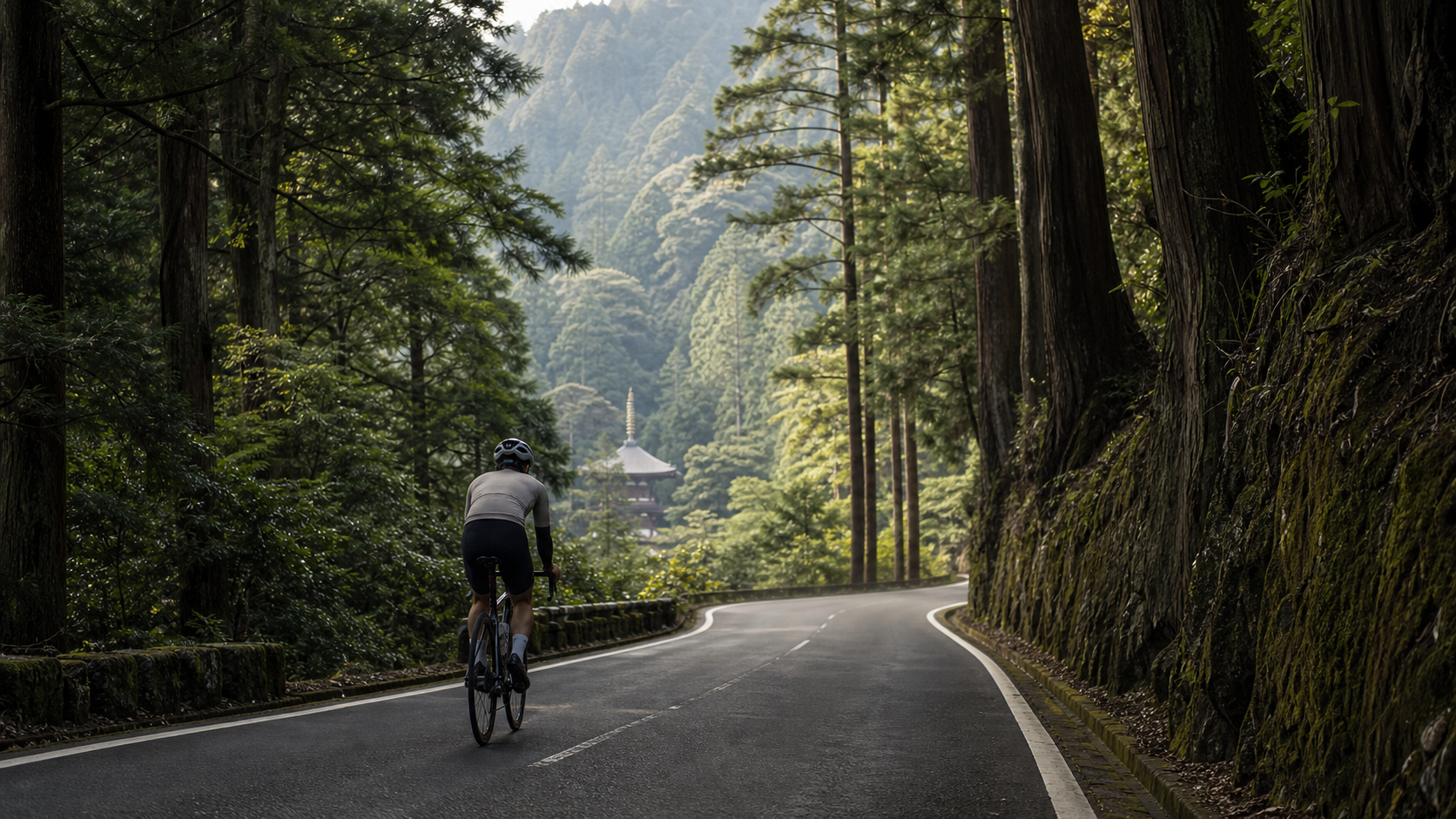
Some mountains you climb for the scenery; some mountains you climb for the record. But Kōyasan—you climb it to arrive at a kind of quiet.
This is a sacred Buddhist site founded 1,200 years ago by the monk Kōbō Daishi (Kūkai), a “religious city” built on a mountain at an elevation of about 800 meters. In 2004, it was inscribed as a UNESCO World Heritage Site under the name “Sacred Sites and Pilgrimage Routes in the Kii Mountain Range.” The climb leading to it stretches 17.4 km with 799 meters of elevation gain and an average gradient of 4.4%—a long road that gradually carries you from the human world into the Buddhist realm.
This article isn’t about pacing. What I want to talk about is this—when you spend over an hour, using your own legs, inch by inch carrying yourself up this sacred mountain, what will the 1,200 years along the way, the towering cedar-lined pilgrimage path, and the air that flows up there—so utterly different from the mundane world—leave in your heart?
A Monk, and a Mountain’s 1,200 Years
To ride Kōyasan, you first need to know a man—Kūkai.
1,200 years ago, this monk, later venerated as Kōbō Daishi, returned from studying Buddhism in Tang-dynasty China, searching deep in the Kii Mountains for a pure land where he could establish a dojo for Shingon esoteric Buddhism. Legend has it that he threw a three-pronged vajra (tokko) into the air, and it flew across the sea, finally landing on a pine tree on Kōyasan—and so he opened the mountain here, establishing Kongōbu-ji, making Kōyasan one of the most important sacred sites in Japanese Buddhism.
From that time onward, for 1,200 years, countless monks, pilgrims, and worshippers have walked up this mountain step by step along the pilgrimage routes. They measured their faith with their feet and drew closer to the sacred realm with their sweat.
And today, you ride your bicycle up the slopes of the same mountain—in a sense, you too have joined this procession that has continued for 1,200 years. You’re not here to chase a personal best; you’re here to complete a modern-day “ascetic practice,” replacing footsteps with wheels.
Departing from the Satoyama, Heading Toward the Sacred Realm
The Kōyasan climb begins in the rural satoyama fields at the mountain’s foot.
The early section is open, with a gentle gradient—the 4.4% average slope gives you room to take in your surroundings. This is typical Kii countryside in Wakayama—rice terraces, hamlets, persimmon trees, winding streams. The air is warm, the sunlight is bright, everything still feels very much “of the human world.”
Then, the road turns into the mountains, and the long ascent begins.
As elevation rises, the scenery changes bit by bit. The warmth of the satoyama fades, and cedar forests gradually close in around you. The cedars of Kōyasan are the kind of towering trees that require you to tilt your head all the way back to see their crowns—straight, deep green, solemn. Sunlight filters through layer upon layer of cedar canopy, scattering dappled light across the road. The air turns cool and damp, carrying the characteristic quiet scent of coniferous forest.
You’ll find yourself unconsciously softening your breath. This mountain has a presence—the higher you go, the quieter it becomes, the more it makes you want to fall silent. This isn’t the “agonizing silence” of a typical climb; it’s a near-reverent stillness, wrapped in forest and time.
Climbing as a Modern Ascetic Practice
17.4 kilometers is long. At a gentle 4.4% gradient, it won’t make your legs buckle and give out, but it will take a full hour or more to grind you into a particular state of mind.
Anyone who has climbed a long mountain knows that feeling—past a certain point, your thoughts slowly settle. At first, you might still be thinking about pacing, about how much farther, about the various concerns of daily life. But as the cedar groves recede one after another, as breathing and pedaling merge into a steady rhythm, those thoughts quiet down one by one.
In the end, almost nothing remains in your mind. Only breathing, only pedaling, only the road ahead of you, lined with cedars, leading to the sacred realm.
I’ve always believed this is the most precious thing about the Kōyasan climb. Its length forces you to slow down, its forests force you into stillness, and its 1,200-year-old solemn presence forces you to strip away the mundane distractions of the world, layer by layer. When you reach the summit, you haven’t just physically arrived at 800 meters above sea level—your mind has been washed clean by this mountain as well.
This, perhaps, is the closest thing to “ascetic practice” you can find on a bicycle.
On the Mountain: A City Flowing on Different Time
Passing through the final stretch of the pilgrimage path, you arrive at the sacred precincts of Kōyasan.
It’s a peculiar experience—you’re riding along, and suddenly, from the deep mountain cedar forests, you ride into an entire “city on a mountain.” Here, there are over a hundred temples, shukubō lodging where travelers can stay and experience monastic life, the solemn Danjō-garan and Kongōbu-ji, and the pilgrimage path leading straight to Okunoin.
Some describe Kōyasan as “flowing on time utterly different from the mundane world.” The Michelin Green Guide even gives it three stars, saying it is “so mysterious it feels like stepping into another world.” When you lean your bike against the side, walking on the stone paths of this sacred city on the mountain, you’ll understand what that means—the air is still, time is slow, even the angle at which sunlight falls seems to carry a certain religious gentleness.
Especially the path to Okunoin, flanked by two kilometers of giant cedars several hundred years old, with countless stone pagodas and grave markers standing among the trees. Walking there, you feel an indescribable solemnity—you are walking through a river of time built from 1,200 years of faith.
A Bowl of Sesame Tofu, and the Flavors of the Mountain
On Kōyasan, don’t forget to try the shōjin ryōri—the monks’ vegetarian cuisine.
The most famous is goma-dōfu (sesame tofu), made from sesame and kudzu starch, with a dense, silky texture and an elegant, refined flavor. Having just climbed the 17.4 km slope, sitting in a temple or dining hall and enjoying a light yet profound shōjin ryōri meal—that feeling of “being purified” resonates perfectly with the mountain’s character.
No rich meats or fish, yet it leaves you deeply satisfied. Just like this climb—no ostentatious conquest, but a quiet sense of completeness.
Kōyasan Through the Four Seasons
- Spring, cherry blossoms interweave with fresh greenery on the mountain—the season when the sacred site awakens.
- Summer, at around 800 meters elevation, Kōyasan is considerably cooler than the plains, making it an excellent summer retreat, with the deep green cedar forests offering particular coolness.
- Autumn, the deep green of the cedars contrasts with the crimson of maple leaves—Kōyasan’s most beautiful season, as the mountain’s autumn colors drape the sacred city in splendor.
- Winter, snow falls on Kōyasan, blanketing temples and cedar forests in white, the entire mountain serene as a painting—but that cold and danger should be left to those who come well-prepared and with reverence.
Descending, Returning to the Human World
When you’ve had your fill of the mountain, it’s time to descend.
The long downhill carries you back from the sacred realm to the human world, inch by inch. The cedars recede, the satoyama reappears, warmth returns to your body. This round trip—from the human world to the Buddhist realm, and back again—is itself a complete metaphor: you ascend carrying the weariness of the mundane world, and descend carrying a body full of stillness.
Back at the foot of the mountain, you might look back at the sacred peak you just climbed. It stands quietly in the mist, as it has for the past 1,200 years. And you, with your own legs, have briefly become a small chapter in its long story.
Epilogue: Riding Toward a Kind of Quiet
17.4 kilometers, 799 meters of elevation gain. In the world of cycling, these numbers aren’t particularly remarkable.
But Kōyasan has never been a road measured by numbers. Its value lies in that 1,200 years of faith, in the solemn cedar-lined pilgrimage path, in the sacred city on the mountain flowing on different time, in the heart washed clean layer by layer by the forest during the climb.
People ask me, with a climb that long, weren’t you tired?
I’d say: yes, tired. But when you ride into those cedar forests, when the clamor of the mundane world is left behind at the foot of the mountain, when you feel that 1,200-year-old stillness among the giant trees of Okunoin—you’ll feel that every single breath on those 17.4 kilometers was worth it.
Because what you’re riding toward isn’t just a mountain—it’s a kind of quiet you haven’t felt in a long, long time.
Route data: Kōyasan, distance 17.4 km, total elevation gain 799 m, average gradient 4.4%, Ito District, Wakayama Prefecture, leading to a 1,200-year-old UNESCO World Heritage Buddhist sacred site—a long-distance ascetic road that rides from the human world into the sacred realm.
Kūkai and Shingon Esoteric Buddhism: A Faith Spanning a Millennium
To truly enter Kōyasan, you need to know a bit more about its soul—Kūkai, and the Shingon esoteric Buddhism he founded.
Kūkai was born in 774 CE, a great monk of Japan’s Heian period. In his youth, he traveled to China with a Japanese envoy, studied under Master Huiguo at Qinglong Temple in Chang’an, received the orthodox transmission of Shingon esoteric Buddhism, and returned to Japan with a vast collection of scriptures and ritual implements. Shingon esoteric Buddhism (Tōmitsu) emphasizes “becoming a Buddha in this very body” (sokushin jōbutsu)—the belief that one can, in this lifetime, with this physical body, attain enlightenment through practice. This was an extraordinarily revolutionary idea at the time.
Kūkai’s choice of Kōyasan as the fundamental dojo of Shingon Buddhism was no accident. The mountain is surrounded by peaks, its topography resembling a lotus flower, and is regarded as a natural mandala (the cosmic diagram of esoteric Buddhism)—eight peaks encircling a central plateau, symbolizing the world of the Buddha. In this terrain, considered sacred, Kūkai established Kongōbu-ji and the Danjō-garan, making Kōyasan the heart of Shingon Buddhism for 1,200 years.
Even more moving is the belief in “nyūjō” (eternal meditation)—according to tradition, Kūkai did not die, but entered an eternal state of meditation at Okunoin, where he remains to this day, praying for the salvation of all beings. That is why, even now, monks at Kōyasan offer meals to Kūkai’s mausoleum at Okunoin every single day, a ritual that has never ceased. When you know this, and then walk into the cedar-lined path of Okunoin, you feel an indescribable solemnity—time here truly seems frozen 1,200 years in the past.
Riding up Kōyasan, in a sense, is traveling upstream along this river of faith. Every inch of slope you pedal over is layered with the footsteps of countless pilgrims accumulated over 1,200 years.
The Okunoin Pilgrimage Path: A Two-Kilometer Time Tunnel
If you could only see one place on Kōyasan, I would say without hesitation: Okunoin.
From Ichinohashi Bridge to Kūkai’s mausoleum, it’s a roughly two-kilometer path, flanked by an unbroken procession of giant cedars, many several hundred years old, towering into the sky and cutting the heavens into a single line. Among the trees stand over 200,000 stone pagodas, grave markers, and memorial stupas—here rest countless luminaries of Japanese history: Sengoku warlords, feudal lords, generals, poets and writers. Oda Nobunaga, Toyotomi Hideyoshi, Takeda Shingen, Uesugi Kenshin… these figures who clashed and fought in the pages of history books all chose to rest here in the end, finding eternal peace under Kūkai’s protection.
Walking this path is an extraordinarily unique experience. Sunlight filters through layer upon layer of cedar canopy, casting dappled light on moss-covered stone pagodas. The air is damp, cool, carrying the scent of cedar and moss. It is extraordinarily quiet, broken only by the occasional birdcall or footstep. That solemnity makes you unconsciously soften your breath and lower your voice.
The first time I walked this path, I was struck by an overwhelming sense of “time.” These giant trees have stood here since Kūkai’s era, witnessing 1,200 years of historical rise and fall; and the people resting beneath these stone pagodas, once wielding immense power and commanding the world, have all become part of this peaceful forest. In a place like this, you suddenly gain a new, humble understanding of grand themes like “life,” “time,” and “power.”
The hardship of the 17.4 km climb you just completed seems utterly insignificant before the solemnity of this path. And it is precisely this sense of “smallness” that gives this ride a meaning that transcends sport itself.
Shōjin Ryōri: Profundity in a Simple Meal
On Kōyasan, you must try shōjin ryōri—the monks’ vegetarian cuisine.
Shōjin ryōri originates from the Buddhist precept of “not taking life,” using no meat or fish at all, centered on vegetables, soy products, and mountain greens. But don’t mistake its simplicity for monotony—Kōyasan’s shōjin ryōri is a culinary art that elevates “austerity” to its highest form. Every dish is meticulously prepared and elegantly plated, using the simplest ingredients to create layered, complex flavors.
The most famous is goma-dōfu (sesame tofu)—made from sesame and kudzu starch, with a silky, dense texture that melts in your mouth, carrying the fragrance of sesame and a subtle sweetness. There’s also kōya-dōfu—a freeze-dried tofu that originated on Kōyasan and became famous nationwide, deliciously juicy when it soaks up broth.
Having just finished a long climb, sitting in a temple or dining hall and slowly enjoying a shōjin ryōri meal—the feeling is remarkable. Your body has just endured intense exertion, yet now it is soothed by a meal that is light, pure, and full of Zen. No stimulation from rich foods, but a sense of purification and satisfaction that comes from within. This perfectly echoes Kōyasan’s character—it doesn’t win through intense stimulation, but with purity and profundity, slowly seeping into your heart.
Shukubō Experience: Spending a Night in a Temple
If time permits, I strongly recommend staying a night at a shukubō on Kōyasan.
Shukubō are lodging facilities that temples provide for pilgrims. On Kōyasan, dozens of temples open their doors as shukubō, allowing travelers to experience monastic life. Staying at a shukubō, you can join the morning service (asakuyō)—the monks’ dawn sutra chanting—welcoming the sacred mountain’s sunrise amid the resonance of Buddhist chants; you can enjoy exquisite shōjin ryōri in a tatami room; you can sit quietly in the temple garden, feeling a stillness rarely found in the mundane world.
Riding up Kōyasan, then spending a night at a shukubō—this is the most complete way to combine “cycling challenge” with “spiritual practice.” By day, you conquer the 17.4 km slope with your legs, pushing your body to its limits; by night, amid the chanting and stillness of a thousand-year-old temple, you let your mind settle. This dual cleansing of body and mind is the most unique and precious gift this road to Kōyasan has to offer.
After the Epilogue: On the Matter of “Pilgrimage”
In this age that prizes speed and convenience above all, “pilgrimage” sounds like an ancient and distant word.
But I’ve gradually come to believe that riding a bicycle up a sacred site like Kōyasan is itself a form of modern pilgrimage.
Ancient pilgrims walked up the sacred mountain step by step, expressing their inner devotion through physical hardship. And today, we ride up this mountain pedal by pedal, likewise using sweat and fatigue to complete a journey toward the sacred. The form differs, but the essence is the same—through the offering of the body, drawing closer to something beyond the everyday, something higher.
The meaning of pilgrimage, perhaps, lies not in what awaits at the destination, but in the process of “going” itself. On those 17.4 kilometers of long slope, when you are forced to slow down, forced into solitude, forced to confront your own limits and inner self, you are in fact conducting a silent ascetic practice. The clamor of the mundane world is cast off section by section behind you, the distractions of the mind are ground smooth by the rhythm of your pedaling, and in the end, when you ride into that sacred city on the mountain, you carry with you a heart washed clean by the long climb, exceptionally clear and serene.
This is Kōyasan’s deepest value. It doesn’t just give you a slope and a view; it gives you a rare opportunity to be alone with your own mind, a journey toward stillness that is almost a luxury in modern life.
May you one day ride up this thousand-year-old sacred mountain, and among the towering cedar-lined paths, rediscover that long-missed inner quiet. And when you descend, returning to the mundane world, may you carry the stillness you found on the sacred mountain into every noisy day that follows.
Namu Daishi Henjō Kongō. May you travel safely, body and mind at peace.
A Taiwanese Rider’s Kōyasan: Resonance Between Faith and Mountains
As a Taiwanese rider, pedaling through the towering cedar-lined paths of Kōyasan, what surfaced in my heart was, unexpectedly, the temples and mountains of my homeland.
Taiwan is an island where faith flourishes profoundly. We have temples scattered across cities and countryside, grand pilgrimages like the Mazu procession that draws hundreds of thousands of people walking on foot, and century-old pilgrimage traditions like Dajia and Baishatun. The devotion Taiwanese people hold for deities and faith resonates deeply with the reverence Japanese people have for Kōyasan.
During the Mazu procession, devotees walk hundreds of kilometers, expressing their inner devotion through physical hardship—this is essentially the same as ancient pilgrims walking up Kōyasan on foot. Both believe that “the offering of the body brings one closer to the sacred.” And today, riding my bicycle up Kōyasan, in a sense, I too have joined this long river of pilgrimage that spans different cultures and different faiths.
Standing in the solemn cedar forest of Okunoin, I suddenly gained a broader understanding of “faith.” Whether it’s Japan’s Shingon Buddhism or Taiwan’s Mazu worship, what people seek is ultimately the same thing—in the impermanence of life, finding a source of stability; beyond the smallness of the self, connecting to something greater. This pursuit transcends national borders and religious forms; it is a spiritual longing common to all humanity.
After riding Kōyasan, I miss Taiwan’s mountains and temples even more. I think of ancient temples in the mountains shrouded in morning mist, of the devout and humble faces in the pilgrimage processions. And carrying this feeling of Kōyasan home, perhaps I will look upon the familiar religious landscapes of my homeland with new, deeper eyes.
If you are also a Taiwanese rider, after making your pilgrimage to Kōyasan, take a moment to think of the temples and mountains of your homeland. You’ll find that the deepest stillness and emotion know no borders; and a pilgrimage to a distant land will ultimately lead you to love the land that raised you even more deeply.
Mountains and faith are humanity’s shared homesickness. May we all find our own sense of peace along the way.
Slowing Down Is What This Mountain Taught Me
What Kōyasan ultimately taught me is “slowness.”
We live in an era held hostage by speed. Everything must be fast—reply to messages quickly, finish work quickly, arrive at destinations quickly, succeed quickly. Slowness has become a sin, a symbol of falling behind. We rush along the road, yet rarely stop to ask ourselves: what exactly am I rushing toward?
And Kōyasan, with its 17.4 km of long slope, forced me to slow down.
On that road to the sacred realm, you cannot go fast. The gradient is gentle, but it is long enough that you must abandon all thoughts of “speed” and accept that you will spend over an hour, inch by inch, making your way up. And it is precisely in this forced slowness that something remarkable happens—my mind slowed down too. Those anxieties, to-dos, and distractions that fill the mind on ordinary days, one by one, quieted down as the cedar groves receded behind me. In the end, my mind was completely clear, leaving only breathing, pedaling, and this solemn road before me.
That was an inner stillness I hadn’t experienced in a very long time.
After descending the mountain and returning to the clamor of the mundane world, I found I had brought something back. Not photos, not a record, but a certainty that “it’s okay to slow down.” Kōyasan taught me that life is not a race to see who’s fastest; some of the most precious things—stillness, awareness, connection with oneself—can only truly be possessed when you are willing to slow down.
So, if you too always live too fast, too rushed, too exhausted, I’d like to invite you to ride Kōyasan once. Let that thousand-year-old long slope force you to slow down; let those towering cedar-lined paths return to you a long-missed stillness. You’ll discover that slowness was never falling behind, but a capacity to refocus your life.
May we all, on this sacred mountain, relearn how to slow down; and may we carry this “wisdom of slowness” back into every breathless, fast-paced day that follows. Gasshō.
Related Reading
- Kōyasan Guide: Full Guide to Endurance Pacing, Gearing, and Nutrition for the 17.4 km 4.4% Long Climb
- Riding a World Cultural Heritage Site: The Pilgrimage Road of Fuji Subaru Line and the Sea of Clouds for Those Who Strive
- Kaohsiung Dashu to Fo Guang Shan Route: Complete Guide to a Southern Temple Culture Ride
- Ancient Trees and Heavenly Lake in the Clouds: A Cycling Pilgrimage on Daxue Mountain, Riding Elevation into an Ascetic Practice
嘉義大埔、阿婆灣挑戰賽,美到以為在日本!ft. 環騎5 Cool 西拉雅188 / 公路車 / CT Yeh
7 個月前
台北闊瀨陡坡 騎旅 / 日本單車雜誌編輯車友臨時加入!/ 髮香才是最強的 / feat. 北迴歸線小隊 / 公路車 CT Yeh
6 個月前
小野田真的存在!日本赤城山爬坡公路賽 台灣首發團完全實錄 | 頭文字D真實賽道! | 看完東奧自行車賽後好想再去騎一次啊! | 公路車 | CT Yeh
4 年前
日本🇯🇵岡山&島波海道 單車之旅 (上集) / 機場停車省錢秘笈?/ 旅館有單車組裝室 / 差點上不了機場捷運 / 公路車 / CT Yeh
2 年前
2025 乘鞍 KOM 登山賽挑戰實錄 / 日本公路最高 ! 賽前探路篇 / 比富士山厲害,無敵絕景!/ 40週年 / 中文YT首發 / 公路車 / CT Yeh #乘鞍ヒルクライム
11 個月前
大禹嶺 到 武嶺牌樓 全程前後實況錄影 | 北進武嶺 | 東進武嶺 | KOM | 訓練台 | 坡度分析 | Taiwan KOM Last 10 km HARD | 公路車
6 年前
一定要騎一次!阿里山最深處:里佳部落!單車旅行 | 2800m爬升 | 深度部落體驗:嗨翻晚會、螢火蟲、銀河 | feat. JJSC & 廢物伙伴 | 公路車 CT Yeh
10 個月前
宇老大滿貫 拉拉山 員工旅遊 有如爬了一座東進武嶺 #公路車 4K高畫質
6 年前