Riding Toward Kinki's Last Hidden Frontier: Ōdaigahara, a Road into the Deep Mountains and into Yourself
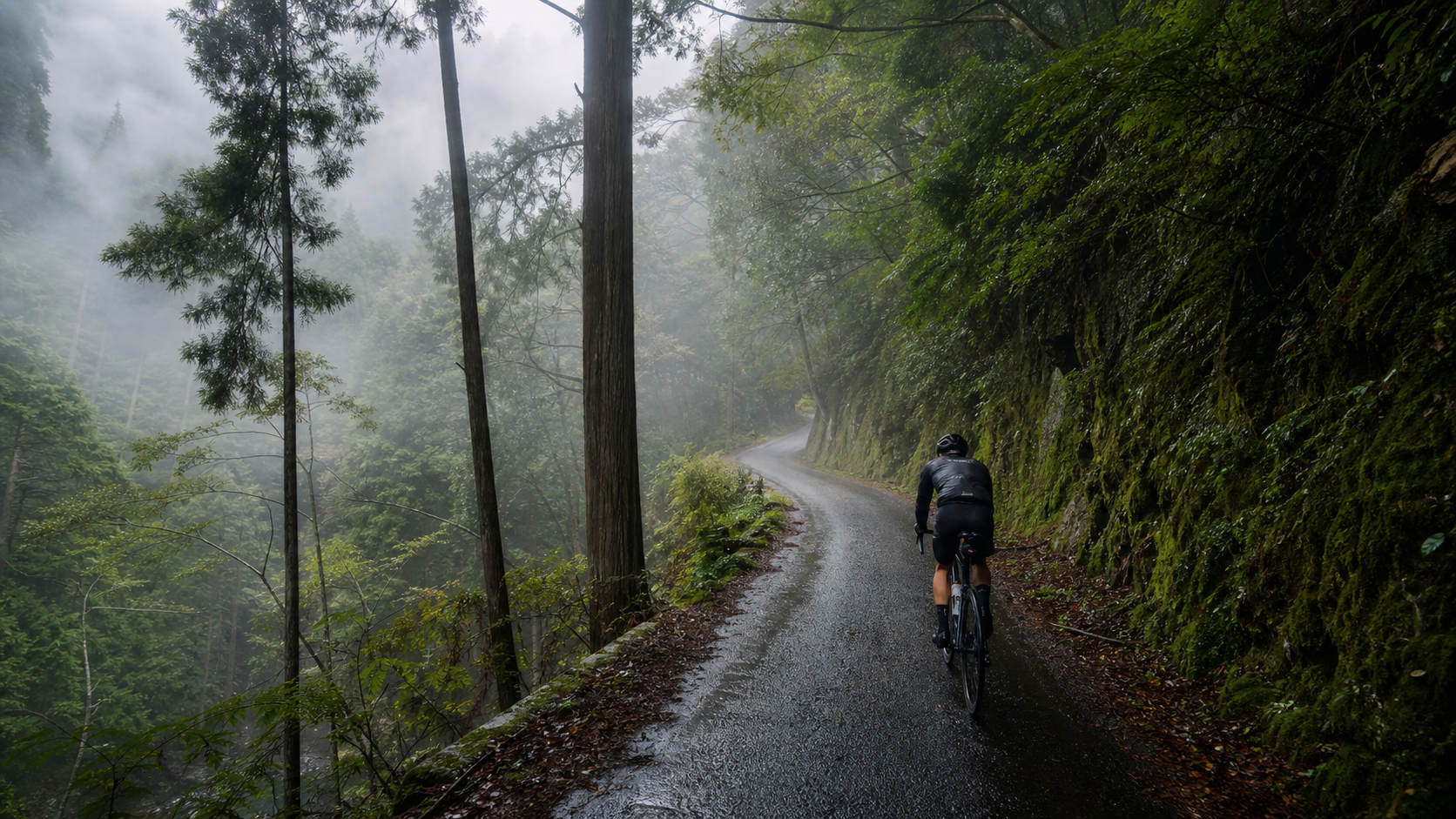
Some roads lead to scenery; the road to Mt. Ōdaigahara leads to one of “Japan’s deepest hidden realms.”
In the innermost mountains of Nara Prefecture, National Route 309 runs like a thin thread, winding its way into layer upon layer of deep mountains. Climbing along it toward Mt. Ōdaigahara—this 9.9 km, 572 m elevation gain, 5.8% average gradient stretch (which is actually the core section of a longer, far more grueling full climb)—you step away from human habitation, one step at a time, and enter a near-mythical world ruled by clouds, primeval forest, and abundant rainfall.
This piece isn’t about pacing. What I want to take you into is the “depth” of this road—geographical depth, historical depth, and the deeper self a rider encounters in such deep mountains.
Toward the “Last Hidden Realm of Kinki”
Mt. Ōdaigahara is called the “Last Hidden Realm of Kinki.”
It straddles the prefectural border between Nara and Mie, and is one of Japan’s most famous rainy regions—with astonishing annual rainfall, its abundant precipitation nurtures a moist, lush, almost primeval forest. It is part of “Yoshino-Kumano National Park” and is also connected by blood to the World Heritage site “Sacred Sites and Pilgrimage Routes in the Kii Mountain Range.” Moss covers the rocks and tree roots, clouds and mist drift through the forest year-round, and the air is so humid you could wring water from it.
Riding toward Mt. Ōdaigahara means riding toward such a primeval land, soaked by rain and time for tens of millions of years. The deeper you go, the fewer traces of humanity remain, and the stronger nature’s power becomes. In the end, you feel you aren’t “conquering” this mountain—you are being “permitted” to enter it.
The Gentleness of the Valley Is a Gentle Trap
The beginning of this road is gentle.
The early section runs alongside settlements and a valley, with a mild gradient, clear stream water flowing beside you, and sunlight filtering through the leaves onto the pavement. You can’t help but relax, can’t help but speed up, can’t help but think, “This legendary hard road—maybe it’s not so bad after all.”
But this gentleness is a trap.
The first time I rode Mt. Ōdaigahara, I was fooled by this valley section. I rode too easily, too happily at the start, and by the time the road turned into that narrow forest road and the gradient picked up without ceremony, I realized I had wasted too much energy on that beautiful valley. A road in the deep mountains is never gentle all the way—it’s just waiting for you to let your guard down.
Entering the Forest Road: One Person, and a Deep Mountain
Past the settlement, the world suddenly changes.
The road narrows into a forest road barely wide enough for one car to pass, and the tall forests on both sides close in, blocking out the sky. The gradient climbs relentlessly, with no end in sight, no distant view—your world instantly shrinks to the few meters of pavement before you, and the sliver of sky cut by the canopy above.
Silence. Utter silence. No city noise, no traffic, not even other riders. Only the low hum of the chain, your own heavy breathing, and the occasional birdsong and water sounds from deep in the forest.
Climbing on such a deep forest road is a very special kind of solitude. It isn’t frightening; instead, it makes you extraordinarily clear-headed. When everything external is stripped away, you hear the most honest voice inside yourself—that urge to give up, that will that says “hold on a little longer,” that self buried beneath daily noise, the one you haven’t truly listened to in a long time.
The deep mountains force you into solitude, and solitude makes you honest. This is the deepest gift Mt. Ōdaigahara gives to those who climb.
Clouds, Moss, and a Breathing Forest
The deeper you go, the thicker the clouds and mist.
Mt. Ōdaigahara is rainy and foggy, and that mist isn’t a distant landscape—it’s a physical presence that wraps around you. It flows slowly through the trees, staining them into hazy silhouettes, muffling and softening every sound. The air is moist with the scent of moss and decaying leaves—that distinctive smell of a primeval forest, the smell of the cycle of life.
The rocks, tree roots, and fallen logs along the roadside are all covered in thick moss, green and glistening. This is a living, breathing forest. Riding through it, you get the illusion of traveling through time—as if this forest has looked exactly this way since ancient times, and you are merely a brief passerby.
In such an environment, the hardship of climbing takes on another meaning. You aren’t just fighting the gradient; you’re in dialogue with an ancient and powerful nature. Every breath draws in the moisture and lushness of this forest’s tens of millions of years.
A Mountain Race Continuing for Over Twenty Years
This road also carries a memory belonging to cyclists.
Since 2001, the “Hill Climb Ōdaigahara” has been held here—one of western Japan’s most prestigious climbing races. For over two decades, generation after generation of climbers have pushed their limits on this narrow, steep road with its enormous elevation difference. It is famous for being “hard”—that narrow core forest road is a nightmare in countless racers’ minds, and also a badge of honor.
When you ride this road alone, you realize that every inch of asphalt you tread has been soaked by the sweat of countless challengers. You aren’t climbing alone—you’ve joined an invisible team that has continued for over twenty years. Those who gasped their way up here before you, those who were fooled by the valley at the start and gritted their teeth through the forest road at the end, just like you—you are all connected by this same road deep in the mountains.
The Four Seasons of the Deep Mountains, and a Sky Full of Stars
- Summer, when the cities of Kansai are scorched by heat, this high mountain region stays cool and moist—a perfect hidden summer retreat.
- Autumn, the area around Mt. Ōdaigahara is painted in layers of color; autumn leaves against the lush primeval forest create a breathtaking beauty, making this the most popular season of the year. And after nightfall, far from light pollution, Mt. Ōdaigahara is a renowned stargazing spot—when you have the chance to look up there, the sky full of stars and the clearly visible Milky Way will make you forget all the hardship of the climb.
- Winter, Mt. Ōdaigahara is closed. Snow, bitter cold, and closed roads send this hidden realm into slumber. It doesn’t belong to winter riders—that’s nature’s boundary for us, and we should respect it.
Epilogue: Riding Deep into the Mountains, Meeting Yourself
9.9 km, 572 m of climbing. These numbers aren’t exactly earth-shattering.
But Mt. Ōdaigahara has never been a road measured by numbers. Its weight lies in that primeval forest of the “Last Hidden Realm of Kinki,” in that moist world ruled by clouds and moss, in that narrow forest road that forces you into solitude and honesty, in the accumulated weight of a climbing race spanning over twenty years, and in that starry sky deep in the mountains that can move you to tears.
People ask me why I ride roads so deep, so hard, so solitary.
I’d say: because in the city, in the crowd, it’s hard to hear ourselves. But on that deep mountain forest road of Mt. Ōdaigahara, wrapped in clouds and mist, when all the noise is stripped away, you can finally grow quiet and meet that long-unseen, most authentic self.
For that encounter, this road into the deep mountains is worth it.
Route data: Mt. Ōdaigahara—National Route 309, distance 9.9 km, total elevation gain 572 m, average gradient 5.8% (core section of the long climb to Mt. Ōdaigahara), Kamikitayama Village, Nara Prefecture, the “Last Hidden Realm of Kinki,” stage of a renowned western Japan climbing race, a road that leads deep into the mountains, and deep into yourself.
The “Last Hidden Realm of Kinki”: A Primeval Land Ruled by Rain
Mt. Ōdaigahara is called the “Last Hidden Realm of Kinki.” This title isn’t exaggeration—it’s an accurate geographical description.
It straddles the prefectural border between Nara and Mie, and is one of Japan’s most famous rainy regions—with astonishingly high annual rainfall, said to be among the highest on Japan’s main island of Honshu. This extreme abundance of rain nurtures a moist, lush, almost untouched primeval forest. It is the core of “Yoshino-Kumano National Park” and is also connected by blood to the World Heritage site “Sacred Sites and Pilgrimage Routes in the Kii Mountain Range.”
Precisely because the rainfall is so abundant, the forest of Mt. Ōdaigahara has an appearance that’s hard to replicate elsewhere—moss covers every rock and every stretch of tree root, green and glistening; clouds and mist drift through the forest year-round, staining the trees into hazy silhouettes; the air is so humid it feels like you could wring water from it, carrying that distinctive scent of a primeval forest—moss and decaying leaves, the smell of the cycle of life. This is a truly “living,” breathing forest.
Riding toward Mt. Ōdaigahara means riding toward such a primeval land, soaked by rain and time for tens of millions of years. The deeper you go, the fewer traces of humanity remain, and the stronger nature’s power becomes. In the end, you clearly feel—you aren’t “conquering” this mountain, but being “permitted” to enter it. This reverence for nature’s raw power is what most profoundly sets the road to Mt. Ōdaigahara apart from an ordinary climb.
The Gentleness of the Valley Is a Gentle Trap
The beginning of this road is gentle—and that gentleness is a carefully designed trap.
The early section runs alongside settlements and a valley, with a mild gradient and clear stream water flowing beside you, sunlight filtering through the leaves onto the pavement. Scenery like this makes you want to relax, to speed up, to mutter to yourself: “This legendary hard climb… doesn’t seem so bad after all.”
But mountain roads are never gentle forever. They’re just waiting for you to let your guard down.
The first time I rode Ōdaigahara, I was thoroughly deceived by that valley. I rode the early part too easily, too joyfully, wasting too much energy on that beautiful valley. By the time the road turned into that narrow forest track and the gradient kicked up without mercy, I realized I’d made a grave mistake—the strength in my legs had already been quietly drained by that gentle slope.
That was the first lesson Ōdaigahara taught me, and the most profound one: the more gentle the opening seems, the more vigilant you must remain. This principle holds true on the mountain, and no less so in life. The hardest trials are often hidden right after our most relaxed moments. Knowing how to stay alert in good times and save your strength for the real challenges—this is the wisdom Ōdaigahara taught me through a valley.
Into the Forest Track: Solitude with a Deep Mountain
Past the settlement, the world suddenly changes.
The road narrows into a forest track barely wide enough for one car to squeeze through, with towering forest closing in on both sides, blocking out the sky. The gradient climbs relentlessly, with no end in sight and no view of the distance—your world instantly shrinks to the few meters of pavement before you and that sliver of sky cut by the canopy above.
Silence. Utter silence. No city noise, no traffic, often not even another rider. Only the low hum of the chain, your own heavy breathing, and the occasional birdsong and water sounds from deep in the forest.
Climbing on a forest track like this, in such deep mountains, is a very particular kind of solitude. It isn’t frightening—on the contrary, it brings an extraordinary clarity. When everything external is stripped away, you hear the most honest voice inside you—that thought of giving up, that will to “push a little longer,” that self buried beneath the noise of daily life that you haven’t truly listened to in a long time.
Our daily lives are filled with too many sounds, too many people, too many things. We rarely have the chance to truly be alone with ourselves. But that narrow, forest-wrapped track on Ōdaigahara shuts out all of that external noise, leaving only you, that climb, and your most authentic self. The deep mountain forces you into solitude, and solitude makes you honest. This is the deepest gift Ōdaigahara offers to those who climb.
Cloud, Mist, Moss, and a Breathing Forest
The deeper you go, the thicker the cloud and mist.
Ōdaigahara is rainy and foggy, and that mist isn’t a distant view—it’s a physical presence that wraps around you. It drifts slowly through the trees, turning them into hazy silhouettes, muffling and softening every sound. The rocks, roots, and fallen logs along the roadside are all covered in thick moss, glowing green. This is a living, breathing forest—riding through it, you get the illusion of traveling through time, as if this forest has looked exactly this way since ancient times, and you are merely a brief passerby.
In such an environment, the hardship of climbing takes on another layer of meaning. You aren’t just fighting the gradient; you’re in dialogue with an ancient and powerful nature. Every breath draws in the millennia of moisture and verdant depth of this forest. This kind of humble, intimate encounter with nature is something you could never experience in the city or on popular tourist routes. With its depth, its dampness, its wildness, Ōdaigahara reconnects you to nature’s most primal power.
The Deep-Mountain Night Sky: A Cosmic Reward for the Persistent
Ōdaigahara has another identity that few know about—it’s one of Japan’s renowned stargazing spots.
Because it sits deep in the mountains, far from urban light pollution, the night sky over Ōdaigahara is the kind of true starry sky that can move city dwellers to tears. A sky full of stars, a Milky Way so clear it seems within reach, unfolds without reservation across that darkness. If you have the chance to stay overnight and gaze up at that sky—the awe of it will make you instantly forget all the suffering of the day’s climb.
I’ve always felt that this starry sky is nature’s cosmic reward for those willing to venture deep into hidden places. People who drive up can see it too, of course, but the feeling is absolutely different from that of a rider who pedaled into this deep mountain and was tormented by its forest track. When you’ve paid that price in effort, when your body still remembers the agony of that narrow, steep forest track from the daytime, that brilliant starry sky carries a weight in your eyes that is beyond measure.
In autumn, the area around Ōdaigahara is painted in layers of color—autumn leaves set against the lush primeval forest, breathtaking by day, and a sky full of stars by night. This double feast of “daytime splendor, nighttime sea of stars” is the most luxurious experience this hidden land has to offer.
After the Epilogue: Riding into the Deep Mountains to Meet Yourself
In the city, in the crowd, it’s hard to hear ourselves. The relentless noise of daily life smothers the most honest voice within us.
But that cloud-wrapped forest track on Ōdaigahara, with its extreme silence and solitude, strips all that noise away. When you ride alone on that narrow, steep climb with no end in sight, when every external sound disappears, you can finally quiet down and meet that long-unseen, most authentic self.
That self may hold the fragility and the urge to give up that you’d rather not face on ordinary days; but that self also holds the resilience and the will to “push a little longer” that you’d long forgotten. In the solitude of the deep mountain, you will come face to face with both. And every time you grit your teeth and push through the hardest stretch of forest track, every time the will to “push a little longer” defeats the thought of “giving up”—you win something for yourself. That something becomes the foundation of courage you carry into other challenges in life.
This is why some people are willing to ride so deep, so hard, so alone. Not for results, not for showing off, but for that encounter with their most authentic self in the deep mountains.
Ōdaigahara is not an easy road. It will deceive you with the gentleness of its valley, test you with its narrow, steep forest track, and remind you to stay humble with its hidden wilderness. But when you make it through the hardest stretch of forest track, when you feel that ancient, primal stillness among the mist and moss, when you gaze up at that brilliant starry sky on a deep-mountain night—you’ll understand that all the hardship was worth it.
Because what you ride toward is never just a deep mountain. You ride toward the self that has been lost in the noise for so long, finally rediscovered in the silence of the mountains.
May you one day find the courage to ride into Ōdaigahara, the last hidden wilderness of the Kinki region. May you meet, on that lonely forest track, a self that is stronger, clearer, and more reverent. And that self is worth every bit of effort you pedal through to find it.
A Race Spanning Over Two Decades, and an Invisible Team
This road also carries a collective memory shared by cyclists.
Since 2001, it has hosted the “HILL CLIMB ODAIGAHARA”—one of western Japan’s most prestigious hill climb races. For over twenty years, generation after generation of climbers have pushed their limits on this road with its extreme elevation gain, narrowness, and steepness. It’s known for being “hard”—that narrow core forest track is a nightmare in countless riders’ minds, and also their proudest badge of honor.
When you ride this road alone, you become aware of something deeply moving: you are not alone. Every meter of asphalt you pedal over has been soaked with the sweat of countless challengers. Those who gasped their way up here before you, those who, like you, were deceived by the gentle valley at the start and gritted their teeth through the forest track at the end—you are all connected by the same deep-mountain road.
Though you may ride alone on that silent forest track, you have actually joined an invisible team that has endured for over two decades. In this team are veterans from twenty years ago, newcomers who finished last year, and riders preparing for this road somewhere right now, just like you at this moment. You’ve never met, yet you share the same reverence and passion for this road.
This feeling of being connected to countless strangers through the same road is a romance unique to legendary courses. It gives a solitary challenge a collective weight that transcends time. When you want to give up on the hardest stretch of forest track, think of that invisible team—think of those before you who gritted their teeth and made it through—and perhaps you’ll find one more pedal stroke, one more stretch to endure.
For Those About to Take on the Challenge: A Sincere Word of Advice
Ōdaigahara is not a route to be taken lightly. If you plan to conquer it, I’d like to offer you a few sincere words of advice.
First, honestly assess your own ability. This route is gentle at the start and steep at the end, with the latter section being a narrow, steep forest road that requires a solid foundation in climbing ability and endurance. If you’re new to climbing, I’d suggest you start with the more forgiving routes on this list (such as Yufudake or Ikoi Highlands) to build up enough strength and experience before taking on Ōdaigahara. Treating this route with respect is taking responsibility for your own safety.
Prepare to the absolute maximum. Bring a full range of gearing (34T minimum, 36T to be conservative), carry ample supplies, pack warm clothing, check the weather thoroughly, confirm road openings, and share your itinerary with companions—these preparations are “recommended” on ordinary routes, but on Ōdaigahara, they are “mandatory.” Deep mountain wilderness leaves no room for luck.
Let go of your obsession with performance. The value of this route lies not in how fast you ride, but in the encounter with yourself on that lonely forest road. Let go of your fixation on time and focus on “completing it safely” and “experiencing this hidden wilderness.” When you stop worrying about your results, you’ll truly be able to appreciate the deepest beauty this route has to offer.
May you take on this last hidden wilderness of the Kinki region with thorough preparation and humble respect. May you gain from the silence of the deep mountains not just a completed ride, but the most profound conversation with yourself and with nature. That is the most precious thing Ōdaigahara can give a rider. See you in the mountains—may you ride safely.
Related Reading
- Ōdaigahara (Route 309) Guide: Pacing, Life-Saving Gearing, and Deep-Mountain Supplies for the 9.9 km Gentle-to-Steep Narrow Forest Road
- Hidden Gem Cycling in Taiwan: 10 Little-Known Breathtaking Routes
- Deep Valley Cycling in Taiwan: Ten Hidden Scenic Routes in the East Rift Valley
- A Journey Along Provincial Highway 3: Riding the Inland Mountain Road from Taipei to Pingtung
台北闊瀨陡坡 騎旅 / 日本單車雜誌編輯車友臨時加入!/ 髮香才是最強的 / feat. 北迴歸線小隊 / 公路車 CT Yeh
6 個月前
一定要騎一次!阿里山最深處:里佳部落!單車旅行 | 2800m爬升 | 深度部落體驗:嗨翻晚會、螢火蟲、銀河 | feat. JJSC & 廢物伙伴 | 公路車 CT Yeh
9 個月前
虎豹潭!日本老師來台一日約騎 台灣車友熱情招待私房路線 / CT Yeh
19 天前
嘉義大埔、阿婆灣挑戰賽,美到以為在日本!ft. 環騎5 Cool 西拉雅188 / 公路車 / CT Yeh
7 個月前
大武山後門26%歡樂陡坡!JJSC南台灣單車行Day2 / 被颱風追著跑 / 公路車 / CT Yeh
2 年前
大禹嶺 到 武嶺牌樓 全程前後實況錄影 | 北進武嶺 | 東進武嶺 | KOM | 訓練台 | 坡度分析 | Taiwan KOM Last 10 km HARD | 公路車
6 年前
京都!99%人不知道的秘境玩法!租 E-Bike 騎進探訪宇治抹茶原鄉 刺激好玩絕美的山林古道 鬼滅之刃的場景探訪 / CT Yeh
12 天前
里佳部落 阿里山單車深度旅遊! | 竹山/草嶺/來吉/奮起湖 | 無敵銀河絕景 全新路線探索! 驚險狀況百出! | 4K沉浸式畫質 | 公路車 | CT Yeh
3 年前