Riding onto a World Heritage Site: The Pilgrimage Road of Fuji Subaru Line and the Sea of Clouds Awaiting Those Who Strive
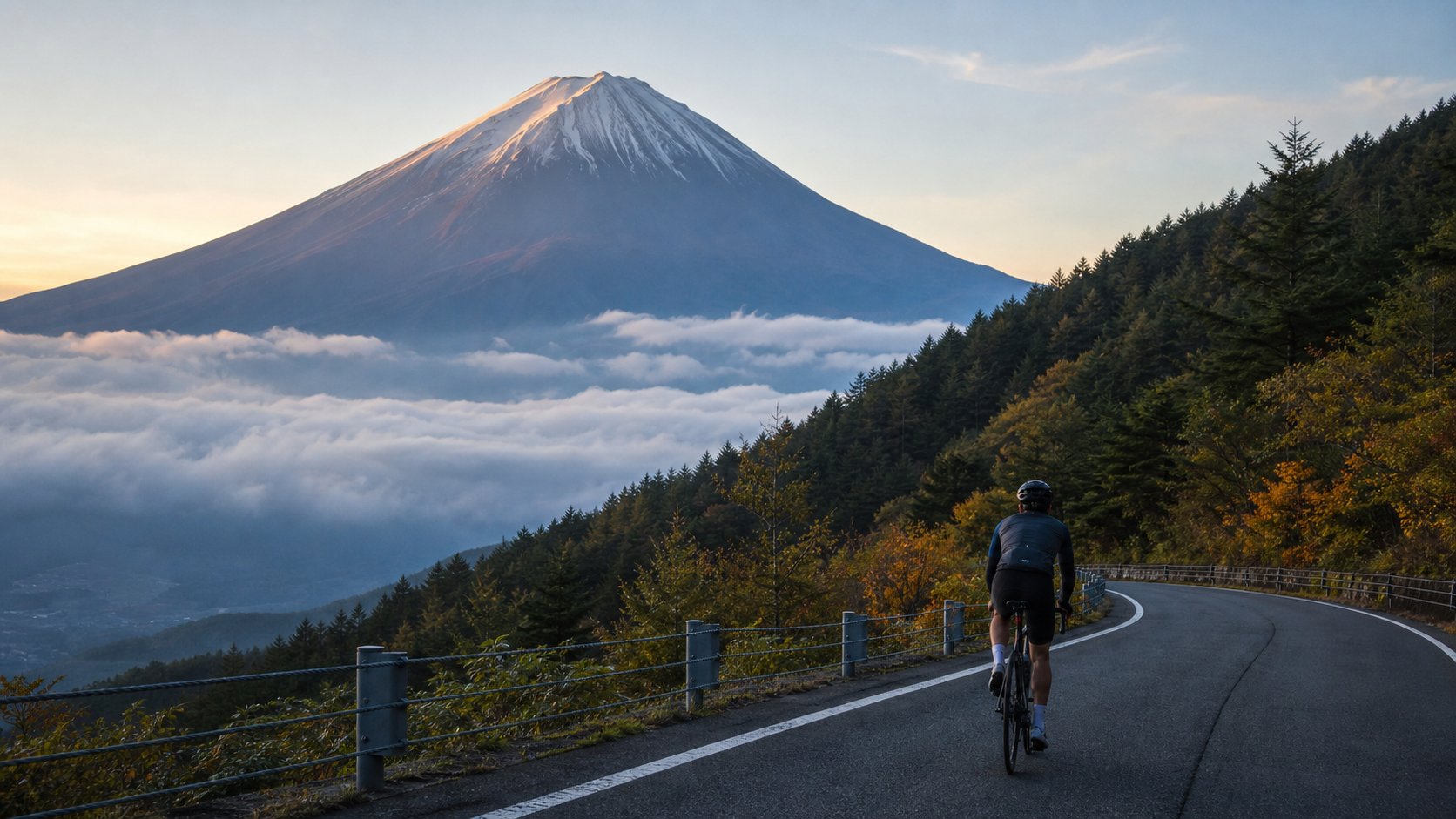
At five in the morning, Fujiyoshida City was still wrapped in a thin layer of blue morning mist. I wheeled my bike out from the entrance of the guesthouse and looked up at the mountain gradually emerging against the rising sun—Mount Fuji, 3,776 meters above sea level, Japan’s highest peak and the nation’s almost sacred spiritual symbol. Today, I would ride my own two wheels up the Fuji Subaru Line, climbing to its fifth station at 2,300 meters. This was not just a climb; it felt like a pilgrimage.
A Mountain Inscribed as a World Cultural Heritage Site
Before I push down on the first pedal, let me talk about this mountain. Mount Fuji was designated a UNESCO World Heritage Site in 2013—note, a “cultural” heritage site, not a “natural” one. This classification says it all: to Japan, Mount Fuji has never been merely a geographical peak, but an entire cultural symbol woven into religion, art, literature, and national identity.
If you have seen Katsushika Hokusai’s ukiyo-e series Thirty-six Views of Mount Fuji, you will surely remember The Great Wave off Kanagawa—a towering wave curling like a claw, with a serene Mount Fuji standing immovable in the distance. That series depicted Fuji from thirty-six angles, spreading the mountain’s image across the world through art. When you actually ride on its slopes, you suddenly understand why Hokusai was so captivated: Mount Fuji’s presence exerts a gravity that makes you want to turn back and gaze at it again and again.
To the ancient Japanese, Mount Fuji was where the gods dwelled. Climbing it was itself a form of ascetic practice, a ritual of drawing closer to the divine.
Footsteps of White-Clad Believers: The Faith Road of Fuji-ko
Hundreds of years before cycling existed, this road to the summit had already been trodden by countless straw sandals. During the Edo period, a folk religious organization called “Fuji-ko” flourished. Its followers, dressed in pure white garments, would travel in groups on foot from the mountain’s base, worshipping and climbing to the summit, treating the ascent of Mount Fuji as a sacred act of purifying body and mind and praying for blessings.
The paved road I rode today is a modern mountain road, but the direction it follows, the mountain body it crosses, is the same realm those white-clad believers once looked up to and trekked across. As I pedaled quietly through the forest, I occasionally felt a strange illusion: as if, in some fold of time and space along this road, the footsteps and chanting of pilgrims from centuries ago still echoed. Bicycle and straw sandals, modernity and tradition—within the embrace of this mountain, they were unexpectedly harmonious.
A Vertical Botanical Journey
One of the experiences that fascinated me most about riding the Fuji Subaru Line is that, within just over twenty kilometers, you undergo a dramatic “vertical vegetation change.” This is a gift that low-altitude flat riding can never give you.
At the start, you are amid temperate broadleaf forest. On both sides are lush, verdant, vibrant deciduous trees; sunlight filters through layers of leaves, casting dappled spots of light, and the air carries the scent of moist soil and grass. This is the mountain’s “waist”—full and gentle.
As the altitude climbs bit by bit, you notice the tree species quietly changing. The broadleaf forest gradually gives way to conifers—trunks grow straighter, leaves become needle-like, and the forest turns deeper, quieter, with a touch of coolness. The air changes too, gaining a hint of pine resin.
Higher still, the trees begin to shorten and thin out, the gaps between them widening, and the view opens up. This is the sign of approaching the “tree line”—above this altitude, the climate is too harsh for tall trees to survive. When you cross this invisible yet very real boundary, you get the illusion of “stepping into another world.”
This entire journey compresses the plant zones from temperate to subarctic into just an hour or two of riding. Every time you look up and notice the forest changing, it is the mountain quietly whispering in your ear: “You are a little closer to me now.”
Faith Markers Along the Way and That Sea of Clouds
On the road to the fifth station, a small shrine called Kotakiji-jinja stands quietly. This shrine is closely tied to the climbing faith of Mount Fuji, a place where many climbers and pilgrims stop, press their palms together, and pray for safety. When I paused there briefly, watching the devout figures of worshippers, I was moved by a quiet power—this road, seen by cyclists as a “training sanctuary,” is for another group of people a path to the divine.
And if you are lucky enough, on certain mornings or when weather conditions align perfectly, once you climb high enough, you will see a magnificent sea of clouds spread out beneath your feet. It is an indescribable scene: you seem to stand at the boundary between heaven and earth, clouds like a soft white ocean surging and flowing below, while distant peaks float on the clouds like islands. In that moment, all the pain of the climb, the burning legs, the gasping breath, becomes utterly worthwhile.
Some scenery is only shown to you when you have climbed to that height with your own legs. The sea of clouds is exactly such a reward for those who make the effort.
A First-Person Riding Narrative: What I Experienced in That Hour-Plus
Let me honestly record how I felt that day.
For the first few kilometers after setting off, I felt unrealistically light. The morning breeze was cool, the forest fresh, and the pedals seemed to meet no resistance. I knew this was a trap, so I deliberately held back my power, keeping myself in a comfortable zone where I “could still chat.” I silently counted my breaths, watching the walls of trees recede one by one on either side.
Once I entered the middle section, my body began to respond honestly. Sweat soaked my jersey, and my heartbeat pounded steadily and forcefully. My world shrank to three things: the short stretch of slope ahead, my rhythmic breathing, and the cadence of the pedals turning. The surrounding forest was so quiet that only the faint sound of the chain running, the rustle of tires on asphalt, and my own panting remained. It was a strange solitude, yet also a rare focus and calm—in that moment, all the clutter of daily life was filtered out by the thin air, leaving only me, the bike, and this mountain.
When I reached the high-altitude zone, the air grew noticeably thinner. The same effort now bought only more rapid breathing and heavier legs. I stopped looking at the power numbers and simply paced by feel, focusing on one corner, one stretch of slope at a time. My head felt a bit swollen, my fingertips cold, but every time I looked up and saw the trees getting shorter and the sky drawing nearer, I knew—I was approaching that goal.
When the buildings of the fifth station finally appeared at the edge of my vision, I had no energy to cheer; I just exhaled deeply and slowly. I stopped the bike and almost immediately wrapped myself in a jacket—the wind at the top was bitingly cold, a world apart from the warm morning down below. Leaning against my bike, I turned to look back at the entire forest I had just crossed and the winding road, and my eyes suddenly grew a little hot. Not from exhaustion, but from that sense of completeness: “I arrived here with my own strength.”
What This Route Means to a Rider
I have ridden Taiwan’s Wuling and countless leg-breaking climbs, but the Fuji Subaru Line felt completely different. It does not torment you with steepness; instead, it pushes you upward in a nearly gentle yet utterly firm, continuous, linear way. It is like a strict but fair teacher—it does not allow shortcuts, rewarding only honesty and patience.
For many Asian riders, “climbing Mount Fuji once” is a symbolic milestone in a cycling career. It represents not just a physical achievement, but a cultural completion—you approach a sacred mountain revered by an entire nation in the purest, most primal way: human power. When you finish it, what you take away is not just a result, but a private memory between you and Mount Fuji, your own.
Scenery Limited by Season
Visiting this route in different seasons, you will encounter completely different versions of Mount Fuji.
- Early summer (around June): This is when official events are mostly held and one of the best seasons for riding. The forests at the base are lush and green, the climate relatively stable, making it the ideal time to experience the full vegetation transition.
- Summer: Hot at the base, but still cool at high altitude, making it a good choice for a summer escape; however, be especially mindful of afternoon thunderstorms and fog.
- Autumn: If the road is open and weather permits, the foothills of Mount Fuji in autumn are painted in layers of red and yellow, the broadleaf trees’ transformation making the whole road feel like stepping into an oil painting.
- Winter to early spring: Due to snow at higher elevations, the mountain road is usually closed, and riding to the fifth station is not possible—this is important information to confirm in advance.
Please be sure to note that mountain road opening times, weather, and visibility vary greatly by season and daily conditions; always check the latest road and weather information before setting out.
Suggested Side Trips: Making Your Mount Fuji Journey More Complete
Since you have traveled all the way to the foothills of Mount Fuji, it would be a shame to leave after riding just one climb. The area around here is rich with side attractions, and the following directions are worth adding to your itinerary:
Arakura Sengen Shrine Park — That Most Iconic View of Mount Fuji
If you’ve ever seen that classic postcard image on social media of the “five-story pagoda + cherry blossoms + Mount Fuji” all in one frame, chances are it was taken at Arakura Sengen Shrine Park. Here, the five-story pagoda (Chureito Pagoda) and Mount Fuji in the distance form a breathtaking scene steeped in Japanese imagery. Especially during cherry blossom season, when the pink sea of flowers, the vermilion pagoda, and the snow-capped peak layer together, the beauty is simply staggering. Climbing the steps to the observation deck may leave you a little breathless, but the reward is absolutely worth it.
The Fuji Five Lakes — Reflections of Mountain and Water
Scattered around the foothills of Mount Fuji are the famous “Fuji Five Lakes,” including Lake Kawaguchi and Lake Yamanaka. On windless mornings or evenings, the lake surfaces mirror a complete reflection of Mount Fuji, creating the dreamlike “inverted Fuji” (sakasa-Fuji) scene. The roads circling the lakes are also wonderfully suited for relaxed riding, making them perfect for a recovery ride the day after a climb. Along the shores, you’ll find plenty of cafés and viewpoints, ideal spots to unwind and recharge.
Yoshida Udon — Replenishing Your Glycogen with a Bowl of Noodles
After climbing Mount Fuji, your body is desperately craving carbohydrate replenishment, and the city of Fujiyoshida happens to have a local specialty that fulfills that need perfectly — Yoshida udon. This udon is renowned for being “thick, firm, and chewy,” with a substantial, hearty noodle, typically served with cabbage and horse meat in a rich, flavorful broth. For a rider who has just drained their glycogen stores, that solid bowl of noodles going down is nothing short of heavenly redemption.
The area is home to numerous famous shops, each with its own loyal following, and lines can get long during meal times. It’s worth checking the day’s business hours and regular closing days before you set out, so you don’t end up disappointed.
Conclusion: The Mountain Remembers Everyone Who Faces It Honestly
After riding back down, I sat on a bench by the lake, gazing at the mountain I had just conquered with my legs (or rather, been gently conquered by). The setting sun gilded its silhouette with a rim of gold — serene, majestic, unchanging through the ages.
It suddenly dawned on me that the appeal of Mount Fuji lies precisely in its “constancy.” Centuries ago, white-robed pilgrims gazed up at it; Katsushika Hokusai depicted it; and today, I approach it by bicycle — times change, methods change, but the mountain remains there, quietly welcoming everyone who faces it honestly and strives to draw near.
If you ever have the chance to ride here yourself, don’t rush after numbers. Remember to stop at some bend in the road, look back at the forest you’ve just ridden through, and look up at the summit drawing ever closer. Because what this road truly wants to give you is never just a climbing statistic, but an irreplaceable encounter between you and this sacred mountain.
Understanding the Mountain’s Rhythm Through “Gōme”
In Japan’s mountaineering culture, there’s a beautiful concept called “gōme” (合目). The entire mountain, from base to summit, is divided into ten “gōme” — the first gōme at the lowest point, and the tenth gōme at the summit. Legend has it that this division originated from ancient pilgrims climbing at night, estimating the distance of the entire journey by “how long a single lamp’s worth of oil would burn” — one “gō” of oil covering one stretch of road, giving rise to the term “gōme.”
Our destination as cyclists — the fifth gōme — happens to be the midpoint of the mountain. This position carries a curious symbolic weight: it’s the limit reachable by human-powered transport; beyond it, you must surrender entirely to your feet and willpower. When you ride to the fifth gōme, you’re standing on the boundary between “civilization” and “wilderness.” Look down, and you see forests, roads, towns, and the smoke of human life; look up, and you see scree, biting wind, thin air, and a world that belongs purely to climbers and the gods.
Once you understand the concept of “gōme,” you can experience this ride in a way that resonates more deeply with the mountain’s cultural context. You’re not just climbing a stretch of pavement — you’re following the rhythm laid down by pilgrims over centuries, approaching this sacred mountain one gōme at a time.
The People You Meet Along the Way
Riding up Mount Fuji, you’ll never be alone. Part of the charm of this road lies in how it gathers all kinds of people — from different places, yet carrying similar dreams.
You’ll encounter highly competitive riders with top-tier gear and lean, sculpted builds, passing you quietly and swiftly like arrows loosed from a bow. You’ll also meet first-time challengers, gasping for breath yet beaming with radiant smiles — they may be slow, but every pedal stroke is written with determination. You’ll see silver-haired elders, still spry and agile, pressing on steadily with a rhythm that commands quiet respect — their passion for cycling will leave you in awe.
On this road, speed is no longer the only language. Fast or slow, every person pushing pedals upward is engaged in the same endeavor — drawing closer to the mountain with their own strength. When you exchange a knowing smile with a stranger at a rest stop, or hear someone cheering you on at a steep pitch, you’ll feel a warmth of connection unique to cyclists — one that transcends language and nationality. It’s a bond that no amount of solo training can ever provide.
With Reverence, and with Gratitude
As I write this, what I really want to convey is a state of mind.
Mount Fuji won’t give you more scenery just because you ride faster, nor will it give you less inspiration because you ride slower. It treats everyone who comes before it with perfect fairness. All we can do is approach it with reverence — reverence for its height, its weather, and the faith and culture it has carried for centuries — and leave it with gratitude — gratitude for letting us use our legs to traverse a journey that connects body, nature, and history.
When you descend, return to the warmth of the human world, and drink down that hearty bowl of Yoshida udon, you’ll find that what this ride leaves in your heart isn’t sore legs, but a fullness that’s hard to put into words. It’s the grounded serenity of knowing, “I once worked this hard to draw close to a sacred mountain.” And that feeling will, again and again, in the long days ahead, gently remind you why you fell in love with riding a bike.
The Water of Mount Fuji’s Foothills: An Invisible Yet All-Pervading Blessing
Riding and exploring the foothills of Mount Fuji, you’ll constantly encounter “water.” The mountain’s most precious — yet most easily overlooked — gift is precisely water.
Mount Fuji is a colossal natural water tower. Rain and snow that fall on the summit and slopes seep into the strata of porous volcanic rock, undergoing decades of slow, pure filtration, before re-emerging across the foothills as clear, cold springs. The spring water of this land is famed for its clarity and sweetness, nourishing the region’s ecology, agriculture, and daily life.
When you’re out riding and come upon a spring so clear you can see the bottom, cupping a handful of that icy, refreshing water, what you’re actually drinking is snow that fell on Mount Fuji’s summit decades ago. This wondrous connection to time and the cycles of nature lends a ride that might otherwise be “just exercise” a touch of near-poetic emotion. It’s also the deeper reason Mount Fuji is designated a sacred site of both world cultural and natural significance — it isn’t merely a mountain; it’s an entire life-sustaining system.
A Gentle Reminder for Taiwanese Riders Planning the Expedition
If you’re a Taiwanese rider seriously considering adding “riding Mount Fuji” to your life’s cycling checklist, I’d like to offer you a few words in all sincerity.
First, don’t be intimidated by its reputation as “Japan’s premier climbing destination.” The gradients on this route are actually quite friendly to Taiwanese riders — the climbs we train on regularly, like Wuling or Tataka, are often steeper. As long as you have solid threshold endurance and have done your homework on high-altitude pacing and staying warm, this is a route where “adequate preparation turns dreams into reality” — not an unattainable chasm.
Second, treat this journey as a “cultural pilgrimage,” not just a “pursuit of performance.” The greatness of Mount Fuji lies not in how hard it is to ride, but in the faith, art, history, and natural beauty it embodies. If you only stare at the numbers on your cycling computer, you’ll miss everything this mountain truly wants to give you. Slow down a little, take an extra look at that forest, that shrine, that sea of clouds — what you bring back to Taiwan will then be a complete and profound memory.
Finally, may you, at the moment you pedal onto the fifth gōme, zip up your jacket, and look back at the road behind you, truly feel — that using your own legs to draw close to a sacred mountain revered by an entire nation for a thousand years is something so romantic, so worthwhile. Mount Fuji will be there, quietly waiting for you.
One Mountain, Two Ways of Seeing: From Gazing Up from Below, to Riding Up Its Slopes
Before riding this road, my understanding of Mount Fuji had always remained at the perspective of “gazing upward”—from the shores of Lake Kawaguchi, from beside the five-storied pagoda of Mount Arakura, from countless postcards and paintings, gazing from afar at that symmetrical, elegant, snow-capped perfect silhouette. It was a static, postcard-like beauty.
But when I actually rode this road, everything changed. Mount Fuji transformed from “an object to be viewed” into “a world to be entered.” I was no longer standing at a distance admiring its outline, but had climbed into its very body—passing through its forests, feeling its gradients, breathing its thin air, being buffeted by the cold winds at its summit.
These are two entirely different ways of seeing. Gazing up from below, you see Fuji’s “form”—its perfect posture, its symbolism as a cultural icon. But riding up its slopes, you touch Fuji’s “substance”—its real temperature, the scent of its soil, its breathing and pulse as a living natural entity.
I think this is precisely what makes cycling travel so captivating. It allows us to “enter” a landscape in the most intimate, slowest, most honest way possible, rather than merely “passing through” it. When you spend over an hour, using every ounce of your body’s strength, climbing inch by inch into the embrace of this mountain, a profound, deeply personal connection is forged between you and it. From then on, whenever you see a photograph of Mount Fuji anywhere, your feeling will be different—because you know that you have, truly and authentically, walked into its body.
The Afterglow of a Journey: What I Brought Back to Taiwan Wasn’t Just Photographs
For a long time after returning to Taiwan from Mount Fuji, the afterglow of that ride lingered in my heart.
I discovered that what truly remains is often not the “significant” imagery—not the sense of achievement at reaching the Fifth Station, nor the numbers on the cycling computer. Instead, it’s the fragmented, seemingly insignificant moments: a beam of light filtering through the forest, a vista that suddenly opened up after a certain bend, the moment of exchanging smiles with a fellow rider, the biting cold of the summit wind against my cheeks, the satisfaction of a steaming bowl of udon after the descent. These tiny sensory memories, like seeds, are buried in the heart, quietly sprouting from time to time in the ordinary days that follow.
This is also what I have always believed and want to share with every rider: the value of cycling has never been merely about exercise, about data, or about conquest. It is, more profoundly, a way of “experiencing the world through the body.” When we ride our bicycles into unfamiliar lands and great mountains, we are, in essence, collecting irreplaceable, unreplicable memories of real experience for our own lives.
And Mount Fuji is precisely such a memory—an especially brilliant star within it. What it taught me was reverence, patience, focus, and that indescribable humility and awe that wells up inside when approaching great nature with the most primal of forces. If you too love cycling, I sincerely hope that one day, the name of this sacred mountain will find its way onto your riding list. And then, on some early summer morning, you will personally come to understand that all this anticipation and preparation was immeasurably worthwhile.
Related Reading
- Riding the Highest Point Accessible on Mount Fuji: The Fuji Skyline, Hoei Crater, and a Long Cloud-Level Journey Through the Forest Belt
- 8,500 Riders Competing on the Same Course: The Fuji Subaru Line, Asia’s Largest Hill-Climb Pilgrimage
- The Sky Road to a Sacred Mountain: The Ishizuchi Skyline, Shugendo Faith, and a Journey Across the Roof of Shikoku with Menagawa Blue
- A Pilgrimage Beneath a Towering Wall: The Fuji Azami Line, Subashiri Pass, and a Trial of Will on a Brutal Steep Climb
2025 乘鞍 KOM 登山賽挑戰實錄 / 日本公路最高 ! 賽前探路篇 / 比富士山厲害,無敵絕景!/ 40週年 / 中文YT首發 / 公路車 / CT Yeh #乘鞍ヒルクライム
10 個月前
2025 乘鞍岳登山賽 比賽全紀錄篇 / 完整路線攻略介紹 / 日本版武嶺 公路最高點 / 高山空拍絕景 / 明年會開團! / 公路車 / CT Yeh
10 個月前
2025富士山登山賽團,預約報名中! #cycling #公路車
2 年前
2024富士山KOM!兩萬人規模參賽!報到篇 / 台灣車友擠爆機場/超震撼會場!/ 公路車 / CT Yeh
2 年前
小野田真的存在!日本赤城山爬坡公路賽 台灣首發團完全實錄 | 頭文字D真實賽道! | 看完東奧自行車賽後好想再去騎一次啊! | 公路車 | CT Yeh
4 年前
富士山KOM 賽事篇 VLOG!/ 小野田出沒!/ 完整路段分析 / 武嶺要騎多快才能拿環?/ 台灣選手 第20回Mt.富士ヒルクライム 参加!/ 公路車 / CT Yeh
2 年前
北海道 白色戀人發源地 利尻島 單車環島 體驗! 空拍 りしりとう サイクリング Rishiri island cycling
8 年前
和Q老師去福井單車遊 | 絕美三方五湖 全新密境 | feat. Q老師 & 運動生活 | CT Yeh
8 個月前