Climbing Mount Gassan: A Journey of Death and Rebirth — The Millennial Faith of Dewa Sanzan and Basho's Mountain of the Moon
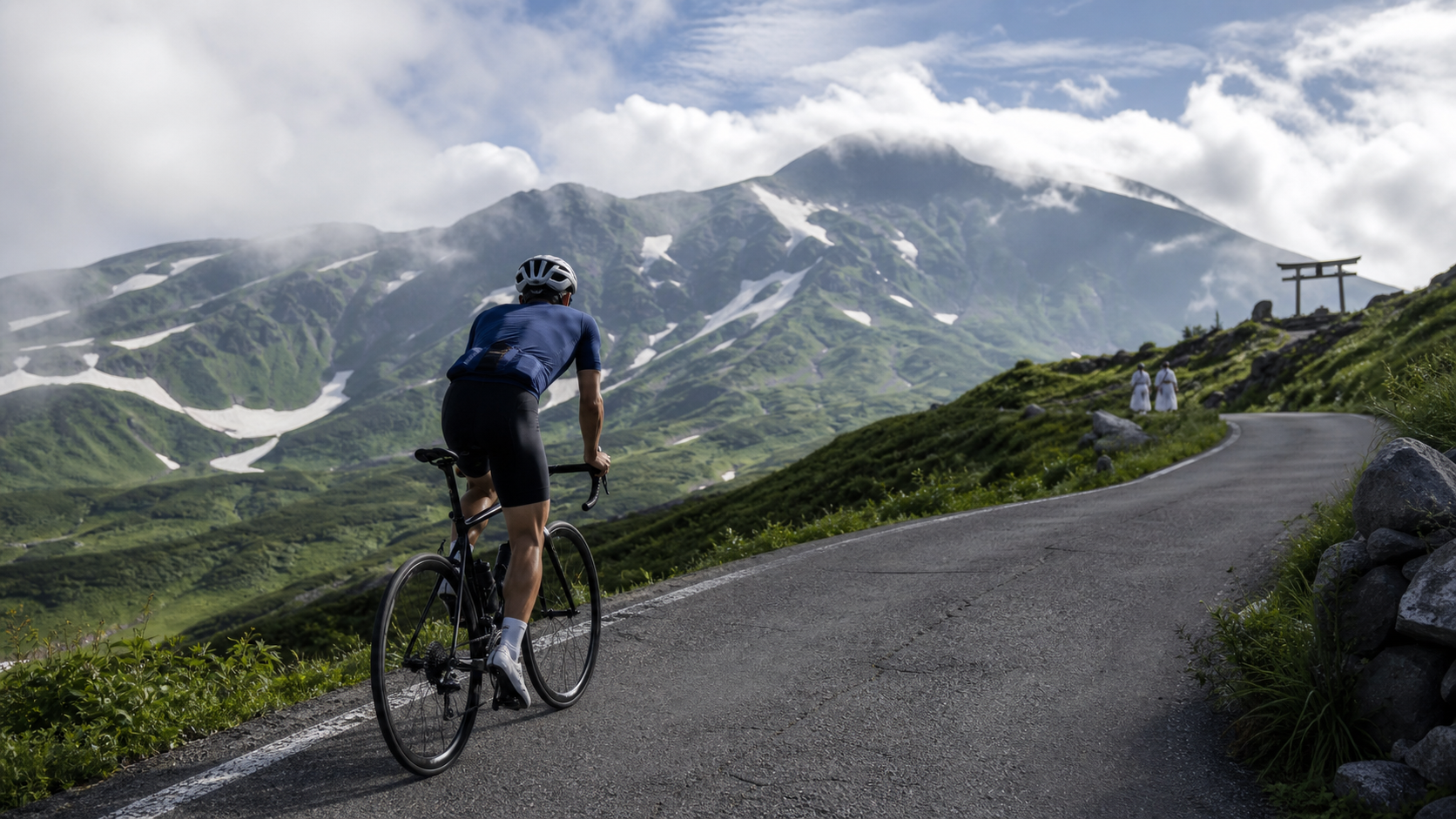
Some mountains you ride to conquer; others you ride to become a different person. Mount Gassan is the latter.
In Higashitagawa District, Yamagata Prefecture, there is a climb leading toward the Gassan Hōzawa trailhead. The cold data on Strava reads: approximately 4.84 kilometers in distance, 377.9 meters of total elevation gain, and an average gradient of about 7.8%. But when you actually put your wheels on this slope, you gradually come to understand that every pedal stroke here lands on ground the Japanese call “umarekawari no tabi”—a journey of rebirth—on sacred soil. This article is not about power and gear ratios; it is about taking you into the soul of Mount Gassan, into the thousand-year flame of faith of the Three Sacred Mountains of Dewa, and into the lingering resonance of the haiku left by Basho.
“Kumo no mine / ikutsu kuzurete / tsuki no yama” —Matsuo Basho
1. The Three Sacred Mountains of Dewa: A Journey of Death and Rebirth
To understand Mount Gassan, you must first understand the “Three Sacred Mountains of Dewa.” This is a sacred site of Shugendō composed of three mountains: Mount Haguro (414 m), Mount Gassan (1,984 m), and Mount Yudono (1,500 m). They are not merely three geographic peaks but symbols imbued with profound life philosophy.
In the belief system of the Three Sacred Mountains of Dewa, these three mountains represent three stages of life:
| Mountain | Elevation | Symbolic Meaning | Stage of Life |
|---|---|---|---|
| Mount Haguro | 414 m | The present world (now) | Living in the here and now |
| Mount Gassan | 1,984 m | The past (after death) | Facing death and ancestral spirits |
| Mount Yudono | 1,500 m | The future (rebirth) | Being reborn anew |
Pilgrimaging these three mountains in order is called the “umarekawari no tabi”—the journey of rebirth. Believers hold that completing this journey is equivalent to experiencing a symbolic death and rebirth: setting out from the present world of Mount Haguro, ascending Mount Gassan to face death and ancestral spirits, and finally attaining rebirth at Mount Yudono, returning to the human world with a purified soul.
And you, riding a bicycle, are using your own legs, lungs, and heart to reenact the most central segment of this ancient spiritual journey—the climb to Mount Gassan, the “world after death.” As you gasp for breath on the 7.8% slope, struggle through the lactic acid, and grit your teeth at the edge of your willpower, in a certain sense you too are undergoing your own miniature “death and rebirth.” This is the most fascinating aspect of riding Mount Gassan: physical suffering is given spiritual weight.
2. Prince Hachiko and 1,400 Years of Faith
The flame of faith on Mount Gassan can be traced back to 593 AD. According to legend, the Three Sacred Mountains of Dewa were founded by Prince Hachiko. He was a prince of Emperor Sushun who, after his father was assassinated, fled the bloody storms of political strife for the northeast, ultimately establishing a Shugendō training ground deep in these mountains.
From that time onward, the faith of this sacred land has continued for over 1,400 years. What does 1,400 years mean? It is a span of time longer than the histories of many nations. Over these 1,400-plus years, countless ascetics, believers, and travelers have set foot on this mountain path, and their prayers, their reverence, and their contemplation of life and death have settled layer upon layer into this land.
When you ride this slope, you are not alone. Every inch of road beneath you has been trodden by countless pilgrims in white robes. This thickness of history will strike you at some moment—perhaps when you glimpse mist-shrouded mountain ridges around a bend, perhaps when you hear the wind passing through the forest—and you will suddenly realize that you are taking part in a dialogue spanning a thousand years.
3. Yamabushi: Ascetics in White Robes
If you visit in the right season, you may encounter a distinctive group of figures in the mountains—yamabushi, the practitioners of Shugendō.
Yamabushi wear white robes, and that white is not an arbitrary choice. In Japanese culture, white robes are “shini-shōzoku”—the color worn by the deceased. When yamabushi don white robes and enter the mountains, it symbolizes “temporary death,” casting off the mundane self and forging body and mind through severe ascetic practices in the mountains (mountain climbing, waterfall purification, fasting, sutra chanting), before finally “returning to life” with a purified soul and coming back to the human world.
This resonates strangely with the mindset of a cyclist challenging a climb. We put on our jerseys, clip into our shoes, and surrender ourselves to a difficult slope, burning away the distractions, anxieties, and fatigue of daily life in the suffering. What we gain at the summit is not just physical accomplishment but a kind of spiritual clarity and rebirth. From this perspective, every cyclist straining up the slopes of Mount Gassan is a contemporary yamabushi of this sacred land.
4. Midagahara: The Pure Land of Paradise at the Summit
If your journey goes beyond riding to Hōzawa and you are willing to continue exploring higher up Mount Gassan, you will encounter a breathtaking landscape—the Midagahara wetland, located around the eighth station of Mount Gassan.
The characters “Mida” refer to Amitābha Buddha, and “Midagahara” is, in the imagination of the faith, the very embodiment of the Pure Land of Paradise. When you stand before this alpine wetland, the imagery is not hard to grasp:
- A sea of alpine flowers: In summer, the wetland is dotted with all kinds of alpine plants, small blossoms blooming in a harsh environment, composing a picture that is both delicate and resilient.
- Scattered ponds (pond clusters): Pools of various sizes are scattered across the wetland, reflecting the sky and clouds like fragments of a mirror fallen to earth.
- Perennial snow: Even in summer, some shaded areas retain snow that never fully melts, with white snow interweaving with green meadows and blue sky to create an almost surreal sense of sanctity.
Standing here, you understand why the ancients named this wetland the “Pure Land of Paradise.” It is a tranquility and solemnity that language struggles to precisely describe, as if you have truly walked to the edge of the world, to the boundary between life and death. For a cyclist, such scenery is the finest reward—it elevates all your sweat and gasping breath in that single moment.
5. In Basho’s Footsteps: The Mountain of the Moon on the Narrow Road to the Deep North
When discussing the cultural significance of Mount Gassan, one name is absolutely unavoidable—Matsuo Basho. The greatest haiku poet of the Edo period, in his immortal travelogue The Narrow Road to the Deep North (Oku no Hosomichi), personally made a pilgrimage to the Three Sacred Mountains of Dewa and left behind a haiku at Mount Gassan that has been passed down through the ages:
Kumo no mine / ikutsu kuzurete / tsuki no yama
The imagery of this haiku is exquisitely beautiful: the cumulonimbus clouds piled layer upon layer like towering peaks during the day (kumo no mine) collapse and disperse one by one as time passes, and when the clouds clear, the luminous mountain named “Moon” (tsuki) quietly appears before your eyes. There is a profound sense of impermanence here—majestic as cloud peaks may be, they will eventually crumble, while only Mount Gassan stands eternal. This echoes the core philosophy of “death and rebirth” of the Three Sacred Mountains of Dewa.
As you ride the slope toward Mount Gassan, take a moment at some rest stop around a bend to look up at the sky. If it happens to be a summer afternoon, you might truly see clouds piled like mountain peaks slowly transforming before your eyes. In that moment, you share the same sky and the same gaze upon this mountain with Basho from over 300 years ago. This romance across time and space is a gift unique to the Mount Gassan journey.
6. The Flavors of Shōnai: Mountain Vegetables, Gassan Bamboo Shoots, and Local Terroir
Riding is never only about the mountain roads; it is also about the human warmth at the foot of the mountain. The Shōnai region, where Mount Gassan lies, is a land of abundant produce and deep culture, with nearby Tsuruoka being an excellent base for exploring local flavors.
- Gassan bamboo shoots: This is a highly representative local mountain vegetable, a seasonal delicacy nurtured in the Mount Gassan area. Tender and sweet, these shoots appear only during a brief season, making them a taste that gourmands eagerly await each year.
- Mountain vegetable cuisine: The mountain vegetable culture of the Shōnai region is extremely rich. A wide variety of wild greens gathered from the forests are prepared using techniques passed down through generations of locals, yielding flavors that are simple yet profound. Such meals are light and easy to digest, making them an excellent choice for replenishing energy during a ride.
- Local food culture: Shōnai is hailed as one of Japan’s important treasure houses of food culture. Its devotion to ingredients and respect for seasonality are themselves a culture worth savoring carefully.
Of course, specific restaurant names and business conditions may change from year to year, so it is worth doing some homework before your trip and asking around on site. Incorporating the exploration of your palate into your riding plan is what makes the Mount Gassan journey complete.
7. Hagurosan Five-Story Pagoda: A National Treasure Deep in the Forest
If time permits, I strongly recommend adding a visit to Mount Haguro to your itinerary. As the symbol of the “present world” in the Three Sacred Mountains of Dewa, Mount Haguro may not be particularly tall (414 meters), but it conceals a breathtaking national treasure—the Hagurosan Five-Story Pagoda.
This pagoda stands quietly deep within the cedar forest beside the pilgrimage path, surrounded by towering thousand-year-old cedar trees. As you walk along the path paved with stone steps and lined with ancient cedars, sunlight filters through the canopy casting dappled shadows, and the ancient tower appears and disappears amidst the forest’s stillness. The solemnity and sanctity of the scene will instantly quiet even the most restless mind. For cyclists who have just exhausted themselves on the slopes of Mount Gassan, this is the perfect final destination—a place to let body and mind settle, and to hold one last dialogue with this sacred land.
8. The Seasonal Scenery of Mount Gassan
The beauty of Mount Gassan transforms continuously with the turning seasons. Understanding its seasonality will help you choose the best time to visit.
Summer: Summer Skiing and Flower Fields
What Mount Gassan is most famous for is the remarkable sight of “skiing in summer.” This mountain has an exceptionally long snow season—even as summer arrives, the high-altitude areas retain considerable snowpack, making it a rare summer ski destination in Japan. Imagine this: the Shonai Plain below is lush with midsummer greenery, yet as you ride up into the mountains, you can see skiers carving down distant snowfields—this stark contrast is the unique magic of Mount Gassan in summer. This is also the season when alpine wildflowers bloom in their most spectacular display.
Lingering Snow and Fresh Greenery
In early summer, before the remaining snow has fully retreated, white snow interweaves with newly sprouted greenery, creating a scene where vitality and stillness coexist. This is the visual moment that best embodies Mount Gassan’s imagery of “death and rebirth”—the remnants of winter still present, while the life of spring has already begun to emerge.
Seas of Clouds and Summer Clouds
As depicted in Basho’s haiku, Mount Gassan’s summer skies often feature magnificent cumulonimbus clouds piled up like peaks. If you’re lucky, you might even encounter a sea of clouds at higher elevations, watching mist flow and churn across the mountainside, as if you’ve stepped into a celestial realm. This echoes the imagery of “Midagahara = Pure Land of Ultimate Bliss”—you have truly ridden to a place close to heaven.
9. One Ride, One Rebirth
Let me conclude this journey with a first-person imagining.
In the early morning, you depart from the base of the mountain, the air carrying the fragrance of rice paddies and moisture from the Shonai Plain. As your wheels begin to bite into that 7.8% gradient, your breathing quickens, and your heart pounds like a drum against your ribcage. For the first kilometer, you’re still thinking about yesterday’s work troubles and the trivialities of daily life; but as the gradient keeps pushing you toward your limits, those distracting thoughts are burned away one by one—like the crumbling cloud peaks in Basho’s verse. By the steepest third section, you’re reduced to nothing but breathing and pedaling; the world shrinks to just the road ahead and your own heartbeat. This, right here, is a cyclist’s ascetic training.
When you finally reach the summit, gasping for air as you grip your handlebars, you look back at the road you’ve climbed—layered mountain ranges in the distance, flowing seas of clouds, and the fields of the Shonai Plain glistening in the sunlight. What wells up in that moment is not just the sense of accomplishment of “I did it,” but something deeper—a purified clarity. You have shed the self you were at the foot of the mountain, undergone a symbolic “death” on the slopes, and now stand reborn at the summit.
This is Mount Gassan. This is why some mountains you climb not to conquer, but to become a different version of yourself.
10. Mount Yudono: The Ineffable Place of Rebirth
To fully understand the cycle of “death and rebirth” in the Three Sacred Mountains of Dewa, one must not overlook Mount Yudono (1,500 meters). If Mount Haguro represents the present world and Mount Gassan represents the afterlife, then Mount Yudono is the culmination and climax of this journey—rebirth.
Mount Yudono holds an extremely sacred and mysterious position within the faith of the Three Sacred Mountains of Dewa. Since ancient times, an old precept has been passed down here: “Speak not of it, ask not of it.” This means that everything seen and felt at Mount Yudono must not be spoken of to others, nor inquired about. This taboo of “ineffability” veils Mount Yudono in a profound spiritual mystery, making it the most intimate and moving part of the Dewa Sanzan faith.
For this very reason, Mount Yudono is regarded as the place where the entire “journey of rebirth” concludes. After pilgrims experience the present world at Mount Haguro and confront death and ancestral spirits at Mount Gassan, they ultimately receive the cleansing and renewal of their souls at Mount Yudono, returning to the mortal world with purified hearts. For a cyclist who has just expended every ounce of strength on the slopes of Mount Gassan and experienced a form of spiritual purification upon reaching the summit, the imagery of “rebirth” that Mount Yudono represents will resonate with particular depth—have you not also, through this ride, burned away your old self and been reborn as someone stronger and clearer?
11. Why “Moon” Mountain: Reflections on the Name
The name “Gassan” (Moon Mountain) itself is filled with poetic and imaginative possibilities. Why “moon”?
One theory relates to the mountain’s silhouette—Mount Gassan’s summit is gentle and its ridgeline curves like a bow, appearing from a distance like a crescent moon resting quietly against the sky. Another theory carries deeper religious significance: the moon, in many cultures, is associated with the feminine, with night, and with the world of the dead—and Mount Gassan is precisely the one among the Three Sacred Mountains of Dewa that symbolizes the “afterlife.” The imagery of the moon—that cool, luminous, eternal beauty tinged with a hint of melancholy—perfectly echoes the contemplations of death and ancestral spirits that this mountain embodies.
As you murmur the name “Gassan” during your ride, allow yourself to imagine: perhaps this mountain is called Moon Mountain because the ancients saw in it a wisdom about life’s end that is as clear and solemn as moonlight. And as you ride toward it now, in a sense, you are also riding toward a dialogue with the very essence of life.
12. A Gentle Reminder for Cyclists: Slow Down and Feel
In this era of chasing data, chasing PRs, and chasing Strava crowns, Mount Gassan offers a rare reminder: some mountains are worth slowing down for.
Of course, you can treat this 7.8% gradient as a time trial, sprinting with full effort and setting new records—that is also a wonderful way to ride. But what makes Mount Gassan unique is that it simultaneously invites you to set aside your cycling computer and power meter, and to experience this sacred land with your most primal senses. Listen to the wind passing through the mountain forest, watch the cloud peaks crumble and transform at the horizon, imagine the footprints of white-robed mountain ascetics who have trodden here for a thousand years, and feel the weight of “umarekawari” (rebirth).
Perhaps the ideal Mount Gassan journey combines both: use one serious climb to temper your body, then follow it with a period of silence at the summit to let your mind settle. When you fuse the passion of cycling with the spiritual depth of this sacred land, you will gain a holistic experience of body and mind united—something few other routes can offer.
Suggested Side Trips: Making Your Mount Gassan Journey More Complete
- Pilgrimage of the Three Sacred Mountains of Dewa: If time allows, visit Mount Haguro (present world), Mount Gassan (past), and Mount Yudono (rebirth) in sequence to complete the full “journey of rebirth”—this is the most profound way to understand this sacred land.
- Hagurosan Five-Story Pagoda: Be sure to set aside time to walk the cedar-lined pilgrimage path and witness this national treasure in the forest with your own eyes.
- Tsuruoka and Shonai Cuisine: Include mountain vegetables, Gassan bamboo shoots, and local dishes in your itinerary, and remember this region’s terroir with your palate.
- Summer Skiing on Lingering Snow: If you visit in summer, consider experiencing the wonder of “summer skiing”—a unique gift Mount Gassan offers to travelers.
- The Basho Trail: Embark on your journey with the spirit of The Narrow Road to the Deep North, seeking the意境 of the verse “Cloud peaks crumble—and this is the moon’s mountain” along the way, letting literature gild your ride with poetry.
13. Shugendo: Japan’s Unique Mountain Faith
To truly understand Mount Gassan, one must also gain some familiarity with “Shugendo,” a distinctive belief system. Shugendo is neither purely Buddhist nor purely Shinto, but rather a unique religious practice that fuses Shinto’s nature worship, Buddhist (particularly esoteric Mikkyo) training methods, and Japan’s ancient mountain worship.
The core philosophy of Shugendo is “sokushin jobutsu”—attaining enlightenment in this very body. Rather than waiting until after death, practitioners train in harsh natural environments to achieve union with the divine in this lifetime, in this body. And “mountains” are the training grounds for this practice. In the Shugendo worldview, deep mountains are not barren wilderness but sacred realms filled with spiritual power, connecting life and death, humans and gods. The reason the Three Sacred Mountains of Dewa became one of the most important sacred sites of Shugendo is precisely because they fully embody this faith of “mountains as training grounds, the body as a vessel.”
When you ride up the slopes of Mount Gassan, using your own body to endure the hardship of the climb, in a sense, you are unknowingly practicing the most essential spirit of Shugendo—attaining spiritual elevation through physical trial. This commonality that transcends religious forms is exactly why Mount Gassan can move both pilgrims and cyclists alike.
14. Remnant Snow and Skiing: The Snow Miracle of Mount Gassan
As mentioned earlier, Mount Gassan offers the remarkable sight of “summer skiing.” This deserves deeper exploration, as it is one of the mountain’s most celebrated features and best exemplifies its uniqueness.
Among Japan’s many ski resorts, the vast majority operate only in winter, closing once the snow melts in spring and summer. But Mount Gassan is different. This mountain receives massive amounts of moisture from the Sea of Japan, resulting in extraordinary winter snowfall. The depth of the snowpack and the length of the snow season make it one of the very few places where skiing remains possible even in summer. Picture this scene: at the mountain’s base, the Shonai Plain stretches out with verdant rice paddies and the chorus of cicadas—the quintessential Japanese summer. Yet as you climb Mount Gassan on your bike, you can see pristine white snow in the distance, even catching glimpses of skiers gliding down the slopes. This striking dislocation of seasons is Mount Gassan’s unique brand of magical realism.
For cyclists, such a sight is more than a visual marvel—it is a profound metaphor. On the same mountain, winter and summer coexist; lifeless snow and vibrant vitality stand side by side. Is this not the most vivid natural illustration of the Dewa Sanzan philosophy of “death and rebirth”? When you ride toward a mountain still holding its eternal snow in the heat of summer, you are, in truth, riding into a sacred realm where life and death perpetually cycle and intermingle.
15. Turning a Ride into a Pilgrimage: Words for Every Traveler to Mount Gassan
We live in an age that easily reduces sport to mere utility—riding to burn fat, to chase numbers, to share achievements on social media. There is nothing wrong with any of that, but Mount Gassan reminds us that cycling can be something else entirely. It can be a pilgrimage, an opportunity for dialogue with oneself, a journey of “rebirth” in the truest sense.
When you press your wheels onto the slope leading up to Gassan Oisawa, you are not merely completing a Strava segment. You are treading a sacred path steeped in 1,400 years of faith, retracing the footsteps of countless ascetic practitioners since Prince Hachiko first opened this mountain, sharing the same crumbling cloud-capped peaks with Basho, and experiencing what the white robes of the yamabushi symbolize—“a temporary death, and then rebirth.” Every gasp for breath, every gritted-teeth effort, every moment of release upon reaching the summit writes your own contemporary page in this ancient spiritual journey.
This is the irreplaceable value of a journey to Mount Gassan. It tests not only your legs but also touches your soul.
May your journey to Mount Gassan be not merely a journey of the legs, but a journey of rebirth for the soul. When you descend, what you carry away will not just be an impressive ride record, but a version of yourself—washed clean by the sacred mountain, clearer and more resilient than before.
Related Reading
- Riding Up a World Cultural Heritage Site: The Pilgrimage Road of Fuji Subaru Line and the Sea of Clouds Awaiting Those Who Strive
- Riding into Myth and Volcanic Land: A Cycling Account of Ebino Highlands, a Highland Pilgrimage Across the Kirishima Mountain Range
- The Sky Road to a Sacred Mountain: Ishizuchi Skyline, Shugendo Faith, and a Journey Across the Roof of Shikoku with Menagawa Blue
- Riding to the Land Where the Heavenly Grandson Descended: A Cycling Story of Takachiho-gawara, Climbing from a National Treasure Shrine to a Mythic Sacred Mountain
台北闊瀨陡坡 騎旅 / 日本單車雜誌編輯車友臨時加入!/ 髮香才是最強的 / feat. 北迴歸線小隊 / 公路車 CT Yeh
6 個月前
新竹白蘭部落! 爬陡坡還能講笑話...? 廢物伙伴の約騎 | 公路車 | CT Yeh
4 年前
2025 乘鞍 KOM 登山賽挑戰實錄 / 日本公路最高 ! 賽前探路篇 / 比富士山厲害,無敵絕景!/ 40週年 / 中文YT首發 / 公路車 / CT Yeh #乘鞍ヒルクライム
11 個月前
北海道 白色戀人發源地 利尻島 單車環島 體驗! 空拍 りしりとう サイクリング Rishiri island cycling
8 年前
大武山20%魔王陡坡【JJSC南台灣遊騎Day2】!屁股真的要裂開了...凡士林抹滿也沒用?神秘金教堂還有超便宜夜市
3 個月前
宇老大滿貫(改)/ UBike神人 / 太離譜了!出大景 差點被擊落 / feat. 神秘密境單車團 / 公路車 / CT Yeh
2 年前
觀霧 變好騎了! | 北高車友爆笑大會師 | 公路車 | 單車旅遊 Taiwan Cycling Route GuanWu
6 年前
京都!99%人不知道的秘境玩法!租 E-Bike 騎進探訪宇治抹茶原鄉 刺激好玩絕美的山林古道 鬼滅之刃的場景探訪 / CT Yeh
14 天前